The NMAT 2026 exam delivery window starts on November 2 and ends on December 20, 2026.
The Language Skills section has 36 questions to be attempted in 28 minutes, making time management a key part of preparation. The section carries a score range of 12-120 and has no negative marking.
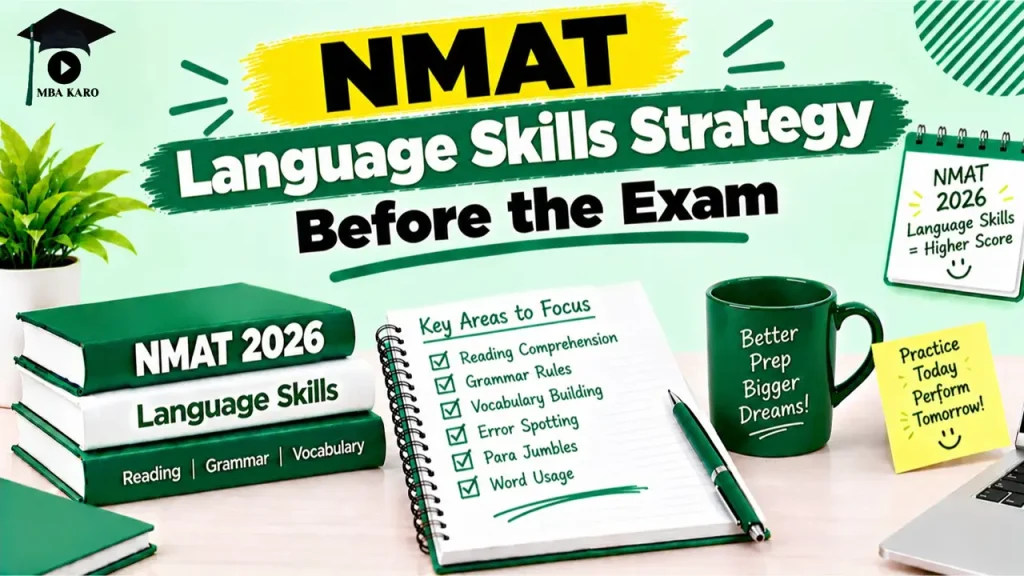
With limited time per question, your revision should focus on reading comprehension, grammar, vocabulary, para jumbles, prepositions, and verbal analogy.
A clear attempt strategy can help you cover more questions without spending too long on any single problem.
MBA Karo NMAT 2026 Online Course
NMAT Language Skills Exam Pattern and Time Management
You have 28 minutes to attempt all 36 questions, which gives you less than a minute per question on average. However, each question type requires a different amount of time.
Reading comprehension needs more attention, while direct grammar and vocabulary questions can often be solved faster.
Keep these points in mind during your final revision:
- Reading Comprehension: Allocate around 12-15 minutes to passages and their questions.
- Grammar and vocabulary: Practise identifying errors, completing sentences, and solving word-based questions quickly.
- Para jumbles: Focus on sentence connections and logical paragraph flow.
- Prepositions: Revise common word-preposition combinations to reduce hesitation.
- Verbal analogy: Identify the relationship between words before checking the answer choices.
NMAT Language Skills Strategy Before Exam
Avoid spending more than 15 minutes on reading comprehension. If a passage or question takes too long, move ahead and return to it if time permits.
Since NMAT has no negative marking, leaving questions unanswered is generally not a useful strategy when you can make an informed attempt or eliminate options.
1. Practise Reading Comprehension with a 15-Minute Limit
Reading Comprehension is an important part of NMAT Language Skills. You can generally expect two to three passages, often around 300–400 words each, although the actual number may vary.
Passages can cover business, finance, science, the environment, arts, culture, lifestyle, psychology, and philosophy.
Questions may test factual understanding, the central idea, the author’s tone, arguments, inferences, conclusions, and reasoning.
Your preparation should cover all these question types instead of focusing only on direct questions based on passage details.
Use the following approach during practice:
- Read the passage to understand its central argument and purpose.
- Pay attention to contrasting ideas, supporting examples, and the author’s opinion.
- For factual questions, locate the relevant information in the passage.
- For inference-based questions, select an answer supported by the passage rather than outside knowledge.
- For tone questions, consider the author’s overall attitude towards the subject.
- Practise passages within a fixed time limit. Around 12–15 minutes is a reasonable target for the complete RC set, including reading and answering questions.
NMAT Reading Comprehension is generally less demanding than CAT-level RC. Include practice material suited to NMAT’s expected difficulty.
This helps you develop the speed and accuracy required for the actual exam.
2. Revise Grammar Rules for Error Identification
Error identification can account for around 6-8 questions. These questions may ask you to identify the incorrect part of a sentence. The error could involve grammar or spelling, so checking only one type of mistake can lead to incorrect answers.
Prioritise these grammar topics during revision:
- Subject-verb agreement
- Tenses
- Pronouns
- Adjectives and adverbs
- Parallelism
- Prepositions
- Common spelling errors
Do not spend the final days reading lengthy grammar explanations without practising questions. Revise one rule at a time, solve related questions, and review the errors you make.
For example, when checking subject-verb agreement, identify the subject first and then determine whether the verb matches it. In parallelism questions, check whether items in a list or connected phrases follow a consistent grammatical structure.
Maintain a short list of recurring mistakes. Reviewing this list daily can help you avoid repeating errors in the exam.
3. Strengthen Vocabulary for Fill in the Blanks
Fill in the Blanks can account for around 6–8 questions and may include single or double blanks. These questions test vocabulary, grammar, or both.
Memorising word meanings alone may not be sufficient. You also need to understand how a word fits the context and whether it works grammatically within the sentence.
During revision, focus on:
- Synonyms and antonyms
- Common idioms and phrases
- Word meanings and usage
- Sentence context and tone
- Grammatical agreement between words
When solving a question, read the complete sentence before selecting an option. For double blanks, check whether both words fit the meaning and structure of the sentence.
A word may appear suitable on its own but fail to match the context when combined with the second blank.
Revise vocabulary in short, regular sessions. Practising words in sentences is more useful than memorising long lists without understanding their usage.
4. Practise Para Jumbles and Prepositions Separately
Para jumbles can contribute around 4-6 questions. These questions usually provide four or five sentences that must be arranged in a logical order.
Start by identifying the sentence that introduces the subject. Then look for connections between sentences through pronouns, repeated ideas, examples, and cause-and-effect relationships. The opening sentence should establish the context, while the remaining sentences should develop the discussion logically.
Prepositions may account for around 3-5 questions. The questions can use a combination-based format in which you match prepositions to multiple sentences and select the option containing the correct sequence.
Revise commonly used combinations such as “focus on” and “sweep under the carpet.” Practise these expressions in complete sentences to understand their usage.
This is important because preposition questions often depend on established word combinations rather than general grammar rules alone.
Give these two topics dedicated practice time. Their question formats require different approaches, and regular exposure can help you recognise the correct sequence or combination faster.
5. Prepare for Verbal Analogy with Relationship-Based Practice
Verbal analogy can account for around 5-6 questions. These questions may involve synonyms, antonyms, collective nouns, general awareness, or other verbal relationships.
The key is to identify how the given words relate to each other. Do not select an answer only because the words appear similar in meaning or belong to the same category.
For example, a question may test a relationship based on opposites, word associations, or a particular function. Once you identify the relationship in the original pair, check which option follows the same pattern.
Practise different analogy formats and review why the incorrect options do not fit. This will help you distinguish between a genuine relationship and a superficial similarity.
6. Follow a Focused Revision Plan Before NMAT 2026
Your final revision should cover every major topic without allowing one area to consume the available study time. Divide your practice into reading comprehension, grammar, vocabulary, and question-specific exercises.
Solve timed sets of 36 questions to simulate the section’s 28-minute limit. After each set, check your accuracy, identify questions that took too long, and review the rules or word meanings behind your mistakes.
Track three things in particular: questions attempted, errors made, and time spent on each question type. This will show whether you need more work on RC speed, grammar accuracy, or vocabulary-based questions.
Do not judge your preparation only by the number of questions solved. Reviewing mistakes and understanding the correct approach are equally important. In the final days, prioritise familiar question formats, revise frequently tested grammar rules, and practise at the NMAT level.
Conclusion
The NMAT Language Skills section requires a balance of reading speed, grammar knowledge, vocabulary, and quick decision-making. With 36 questions to solve in 28 minutes, a timed practice routine and targeted revision can help you use the available time effectively.
If you need structured preparation, the MBA Karo NMAT Online Course can be considered as part of your revision plan.
Combine your course practice with timed question sets and regular error analysis to strengthen your preparation before the NMAT 2026 exam.