The NMAT 2026 exam window runs from November 2 to December 20, 2026. The Logical Reasoning section has 36 questions to be attempted in 40 minutes, with a scaled score range of 12-120.
With limited time per question, revision should focus on high-frequency topics, familiar question patterns and quick decision-making.
Critical Reasoning is a major part of NMAT Logical Reasoning, with around 15–20 questions expected based on the shared topic analysis.
Input-Output, analytical puzzles, Syllogism, Fact Statement and Venn Diagram questions also deserve attention. The exact distribution can change across papers, so candidates should revise the major topics first and then cover less frequent areas.
MBA Karo NMAT 2026 Online Course
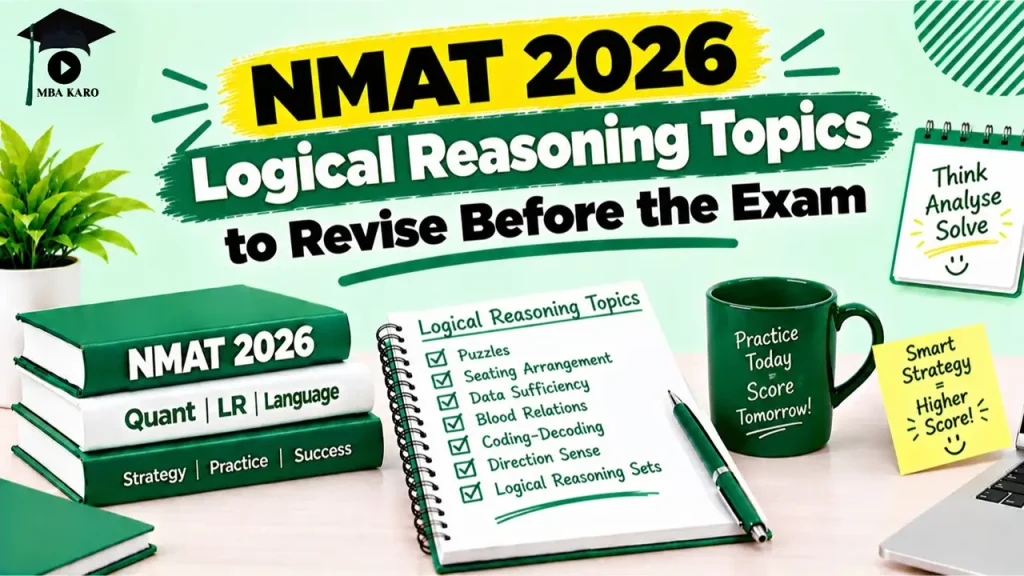
NMAT Logical Reasoning Important Topics to Revise
The Logical Reasoning syllabus broadly covers Critical Reasoning and Analytical Reasoning. Critical Reasoning tests how well you evaluate statements and arguments.
Analytical Reasoning focuses on arrangements, patterns, relationships and logical conditions.
Here are the topics to prioritise before the exam.
1. Critical Reasoning: Assumptions, Inferences and Arguments
Critical Reasoning is one of the highest-priority areas for NMAT 2026. Around 15–20 questions may come from this category, making it important to practise different question formats instead of concentrating on only one type.
Revise these topics first:
- Assumptions: Identify an unstated idea that must be accepted for an argument to hold.
- Conclusions: Determine what logically follows from the given statement or paragraph.
- Inference: Select the information supported by the facts provided.
- Course of Action: Evaluate possible actions for a given problem and identify the most appropriate option or combination.
- Decision Making: Choose a logical decision based on the situation and the available information.
- Strengthen and Weaken Arguments: Find the option that supports or challenges the central argument.
- Strong and Weak Arguments: Evaluate whether an argument is relevant and logically convincing.
NMAT Critical Reasoning questions can appear as short statements followed by multiple arguments, conclusions or courses of action.
They can also use paragraphs of around 50–80 words, followed by questions about assumptions, inferences or the author’s likely viewpoint.
During revision, distinguish between information explicitly provided and conclusions that require outside knowledge. An option may sound reasonable in everyday life but still be incorrect if the given information does not support it.
Practise both statement-based and paragraph-based questions. Focus on identifying the main issue, eliminating unsupported options and reaching a decision without repeatedly rereading the passage.
2. Analytical Puzzles and Seating Arrangements
Arrangement-based puzzles are another important area. The shared analysis indicates that around one or two arrangement sets may appear, depending on the paper.
Prioritise these formats:
- Linear arrangement
- Circular arrangement
- Two-row arrangement
- Grid-based arrangement
Questions may involve assigning people, professions, cities, colours, objects or other attributes to specific positions. Some puzzles require arranging people according to their seating positions, while others combine two or more conditions.
For example, a question may provide the seating order of several people along with conditions about their professions or preferred objects. You must use all the clues to determine the correct arrangement.
Revise the basic rules for handling fixed positions, relative positions, immediate neighbours and opposite positions. For grid-based puzzles, organise the information systematically so that you can track multiple conditions without mixing them up.
Practise complete sets under timed conditions. If a puzzle requires too many attempts to establish the arrangement, avoid spending the entire section time on it. Return to it after attempting questions you can solve more quickly.
3. Input-Output: Word and Number Patterns
Input-Output is a high-priority topic for NMAT Logical Reasoning. Around one or two sets may appear, although the exact number and format are not fixed.
In these questions, an initial sequence of words or numbers passes through a series of steps. Your task is to identify the rule behind each transformation and use it to determine the next step or answer.
Number-based Input-Output: Revise patterns involving addition, subtraction, multiplication, squaring and combinations of operations. Compare consecutive steps to identify whether the same operation applies to every number or whether the sequence follows a more complex rule.
Word-based Input-Output: Practise alphabetical arrangement, reverse ordering and patterns that combine words with numbers. Pay attention to how individual elements move from one step to another.
Do not assume that every question follows a familiar formula. Check the position and transformation of each element before deciding the rule.
Arrangement and Input-Output questions may together account for around two or three sets. One paper may contain two arrangement sets and one Input-Output set, while another may contain two Input-Output sets and one arrangement set.
4. Syllogism and Fact Statement
Syllogism should be completed before moving to less frequent miscellaneous topics. These questions test whether a conclusion follows from the relationships established in the given statements.
Revise universal and particular statements, possible relationships between groups, and the difference between a conclusion that must follow and one that may be true. Use simple Venn diagrams when they help clarify the relationships.
Fact Statement questions also require careful evaluation of given information. You may receive a set of facts and need to identify which additional statements logically follow. The format has similarities to Syllogism, but the task depends on the specific information provided.
For both topics, avoid making assumptions based on real-world knowledge. Work only with the conditions in the question and check every statement before selecting an answer.
5. Set Theory and Logical Venn Diagrams
Revise both Set Theory-based questions and Logical Venn Diagrams. They involve groups and their relationships but can test different skills.
Set Theory questions may use two or three overlapping sets. The question can ask for the maximum or minimum number of people who belong to particular groups, or require calculations based on overlapping conditions. One or two questions may appear, sometimes as individual questions rather than a lengthy set.
Logical Venn Diagram questions focus on identifying relationships between categories. For example, the groups may include doctors, engineers and soldiers. You may need to determine which diagram represents the relationship or calculate how many people belong to one category but not another.
Practise identifying common elements, exclusive groups and overlapping sections. These topics can be useful for securing marks without spending as much time as a lengthy arrangement puzzle may require.
6. Number Puzzles, Series and Order Ranking
Number Puzzles can involve grids, circles or other arrangements in which some values are missing. Review common numerical relationships, but check the complete pattern before applying an operation.
Alphabet and Number Series questions require you to identify changes in letters, numerical differences or alternating patterns.
For number series, check differences between consecutive terms and examine whether the differences themselves follow a pattern.
Order Ranking questions deal with positions in a row or a group. You may need to calculate the number of people between two individuals using their respective ranks. Keep track of whether the positions are counted from the left, right, top or bottom.
These topics have lower priority than Critical Reasoning and Input-Output, but they are worth practising after the main areas are covered.
7. Clocks, Calendars, Blood Relations, Cube and Dice
Use the remaining revision time to cover these smaller topics. Clocks and Calendars belong to the miscellaneous section, and a Calendar question was observed in an earlier paper. Revise basic calendar calculations and the standard clock concepts you have already studied.
Blood Relations questions test family relationships across multiple statements. Draw a simple family tree when the relationships become difficult to track.
Cube and Dice questions may involve a cube divided into smaller parts, followed by questions about the resulting pieces or their properties. Revise the standard concepts and solve a few representative questions.
These topics are less frequent in the shared analysis. Complete them after the high-priority areas, but do not assume they cannot appear in your paper.
How to Revise NMAT Logical Reasoning Before the Exam
The 36-question section has a time limit of 40 minutes, which gives you approximately 67 seconds per question on average. Your revision must therefore cover both accuracy and speed.
- Start with Critical Reasoning: Practise assumptions, conclusions, inferences, courses of action and strengthen/weaken questions.
- Revise Input-Output and arrangements: Solve different patterns and complete sets under a timer.
- Cover Syllogism, Fact Statement and Venn Diagrams: Focus on logical accuracy and quick elimination.
- Practise miscellaneous topics: Revise Number Puzzles, Series, Order Ranking, Clocks and Calendars, Blood Relations, and Cube and Dice.
- Take timed practice tests: Review incorrect answers and identify whether the problem was conceptual, caused by misreading or due to poor time management.
The question distribution is not fixed. One possible paper may contain 15 Critical Reasoning questions, 12 questions from puzzles and Input-Output, and nine miscellaneous questions.
Another may have 20 Critical Reasoning questions, eight from puzzles and Input-Output, and eight miscellaneous questions. These are illustrative combinations, not a guaranteed NMAT paper pattern.
NMAT also has no negative marking, equal weightage across its three sections and allows up to three attempts to improve your score. Use practice tests to identify weak areas and refine your approach to question selection. After the exam, download your scorecard within 48 hours, as specified in the shared exam information.
Conclusion
For NMAT 2026 Logical Reasoning, give the most revision time to Critical Reasoning, Input-Output, analytical puzzles, Syllogism and Fact Statement.
Cover Venn Diagrams next, followed by the smaller miscellaneous topics. Since the section has 36 questions and only 40 minutes, practise applying concepts quickly instead of spending all your time reviewing theory.
The MBA Karo NMAT Online Course can support your final preparation with structured learning and practice. Use it to revise important Logical Reasoning concepts, work on weaker areas and practise applying them under timed conditions before your NMAT attempt.