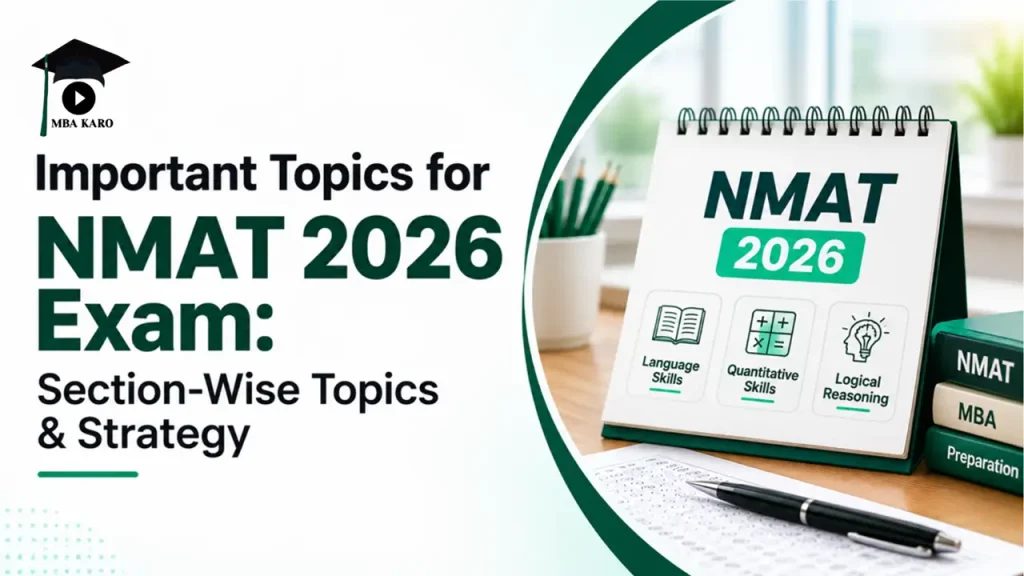
The NMAT 2026 exam has 108 questions to be attempted in 120 minutes across Language Skills, Quantitative Skills, and Logical Reasoning.
Each section has 36 questions, but the time limit differs: 28 minutes for Language Skills, 52 minutes for Quantitative Skills, and 40 minutes for Logical Reasoning.
The overall score range is 36–360, with each section ranging from 12-120.
Knowing the important topics for NMAT 2026 helps you prioritise preparation, particularly because the three sections demand different approaches to speed and accuracy.
Join MBA KARO Whatsapp Community For Daily Updates
NMAT 2026 Important Topics: Overview
Here is a quick overview of NMAT exam important topics for reference:
| Section | Questions | Time | Important Topics |
| Language Skills | 36 | 28 mins | Reading Comprehension, Para Forming, Error Identification, Prepositions, Sentence Completion, Analogies |
| Quantitative Skills | 36 | 52 mins | Arithmetic, Number Properties, Algebra, Probability, DI, Data Sufficiency |
| Logical Reasoning | 36 | 40 mins | Critical Reasoning, Analytical Puzzles, Deductions, Input-Output, Venn Diagram, Syllogism |
Important Topics for NMAT 2026 Language Skills
The NMAT Language Skills syllabus has 36 questions and a 28-minute time limit. The major topics to prepare are:
1. Reading Comprehension
Passages can cover areas such as business, science, environment, arts, culture, psychology, and philosophy. Prepare questions based on:
- Main idea
- Facts
- Inferences
- Tone
- Arguments
- Conclusions
- Reasoning-based understanding
2. Para Forming
Focus on arranging sentences in their logical sequence. Practice identifying sentence links, introductory statements, conclusions, and transition points.
3. Error Identification
Important grammar areas include:
- Subject-verb agreement
- Tenses
- Pronouns
- Adjectives and adverbs
- Parallelism
- Spelling errors
4. Sentence Completion and Fill in the Blanks
These questions can test both grammar and vocabulary. Practise understanding the sentence context before selecting an option.
5. Prepositions
Prepare common word-preposition combinations and combination-based questions.
6. Verbal Analogy
Revise synonyms, antonyms, collective nouns, and other word relationships.
Important Topics for NMAT 2026 Quantitative Skills
The NMAT Quantitative Skills syllabus contains 36 questions in 52 minutes. The important NMAT Quant topics are:
1. Arithmetic
Arithmetic is a major area to prioritise. Focus on the following topics:
- Percentages
- Profit and Loss
- Simple and Compound Interest
- Ratio and Proportion
- Partnership
- Mixtures
- Averages
- Time and Work
- Time, Speed and Distance
2. Algebra
Important topics include:
- Linear Equations
- Quadratic Equations
- Logarithms
- Modulus
- AP
- GP
3. Modern Mathematics and Probability
Prepare the following topics:
- Permutation and Combination
- Probability
- Set Theory
4. Number Properties
Important areas include:
- Units Digit
- Divisibility
- Remainders
- Fractions
- Factorials
- HCF
- LCM
5. Data Interpretation
Practise the following topics:
- Tables
- Bar Graphs
- Line Graphs
- Pie Charts
- Multi-graphs
- Combination graphs
- Caselets
Percentages, ratios, averages, approximation, and fast calculations are useful for solving DI questions efficiently.
6. Data Sufficiency
Prepare Data Sufficiency separately because the objective is to determine whether the information provided is sufficient to answer the question. Questions can be based on Arithmetic, Algebra, Number System, Time-Speed-Distance, Units Digit, and other Quant topics.
Important: Geometry is not included in the provided NMAT Quant syllabus, so it does not need to be a preparation priority for NMAT.
Important Topics for NMAT 2026 Logical Reasoning
The NMAT Logical Reasoning syllabus has 36 questions in 40 minutes. Critical Reasoning is particularly important, with around 15–20 questions expected from this area.
1. Critical Reasoning
Prioritise the following aspects:
- Course of Action
- Decision Making
- Conclusions
- Assumptions
- Inference
- Arguments
- Strong and Weak Arguments
- Strengthen the Argument
- Weaken the Argument
2. Analytical Puzzles
Practise the following topics:
- Linear Arrangement
- Circular Arrangement
- Two-Row Arrangement
- Grid-Based Arrangement
3. Input-Output
Prepare both Number-based Input-Output and Word-based Input-Output. The transformation can involve operations, ordering, or combinations of words and numbers.
4. Syllogism and Fact Statements
These are important miscellaneous reasoning areas and should be covered after the major CR topics.
5. Venn Diagram and Set Theory
Practise questions involving two- and three-set relationships, including maximum, minimum, and group-based calculations.
6. Number Puzzles
Revise grid-based, circular, and pattern-based number questions.
7. Other Reasoning Topics
Once the high-priority topics are covered, prepare:
- Order Ranking
- Alphabet and Number Series
- Clocks and Calendars
- Blood Relations
- Cube and Dice
- Logical Venn Diagram
NMAT 2026 Important Topics: What Should You Study First?
The exact number of questions from individual topics can vary, so preparation should cover the complete syllabus rather than depend on a fixed distribution. A practical priority order is:
- Language Skills: Reading Comprehension → Error Identification → Sentence Completion/Fill in the Blanks → Para Forming → Prepositions → Verbal Analogy
- Quantitative Skills: Arithmetic → Data Interpretation → Algebra → Probability and Modern Mathematics → Number Properties → Data Sufficiency
- Logical Reasoning: Critical Reasoning → Input-Output → Analytical Puzzles → Syllogism and Fact Statements → Venn Diagram → Other Reasoning Topics
How to Prepare Important Topics for NMAT 2026
Give the highest priority to Critical Reasoning in LR because of its significant share.
- Complete Arithmetic before moving to lower-priority Quant topics.
- Practise DI without a calculator to improve calculation speed.
- Prepare Data Sufficiency separately because its solving approach differs from conventional Quant questions.
- Build strong grammar and vocabulary for Language Skills.
- Practise RC within a controlled time limit because the section allows only 28 minutes.
- Take NMAT-specific mocks to practise the 108-question, 120-minute format.
Conclusion
The most important topics for NMAT 2026 vary across the three sections.
Prioritise Reading Comprehension and grammar-based questions in Language Skills, Arithmetic and DI in Quantitative Skills, and Critical Reasoning, Input-Output, and Analytical Puzzles in Logical Reasoning.
With 108 questions to solve in 120 minutes, topic preparation should be combined with timed NMAT-specific practice.
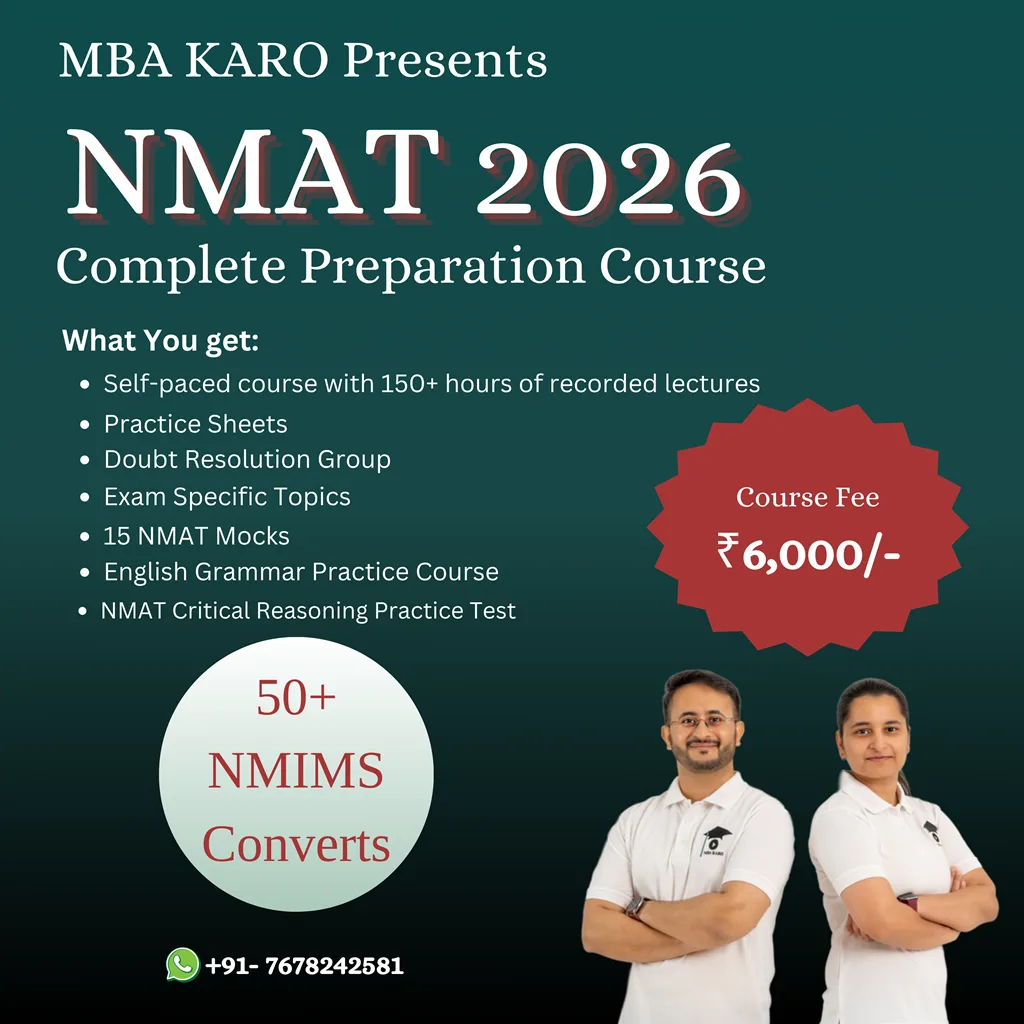
For structured preparation, MBA Karo NMAT Online Coaching combines concept videos, practice sheets, grammar resources, Critical Reasoning Tests, doubt support, and full-length NMAT mocks to help you prepare for the complete exam.