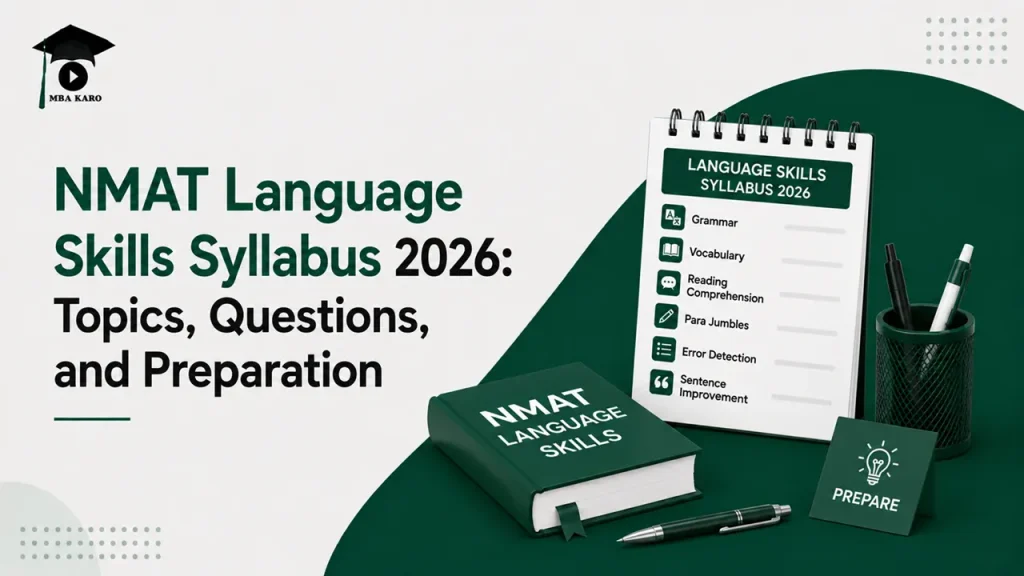
The NMAT Language Skills syllabus 2026 has 36 questions to be solved in 28 minutes. The section has a score range of 12-120 and carries no negative marking.
The questions test reading comprehension, grammar, vocabulary, sentence structure, prepositions, para jumbles, and verbal analogy.
The major topics covered in NMAT Language Skills 2026 are:
- Reading Comprehension
- Para Forming/Para Jumbles
- Error Identification
- Fill in the Blanks/Sentence Completion
- Prepositions
- Verbal Analogy
- Grammar and vocabulary-based questions
With only 28 minutes for 36 questions, you get less than a minute per question on average. RC alone can require around 12-15 minutes, making question selection and time allocation important.
Join MBA KARO Whatsapp Community For Daily Updates
NMAT Language Skills Syllabus 2026: Overview
The number of questions from individual topics can vary. Here are the key highlights of the NMAT language skills syllabus shared below:
| Particular | Details |
| Section | Language Skills |
| Number of Questions | 36 |
| Time Limit | 28 minutes |
| Score Range | 12-120 |
| Negative Marking | No |
| Reading Comprehension | Around 2-3 passages |
| RC Passage Length | Around 300-400 words |
| Para Jumbles | Around 4-6 questions |
| Error Spotting | Around 6-8 questions |
| Fill in the Blanks | Around 6-8 questions |
| Prepositions | Around 3-5 questions |
| Verbal Analogy | Around 5-6 questions |
NMAT Language Skills Topics 2026
Here is the topic-wise syllabus for the NMAT Language Skills section for reference:
Reading Comprehension
Reading Comprehension is an important part of the NMAT Language Skills section. You can generally expect 2-3 passages, although the number can vary.
The passages are usually around 300-400 words long. Topics can include:
- Business
- Finance
- Science
- Environment
- Arts
- Culture
- Lifestyle
- Psychology
- Philosophy
Questions can test different reading skills, including:
- Facts
- Main idea
- Tone
- Arguments
- Inferences
- Conclusions
- Reasoning-based understanding
Around 12-15 minutes can be allocated to RC. Spending more than 15 minutes on the passages can leave limited time for the remaining questions.
NMAT RC is generally lighter than CAT-level RC. Therefore, NMAT preparation should include questions that match the expected level of the NMAT rather than relying only on difficult CAT-level practice.
Para Jumbles
The NMAT Language Skills syllabus also includes para jumbles, referred to as para forming in the given syllabus. You can expect around 4-6 questions from this area. The questions can contain four or five sentences.
These questions may appear across different sets. The task is to identify the correct sequence in which the sentences should be arranged.
Preparation should focus on understanding how sentences connect and identifying the logical order of a paragraph.
Error Identification
You can get around 6-8 error-spotting questions. In a typical question, different parts of a sentence are underlined. You have to identify the part that contains the error.
The error may not always be grammatical. A spelling error can also be tested. Important grammar areas to prepare include:
- Subject-verb agreement
- Adjectives
- Adverbs
- Pronouns
- Tenses
- Parallelism
- Other important grammar rules
Therefore, error identification requires both grammar knowledge and attention to spelling.
Sentence Completion and Fill in the Blanks
Fill in the Blanks can account for around 6-8 questions. The questions may contain single blanks and double blanks. They can test either vocabulary or grammar.
This means preparation for this topic should not be limited to memorising words. You also need to understand how a word or phrase fits grammatically into a sentence.
Vocabulary and grammar are therefore both relevant to the fill in the blanks, part of NMAT Language Skills.
Prepositions
Prepositions are a specific and important NMAT topic. Around 3-5 questions can be asked from this area. The questions can use a combination-based format.
You may be given multiple sentences and several preposition options. Your task is to identify the correct preposition for each sentence and then select the option containing the correct combination.
For example:
- An array of practices and experiences
- Focus on your studies
- Sweeping your problems under the carpet
The correct combination in this example is on under. The answer choices can represent different combinations, and you have to select the one that matches the correct sequence.
This makes prepositions different from a simple sentence-based grammar question. You need to know common word-preposition combinations and apply them accurately.
Verbal Analogy
The Language Skills section can include around 5-6 verbal analogy questions. These questions can be based on areas such as:
- Synonyms
- Antonyms
- Collective nouns
- General awareness
- Similar verbal relationships
The key requirement is to understand the relationship between the words given in the question and identify the option that follows the same relationship.
NMAT Language Skills Preparation: What to Study
Based on the topics and question types provided, your NMAT preparation should cover four major areas: reading, grammar, vocabulary, and question-specific practice.
Grammar
Here is the list of important grammar topics shared below;
- Subject-verb agreement
- Adjectives
- Adverbs
- Pronouns
- Tenses
- Parallelism
- Error identification
- Prepositions
Grammar is relevant to both direct grammar questions and questions such as Fill in the Blanks and Error Spotting.
Vocabulary
Vocabulary is useful for Fill in the Blanks, Verbal Analogy, and Reading Comprehension.
Preparation can include synonyms, antonyms, idioms and phrases, and other vocabulary-based practice.
Reading Practice
Practice passages of around 300-400 words across different topics, including business, science, environment, psychology, arts, culture, and philosophy.
The focus should be on answering questions related to facts, main ideas, tone, arguments, inferences, conclusions, and reasoning.
NMAT-Specific Practice
Some topics need specific NMAT preparation, particularly prepositions and the combination-based format in which they can be tested.
Practice should also include para jumbles, error identification, Fill in the Blanks, and verbal analogy questions in addition to RC.
NMAT Language Skills Time Management
The section gives you 28 minutes for 36 questions. That means you need to manage time across RC and the shorter question types.
For Reading Comprehension, around 12-15 minutes can be used. The remaining time then needs to cover para jumbles, error spotting, Fill in the Blanks, prepositions, and verbal analogy questions.
Since there is no negative marking, unanswered questions do not have the same advantage as attempting all questions. However, you still need to avoid spending too much time on a single question.
The exact number of questions from each topic can vary, so your preparation should cover the complete Language Skills syllabus rather than relying on a fixed topic-wise distribution.
NMAT Language Skills Preparation with MBA KARO
If you want structured preparation for the NMAT Language Skills section, MBA KARO’s NMAT Online Coaching includes concept-based and NMAT-specific practice.
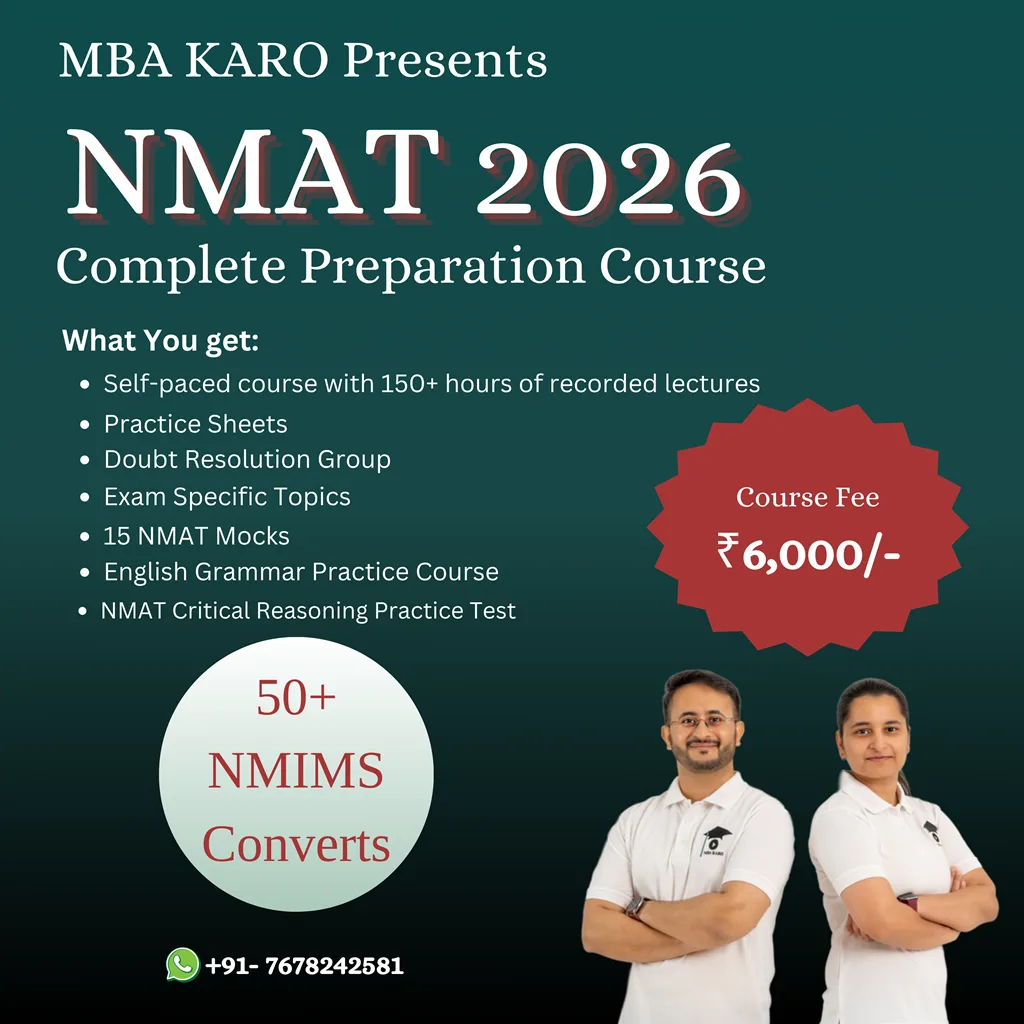
The course includes 150+ recorded concept videos, covering concepts from basic to advanced levels. The concepts are followed by questions so that you can apply what you study.
It also provides topic-wise practice sheets covering NMAT-specific topics, including areas such as prepositions.
For doubt resolution, the course has a doubt-resolution group and live doubt sessions. An English Grammar Practice Course is also included.
The grammar component includes a 160+ English Grammar Rule Book, along with:
- Idioms and phrases
- Vocabulary Powerhouse
- Topic-wise tests
- Mixed practice tests
For exam practice, the course includes 15 full-length NMAT mocks and 20 NMAT Critical Reasoning Tests. The mocks include solutions and are designed around the NMAT difficulty level and interface.
Conclusion
The NMAT Language Skills Syllabus 2026 covers 36 questions in 28 minutes, with a 12-120 score range and no negative marking.
The main areas are Reading Comprehension, Para Jumbles, Error Identification, Fill in the Blanks, Prepositions, and Verbal Analogy, supported by grammar and vocabulary preparation.
RC can take around 12–15 minutes, while the other topics require faster question-solving. Prepositions deserve specific attention because of their NMAT-specific combination format.
For structured preparation, MBA KARO NMAT Online Coaching combines 150+ recorded concept videos, NMAT-specific practice sheets, grammar resources, doubt support, 15 full-length mocks, and 20 Critical Reasoning Tests in one preparation course.