CAT 50 Day Streak – Day 21
30 questions across VARC, DILR & QA · +3 for a correct answer · −1 for a wrong MCQ · no negative marking for TITA
VARC · Verbal Ability & Reading Comprehension
Deep in the Diquis Delta region of southwestern Costa Rica, fruit company bulldozers plowed down swathes of rainforest in the 1930s and dug drainage ditches to make way for banana plantations. In the process, they accidentally exposed a collection of remarkable objects: almost perfectly round spheres carved from hard volcanic rock. The largest one is massive, with a diameter of nearly 9 feet and weighs 26 tons. Research has since revealed the spheres were carved by Indigenous people who abandoned them and their communities before the 16th-century arrival of the Spaniards. Archaeologists have some understanding of their purpose—they believe the spheres were status symbols placed at the entryways of homes of important people. Research has also found that some spheres were aligned with astrological features, such as the location of the sunrise on the horizon at certain days of the year. Beyond that, any additional purposes, spiritual significance and the beliefs of the people who made them are educated guesswork. There has been speculation that they may have been markers for navigators from the mythical city of Atlantis, or even projectiles fired from alien ships to earth.
The train cars that shipped bananas from the plantations were then also used to send the objects known in Costa Rica as “Las Bolas de Piedra” (The Stone Balls) all over the country, says John Hoopes, an archaeology professor who specializes in southern Central and northern South America and has researched the spheres in visits to Costa Rica since 1990. Some ended up as ornaments in front of Costa Rican office buildings and banks and three are on display in front of the Costa Rican congress building. Museums in New York and Denver have them and one is displayed on the campus of Harvard University. The fact that so many were moved from their original locations has complicated research into the spheres’ purpose. Those that are still in the Diquis Delta and on a small island off the country’s Pacific coast were granted protection as national treasures in the 1980s and prohibited from being exported. Their locations were designated as World Heritage sites by UNESCO in 2014.
The Indigenous people who made the spheres lived on mounds with stone foundations to elevate their homes above the region’s frequent flooding. They used two different techniques to fashion sophisticated gold jewelry and made pottery featuring images of birds and crocodiles, Hoopes says. They were members of societies ruled by chiefs in which “extensive farming and the availability of natural resources would have created favorable conditions to undertake important public infrastructure works, create monumental sculptures and obtain symbolic, deluxe goods according to their social condition,” according to the National Museum of Costa Rica. Most spheres “were probably made by the Chiriqui culture (A.D. 800–1500), the last of three major pre-Colombian cultures in Costa Rica, during a period when villages began to form, with cobblestone house foundations, pavements, walls, and mounds,” Archaeology Magazine reports in an article citing museum archaeologist Francisco Corrales. Hoopes says field work by Corrales in the 1990s found two stone spheres on both sides of the entrance ramp to a house platform, representing evidence that the spheres were status symbol ornaments.
Paragraph 1 introduces the spheres and the uncertainty about their purpose. Paragraph 2 explains how dispersal complicated research. Paragraph 3 describes the people who made them. D covers all three.
A covers only the timeline and ignores the creators. B: the author calls everything beyond the basics “educated guesswork”, so no hypothesis is presented as definitive. C: the passage doesn’t frame a contrast with speculators.
The passage says directly: “The fact that so many were moved from their original locations has complicated research into the spheres’ purpose.”
A: the passage mentions the speculation but never says it hinders research. C and D are not mentioned at all.
The status-symbol view is part of what archaeologists “have some understanding of”, and it is backed by Corrales finding two spheres on either side of a house-platform ramp, described as “evidence that the spheres were status symbol ornaments.”
A: “educated guesswork” refers to purposes beyond this. B: the author admits much remains unknown, so “definitive and complete” overstates it. D: the museum never disproves it.
Spheres moved to banks, offices and museums lost their original setting, and the passage says this relocation “complicated research into the spheres’ purpose.”
B: many are in Costa Rica (banks, the congress building). C: the passage never ranks their value. D: Corrales’ evidence came from spheres found in situ at a house platform.
After the paragraph calls for innovative methods and says what they should achieve, the sentence offers “one interesting approach”: testing ancient remedies. The next sentence names it: “This field has recently been named ‘ancientbiotics.’”
At 1 and 2 the requirements haven’t been fully set out. At 4, “this field” would have nothing to refer to.
- Apparently, the effort revealed to the students their own ignorance, because their self-assessments dropped.
- In a study conducted at Yale, graduate students were asked to rate their understanding of everyday devices, including toilets, zippers, and cylinder locks.
- They were then asked to write detailed, step-by-step explanations of how the devices work, and to rate their understanding again.
- Sloman and Fernbach see this effect, which they call the “illusion of explanatory depth,” just about everywhere.
The order runs like this:
- 2: Yale students rate their understanding of devices.
- 3: “They were then asked” to explain step by step and re-rate.
- 1: “The effort” revealed ignorance, so ratings dropped.
- 4: Sloman and Fernbach see “this effect” everywhere.
- They slept in nylon-shell, down-filled sleeping bags that weighed approximately nine pounds.
- Modern sleeping bags weigh just 4.5 pounds and are rated for temperatures as low as -40 Fahrenheit.
- Hillary, Norgay and other expedition members sheltered in tents that featured a canvas shell with an inner nylon tent.
- This makes the achievement of Hillary and Norgay, who didn’t have 70 years of precedent to draw on, all the more remarkable.
- Whereas modern Base Camp tents may be spacious and comfortable, those for high camps and the assault on the summit are small, lightweight and double-walled for protection against fierce winds and extreme elements.
The coherent paragraph is 3 → 5 → 1 → 2, comparing gear then and now:
- 3: The 1953 expedition used canvas-and-nylon tents.
- 5: “Whereas” modern tents are lightweight and double-walled.
- 1: “They” slept in nine-pound down bags.
- 2: Modern bags weigh 4.5 pounds.
Sentence 4 shifts from equipment to accumulated precedent (“70 years” of experience) and makes a judgement that the gear comparison doesn’t lead to.
“Also” adds another non-American early recipe to the English one from 1381. It can’t go at 3: “There were other differences, too” must directly follow the figs/raisins/saffron sentence that lists the first differences. So the Dutch example closes the paragraph at 4, as further proof the dish isn’t uniquely American.
At 1 and 2 the sentence would come before the claim it supports and before the first recorded recipe.
The passage introduces a primer to clear up the confusion caused by the “Br” in Brexit, i.e. the mix-up between Britain and the U.K. B states the distinction the primer sets out: the U.K. is the political state, while Great Britain is the island of England, Scotland and Wales.
A repeats the very confusion the passage wants to correct. C and D get the facts wrong (D swaps the two terms).
- Taking the case of Abraham’s rushing to meet three strangers even though he is in great pain, the rabbis of the Talmud wrote that “Hospitality to wayfarers is greater than receiving the Divine Presence.”
- Wrote Levinas in 1959, “Monotheism is not an arithmetic of the divine; It is, rather, a school of xenophilia and anti-racism.”
- He begins by quoting Emmanuel Levinas, the “great and radical” French “philosopher on the nature of ethical obligation.”
- Shankman explores how xenophilia is fundamental to some of our oldest stories, including those from the Hebrew Bible and the Homeric epics.
The order runs like this:
- 4: Shankman’s subject: xenophilia in our oldest stories.
- 3: “He begins by quoting” Levinas.
- 2: The Levinas quote itself.
- 1: A Hebrew Bible example (Abraham and the Talmud).
DILR · Data Interpretation & Logical Reasoning
X-Phones, a mobile phone retailer, has stores in 8 cities of India. It sells phones of only 4 brands: Xiaomi, Vivo, Samsung and Apple. The below table gives the data about the phones sold by them during a month in these cities:
| City | Samsung | Xiaomi | Vivo | Apple |
|---|---|---|---|---|
| Ajmer | 4960 | 480 | 18% | 14% |
| Bhopal | 19% | 17% | 630 | 22% |
| Chandigarh | 32% | 2160 | 13% | 19% |
| Dehradun | 4260 | 8% | 9% | 12% |
| Jodhpur | 5% | 20% | 1260 | 990 |
| Kanpur | 180 | 2250 | 26% | 900 |
| Ludhiana | 450 | 35% | 4050 | 1350 |
| Meerut | 25% | 725 | 32% | 14% |
The integer values denote the number of phones sold whereas the percentages denote the percentage of the total phones sold in that city. For example, 18% of the phones sold in Ajmer are of Vivo.
In each city, the known numbers make up 100% minus the given percentages, which gives the city total. For example, Ajmer: 4960 + 480 = 68%, so the total is 8000.
| City | Samsung | Xiaomi | Vivo | Apple | Total |
|---|---|---|---|---|---|
| Ajmer | 4960 | 480 | 1440 | 1120 | 8000 |
| Bhopal | 285 | 255 | 630 | 330 | 1500 |
| Chandigarh | 1920 | 2160 | 780 | 1140 | 6000 |
| Dehradun | 4260 | 480 | 540 | 720 | 6000 |
| Jodhpur | 150 | 600 | 1260 | 990 | 3000 |
| Kanpur | 180 | 2250 | 1170 | 900 | 4500 |
| Ludhiana | 450 | 3150 | 4050 | 1350 | 9000 |
| Meerut | 625 | 725 | 800 | 350 | 2500 |
Dehradun : Kanpur : Ludhiana = 6000 : 4500 : 9000 = 4 : 3 : 6.
From the table in Q11, only Chandigarh (1920, 2160, 780, 1140) has at least 500 of every brand. Every other city has at least one brand below 500. Answer: 1.
255/600 × 100 = 42.5%.
- The number of Apple phones sold was the least in Bhopal.
- Vivo is the only company with a sale of more than 1000 in four cities.
- The number of Samsung phones sold in Jodhpur was 24% of the number of Samsung phones sold in Meerut.
- Samsung phones sold in Ludhiana were 30 more than Xiaomi phones sold in Dehradun.
- I: Bhopal’s 330 Apple phones is the lowest ✓
- II: Vivo tops 1000 in Ajmer, Jodhpur, Kanpur and Ludhiana (4 cities). Samsung, Xiaomi and Apple each do so in only 3 ✓
- III: 150/625 = 24% ✓
- IV: Ludhiana Samsung (450) is 30 fewer than Dehradun Xiaomi (480) ✗
True statements: I, II and III.
1440 + 800 = 2240.
Pranav took a workshop of Arithmetic from Monday to Saturday. Six topics – Percentage, Profit Loss, SICI, Ratio, Mixture and Average were taught in the workshop, one on each day. It was observed that:
- Except for the first two days, attendance on a particular day was the average of the attendance of the previous two days.
- The class on Ratio had the least attendance of 30 students. It was immediately before the class on Average, which did not have the highest attendance.
- 3 more students were present in the class on Mixture as compared to the class on SICI, which was taken before the classes on Profit Loss and Mixture.
- Pattern. Let Mon = a and Tue = a + d. Then the attendances run a, a + d, a + d/2, a + 3d/4, a + 5d/8, a + 11d/16. The lowest and highest are always Monday and Tuesday.
- Ratio and Average. Ratio has the least attendance and comes right before Average, which isn’t the highest. If Monday were least, Average would fall on Tuesday, the highest. So Tuesday (Ratio) = 30 is the least, Average is Wednesday, and Monday is the highest.
- In units of e. Mon = 30 + 16e, Wed = 30 + 8e, Thu = 30 + 4e, Fri = 30 + 6e, Sat = 30 + 5e.
- SICI and Mixture. Mixture − SICI = 3 with SICI earlier. SICI Thu / Mixture Fri gives 2e = 3 (non-whole attendance on Saturday ✗). SICI Thu / Mixture Sat gives e = 3 ✓. Profit Loss must come after SICI, so it is Friday, and Percentage is Monday.
| Day | Mon | Tue | Wed | Thu | Fri | Sat |
|---|---|---|---|---|---|---|
| Topic | Percentage | Ratio | Average | SICI | Profit Loss | Mixture |
| Attendance | 78 | 30 | 54 | 42 | 48 | 45 |
Friday’s class was Profit Loss.
Monday: 30 + 16 × 3 = 78.
Average was on Wednesday: (78 + 30)/2 = 54.
Saturday = (42 + 48)/2 = 45.
Profit Loss had 48 and Mixture had 45. The minimum overlap is 48 + 45 − 80 = 13.
QA · Quantitative Ability
Alligation: juniors : seniors = (112 − 85) : (85 − 40) = 27 : 45 = 3 : 5. With 90 juniors, there are 150 seniors, so 240 in total.
240 is 75% of all artists, so the total = 320.
f(4) = 4 − f(5) and f(5) = f(4) + 5. Substituting: f(5) = 9 − f(5), so f(5) = 4.5.
f(6) = f(5) + 6 = 10.5. So f(5) + f(6) = 15.
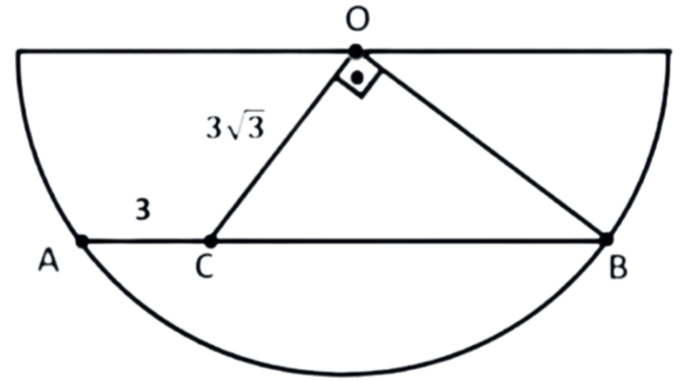
From the figure, OC = 3√3, so OC2 = 27. Let CB = y and the radius be r.
Right angle at O: y2 = OC2 + r2 = 27 + r2.
Power of point C: AC × CB = r2 − OC2, so 3y = r2 − 27.
Subtracting: y2 − 3y = 54, so y = 9 and r2 = 54. Semicircle area = ½πr2 = 27π sq cm.
The numerators are 3n + 1 (2, 4, 10, 28, 82) and the denominators are 9n. So each term = (1/3)n + (1/9)n, starting from n = 0.
Sum = 11 − 1/3 + 11 − 1/9 = 3/2 + 9/8 = 21/8.
Treat each number as five digits with leading zeros: d1 + … + d5 = 11 with 0 ≤ di ≤ 9.
Without the upper limit there are 15C4 = 1365 solutions. Remove those with a digit ≥ 10: that digit takes 10 and the remaining 1 is spread over five places, giving 5 × 5 = 25 cases.
1365 − 25 = 1340.
Let CP = 1 per item and MP = m. For 36 items the dealer receives 35 × 0.9m = 31.5m.
Cost of 36 items = 36. A 5% gain means 31.5m = 37.8, so m = 1.2. The marked price is 20% above CP.
34 = 2 × 17. Both powers are odd, so their difference is even (divisible by 2).
Mod 17: since 2024 ≡ 8 (mod 16), 52024 ≡ 58 ≡ −1 and 32024 ≡ 38 ≡ −1. The difference is ≡ 0.
So 34 divides it, and the remainder is 0.
A and C have the same number of books, n. Their averages differ by 11: 1120/n − 900/n = 11, so n = 20 and a = 59.
Check B: 25 books, 1000/25 = 40 = 59 − 19 ✓. Total = 20 + 25 + 20 = 65.
Acute with 22 the largest side: 222 < 142 + x2, so x2 > 288 and x ≥ 17. Scalene and 22 the maximum: x ≤ 21 and x ≠ 14.
x = 17 to 21 gives perimeters 53 to 57. Median = 55.
Let Nisha’s speed be n km/h. Then Risha = n − 1 and Misha = n + 5.
Same finishing time: 2.4n = 1.6n − 1 + 0.8n + 5. Dividing by 0.8: 3(n − 1)(n + 5) = 2n(n + 5) + n(n − 1), which simplifies to 3n = 15, so n = 5.
Nisha’s time = 2.4/5 h = 28.8 min = 28 minutes 48 seconds.
Correct: 0 · Wrong: 0 · Accuracy: 0%
Keep the streak alive. See you tomorrow for Day 22.