
CAT 50 Day Streak – Day 15
30 questions across VARC, DILR & QA · +3 for a correct answer · −1 for a wrong MCQ · no negative marking for TITA
VARC · Verbal Ability & Reading Comprehension
Some philosophers have argued that, despite widespread intuitions to the contrary, knowledge is not merely a matter of representation but also of construction, and that truth cannot be completely detached from human needs and interests. John Dewey, for example, argued that the object of knowledge is the product of enquiry and not something that exists independently of that enquiry. But this can’t be right. After all, scientists discovered DNA, distant planets and gravity, they did not create them. Facts are facts. Any other view seems disastrous, from the vague assertion that we all create our own truth to the Nietzschean claim that it’s interpretations all the way down. Without a shared target that we all aim at getting right, rational discussion is no longer possible. So what were these philosophers getting at, exactly?
The realist view, which sees enquiry as a process of revelation and knowledge as a representation of antecedent facts, is intuitively compelling. Think of a murder investigation. To be sure, the investigators might need a creative imagination in thinking about possible solutions and ways of looking for evidence, but their knowledge of the killer’s identity does not involve any creation on their part. On the contrary: someone killed the victim, and nothing that the investigators do during their inquiries could alter that fact. Knowledge consists in having the right beliefs about that fact, based on the right evidence.
These kinds of examples are useful for philosophers: they are simple, familiar and they generate powerful intuitions. But, precisely because of their simplicity, they can be misleading. Not all enquiries are like whodunnit investigations. In fact, if we want to know what knowledge is, we should also look at more complex cases, in which the object of investigation itself is articulated only as enquiry progresses. Depending on the type of enquiry we examine, we might find that it is more appropriate to talk of articulation than representation, creation rather than revelation.
Enquiries, whether judicial or scientific, often function like whodunnits. We begin with a question and a predetermined set of potential answers, and our aim is to successfully identify the correct one. Crucially, nothing in our investigation determines the actual truth; we merely attempt to discover it. This limitation creates the tragedy often seen in the legal system, where innocent people are wrongly convicted while the guilty escape justice, leaving some cold cases permanently unresolved with the truth lost forever.
Many scientific enquiries operate under this same principle. Take, for example, the question of Earth's average surface temperature over the past million years. Scientists use complex models and paleontological data to generate estimates, but these may be inaccurate, especially when looking further into the past. Despite the difficulty in precision, the Earth did have a single, measurable average temperature one million years ago, just as it does today. Our inability to precisely determine it doesn't change the fact of its existence. The reality is simple: if we could travel through time, we could take measurements and find the exact answer. Ultimately, both fields seek a fixed, objective truth that is independent of our investigative efforts.
The third paragraph says whodunnit examples “can be misleading” because “not all enquiries are like whodunnit investigations”. It qualifies the realist picture rather than overturning it.
B: the paragraph gives no definitive counterexamples. C: it only says some cases “might” suit talk of creation. D: the move from judicial to scientific enquiry happens in paragraphs 4–5.
“Articulation” fits cases where “the object of investigation itself is articulated only as enquiry progresses”. A new legal framework doesn’t exist beforehand; the drafting process creates it.
A, B and C each have one fixed answer waiting to be found (an epicentre, a key, a composition). They are whodunnit-style revelation.
The whodunnit model assumes that “nothing in our investigation determines the actual truth”. If measurement itself changes what is measured, the enquiry partly shapes the truth, which strikes at that assumption.
A: the author already allows a creative imagination in investigators. C concerns definitions of guilt, not whether facts exist independently. D is the “cold case” tragedy the author already accepts.
Paragraph 1 sets up the debate (construction vs representation) and asks what the constructionists were “getting at”. Paragraphs 2, 4 and 5 explain the realist side through the murder and temperature examples. Paragraph 3 flags the limits of those examples. That is C.
A: neither view is finally dismissed. B: the passage frames an open debate rather than defending an objection. D describes only the last two paragraphs.
A covers all three explanations: Livy’s values (fides, virtus, pietas), the Greek writers’ meritocratic openness, and the modern view of solidarity born of class conflict.
B reduces it to religion and morals and drops the meritocracy. C says Rome “overcame” discord through common values, but the passage says solidarity was born of the conflict. D credits meritocracy and religion with unifying the classes, a causal link the passage never makes.
After the examples of chaos (YouTube, Twitch, TikTok), the sentence sums up how surviving platforms built “systems” for copyright. The next sentence, “Sora will need the same boring plumbing”, needs those systems mentioned just before it. So the sentence belongs at blank 3.
At blanks 1 and 2 the examples aren’t finished. At blank 4 the paragraph has already moved on to Sora.
- If, when you arrive and get the sandwich, it is just what you expected, you get no additional dopamine response.
- Your mind goes to a turkey sandwich you enjoyed last week from a local deli, which gives you a response from dopamine neurons to elicit anticipation and make you form a plan to go there at noon.
- But if the sandwich is even more delicious than you remembered, you will get an extra neurochemical spritz, which teaches you to come back again.
- Imagine that at about 11 a.m., your stomach growls and you think about lunch.
The order runs like this:
- 4: “Imagine…” sets the scene: hungry at 11 a.m.
- 2: You anticipate the deli sandwich (dopamine and a plan).
- 1: If it’s as expected, there’s no extra dopamine.
- 3: “But if” it’s better, you get an extra spritz.
Once the milk has coagulated into a jelly, it is cut into curds. Then “the mixture” (curds in whey) is heated and separated from the whey. So the sentence belongs at blank 2.
At blank 1 there is nothing solid to cut yet. Blanks 3 and 4 come after the curds have already been pressed into wheels.
- A growing troupe of scientists think that focusing on one or two diagnoses in a study has meant that the true nature of mental disorders remains hidden.
- Perhaps it’s because the diagnostic system is faulty.
- Considering the whole spectra of psychiatric possibility reveals similarities in symptoms, brain circuitry and genetics.
- Shaking off the shackles of diagnostic classification, there is growing evidence that all mental disorders are actually the product of a single underlying dimension, a common liability for psychopathology.
- To understand what are essentially brain disorders, they argue you have to zoom out.
The coherent paragraph is 1 → 5 → 3 → 4:
- 1: Scientists think narrow, one-diagnosis studies hide the true nature of disorders.
- 5: “They argue you have to zoom out.”
- 3: Zooming out reveals shared symptoms, circuitry and genetics.
- 4: Hence the evidence for a single underlying dimension.
Sentence 2 (“Perhaps it’s because…”) answers a question that none of the other sentences asks.
- A shogunal succession dispute provided the excuse for the Onin War as aspirants to national power fought for that trophy while nearly everyone else tried to settle local disputes.
- Strictly defined, the period began in 1467 with the outbreak of the Onin War and lasted until 1567 when Oda Nobunaga took over Kyoto and established a semblance of national unity.
- During this century, the authority of the Muromachi shogunate, never strong, slowly disappeared.
- After ten years, exhaustion set in, but by then, Kyoto was devastated, the Ashikaga were on the garbage dump of history and power was divided among local men of power, the daimyo.
The order runs like this:
- 2: Defines the period (1467–1567).
- 3: “During this century”, shogunate authority faded.
- 1: The Onin War’s trigger, a succession dispute.
- 4: “After ten years”, exhaustion, with Kyoto ruined and power with the daimyo.
DILR · Data Interpretation & Logical Reasoning
14 bikes — A, B, C, D, E, F, G, H, I, J, K, L, M, and N, manufactured by one of the four companies — Yamaha, TVS, Ola, and Bajaj, such that 5 are manufactured by Ola, 4 by Yamaha, 3 by TVS, and 2 by Bajaj. The bikes are parked in 14 parking slots, one in each slot, out of the 20 parking slots, numbered from 1 to 20.
Further information is as follows:
- The 4 Yamaha bikes are parked in 4 parking slots, which are consecutive prime numbers. The same is also true for the parking slots, where the 3 TVS bikes are parked.
- C, E and G, manufactured by the same company, are parked in alternate parking slots, in increasing order.
- F and L are of the same company and have an empty slot between them. The same is true for B and D.
- The 5 bikes of Ola are parked in 5 parking slots, which are consecutively numbered.
- K and M are parked in two slots, which are consecutive prime numbers. The same is also true for N and H.
- M and J are manufactured by the same company, and the same is true for N and H.
- Slots between B and M are fewer than those between B and H.
- K is parked in slot numbered 3 and H is parked in slot numbered 19.
- C, E, G are Ola. They sit in slots s, s + 2, s + 4. Three primes two apart can only be 3, 5, 7, but K is in 3. So they are Ola, and Ola’s 5-slot block is exactly s to s + 4.
- Where the Ola block goes. Yamaha (4) and TVS (3) use 7 of the 8 primes up to 19, in two runs, so only one prime is free for anyone else. The Ola block must contain exactly that one prime: 6–10 (prime 7) or 8–12 (prime 11).
- 8–12: Yamaha = 2, 3, 5, 7 and TVS = 13, 17, 19. Then A, B, D, F, I and L would fill 1 Yamaha, 1 TVS, 2 Ola (9, 11) and 2 Bajaj slots. Both F–L and B–D need a same-company pair with an empty slot between; Ola’s 9 and 11 have E between them, so only one pair (Bajaj) fits ✗.
- 6–10: TVS = 2, 3, 5 and Yamaha = 11, 13, 17, 19 ✓. K (3) is TVS, so M (2 or 5) and J are TVS. N and H (17, 19) are Yamaha.
- The pairs. They must be Yamaha (11 and 13, with 12 empty) and Bajaj, so A and I are the Ola bikes in 7 and 9. B has to be nearer M than H, which works only with B = 11 and M = 5. So J = 2 and D = 13.
- Bajaj. F and L need an empty slot between them, which leaves only 14 and 16 (15 empty).
| Slot | Bike | Company |
|---|---|---|
| 2 | J | TVS |
| 3 | K | TVS |
| 5 | M | TVS |
| 6 | C | Ola |
| 7 | A / I | Ola |
| 8 | E | Ola |
| 9 | I / A | Ola |
| 10 | G | Ola |
| 11 | B | Yamaha |
| 13 | D | Yamaha |
| 14 | F / L | Bajaj |
| 16 | L / F | Bajaj |
| 17 | N | Yamaha |
| 19 | H | Yamaha |
Empty slots: 1, 4, 12, 15, 18, 20. J is in slot 2.
Slot 6 holds C. Slots 12, 15 and 18 are empty.
F and L are the two Bajaj bikes, in slots 14 and 16.
A is in 7 or 9 and F in 14 or 16. The fewest slots between them comes from A = 9 and F = 14, which puts I in 7.
Between I (7) and H (19), the bikes are in slots 8, 9, 10, 11, 13, 14, 16 and 17: 8 bikes.
- A: F is Bajaj, in slot 14 or 16, both even. Always true.
- B: M (5, TVS) and C (6, Ola). Always true.
- C: I could be in slot 7 instead of 9. Could be false.
- D: K (3) and M (5) have slot 4 empty between them. Always true.
Five friends, Adam, Bob, Charles, David and Evan, visited a restaurant on five consecutive days of a week for breakfast. The table below gives the split of the bills of these persons. Each of the columns has two values missing. All the values are integers and none of the missing values is more than 10% of the total bill of that day:
| Mon | Tue | Wed | Thu | Fri | |
|---|---|---|---|---|---|
| Adam | 200 | 160 | 105 | ||
| Bob | 130 | 175 | 100 | ||
| Charles | 180 | 225 | |||
| David | 155 | 145 | 115 | 45 | |
| Evan | 145 | 120 | 155 | ||
| Total | 595 | 575 | 540 | 390 | 510 |
Each day, the two missing values add up to the total minus the known values. Each is at most 10% of that day’s total:
| Day | Missing pair | Pair sum | Max each (10%) | Range each |
|---|---|---|---|---|
| Mon | Charles, Evan | 110 | 59 | 51 – 59 |
| Tue | Bob, David | 90 | 57 | 33 – 57 |
| Wed | Adam, Charles | 100 | 54 | 46 – 54 |
| Thu | Charles, Evan | 70 | 39 | 31 – 39 |
| Fri | Adam, Bob | 85 | 51 | 34 – 51 |
Evan’s known amounts total 145 + 120 + 155 = 420. Adding his minimums for Monday and Thursday: 420 + 51 + 31 = 502.
Detailed solution coming soon.
David’s known amounts total 460, so he paid 40 on Tuesday and Bob paid 90 − 40 = 50.
Adam = 465 + AWed + AFri. Bob = 455 + (85 − AFri) = 540 − AFri.
Adam − Bob = AWed + 2AFri − 75, with AWed from 46 to 54 and AFri from 34 to 51. Every integer from 39 to 81 is possible, so 83 cannot occur.
The smallest known value is 45 (David on Friday). The lowest a missing value can go is on Thursday: 70 − 39 = 31.
So no contribution can be below 31.
Possible 5-day totals: Adam 545–570, Charles 533–557, Evan 502–518, David 493–517, Bob 472–513. Evan, David and Bob always trail Adam.
Charles can beat Adam. Take Charles 59 (Mon), 54 (Wed), 39 (Thu), so Adam pays 46 on Wed; with Adam paying 34 on Fri, Charles = 557 and Adam = 545. So only Charles can be the top contributor.
QA · Quantitative Ability
Selling the mixture at the price of pure milk gives a 44% profit, so mixture : milk = 1.44 : 1. The milk fraction is therefore 1/1.44 = (5/6)2.
(1 − 20/V)2 = (5/6)2, so 20/V = 1/6 and V = 120 litres.
By Wilson’s theorem, 16! ≡ −1 (mod 17). Since 16 ≡ −1, 15! ≡ 1. Since 15 ≡ −2, 14! ≡ 1/(−2) ≡ 8, because −2 × 8 = −16 ≡ 1.
14! × 16! ≡ 8 × (−1) = −8 ≡ 9 (mod 17).
For a right triangle with legs a, b and hypotenuse c: r = (a + b − c)/2 and R = c/2. So r + R = (a + b)/2 = 11.5, giving a + b = 23. The area gives ab = 120.
c2 = (a + b)2 − 2ab = 529 − 240 = 289, so c = 17. Perimeter = 23 + 17 = 40 cm.
The sum of the first m days is m(2400 + 100m). Setting this equal to 122500 gives m2 + 24m − 1225 = 0, so m = 25 and n = 20.
Sum of the first 20 days = 20 × (2400 + 2000) = Rs. 88,000.
Measure positions along Romesh’s original direction. The first meeting is at 400 m (Romesh runs 2/5 of 1000).
After reversing and doubling, they still run in opposite directions in the ratio 2 : 3. Each later meeting comes after Romesh runs another 400 m, now in the reverse direction. The meeting points are 400, 0, 600, 200, 800, then 400 again.
That gives 5 distinct points.
Detailed solution coming soon.
Farhat: 10% per half-year for 4 periods, so interest = 70000 × (1.14 − 1) = 70000 × 0.4641 = 32487.
Fatima: 140000 × 12.5% × 2 = 35000.
Difference = 35000 − 32487 = Rs 2513.
The last two digits must be a multiple of 4 with distinct digits: 04, 12, 20, 24, 32 or 40.
- Endings with a 0 (04, 20, 40): the other 3 digits can go in any order, 3! = 6 each → 18
- Endings without a 0 (12, 24, 32): 0 can’t lead, so 3! − 2! = 4 each → 12
Total = 30.
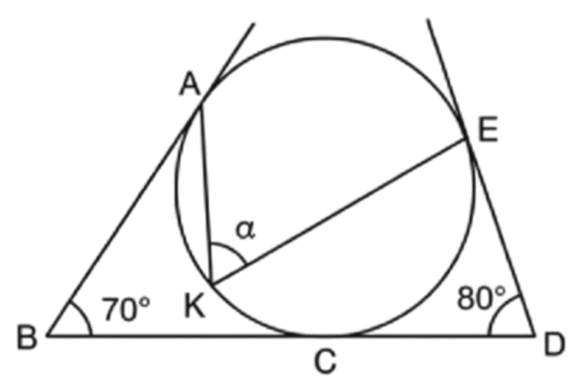
Two tangents from a point make the central angle 180° minus the angle at that point. So ∠AOC = 180° − 70° = 110° and ∠COE = 180° − 80° = 100°.
The arc A → C → E is 210°, so the other arc AE (the one not containing K) is 150°.
α = ½ × 150° = 75°.
Monday 1: boys get 84 and girls 72. With c candies each: b = 84/c and g − 4 = 72/c.
Monday 2: boys get 70 and girls 80. With d candies each: b − 7 = 70/d and g = 80/d.
Trying c = 2: b = 42 and g = 40. Then d = 70/35 = 2 and g = 80/2 = 40 ✓. The difference is 42 − 40 = 2.
Correct: 0 · Wrong: 0 · Accuracy: 0%
Keep the streak alive. See you tomorrow for Day 16.







