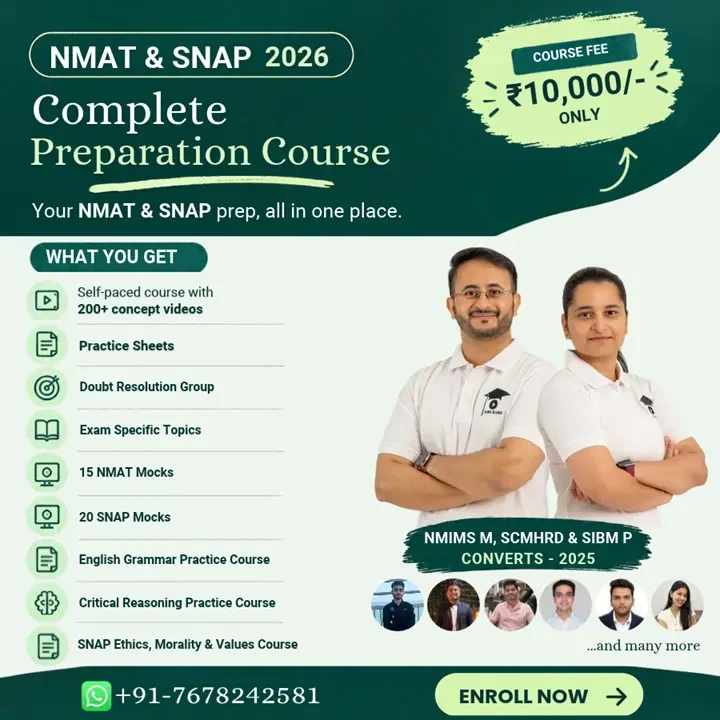

How many mock tests before SNAP 2026 should you take? A practical target is 15-20 full-length mocks before the exam.
However, the number alone does not determine their value. What matters is how well you analyse each test, identify repeated mistakes, and change your strategy in the next attempt.
SNAP 2026 will be conducted on December 13, December 19, and December 26, 2026.
Since the test allows only 60 minutes for 60 questions, regular mock practice can help candidates become comfortable with the pace required on the actual test day.
How Many Mock Tests Before SNAP 2026?
You do not need to take all 20 mocks at once. Spread them across your preparation so that every test has a clear purpose.
| Preparation Stage | Number of Mocks | What to Focus On |
| Starting phase | 3-5 | Understand your current score and weak areas |
| Skill-building phase | 5-7 | Improve speed, accuracy, and question selection |
| Final phase | 5-8 | Practise complete exam-like attempts |
| Total | 15-20 | Build consistency before the exam |
For example, a candidate scoring 30 marks in the first mock should not simply take another test immediately. First, check where the marks were lost.
If 5 incorrect answers came from rushing through questions, the next mock should focus on controlling attempts and reducing avoidable errors.
Benefits of Mock Practice for SNAP 2026
SNAP Mock tests do more than provide an estimated score. They show how effectively you can use the limited time available in the examination.
1. Improves Time Management
With 60 questions in 60 minutes, spending too long on one question can affect the rest of the paper. Mocks help candidates develop a faster decision-making process.
For instance, if a difficult question takes 3 minutes, a mock can reveal how much time could have been saved by skipping it and moving to easier questions.
2. Helps Improve Accuracy
SNAP has 25% negative marking for every incorrect answer. Therefore, blindly increasing attempts may not improve your score.
Regular mocks help you identify whether your mistakes come from calculation errors, incorrect assumptions, or rushing through questions.
3. Builds Question Selection Skills
Not every question deserves equal time. Mock practice helps candidates recognise questions that can be solved quickly and those that are likely to consume excessive time.
This becomes especially useful when deciding which questions to attempt first during the 60-minute test.
4. Shows Section-Wise Performance
A total score does not tell you everything about your preparation. Your mock analysis should also show performance across the different sections.
| What to Track | Why It Matters |
| Attempts | Shows your solving pace |
| Correct answers | Measures accuracy |
| Incorrect answers | Highlights risky attempts |
| Time spent | Identifies slow areas |
| Section-wise score | Shows preparation gaps |
5. Helps Track Progress
Taking mocks at regular intervals gives you measurable data. If your scores move from 34 to 39 to 43, you can examine what changed between those attempts.
The same tracking can also reveal problems. If your score remains around 35 despite taking several tests, you may need topic-level revision.
How to Analyse a SNAP Mock Test
Mock analysis should happen after every full-length test. Divide your mistakes into three categories:
- Conceptual errors: You did not know how to solve the question.
- Calculation or reading errors: You knew the method but made an avoidable mistake.
- Selection errors: You spent too much time on a question that should have been skipped.
Also note questions that you left but could have solved quickly. These can indicate areas where your preparation is stronger than your attempt strategy suggests.
MBA Karo SNAP Mock Test for Practice
The MBA Karo SNAP Mock Test is designed for candidates who want a structured mock-practice plan. It includes 20 full-length SNAP mocks based on the latest pattern, matching the recommended upper range of practice tests.
The course also offers 1,200 questions for additional practice. These can be useful when you need more questions on a particular area.
Each mock includes detailed solutions. This helps you understand the correct approach after the test. The performance analysis feature can further help you review your results and monitor improvement across attempts.
The course also includes 2 trial lessons. This gives candidates an opportunity to explore the learning format before committing to the complete resource.
How to Schedule Mocks Before the Three SNAP Tests?
With three SNAP dates in December, candidates can use the exam schedule to divide their mock practice.
| Period | Mock Strategy |
| Before December 13 | Complete the first 8-10 full-length mocks |
| December 14-18 | Analyse the first attempt and take 2-3 targeted mocks |
| December 20-25 | Focus on final revision and 3–5 mocks |
| Before December 26 | Avoid excessive testing; prioritise analysis and consistency |
The December 13 test can also serve as a real-exam benchmark for candidates appearing on multiple dates. Use the experience to refine timing, attempts, and question selection.
Final Takeaway
For SNAP 2026, aim for 15-20 quality mock tests rather than chasing a high number without analysis. After every test, review your mistakes, compare section-wise performance, and make one or two specific changes in your next attempt.
A structured resource such as the MBA Karo SNAP Mock Test includes 20 full-length mocks, 1,200 questions, detailed solutions, performance analysis, and 2 trial lessons. This can support this practice cycle from initial testing to final revision.