
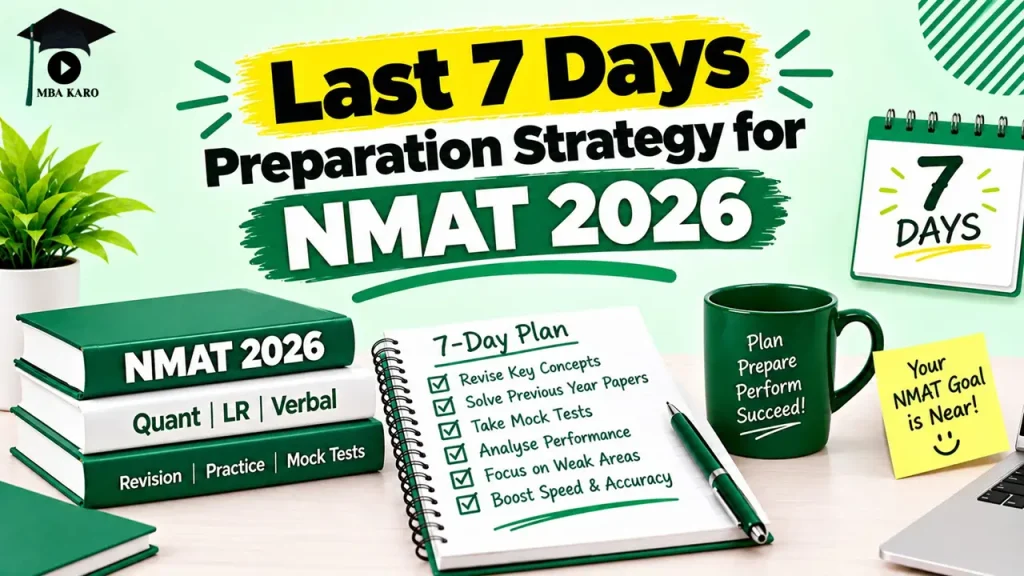
The NMAT 2026 exam window runs from November 2 to December 20, 2026.
The exam has 108 questions across Language Skills, Quantitative Skills and Logical Reasoning, with 120 minutes to complete all three sections.
Each section carries equal weightage, but the time available for solving questions differs considerably.
Read ahead to know the last 7 days preparation strategy for the NMAT 2026 exam.
Last 7 Days Preparation Strategy for NMAT 2026
During the last seven days, focus on improving accuracy, revising familiar topics and practising within the actual section time limits.
Since NMAT has no negative marking and allows up to three attempts, your preparation should also include a clear question-selection strategy and a plan to review your performance after each mock test.
Avoid starting several new topics in the final week. Use this time to identify mistakes and improve your speed on questions you can solve confidently.
Last 7 Days NMAT 2026 Preparation Plan
Follow this seven-day schedule to cover all three sections without spending too much time on any single topic.
Day 1: Take a Full-Length NMAT Mock Test
Start with a timed mock test containing 108 questions across all three sections. Follow the 120-minute limit and the prescribed section timings: 28 minutes for Language Skills, 52 minutes for Quantitative Skills and 40 minutes for Logical Reasoning.
After completing the test, analyse your performance instead of immediately attempting another mock. Identify the following:
- Topics where you answered correctly but took too long.
- Questions you attempted incorrectly because you misunderstood the concept.
- Questions you could have solved but skipped due to poor time management.
- Topics where you spent time without reaching a reliable answer.
Divide your weak areas into two groups: topics that need quick revision and topics that require more practice than you can realistically complete in one week. Prioritise the first group.
Day 2: Revise Language Skills
Language Skills has 36 questions to be answered in 28 minutes. This gives you less than a minute per question on average, so reading speed and quick identification of the correct option are important.
Revise reading comprehension, paragraph formation, error identification, prepositions, sentence completion and analogies. Give particular attention to the question types where you lost marks or spent excessive time in your first mock.
For reading comprehension, practise identifying the central idea, the author’s viewpoint and the relationship between statements.
Avoid rereading the entire passage for every question. For para forming, check the logical sequence of ideas, introductory statements and connecting phrases.
Revise common grammar rules for error identification, prepositions and sentence completion. Solve a short timed practice set after revision and review every incorrect answer. The objective is to reduce hesitation on familiar questions, not to memorise large amounts of new vocabulary or grammar rules.
Day 3: Strengthen Quantitative Skills
Quantitative Skills has 36 questions and 52 minutes, making it the longest section by time. Use this extra time to solve calculation-heavy questions carefully, but do not allow a single difficult problem to consume several minutes.
Revise the following areas:
- Arithmetic: Practise the concepts and calculations you have already studied.
- Number Properties: Review divisibility, factors, multiples and related question types.
- Algebra and Probability: Revisit essential formulas, equations and standard problem-solving methods.
- Data Integration: Practise caselets, tables, graphs and charts.
- Data Sufficiency: Focus on determining whether the given information is sufficient to answer the question.
Solve mixed-topic questions under a timer. Note the calculations or formulas that repeatedly cause errors and revise those points before ending the session.
Do not attempt to master every difficult question type in a day. Prioritise topics in which you can improve your accuracy with limited revision.
Day 4: Practise Logical Reasoning
The Logical Reasoning section contains 36 questions to be completed in 40 minutes. Your preparation should cover critical reasoning, analytical puzzles, deductions and other reasoning questions.
For critical reasoning, practise identifying the conclusion, supporting evidence, assumptions and gaps in an argument. For analytical puzzles, organise the information using short notes, tables or diagrams where needed. Avoid solving every condition mentally when a written arrangement can reduce errors.
In deduction-based questions, check whether the conclusion necessarily follows from the given statements. Do not select an option simply because it seems reasonable in everyday situations.
Complete a timed practice set and review the questions that took the longest. If a puzzle is unusually complex, learn to recognise when to move on and return to it if time permits. Since the exam has no negative marking, you can make an informed attempt at remaining questions rather than leaving them unanswered.
Day 5: Take Another Full-Length Mock
Attempt a second full-length mock using the same section timings. Compare the results with your first test, paying attention to accuracy, time spent and the number of questions you could attempt confidently.
Your review should answer three questions:
- Have you reduced errors in the topics revised during the previous days?
- Are you spending too much time on difficult questions?
- Which section needs the most attention before the exam?
Do not judge progress only by the overall score. A higher score can be useful, but understanding why your performance changed is more important for deciding what to revise next.
Prepare a short error log with the concepts, calculation mistakes and reasoning errors that appeared in the mock. Use this log as the basis for your remaining revision.
Day 6: Revise Weak Areas and Practise Time Management
Spend this day working on the mistakes identified in your second mock. Revisit formulas, grammar rules, reasoning methods and question types that caused avoidable errors.
Attempt short sectional tests instead of another full-length paper if you need targeted practice. Keep each session timed and review the answers immediately afterwards.
Also, refine your question-selection strategy. If you cannot identify a workable approach after a reasonable amount of time, move to another question. Avoid repeatedly checking the clock or changing answers without a clear reason.
Because each section has a fixed time limit, practise switching between easier and more demanding questions while staying within that section’s allotted time. Do not depend on finishing one section early to compensate for another.
Day 7: Light Revision and Exam Readiness
Keep the final day focused on revision rather than intensive practice. Review your error log, essential Quantitative Skills formulas, common grammar rules and the reasoning patterns you frequently encounter.
You can solve a small set of familiar questions to maintain your rhythm, but avoid taking a full mock if it is likely to leave you tired or unsettled. Do not spend hours trying to learn a completely new topic.
Check your exam appointment details and ensure that you understand the applicable test-day requirements. If you have already taken a previous NMAT attempt, review your score and identify the areas that need improvement before your next scheduled attempt.
NMAT 2026 Preparation Tips for the Final Week
Keep these points in mind while following your seven-day plan:
- Prioritise accuracy: Review why an answer is wrong before attempting more questions of the same type.
- Practise within section limits: Use 28 minutes for Language Skills, 52 minutes for Quantitative Skills and 40 minutes for Logical Reasoning during sectional practice.
- Avoid random guessing strategies: There is no negative marking, so attempt all questions within the available time. However, use elimination and reasoning wherever possible instead of spending too long on a single question.
- Revise selectively: Focus on familiar topics with scope for improvement rather than trying to cover the entire syllabus again.
- Review every mock: An error log helps you identify recurring mistakes and prevents unproductive repetition.
- Protect your preparation time: Avoid spending the final days on multiple resources that explain the same concepts differently.
Should You Take All Three NMAT Attempts?
NMAT allows candidates up to three attempts, giving them an opportunity to improve their performance. However, the decision to retake the exam should depend on your preparation, target colleges, available appointment slots and the applicable retake rules.
If you plan to use multiple attempts, treat each test as a separate opportunity to assess your performance. Review the scorecard, identify your weaker sections and revise accordingly before taking another attempt.
Do not assume that a retake will automatically produce a higher score.
The NMAT scorecard is generally available for download within 48 hours of the exam, according to the details provided for this preparation plan. Check your score after the result becomes available and use it to guide your next steps.
Conclusion
A focused final-week plan can help you revise important concepts, practise timed questions and address recurring mistakes.
If you need structured practice and guidance for the exam, the MBA Karo NMAT Online Course can support your preparation with a more organised approach to the three sections.
Use the final days to strengthen your existing preparation, improve your question-selection strategy and build consistency before your scheduled NMAT 2026 attempt.







