
SNAP Daily Practice Day 19

Day 19 / SNAP MBA Karo

SNAP Daily Practice – Day 19

25 questions across General English, Logical Reasoning, Quant & Decision Making · +1 for a correct answer · −0.25 for a wrong answer

0/25Attempted
0Correct
0Wrong
0Score / 25
Q1Direct / Indirect Speech
Select the correct indirect form of the given sentence.
SentenceHe said to Manoj, "I celebrated my birthday two days ago."
AHe told Manoj that he celebrated his birthday two days ago.
BHe told Manoj that he had celebrated his birthday two days before.
CHe told Manoj that he celebrated my birthday two days before.
DHe told Manoj that I celebrated my birthday two days ago.
Solution Answer: B

Converting to indirect speech with a past reporting verb involves three changes:

  • Tense: simple past “celebrated” shifts back to past perfect “had celebrated”.
  • Pronouns: “I/my” become “he/his”, to match the speaker.
  • Time words: “ago” becomes “before”.

A misses the tense and time-word changes. C keeps “my”. D keeps “I” and “my”.

Q2Modals
You _____ share your password with anyone.
Amust not
Bshould
Cmight not
Dwould
Solution Answer: A

“Must not” expresses a strong prohibition, which fits a security rule about passwords.

“Should” would recommend sharing the password, which is the opposite of the intended meaning. “Might not” only expresses possibility. “Would” expresses a conditional or habit and makes no sense here.

Q3Synonym
Select the most appropriate synonym of the underlined word.
SentenceMedicines should be ordered by the generic name, not by the proprietary or trade.
AAncestral
BCommunal
CUnrestricted
DPatented
Solution Answer: D

“Proprietary” means owned by a particular company and protected by a trademark or patent. A proprietary drug name is the brand name, as opposed to the generic name. The closest synonym is patented.

“Ancestral” means inherited from forefathers. “Communal” means shared by a community, which is close to the opposite. “Unrestricted” is the opposite of proprietary.

Q4Parts of Speech
Identify the part of speech of the word ‘vividly’.
SentenceRohini admired the artist’s ability to capture emotions so vividly in her paintings.
ANoun
BAdverb
CAdjective
DConjunction
Solution Answer: B

“Vividly” tells us how the emotions are captured, so it modifies the verb “capture”. That makes it an adverb; it is formed from the adjective “vivid” + “-ly”.

It doesn’t name anything (not a noun). It doesn’t describe a noun (not an adjective). It doesn’t join clauses (not a conjunction).

Q5Proverb
Which proverb explains this situation?
SituationThe startup fired its most experienced manager, only to realise later that the entire team struggled without her guidance.
AToo many cooks spoil the broth
BDon’t count your chickens before they hatch
CYou never miss the water till the well runs dry
DFortune favours the brave
Solution Answer: C

“You never miss the water till the well runs dry” means we don’t value something until it is gone. The startup realised the manager’s worth only after letting her go.

A is about too many people interfering in one task. B warns against relying on outcomes before they happen. D praises boldness. None of these fits the situation.

Q6Analogy
Select the pair that has the same relationship as the given pair.
PairGERMINATE : SEED
AHatch : Egg
BBloom : Leaf
CCrack : Shell
DRipen : Vine
Solution Answer: A

A seed germinates when new life emerges from it. In the same way, an egg hatches: the process by which a new life comes out of its starting form.

B is wrong because flowers bloom, not leaves. In C, cracking a shell is breakage, not the birth of new life. In D, fruit ripens, not the vine.

Q7Number Sequence
In the sequence below, how many even numbers are there that are followed by an even number and preceded by an odd number?
13 6 19 34 80 14 18 6 11 19 14 24 37 66 81 40 71 92 45
A1
B2
C3
D4
Solution Answer: B

We need the pattern odd – even – even, counting the middle number. Check every even number that comes right after an odd number:

  • 13 6 19: the number after is odd, so no.
  • 19 34 80: yes ✓
  • 19 14 24: yes ✓
  • 37 66 81: the number after is odd, so no.
  • 81 40 71 and 71 92 45: the number after is odd, so no.

Total = 2.
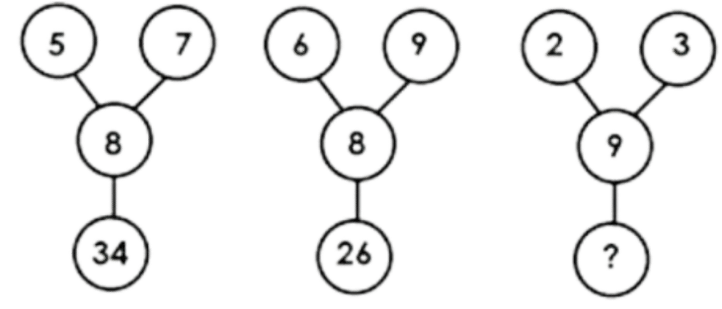
Q8Missing Number
Find the missing number.
Three Y-shaped figures: 5 and 7 joined to 8, then 34; 6 and 9 joined to 8, then 26; 2 and 3 joined to 9, then a question mark
A45
B48
C51
D60
Solution Answer: C

Multiply the two top numbers, add the middle number, then reverse the digits of the result:

  • 5 × 7 + 8 = 43 → reversed = 34 ✓
  • 6 × 9 + 8 = 62 → reversed = 26 ✓
  • 2 × 3 + 9 = 15 → reversed = 51
Q9Assumption
Read the passage and answer the question.
Passage“Many people believe that they can prevent acne by using clay masks to draw impurities from pores and applying toner, which they think will close pores and prevent dirt from getting into them. If this were true, then acne would be very easy to treat with topical measures. In fact, acne blemishes develop within the skin itself and are affected by internal factors such as hormones and sebum. As a result, using external measures like masks and toners is pointless,” says Dr Sinha, a well-known dermatologist in the city.
The dermatologist's conclusion requires the assumption that
ADirt on the skin does not cause acne.
BSome people like the sensation of toners on their skin.
CDoctors have successfully treated acne with oral antibiotics.
DClay masks can dry out the skin.
Solution Answer: A

The doctor concludes that external measures are pointless because acne is driven by internal factors. That only holds if surface dirt plays no causal role. If dirt did cause acne, keeping pores clean would help. So the argument depends on dirt not causing acne.

B is about personal preference, which is irrelevant to effectiveness. C would support internal treatment, but the conclusion doesn’t need it. D is a side effect that doesn’t bear on whether masks prevent acne.

Q10Coding
If AMERICA = 1734651 and INDIA = 68961, then how will you write CANADA?
A719181
B518191
C519581
D715148
Solution Answer: B

Each letter has a fixed digit:

  • From AMERICA: A = 1, M = 7, E = 3, R = 4, I = 6, C = 5.
  • From INDIA: I = 6, N = 8, D = 9, A = 1.

CANADA = C A N A D A = 5 1 8 1 9 1 = 518191.

Q11Blood Relations
U and B are daughters of G and M, respectively. L is the mother of G and M. S is the sister of U. L has only two daughters. How is M related to S?
ASister
BDaughter
CAunt
DCousin
Solution Answer: C
  • G and M are L’s children, and L has only two daughters, so G and M are those two sisters.
  • U is G’s daughter, and S is U’s sister, so S is also G’s daughter.
  • M is the sister of S’s mother, so M is S’s aunt.
Q12Ranking
In a class consisting of 10 girls and 20 boys, the rank of Nisha among the girls is 4th, and in the class, it is 18th. How many boys are behind Nisha in the class?
A6
B7
C13
D14
Solution Answer: A

The class has 30 students. Nisha is 18th, so 30 − 18 = 12 students are behind her.

Among the 10 girls she is 4th, so 10 − 4 = 6 girls are behind her.

Boys behind Nisha = 12 − 6 = 6.

Q13Clocks
How many times do the hands of a clock coincide in a day?
A48
B44
C24
D22
Solution Answer: D

The hands coincide once every 1211 hours. That is 11 times in 12 hours, not 12, because the coincidence between 11 and 1 o’clock happens only at 12. So they coincide 11 × 2 = 22 times in a day.

24 wrongly assumes once every hour. 44 is the number of times the hands are at right angles in a day.

Q14Replacement
Gopal had 73 litres of wine in a drum. He replaced 3.65 litres of it with water and continued doing so until the concentration of wine was less than 85%. The minimum number of operations that Gopal had to perform is
A3
B4
C2
D5
Solution Answer: B

3.65 is 5% of 73, so each operation leaves 95% of the wine. After n operations, the concentration is 0.95n.

  • 0.952 = 0.9025
  • 0.953 ≈ 0.8574, still above 85%.
  • 0.954 ≈ 0.8145, now below 85% ✓

Minimum operations = 4.

Q15Ages
The ratio of the present ages of A and B is 8:15. Eight years ago, the ratio of their ages was 6:13. What will be the ratio of ages of A and B after 8 years from now?
A9:14
B5:8
C5:9
D10:17
Solution Answer: D

Let the present ages be 8x and 15x. Eight years ago: 8x − 815x − 8 = 613.

Cross-multiplying: 104x − 104 = 90x − 48, so 14x = 56 and x = 4. Present ages are 32 and 60.

After 8 years: 40 : 68 = 10 : 17.

Q16Permutations
All the digits of 223355888 are rearranged to form 9-digit integers such that the odd digits occupy even positions. How many such numbers are formed?
A30
B60
C90
D120
Solution Answer: B

The odd digits are 3, 3, 5, 5 (four of them), and the even positions are 2, 4, 6 and 8 (also four). So the odd digits fill the even positions exactly, in 4!2! × 2! = 6 ways.

The even digits 2, 2, 8, 8, 8 fill the 5 odd positions in 5!2! × 3! = 10 ways.

Total = 6 × 10 = 60.

Q17LCM & Remainders
How many numbers less than 1000, when divided by 4, 5, 6, or 7, leave a remainder of 1 in each case?
ANone
B1
C2
D3
Solution Answer: C

LCM(4, 5, 6, 7) = 420, so the numbers have the form 420k + 1.

Below 1000, these are 421 (k = 1) and 841 (k = 2). The trivial case k = 0 gives 1, which is smaller than every divisor and so isn’t a genuine “division with remainder” case. The answer is 2.

Q18Progressions
The weights of 35 people are in an arithmetic progression. The average weight of them is 79. If the heaviest is 87 kg, then what is the weight of the lightest?
A68
B75
C70
D71
Solution Answer: D

In an AP, the average equals the mean of the first and last terms: lightest + 872 = 79.

Lightest = 158 − 87 = 71 kg.

Q19Trigonometry
tan x sin x + cos x =
Asec x
Bcosec x
Ccot x
Dsin2 x
Solution Answer: A

tan x sin x + cos x = sin2 xcos x + cos x = sin2 x + cos2 xcos x = 1cos x = sec x.

Q20Time & Work
A and B can together complete a task in 18 hours. After 6 hours, A leaves. B takes 36 hours to finish the rest of the task. How many hours would A have taken to do the task if he worked alone?
A30
B45
C21
D27
Solution Answer: D

In 6 hours together, they finish 618 = 13 of the task, which leaves 23.

B does 23 in 36 hours, so B alone needs 54 hours.

A’s rate = 118 − 154 = 254 = 127. A alone takes 27 hours.

Q21Integrity
A college admissions officer discovers that a donor's child, who has been admitted, had an application essay written by a paid consultant, in violation of the college's rules. The donor has given the college a large gift that is funding scholarships for low-income students. What is the most ethical course of action for the admissions officer?
AIgnore the violation because the donor's gift benefits many students who could not otherwise attend.
BReport the violation through the college's admissions integrity process, even though it may affect the donor relationship.
CAsk the student to rewrite the essay so that it genuinely reflects the student's own work, then leave the admission decision unchanged.
DRaise the concern only if another applicant or family member complains about the admission.
Solution Answer: B

Admissions must apply the same rules to every applicant. Reporting through the official integrity process is impartial, keeps a record, and leaves the decision to the proper body rather than to one officer.

A lets money buy an exemption from the rules. C has the officer quietly fix the problem alone, so the violation is never addressed. D makes integrity depend on whether someone complains.

Q22Workplace Ethics
A manager learns that a team member has been giving part of their monthly salary to a colleague in the same team who is struggling financially, on condition that the receiving colleague takes on extra administrative work for the giver. Both colleagues are comfortable with the arrangement. Which response is most appropriate?
AAsk the receiving colleague to repay all the money received so far, to restore fairness.
BPublicly praise the arrangement at the next team meeting as an example of solidarity, to encourage similar generosity.
CSpeak privately with both colleagues and explore suitable employee-support options.
DLeave the arrangement alone since both colleagues have freely agreed to it.
Solution Answer: C

Paying a colleague to do one’s assigned work is a private quid-pro-quo. It creates a power imbalance, takes advantage of financial hardship, and distorts how work is allocated. A private conversation respects both colleagues’ dignity. Formal support channels (an employee assistance programme, salary advance or hardship fund) address the real need properly.

A is punitive and humiliating. B publicly endorses an improper arrangement. D ignores the exploitation risk, because “consent” given under financial pressure is not truly free.

Q23Professional Ethics
A real estate agent is selling a house. The agent knows that the previous owner died peacefully in the home. State law says that agents do not have to disclose non-material facts such as natural deaths. The prospective buyers are deeply superstitious. What is the most appropriate course of action for the agent?
ADisclose the information to the buyers because transparency is ethically important in this situation.
BKeep the information confidential because professional standards and the law do not require the agent to disclose a natural death.
CAvoid answering any questions about the history of the house so that the buyers do not become unnecessarily concerned.
DRefuse to sell the house to the buyers because the agent’s personal values conflict with the professional requirements.
Solution Answer: A

The law sets a minimum, not the limit of ethical conduct. The agent knows these particular buyers would consider the fact important to their decision. Withholding it, even legally, would exploit an information gap and damage trust. Transparency lets the buyers make an informed choice.

B confuses legality with ethics. C is deliberate evasion. D is an overreaction, because no professional requirement conflicts with honest disclosure.

Q24Ethics & Psychology
You are walking down a crowded street and witness a teenager being harassed by a group of older individuals. There are dozens of people around, but everyone is either walking away or filming the incident on their phones. The ethical imperative for you to intervene is hindered by a psychological phenomenon known as:
ADiffusion of Responsibility
BThe Veil of Ignorance
CUtilitarianism
DCognitive Dissonance
Solution Answer: A

Diffusion of responsibility (the core of the bystander effect) means that the more people are present, the less responsible each one feels to act, since everyone assumes someone else will.

The veil of ignorance is Rawls’s thought experiment about fairness. Utilitarianism is an ethical theory, not a psychological barrier. Cognitive dissonance is the discomfort of holding conflicting beliefs or actions.

Q25Statement & Conclusion
Read the statements and decide which conclusions follow.
Statements
  1. Personal expenses incurred on company credit cards must be reimbursed by the employee within 30 days of the statement date.
  2. An employee used her corporate card for a personal meal and paid the balance back 45 days after the statement date.
Conclusions
  1. The employee will be fined for violating the company guideline.
  2. The employee intentionally misused company funds for personal gain.
AOnly I follows
BOnly II follows
CBoth I and II follow
DNeither follows
Solution Answer: D

I fails: she did break the 30-day rule, but the statements mention no penalty, let alone a fine. A breach does not tell us the consequence.

II fails: she repaid the full amount. Late repayment shows a delay, not an intent to misuse funds for personal gain.

Day 19 complete! 🔥
0 / 25

Correct 0 · Wrong 0 · Accuracy 0%

Keep the streak alive. See you tomorrow for Day 20.

Get Question PDF And Video Solution on: MBA KARO WhatsApp Community