Preparing for NMAT for the first time can feel confusing. Some students start solving mock tests immediately, while others spend months completing the syllabus before testing themselves. Both approaches can create problems without a clear strategy.
The reality is that NMAT is not a syllabus-completion exam. It is a performance-based MBA entrance test where preparation, practice, speed, and consistency work together.
If you are starting your NMAT 2026 preparation as a beginner, the goal should not be to study everything. The goal should be to study the right things at the right time and track your progress regularly.
This article covers the NMAT preparation strategy 2026 for beginners.
Why NMAT 2026 Requires a Different Preparation Strategy for Beginners
Many MBA aspirants begin their preparation assuming that all entrance exams require the same approach. However, NMAT rewards balanced performance across all sections and gives candidates the flexibility of multiple attempts.
This changes how beginners should prepare. You must focus on building a strong foundation and improving speed.
| NMAT Feature | What It Means for Beginners |
| 108 Questions | Consistent speed is important |
| 120 Minutes | Time management matters |
| 3 Sections | Balanced preparation is necessary |
| Multiple Attempts | Scope for score improvement |
| Moderate Difficulty | Accuracy can be a game-changer |
The smartest strategy for beginners is to focus on consistency rather than intensity. A student who studies regularly for four months often performs better than someone who studies aggressively for a few weeks.
NMAT Preparation Strategy 2026 for Beginners: A Step-by-Step Plan
Starting preparation becomes easier when you divide the journey into stages. They should focus on what should be achieved during each phase of preparation.
Build Concepts During the First Month: The first month should be used to understand the basics of Quantitative Skills, Language Skills, and Logical Reasoning.
This is the stage where you create your foundation. Avoid rushing into advanced-level questions. If the basics are weak, mock test scores will remain inconsistent later.
Create a Daily Study Routine: A realistic study routine is more effective than an ambitious timetable that lasts only a week. Choose study hours that fit your schedule and maintain them consistently.
| Aspirant Type | Recommended Study Hours |
| Working Professional | 2-3 Hours Daily |
| College Student | 3-4 Hours Daily |
| Full-Time Aspirant | 5-6 Hours Daily |
Focus on Accuracy Before Speed: Many beginners try to increase attempts immediately. This often leads to careless mistakes and unstable scores. Before trying to solve more questions, focus on understanding concepts. You must focus on improving accuracy. Speed naturally improves with practice.
Develop a Reading Habit: Language Skills is a scoring section if you prepare well. Reading newspapers, business articles, and editorials regularly improves your comprehension and vocabulary. Even 20-30 minutes of reading every day can help you improve over several months.
Practice Questions Every Day: Concepts become useful only when they are applied. Daily practice helps identify weak areas and improves familiarity with question patterns. A good beginner target is solving 30-50 quality questions daily across different sections.
Section-Wise NMAT Preparation Strategy for Beginners
Each NMAT section requires a slightly different approach. Understanding these differences can help you use your preparation time more effectively.
Here is the section-wise NMAT preparation strategy for beginners;
NMAT Language Skills Preparation Strategy
Language skills are often underestimated by beginners. However, it is the highest-scoring sections when preparation starts early.
Focus on reading comprehension, vocabulary improvement, grammar basics, and language usage. Consistent reading practice is usually more beneficial than memorising long word lists.
Here is the list of important topics for this section:
- Reading Comprehension
- Error Identification
- Para Forming
- Sentence Completion
- Prepositions
- Analogies, etc
NMAT Logical Reasoning Preparation Strategy
Logical Reasoning rewards practice and pattern recognition. Many questions become easier once you understand how different reasoning sets are structured.
Spend time solving puzzles, arrangements, critical reasoning questions, and analytical reasoning exercises. Regular exposure helps improve speed. Here is the list of important topics for this section:
| Topic | Syllabus |
| Critical Reasoning | Conclusion-based questions, Assumption-based questions, Inference-based questions, Strengthening/Weakening, |
| Deductions | Statement-Conclusion, Statement-Course of Action, Statement-Assumption, Statement-Argument, Fact analysis, |
| Analytical Puzzles | Analytical Puzzles, Input-Output |
| Other Reasoning | Missing value in figures, Decision Making, Syllogism, Set Theory, Venn Diagrams, Ranking Test |
NMAT Quantitative Skills Preparation Strategy
Quantitative Skills often require the most preparation time. Beginners should start with arithmetic topics before moving towards algebra, geometry, modern maths, and data interpretation.
The goal should be concept clarity first and calculation speed later.
Here is the list of important topics for this section:
| Topic | Syllabus |
| Number Properties | Basics of Numbers, Fractions, Decimals, Divisibility of Numbers and finding Unit Digit, Factors Multiples, Least Common Multiples (LCM) and Highest Common Factors (HCF), Logarithm |
| Number Properties | Percentages, Profit & Loss, Discount, Simple and Compound Interest, Time and Work, Ratio & Proportion, Averages, Partnership |
| Algebra and Probability | Equations and Inequalities, Permutations and Combinations, Probability, Sequences and Series |
| DI-Caselets and Tables | – |
| DI-Graphs and Charts | – |
| Data Sufficiency | Number Properties, Arithmetic, Algebra Probability |
When Should Beginners Start Taking NMAT Mock Tests?
Many aspirants wait until syllabus completion before attempting their first mock test. This can delay improvement because weaknesses remain hidden.
A better approach is to start taking mock tests once you have basic familiarity with all three sections. Early mocks help you understand where you stand and what requires additional attention.
| Preparation Stage | Mock Test Frequency |
| First 2 Months | One Mock Every Two Weeks |
| Next 2 Months | One Mock Every Week |
| Final Month | Two to Three Mocks Weekly |
Common NMAT Preparation Mistakes Beginners Must Avoid
Preparation becomes more effective when you know what not to do. Many beginners lose valuable time because of avoidable mistakes.
Here are the common NMAT preparation mistakes beginners must avoid:
- Collecting too many books and study resources.
- Ignoring mock tests until the final month.
- Spending excessive time on favourite topics.
- Not revising completed concepts.
- Comparing scores with others too early.
- Changing preparation strategies every few weeks.
How MBA KARO NMAT Online Coaching Helps Beginners Prepare Smarter
Many first-time aspirants struggle not because of a lack of effort but because they do not know what to study next. A structured plan can make the process much easier.
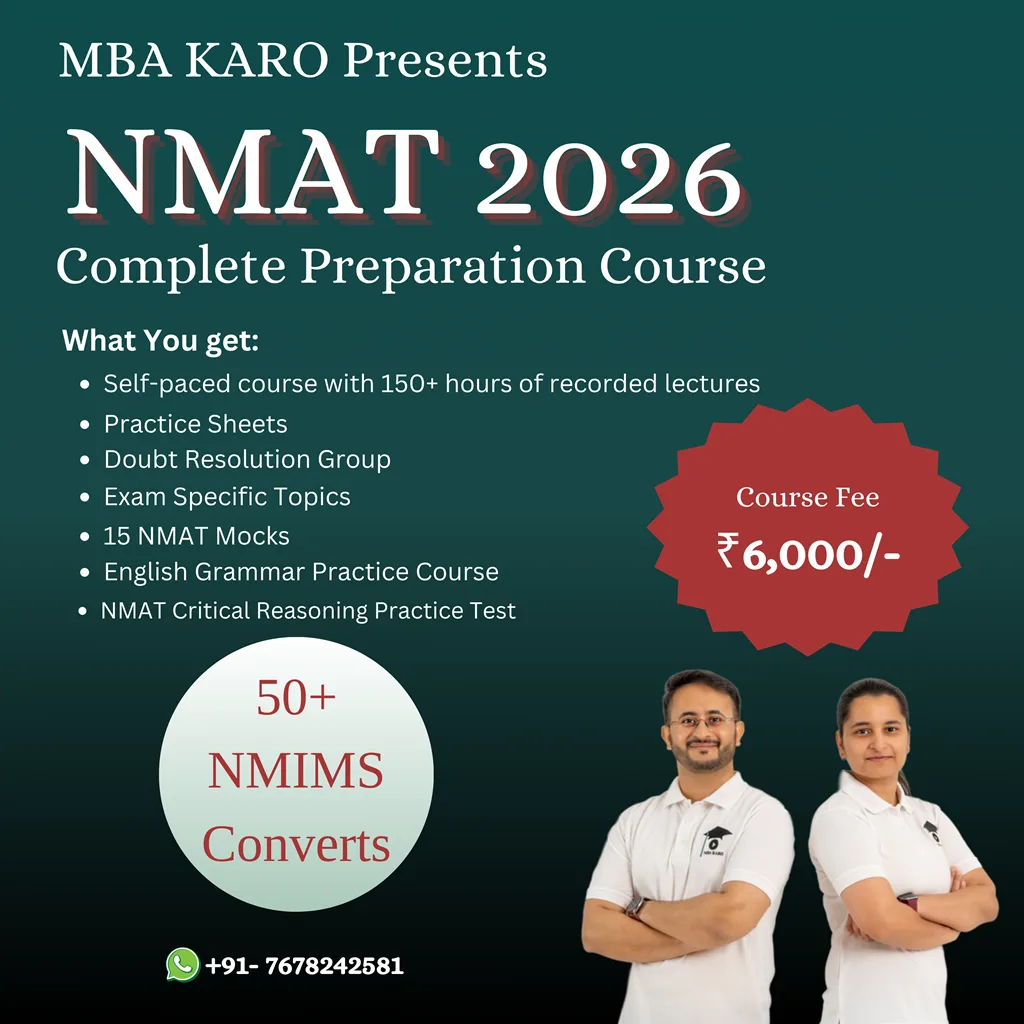
MBA KARO NMAT Online Coaching provides a complete learning ecosystem for NMAT aspirants. The course includes 200+ lessons, 5 tests, and 6 trial lessons, helping students build concepts and practice systematically.
One of the biggest advantages for beginners is the FREE TRIAL. It allows aspirants to explore the platform before enrolling.
This helps students understand the teaching style, course structure, and learning resources. For students looking for guided preparation, section-wise learning, and regular practice support, MBA KARO can help create a more organised preparation journey.
How to Measure Your Progress During NMAT Preparation
Preparation becomes meaningful when progress is measurable. You should track indicators that directly impact performance.
| Progress Indicator | What to Track |
| Mock Scores | Monthly Improvement |
| Accuracy Rate | Consistent Growth |
| Weak Topics | Reduction Over Time |
| Revision Cycles | At Least Two Revisions |
| Practice Questions | Increasing Volume |
Conclusion
The best NMAT Preparation Strategy 2026 for Beginners is built on strong basics, consistent practice and continuous improvement.
You must focus on building concepts, maintaining a realistic study schedule, and tracking your progress. This is where MBA KARO NMAT Online Coaching helps you.
It offers 200+ lessons, 5 tests, 6 trial lessons, and a FREE TRIAL to help beginners prepare with greater clarity and confidence.