
NMAT 2026 Quiz 10: Practice Questions with Solutions

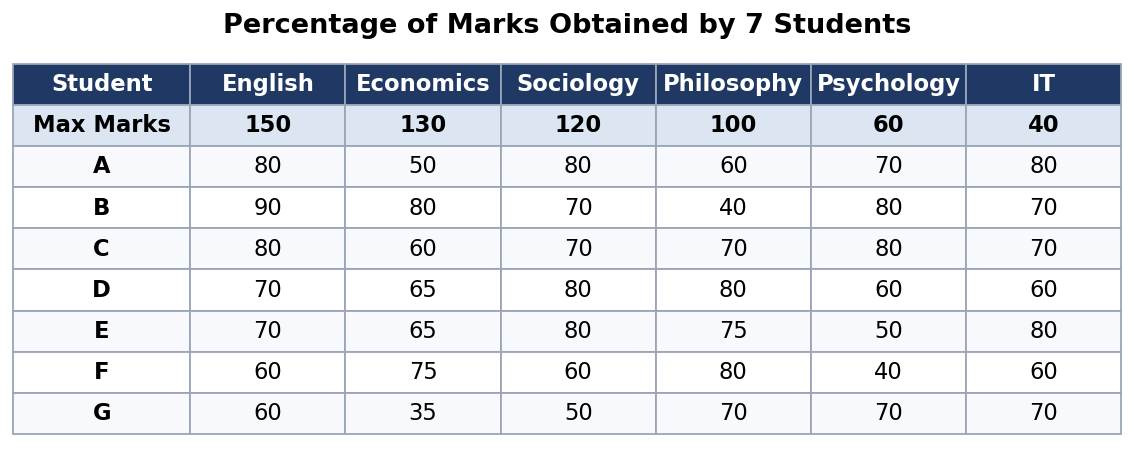
The following table shows the percentage of marks obtained by 7 students in different subjects. Study the table data and answer the questions.
nmat-day10-marks-table

Q1. What are the aggregate marks obtained by C? Correct Option A … Explanation: Marks of C = 80% of 150 + 60% of 130 + 70% of 120 + 70% of 100 + 80% of 60 + 70% of 40 = 120 + 78 + 84 + 70 + 48 + 28 = 428. Hence, option A. Q2. How many students got at least 70% marks in at least 4 subjects? Correct Option C … Explanation: Counting subjects with 70% or more: A = 4, B = 5, C = 5, D = 3, E = 4, F = 2, G = 3. Students with at least 4 such subjects are A, B, C and E, i.e. 4 students. Hence, option C. Q3. The average marks scored by all students put together in economics is closest to: Correct Option E … Explanation: Economics marks (out of 130): A = 65, B = 104, C = 78, D = 84.5, E = 84.5, F = 97.5, G = 45.5. Total = 559, so average = 559/7 ≈ 79.86, which is closest to 80. Hence, option E. Q4. What is the difference between the total marks obtained by A and F? Correct Option D … Explanation: Total of A = 120 + 65 + 96 + 60 + 42 + 32 = 415. Total of F = 90 + 97.5 + 72 + 80 + 24 + 24 = 387.5. Difference = 415 − 387.5 = 27.5. Hence, option D.

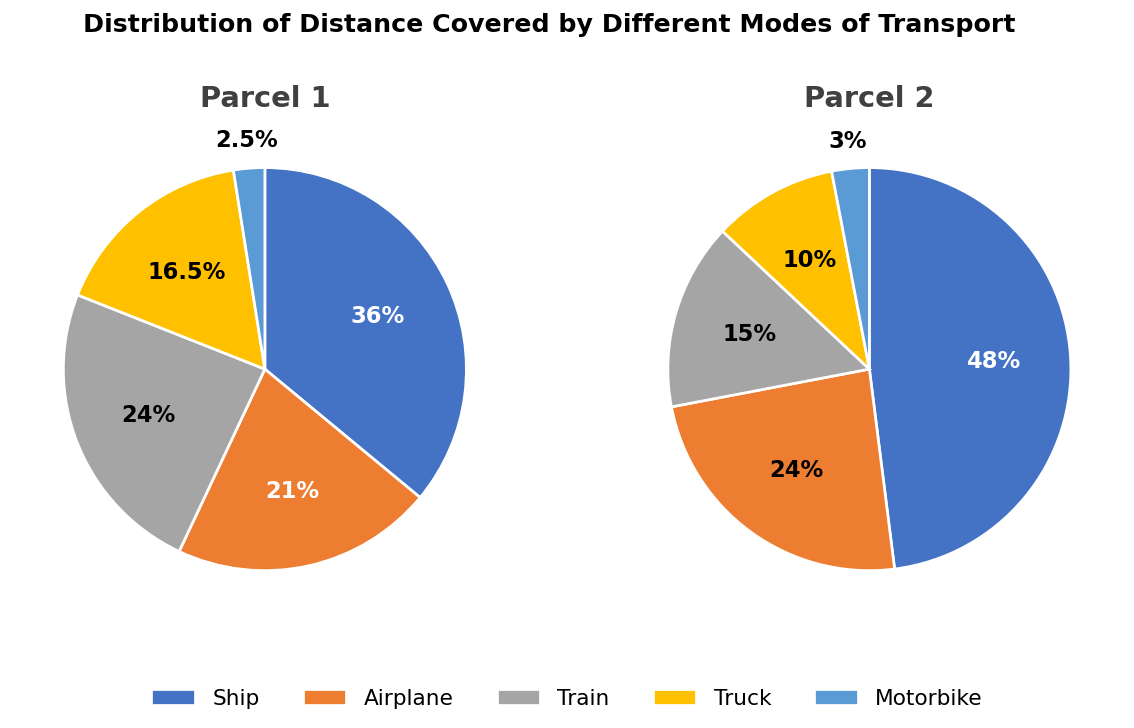
Two parcels were shipped from a port to the same city in the same ship. After that they were taken to different destinations via other means of transport. The pie charts below give the distribution of the distance covered by different modes of transport for the two parcels:
nmat-day10-parcel-distance-pie-charts

Given that the total distance covered on motorbike for the two parcels was 570 km.

Q5. What is the total distance travelled (in km) by train for the two parcels? Correct Option B … Explanation: Both parcels travelled the same ship distance, so 36% of X = 48% of Y, giving X = 4Y/3 (X and Y are the total distances of parcels 1 and 2). Motorbike: 2.5% of X + 3% of Y = 570 → Y/30 + 3Y/100 = 570 → Y = 9000 km and X = 12000 km. Train distance = 24% of 12000 + 15% of 9000 = 2880 + 1350 = 4230 km. Hence, option B. Q6. For both the parcels, the airplanes took 1/40 of the time taken by the ship. What is the ratio of the speeds of airplanes in which parcels 1 and 2 were carried, respectively? Correct Option A … Explanation: Both parcels were on the same ship for the same distance, so their ship times are equal, and hence their airplane times (1/40 of ship time) are also equal. With equal times, speed ratio = distance ratio = 21% of 12000 : 24% of 9000 = 2520 : 2160 = 7 : 6. Hence, option A. Q7. For parcel 2, the speeds of ship, airplane, train, truck and motorbike were 36 km/h, 720 km/h, 60 km/h, 72 km/h and 54 km/h, respectively. What was the total time (in hours) for which parcel 2 was in transit? Correct Option D … Explanation: Parcel 2 distances (total 9000 km): ship 4320, airplane 2160, train 1350, truck 900, motorbike 270. Times = 4320/36 + 2160/720 + 1350/60 + 900/72 + 270/54 = 120 + 3 + 22.5 + 12.5 + 5 = 163 hours. Hence, option D. Q8. If the average speed of the train carrying parcel 1 is reduced by 20 km/h, its delivery time would increase by 12 hours. What is the expected time for the train journey for parcel 1? Correct Option C … Explanation: Train distance for parcel 1 = 24% of 12000 = 2880 km. If speed is v, then 2880/(v − 20) − 2880/v = 12 → v(v − 20) = 4800 → v = 80 km/h. Expected time = 2880/80 = 36 hours. Hence, option C.

Mr Rana has several properties for rent. There are 5 types of rooms: R1, R2, R3, R4 and R5. The graph below shows the dimensions (in feet) of the 5 rooms.

The following information is known:

– The rent of R1 is Rs 7200, and that of R2 is Rs 14400.

– The rates of rent of R1 and R5 is the same.

– The rate of rent of R3 is 12.5% less than the rate of rent of R2.

– The rate of rent of R4 is 10% less than the rate of rent of R1.

Rent = Area x Rate of rent

All rents are on a monthly basis.
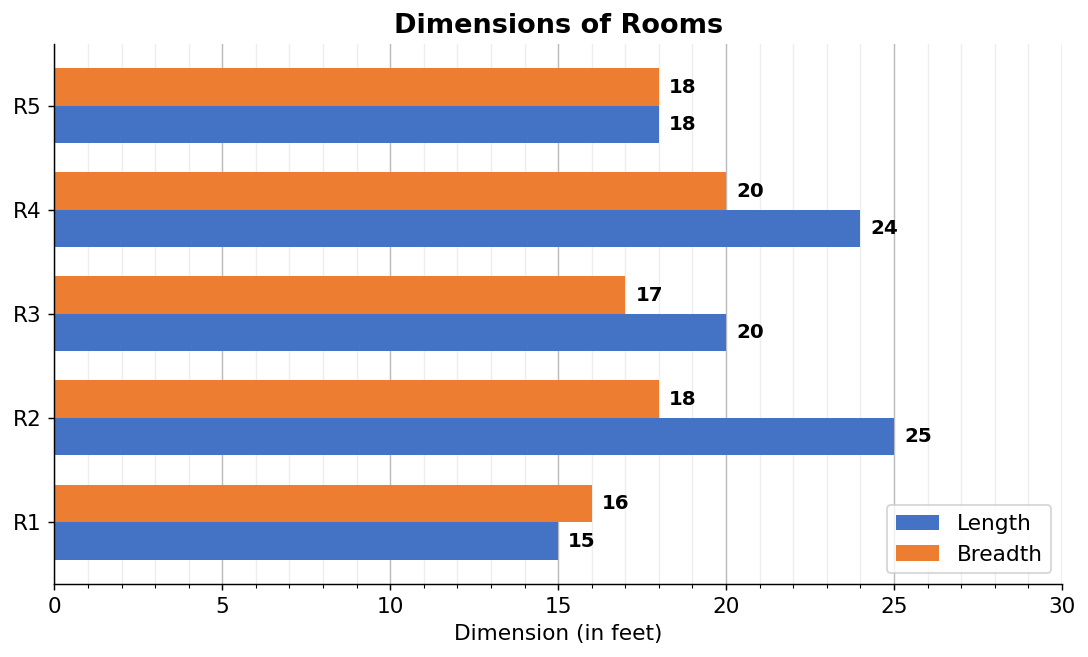
Q9. What is the difference between the rents of R3 and R4? Correct Option E … Explanation: Areas: R1 = 240, R2 = 450, R3 = 340, R4 = 480, R5 = 324 sq ft. Rates: R1 = 7200/240 = Rs 30, R2 = 14400/450 = Rs 32, R3 = 87.5% of 32 = Rs 28, R4 = 90% of 30 = Rs 27. Rent of R3 = 340 × 28 = Rs 9520 and rent of R4 = 480 × 27 = Rs 12960. Difference = Rs 3440. Hence, option E. Q10. If the rate of rents of all the rooms were Rs 30/sq ft, what would have been the increase in rent received if 1 room of each type is rented? Correct Option A … Explanation: Current rents: R1 = 7200, R2 = 14400, R3 = 9520, R4 = 12960, R5 = 324 × 30 = 9720; total = Rs 53800. At Rs 30/sq ft, total area 1834 sq ft gives Rs 55020. Increase = 55020 − 53800 = Rs 1220. Hence, option A. Q11. If the rents of R1, R2 and R3 are increased by 15%, 10% and 25% respectively, what is the total rent collected from 1 room each of R1, R2 and R3? Correct Option C … Explanation: New rents: R1 = 1.15 × 7200 = 8280, R2 = 1.10 × 14400 = 15840, R3 = 1.25 × 9520 = 11900. Total = 8280 + 15840 + 11900 = Rs 36020. Hence, option C. Q12. What is the monthly rent if 2 rooms of R2 type, 3 rooms of R3 type and 5 rooms of R5 type are rented? Correct Option B … Explanation: Rent of R5 = 324 × 30 = Rs 9720. Total = 2 × 14400 + 3 × 9520 + 5 × 9720 = 28800 + 28560 + 48600 = Rs 105960. Hence, option B.

Five sports − hockey, cricket, tennis, badminton and baseball are included in a sports competition. Each person plays exactly one sport. The total number of players in this sports competition is 800. The ratio of men and women players is 3 : 1.

25% of the total players play cricket. 110 players play badminton, and 10% of players play tennis. The number of hockey players are two times that of badminton players. 30% of cricket players are women. Half of the women cricketers are equal to the number of women badminton players. 10% of hockey players equal the number of women tennis players. Hockey and baseball have equal numbers of women players.

Q13. What is the total number of men players in Hockey, Cricket and Baseball? Correct Option C … Explanation: Totals: Men = 600, Women = 200. Cricket = 25% of 800 = 200, Badminton = 110, Tennis = 10% of 800 = 80, Hockey = 2 × 110 = 220, Baseball = 800 − 610 = 190. Women: Cricket = 30% of 200 = 60, Badminton = 60/2 = 30, Tennis = 10% of 220 = 22, and Hockey = Baseball = (200 − 60 − 30 − 22)/2 = 44 each. Men: Hockey 176, Cricket 140, Tennis 58, Badminton 80, Baseball 146. Required total = 176 + 140 + 146 = 462. Hence, option C. Q14. The number of women Baseball players is what percent of the number of male Hockey players? Correct Option A … Explanation: Totals: Men = 600, Women = 200. Cricket = 25% of 800 = 200, Badminton = 110, Tennis = 10% of 800 = 80, Hockey = 2 × 110 = 220, Baseball = 800 − 610 = 190. Women: Cricket = 30% of 200 = 60, Badminton = 60/2 = 30, Tennis = 10% of 220 = 22, and Hockey = Baseball = (200 − 60 − 30 − 22)/2 = 44 each. Men: Hockey 176, Cricket 140, Tennis 58, Badminton 80, Baseball 146. Required percentage = 44/176 × 100 = 25%. Hence, option A. Q15. What is the difference between the number of male baseball players and male badminton players? Correct Option C … Explanation: Totals: Men = 600, Women = 200. Cricket = 25% of 800 = 200, Badminton = 110, Tennis = 10% of 800 = 80, Hockey = 2 × 110 = 220, Baseball = 800 − 610 = 190. Women: Cricket = 30% of 200 = 60, Badminton = 60/2 = 30, Tennis = 10% of 220 = 22, and Hockey = Baseball = (200 − 60 − 30 − 22)/2 = 44 each. Men: Hockey 176, Cricket 140, Tennis 58, Badminton 80, Baseball 146. Required difference = 146 − 80 = 66. Hence, option C. Q16. In which sports, the women are the maximum and the men are the minimum, respectively? Correct Option D … Explanation: Totals: Men = 600, Women = 200. Cricket = 25% of 800 = 200, Badminton = 110, Tennis = 10% of 800 = 80, Hockey = 2 × 110 = 220, Baseball = 800 − 610 = 190. Women: Cricket = 30% of 200 = 60, Badminton = 60/2 = 30, Tennis = 10% of 220 = 22, and Hockey = Baseball = (200 − 60 − 30 − 22)/2 = 44 each. Men: Hockey 176, Cricket 140, Tennis 58, Badminton 80, Baseball 146. Women are maximum in Cricket (60) and men are minimum in Tennis (58). Hence, option D.

The charts below give the total number of children in 6 different schools and the percentage of girls in them.
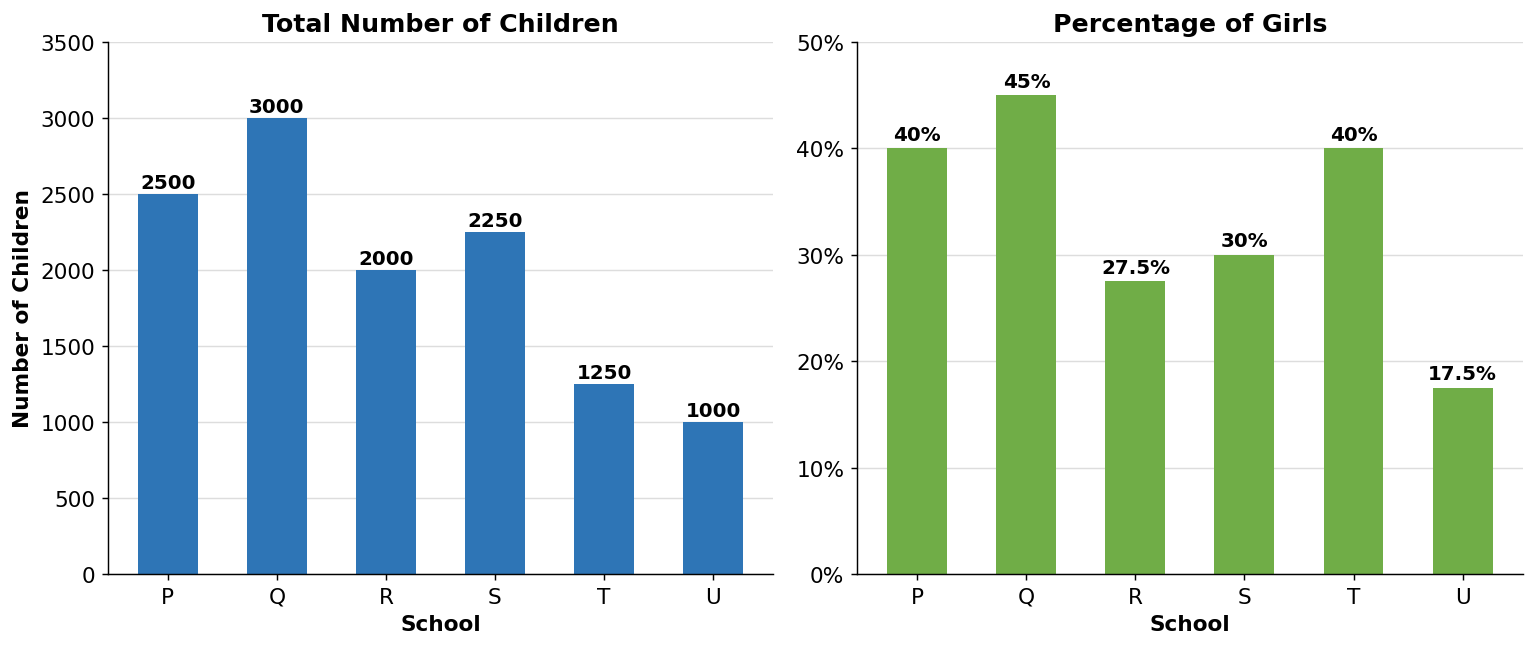

Q17. What is the percentage of boys in schools R and U together? Correct Option D … Explanation: Students in R and U = 2000 + 1000 = 3000. Girls = 27.5% of 2000 + 17.5% of 1000 = 550 + 175 = 725, so boys = 2275. Percentage of boys = 2275/3000 × 100 ≈ 75.83%. Hence, option D. Q18. What is the ratio of boys to girls across all six schools? Correct Option C … Explanation: Girls: P = 1000, Q = 1350, R = 550, S = 675, T = 500, U = 175 (total 4250). Boys: P = 1500, Q = 1650, R = 1450, S = 1575, T = 750, U = 825 (total 7750). Ratio = 7750 : 4250 = 31 : 17. Hence, option C. Q19. The total number of boys in schools P, Q and R is what percent of the number of girls in the same schools? Correct Option A … Explanation: Boys in P, Q, R = 1500 + 1650 + 1450 = 4600. Girls in P, Q, R = 1000 + 1350 + 550 = 2900. Required percentage = 4600/2900 × 100 ≈ 158.62%. Hence, option A. Q20. Which of the following statements is incorrect? Correct Option E … Explanation: Girls: P = 1000, Q = 1350, R = 550, S = 675, T = 500, U = 175 (total 4250). Boys: P = 1500, Q = 1650, R = 1450, S = 1575, T = 750, U = 825 (total 7750). Option A is correct as 1350 girls in Q exceed the students in T (1250) and U (1000). Option B is correct as 750 : 1000 = 3 : 4. Option C is correct as 1650 = 3 × 550. Option D is correct as (675 + 175)/4250 = 20%. Option E is incorrect because boys in R (1450) are not twice the boys in T (2 × 750 = 1500). Hence, option E.