
With 2 months left for NMAT 2026, your preparation needs to focus on speed, accuracy, topic selection and familiarity with the NMAT interface.
NMAT is different from exams such as CAT because you can choose the order of sections, there is no negative marking, and you cannot go back to a previous question.
For a 240+ score, you need balanced preparation across Language Skills, Logical Reasoning and Quantitative Skills. Critical Reasoning is particularly important in Logical Reasoning, while Modern Maths and Number System need special attention in Quant.
In Language Skills, you need to balance RCs with quick-scoring areas such as grammar, vocabulary and fill-in-the-blanks.
The two-month NMAT 2026 study plan should therefore cover concepts first, followed by intensive practice, mock tests and time-management work.
Join MBA KARO Whatsapp Community For Daily Updates
NMAT 2026 Exam Pattern to Keep in Mind
Before starting your NMAT two-month preparation, understand the time pressure in each section. Check the NMAT exam pattern below:
| Section | Questions | Time | Key Preparation Focus |
| Language Skills | 36 | 28 minutes | Grammar, vocabulary, RCs, fill in the blanks |
| Logical Reasoning | 36 | 40 minutes | Critical Reasoning, quick reading |
| Quantitative Skills | 36 | 52 minutes | Modern Maths, Number System, Arithmetic, calculations |
| Total | 108 | 120 minutes | Balanced sectional performance |
NMAT has sectional timings and cut-offs, so performing very well in two sections while scoring low in the third can affect your chances of meeting the required cut-off.

What Makes NMAT Different from Other MBA Entrance Exams?
Your NMAT preparation strategy should account for the specific NMAT features.
You Can Choose the Section Order
NMAT allows you to choose which section to attempt first. For example, if Quant is your strongest section, you can start with Quant to get a confidence boost and then move to the other sections.
Use this flexibility strategically. Your mock-test practice should help you identify the section order in which you perform best.
There Is No Negative Marking
NMAT does not have negative marking. Therefore, you should aim to attempt the maximum possible number of questions.
However, this does not mean ignoring accuracy. Your preparation should focus on getting a high number of questions correct while managing the available time.
You Cannot Go Back to a Question
Once you move forward, you cannot return to a previous question. You have to answer the current question before moving to the next one.
This makes time management extremely important. Spending too much time on one difficult question can reduce the number of questions you are able to attempt.
Sectional Timing and Cut-offs Matter
You need to maintain a balanced score across the three sections. A strong performance in two sections cannot completely compensate for a weak sectional score.
Therefore, your two-month preparation should not focus only on your strongest section.
NMAT 2026 2-Month Study Plan
The NMAT preparation can be divided into two stages:
- Month 1: Build concepts and strengthen important NMAT topics.
- Month 2: Increase question practice, improve speed and use mocks to build exam familiarity.
Month 1: Build Your NMAT Preparation Base
The first month should be used to cover the important areas and understand the question types that appear in NMAT.
Language Skills
Give special attention to grammar, vocabulary and RCs. Grammar is a quick-scoring area because the rules are limited compared with vocabulary. Regular practice can make areas such as error spotting easier. Focus on the following aspects:
- Error spotting
- Fill in the blanks
- Prepositions
- Grammar rules
- Vocabulary
- Analogy-based questions
- Reading Comprehension
Do not depend completely on vocabulary. Vocabulary can be unpredictable even if you have prepared a large number of words. RCs require a different skill. You do not need prior knowledge to answer them; you need to understand the passage and answer the questions correctly.
Logical Reasoning
Critical Reasoning should be one of your biggest priorities in LR. Around half of the LR section can be dominated by Critical Reasoning, so this area needs regular practice.
Prepare questions based on the following topics:
- Course of action
- Assumption
- Argument
- Fact
- Statement
- Inference
- Conclusion
You can expect around 15–20 Critical Reasoning questions, making this an important scoring area.
Along with solving questions, work on your reading speed because many Critical Reasoning questions require you to read and understand passages quickly.
Quantitative Skills
Do not prepare Quant only around Arithmetic. The important difference highlighted for NMAT is the weight given to Modern Maths and Number System. Focus on the following aspects:
- Modern Maths
- Number System
- Probability
- Permutation and Combination
- Remainders
- Last digit
- HCF
- LCM
- Arithmetic
You can expect around 5–6 questions from Modern Maths and around 3–4 questions from Number System.
Probability and Permutation and Combination can also contribute questions. Arithmetic should not be ignored, but do not rely on it alone. Arithmetic questions in NMAT can be lengthy, challenging and calculation-heavy.
Month 2: Speed, Practice and Mock Tests
The second month should shift your focus from learning topics to performing within NMAT’s time limits.
Practice Language Skills Under Time Pressure
Language Skills has 36 questions in 28 minutes. You therefore need to balance longer RC questions with shorter questions. For example, an RC can take around 7–8 minutes when you include reading the passage and answering its questions.
Short questions such as vocabulary, grammar and fill-in-the-blanks can allow you to answer multiple questions in less time.
Since the questions appear in a mix, you need to develop the ability to move through the section without getting stuck. Your practice should include the following aspects:
- Timed RC practice
- Grammar questions
- Vocabulary questions
- Fill-in-the-blanks
- Error spotting
- Prepositions
- Analogy-based questions
The objective is to make grammar and other short questions your quick-scoring areas while continuing to improve RC speed.
Increase Critical Reasoning Practice
Use the second month to make Critical Reasoning more comfortable. Try to reach a stage where you can maintain around 80–90% accuracy in Critical Reasoning questions.
Fast reading will also help because CR questions can contain passages. Continue practising:
- Course of action
- Assumption
- Argument
- Fact
- Statement
- Inference
- Conclusion
Improve Quant Calculation Speed
Calculation speed is important because NMAT does not provide a calculator. This is especially relevant for:
- DI
- Arithmetic
- Calculation-intensive Quant questions
Work on calculation hacks and practise solving questions without depending on a calculator. At the same time, continue revising Modern Maths and Number System. Do not leave these topics simply because they may receive less attention in exams such as CAT.
Section-Wise NMAT 2026 Strategy for 240+
Here is the section-wise NMAT 2026 strategy for 240+ marks for reference;
Language Skills Strategy
The main challenge in Language Skills is completing 36 questions within 28 minutes. Your preparation should create a balance between RCs and short questions.
What to Prioritise
- Grammar: High priority because it is limited and quick scoring.
- RC: Regular practice is required because RC takes more time but does not require prior knowledge.
- Vocabulary: Prepare it, but do not depend completely on it because the words appearing in the exam can be unpredictable.
Fill in the blanks, error spotting and prepositions: Practise these regularly because they can help you collect quick points.
Two-Month Target
- Build grammar rules in Month 1.
- Practise short verbal questions regularly.
- Start timed RC practice.
- Increase RC speed in Month 2.
- Use mocks to understand how you balance RCs and short questions.
Logical Reasoning Strategy
Critical Reasoning should be at the centre of your LR preparation. CR is a major part of the section, with around 15–20 questions possible from this area.
The goal should be to become comfortable with the question types rather than spending too much time on individual questions.
Focus on Critical Reasoning
- Practise the following topics:
- Course of action
- Assumption
- Argument
- Fact
- Statement
- Inference
- Conclusion
Build Reading Speed
Fast reading is important for LR because CR questions can involve passages. Start practising on a laptop or desktop rather than relying only on mobile reading.
The exam is taken on a desktop, and practising on a larger screen helps you build the required reading habit and muscle memory.
Quantitative Skills Strategy
Quant requires a different approach from CAT preparation. The most important point is: do not ignore Modern Maths and Number System.
Modern Maths
Around 5-6 questions can come from Modern Maths, with around 2–3 questions of Probability and 2-3 questions of Permutation and Combination potentially appearing.
Give particular attention to the following aspects:
- Probability
- Permutation and Combination
- Other Modern Maths areas
Number System
Around 3-4 Number System questions can be seen. Prepare the following topics:
- Remainders
- Last digit
- HCF
- LCM
Arithmetic
Arithmetic can include lengthy and calculation-heavy questions. Since there is no calculator, calculation speed becomes important. Therefore, do not build your entire Quant strategy around Arithmetic. Prepare Modern Maths and Number System alongside it so that you have more areas from which you can attempt questions confidently.
NMAT 2026 Daily Preparation Priorities
With two months remaining, your regular NMAT preparation should cover all three sections.
The key is to avoid preparing one section while completely ignoring another because NMAT has sectional timings and cut-offs.
| Area | What to Practise |
| Language Skills | Grammar, RCs, vocabulary, fill in the blanks, error spotting, prepositions |
| Logical Reasoning | Critical Reasoning, quick reading, assumption, argument, inference, conclusion |
| Quantitative Skills | Modern Maths, Number System, Arithmetic, DI and calculation hacks |
| Speed | Timed section practice |
| Accuracy | Topic-wise question practice |
| Exam Familiarity | Official mock and NMAT-style mocks |
Why Reading Speed Matters for NMAT 2026
Reading speed should be developed during both months of preparation. It is useful for:
- RCs in Language Skills
- Critical Reasoning in Logical Reasoning
- Passage-based questions
If you have mainly been reading on your mobile, shift some of your practice to a laptop or desktop. The objective is to develop the muscle memory required to read quickly on the screen you will use for the examination.
NMAT Mock Test Strategy
Mock tests are essential because NMAT has an interface and structure that are different from many other exams. The most important mock to attempt is the official NMAT mock. It helps you understand the following topics:
- The actual interface
- Section selection
- Sectional timings
- The one-direction movement between questions
- Your approximate score
- Topics that need more preparation
You can also use the official mock’s reattempt option. There is one attempt plus a reattempt, allowing two attempts. Some questions may also overlap in the reattempt.
Why the NMAT Interface Needs Practice
In many exams, you can move backwards to a previous question. In NMAT, you cannot. You also have to answer the current question before moving ahead.
Therefore, mock tests should not be treated only as score-checking tools. They should be used to practise decision-making under NMAT’s actual interface.
NMAT Mock Tests: What to Look For
If you use additional mock tests, focus on mocks that provide:
- A similar interface
- Similar difficulty level
- NMAT-style question patterns
- Solutions
- Practice for section selection
The exact NMAT marking algorithm is not known to coaching institutes. Therefore, institute mocks may have a similar interface, pattern and difficulty but cannot claim to use the actual NMAT marking algorithm. The official mock remains important for understanding your approximate standing.
Free NMAT 2026 Quiz Practice
MBA Karo is also providing free NMAT quizzes from the beginning of September. The quizzes will be available around three to four times a week on the MBA Karo website.
You can use them for additional question practice. Questions and PDFs are also being provided through the MBA Karo WhatsApp community. The quiz can be attempted on the website, while the PDF can be used for later practice.
NMAT 2026 2-Month Roadmap at a Glance
| Timeline | Language Skills | Logical Reasoning | Quantitative Skills | Mock/Practice Focus |
| Month 1 | Grammar, vocabulary, RCs, short verbal questions | Critical Reasoning and reading speed | Modern Maths, Number System, Arithmetic | Topic-wise practice |
| Month 2 | Timed RCs and quick-scoring questions | CR accuracy and speed | Calculation hacks, Modern Maths, Number System, Arithmetic | Official mock + NMAT-style mocks |
| Final Phase | Balance speed and accuracy | Maintain CR accuracy | Improve calculation speed | Analyse weak areas and practise the NMAT interface |
NMAT 2026 Preparation: Mistakes to Avoid
Here are common mistakes to avoid during the NMAT 2026 preparation:
- Do Not Ignore Modern Maths and Number System: These areas can contribute several questions. Do not prepare Quant only through Arithmetic.
- Do Not Depend Only on Arithmetic: NMAT Arithmetic can be lengthy and calculation-heavy. Build strength in other Quant areas as well.
- Do Not Skip Critical Reasoning: With a large share of LR questions coming from CR, leaving this area can directly affect your LR score.
- Do Not Practise Only on Mobile: Build reading speed and screen familiarity on a laptop or desktop.
- Do Not Skip the Official Mock: The interface, section selection and one-way movement make NMAT different. The official mock gives you a better understanding of the actual exam experience.
- Do Not Get Stuck on One Question: Since you cannot return to a previous question, spending too much time on one question can reduce your overall attempts.
- Do Not Focus Only on Overall Score: Sectional timings and cut-offs mean you need a balanced performance across sections.
Conclusion
With 2 months left for NMAT 2026, your preparation should focus on the areas that are particularly important for NMAT: Critical Reasoning, reading speed, Modern Maths, Number System, grammar, RCs and calculation speed.
Do not ignore Modern Maths and Number System because of their relatively lower importance in CAT. Similarly, do not rely only on Arithmetic in Quant. In Language Skills, balance RCs with quick-scoring grammar and verbal questions.
Most importantly, attempt the official NMAT mock and practise the NMAT interface because you cannot move backwards between questions.
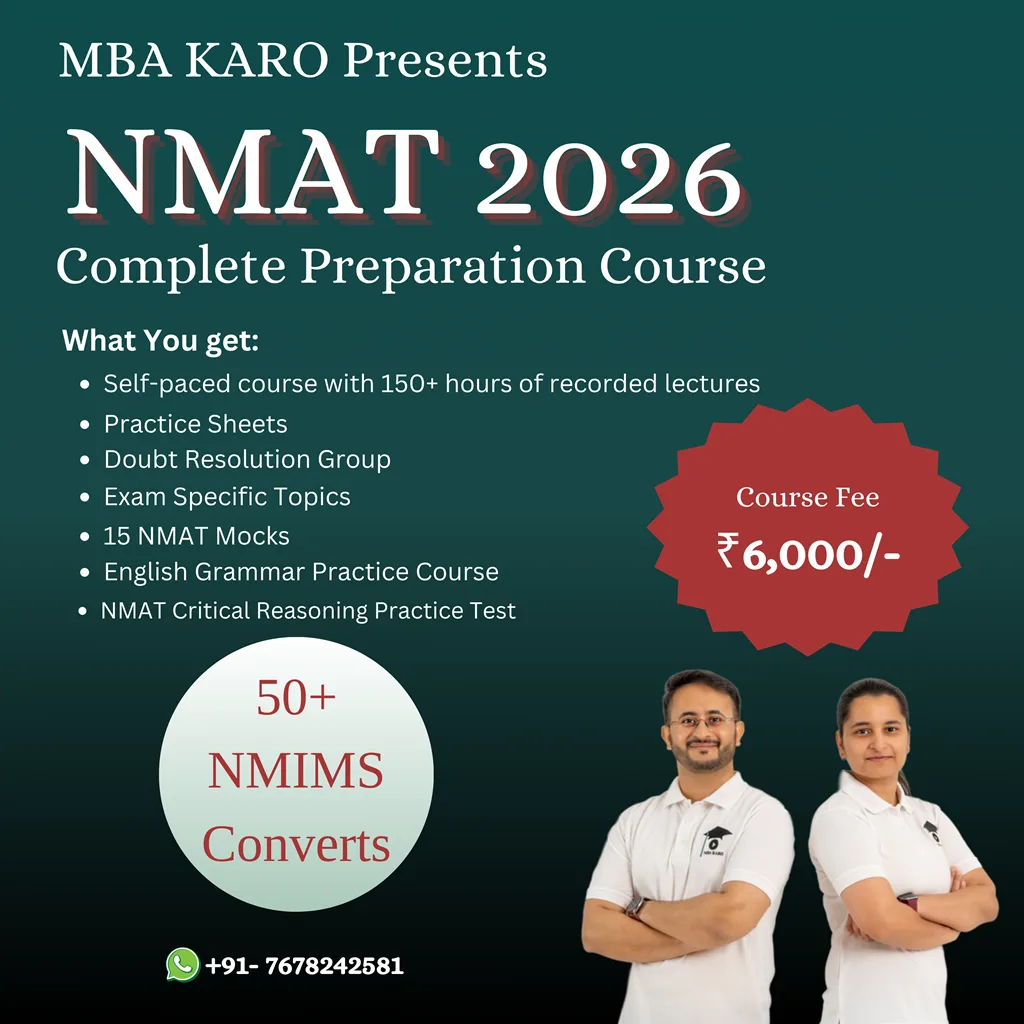
If you want structured preparation covering the NMAT syllabus, practice and mocks in one place, you can check MBA Karo NMAT Online Coaching.
The course provides end-to-end NMAT preparation with the topics covered in depth, along with mock-test practice.