
CAT 50 Day Streak – Day 1
30 questions across VARC, DILR & QA · +3 for a correct answer · −1 for a wrong MCQ · no negative marking for TITA
VARC · Verbal Ability & Reading Comprehension
So far, we have told the story of progress as one of humanity climbing out of poverty, isolation, disease and death into abundance, connectedness, health and safety. More fundamentally, it is a story of the expansion of human agency. Our primitive ancestors lived at the mercy of nature. They ate what food they found: what edible plants happened to be growing nearby, what game they could catch. They fashioned tools, clothing, and shelter out of found materials: wood, stone, leaves and grass; the hide, hair, bones, or shells of animals. They might temper these materials with fire, but they could not fundamentally transform them. And as nomads, they were forced to limit their possessions to what could be carried. Until about ten thousand years ago, they did not even have draft animals; they controlled no power sources other than their own muscles.
They had little choice of where to live: when local food resources ran out, they moved on—and they were constantly on the move. They had little choice of what to do with their lives, as any division of labour within the tribe was extremely limited—hunting, foraging, and tool-making—and much of that was determined by social roles. They had little choice of whom to socialise with: they were a part of the community they were born into. When their environment changed, they had to simply react as best they could. They had little to no ability to predict the weather or to grasp climate change. They had no techniques to prevent disease, not even washing hands or boiling water. They fell victim to attacks from wild animals and to raids from other tribes. Estimates of historical world population show very low growth rates for a very long time, which implies high mortality. Although they lived as best they could, although they applied all their intelligence, effort, and will, and although they were surely no less clever and brave than you or I, the life they could create was still merely a tiny enclave carved out of a vast world.
The advent of agriculture and settled society over ten thousand years ago was a major leap forward in human agency. For the first time, we ate not the plants we found and the game we caught in the wild, but the crops we had sown and the livestock we had raised. We chose where to live and we made our homes, finally able to invest in them for the long term. The first settlers and agriculturalists did not have much choice in these things, and their options were poor. They probably worked harder than hunter-gatherers, and they had smaller stature, indicating worse nutrition. Some have interpreted the shift to agriculture as a mistake, even “the worst mistake” in history. More likely, hunter-gatherers were led or forced into agriculture by circumstances beyond their control, such as rising population density or climate change. To call this evolution a “mistake” is ahistorical: a mistake implies a choice, but primitive peoples could not direct the course of their societies, nor even comprehend when a change of this magnitude was occurring. The lesson instead is the extremely limited agency of hunter-gatherer societies: even if they enjoyed their lifestyle, they were unable to keep it when the environment changed.
The passage calls progress “a story of the expansion of human agency”. It moves from ancestors who lived “at the mercy of nature” to agriculture as “a major leap forward in human agency”. That is exactly the arc option C describes.
A picks up only a minor detail about nutrition. B contradicts the author, who says early humans were “no less clever and brave than you or I”. D is the very view the author rejects as ahistorical.
The author’s argument is that “a mistake implies a choice”. Hunter-gatherers were likely forced into farming by rising population density or climate change. B confirms that there was no real choice, which directly supports the argument.
A and D show farming made life worse, which supports the “mistake” camp. C says tribes chose willingly, which would weaken the author’s position.
The author calls agriculture a leap in agency even though early farmers worked harder and were worse nourished. The same logic applied to industrialisation gives B: initial hardships, but a further expansion of agency.
A and C use the “mistake” or “reversal” framing that the author rejects. D introduces a claim about voluntariness that isn’t part of his framework.
If tribes deliberately tried small-scale farming while still hunting and gathering, they were weighing two ways of life side by side. That means adopting agriculture was, at least partly, a choice, which strikes at the author’s “no true choice” claim.
B is about hardship, not choice. C concerns avoiding new practices in general, not a decision about farming. D is irrelevant to whether a choice existed.
- Early European efforts to create a global standard for writing Mayan languages have enabled the preservation of great works of literature like the Popol Vuh and Chilam Balam, but the initial attempts were fraught with miscommunications and rivalries.
- A bishop named Diego de Landa convinced a Mayan scribe, Gaspar Antonio Chi, to match, letter for letter, the signs of the Mayan script and the Spanish alphabet.
- The scribe’s frustration with de Landa is evident in the last exercise that he completed for the bishop. Asked to pen any sentence in Mayan hieroglyphs, Chi wrote: “I don’t want to.”
- When the scribe heard the Spanish pronunciation of the letter ‘b,’ says Pallán, he wrote the sign for bih, which means “road.”
- The long line of code-breakers to take on Mayan hieroglyphs started with Spanish colonists in the sixteenth century.
The coherent paragraph is 5 → 2 → 4 → 3:
- 5: Code-breaking of Mayan hieroglyphs began with Spanish colonists.
- 2: Bishop de Landa made the scribe Chi match signs to letters.
- 4: The ‘b’ → bih (“road”) confusion that followed.
- 3: Chi’s frustration, ending with “I don’t want to.”
Sentence 1 shifts to a broader theme, a global writing standard and the preservation of literary works, so it doesn’t belong to this anecdote.
- This analysis implicated the axons (output connections) of neurons as well as parts of the cortex and deeper “subcortical” brain regions like the striatum, involved in movement.
- These findings tally with brain-imaging studies suggesting dysfunction of some regions in insomnia, and with animal studies implicating these cells in sleep regulation.
- It also tagged “medium spiny neurons,” which occupy most of the striatum as well as neurons in other regions, including the hypothalamus.
- The researchers then investigated which brain regions and cells these genes frequently turn up in.
- In fact, it is probable that insomnia is not a singular condition but a cluster of symptoms grouped, which can have a range of underlying causes.
The coherent paragraph is 4 → 1 → 3 → 2:
- 4: Researchers checked where the genes turn up.
- 1: “This analysis” implicated axons, cortex and striatum.
- 3: “It also” tagged medium spiny neurons.
- 2: “These findings” tally with imaging and animal studies.
Sentence 5 makes a general claim that insomnia is a cluster of symptoms. It breaks away from the gene-mapping thread.
A covers both halves of the passage. Native healers’ tree medicine saved colonists dying of scurvy, and the author still drinks tree tea daily, feeling united with the pine.
B reverses who taught whom. C (“no relevance today”) and D (“valued for taste”, “largely symbolic”) contradict the passage.
The sentence describes rebuilding the Lakenhalle, so it must come after the hall has been introduced (destroyed) and described (the thirteenth-century Gothic building). Blank 3 closes the Ypres story before the paragraph moves on to “another Belgian example”, Leuven.
Blank 2 would interrupt the description of the building. Blank 4 sits inside the Leuven discussion.
“They” needs small businesses as its immediate antecedent. The sentence “Thirty-five million small businesses are the engine of the U.S. economy” supplies it. The missing lines then continue that praise (job creators, heartbeat of communities) before the concluding call to action.
At blanks 1–3, “they” would point to universities or schools, which makes no sense.
- Ideally, children would be monitored before puberty and until sexual maturity is reached.
- Determining the effect of SBIF on human reproductive development requires a long-term commitment, both on the part of the investigator(s) as well as the subjects.
- Furthermore, reproductive capacity should be assessed throughout potential child-bearing years.
- This would allow potential differences in reproductive organ development to be discerned.
The order runs like this:
- 2: Introduces the topic and the need for a long-term commitment.
- 1: Describes the ideal monitoring window, from before puberty to maturity.
- 4: “This would allow…” gives the benefit of that monitoring.
- 3: “Furthermore” adds a second requirement, assessment through the child-bearing years.
DILR · Data Interpretation & Logical Reasoning
Eight trains depart from Delhi to different cities at different times of day. The destination cities are Jaipur, Agra, Nagpur, Mumbai, Kolkata, Bhopal, Patna, and Raipur. The following information is known about them:
- The trains departing for Agra and Kolkata depart at a time difference of 12 hours. One of them is the last train to depart.
- The train to Jaipur departs at 6:00 am and travels at a speed of 100 km/hr, which is the second-highest speed among all trains.
- The train to Bhopal is the first to depart, at a speed of 70 km/hr. The train to Nagpur is the fastest.
- Three trains depart after the train to Raipur departs; the next one departs an hour later.
- The speed of the train to Patna is half that of the train to Jaipur and departs immediately after the train to Raipur.
- The sum of the speeds of the Mumbai and Agra trains is equal to the speed of the Jaipur train.
- The train to Mumbai departs at 11:30 am after three trains have already departed.
- The train to Agra departs at 7:00 am with a speed of 40 km/hr, which is half the speed of the train to Raipur, departing at 2:00 pm.
- One of the trains departs at 2:30 am and another at 4:30 pm.
- The speeds of the three fastest trains are in an Arithmetic Progression with a difference of 10 km/h.
Timings.
- Raipur leaves at 2:00 pm with three trains after it. The next one, Patna, leaves an hour later at 3:00 pm.
- Agra leaves at 7:00 am, so Kolkata leaves 12 hours later at 7:00 pm, the last train.
- The 4:30 pm slot must then be Nagpur, and the 2:30 am slot is Bhopal, the first train.
Speeds.
- Jaipur (100) is second fastest, so the AP of the top three gives Nagpur 110, and the third fastest, 90, goes to Kolkata.
- Raipur = 2 × Agra = 80, Patna = 100 ÷ 2 = 50, and Mumbai = 100 − 40 = 60.
| # | City | Time | Speed (km/hr) |
|---|---|---|---|
| 1 | Bhopal | 2:30 am | 70 |
| 2 | Jaipur | 6:00 am | 100 |
| 3 | Agra | 7:00 am | 40 |
| 4 | Mumbai | 11:30 am | 60 |
| 5 | Raipur | 2:00 pm | 80 |
| 6 | Patna | 3:00 pm | 50 |
| 7 | Nagpur | 4:30 pm | 110 |
| 8 | Kolkata | 7:00 pm | 90 |
The 11:30 am train goes to Mumbai at 60 km/hr.
Using the solved speeds:
- A: Agra 40, Mumbai 60, Raipur 80 is an AP.
- B: Bhopal 70, Raipur 80, Jaipur 100 has gaps of 10 and 20, so it is not an AP.
- C: Patna 50, Bhopal 70, Kolkata 90 is an AP.
- D: Agra 40, Patna 50, Mumbai 60 is an AP.
The departure order is Jaipur (6:00 am), Agra (7:00 am), Patna (3:00 pm), Nagpur (4:30 pm).
Agra is 3rd (7:00 am) and Patna is 6th (3:00 pm). In between are Mumbai (11:30 am) and Raipur (2:00 pm), so 2 trains.
Speeds in ascending order: Agra 40, Patna 50, Mumbai 60, Bhopal 70, Raipur 80, Kolkata 90, Jaipur 100, Nagpur 110. The second slowest train goes to Patna.
Given below is the division of a number by another. In the representation, each of the digits 0, 1, 2, 3, 4, 5, 6, 7, 8, 9 has been coded with one letter, with distinct letters representing distinct digits.
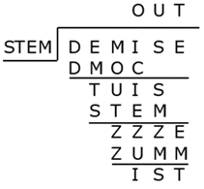
Decoding the division gives C = 0, U = 1, S = 2, T = 3, O = 4, M = 5, I = 6, E = 8 and D = 9. The remaining letter stands for 7.
From the decoded division (C = 0, U = 1, S = 2, T = 3, O = 4, M = 5, I = 6, E = 8, D = 9), the digit 8 is E. D = 9, S = 2 and O = 4.
O = 4, U = 1 and T = 3, so the quotient OUT = 413.
I = 6, S = 2 and T = 3, so the remainder IST = 623.
D = 9, I = 6, C = 0, E = 8 and S = 2, so DICES = 96082.
QA · Quantitative Ability
After the first strike, the ball rises to 54, 36, 24 and 16 cm. It travels each of these heights twice (up and down) before strikes 2 to 5.
Total = 81 + 2(54 + 36 + 24 + 16) = 81 + 2 × 130 = 341 cm.
Let ∠A = ∠C = α. Since AD = MD, triangle ADM is isosceles, so ∠ADM = 180° − 2α.
DN = DM = AD = DC, so triangle DCN is also isosceles, giving ∠CDN = 180° − 2α.
∠ADC = 180° − α, and it splits as (180° − 2α) + 60° + (180° − 2α). So 420° − 4α = 180° − α, which gives α = 80°.
∠ABC = 180° − 80° = 100°.
Market price = (1750 + 2100) ÷ 70 = Rs. 55 per kg.
With x kg of cheaper rice: 55(70 + x) − (1750 + 10x) = 3900, so 3850 + 45x − 1750 = 3900, which gives 45x = 1800 and x = 40 kg.
Detailed solution coming soon.
f(x) = x(x + 1)(2x + 1)/6 = 1² + 2² + … + x², the sum of the first x squares.
So f(n) − f(n − 1) = n² = 2025, which gives n = 45. Then (n − 3)/6 = 7.
f(7) = 7 × 8 × 15 ÷ 6 = 140.
LHS: since x¹⁰ ≥ 0, 20/(10 + x¹⁰) ≤ 2, with equality only at x = 0.
RHS: by AM ≥ GM, 11ˣ + 11⁻ˣ ≥ 2, with equality only at x = 0.
The two sides can be equal only when both equal 2, which happens only at x = 0. So there is exactly 1 real root.
PQ ∥ BC, QR ∥ AB and ∠B = 90°, so PBRQ is a rectangle. Its diagonals are equal, so PR = BQ.
BQ is shortest when it is perpendicular to AC. AC = 15, so the minimum BQ = (12 × 9) ÷ 15 = 7.2 cm.
Let the uphill, flat and downhill distances on the way out be u, f and d. On the return trip, uphill and downhill swap.
Adding both trips: (u + d)(1/6 + 1/8.4) + 2f/7 = 1.75 + 2.25 = 4.
Since 1/6 + 1/8.4 = 2/7, this becomes (2/7)(u + d + f) = 4, so the distance u + f + d = 14 km.
Exactly 2 boxes must be non-empty. Choose them in ⁵C₂ = 10 ways.
Distributing 4 distinct balls into those 2 boxes with neither empty gives 2⁴ − 2 = 14 ways.
Total = 10 × 14 = 140.
Take the tank as 450 units, so A fills 6 units/min and B fills 5 units/min.
A runs the full 60 min and B runs t min: 360 + 5t = 450, so t = 18 min.
If A is switched off at 18 min instead, 18 × 11 = 198 units are filled. B fills the remaining 252 units in 252 ÷ 5 = 50.4 min, so the total is 68.4 min.
Extra time = 8.4 min = 8 minutes 24 seconds.
Correct: 0 · Wrong: 0 · Accuracy: 0%
Keep the streak alive. See you tomorrow for Day 2.