
NMAT 2026 starts on November 2, 2026, with the exam carrying 108 questions to be solved in 120 minutes.
The paper has three equally weighted sections: Language Skills, Quantitative Skills and Logical Reasoning.
Each section has 36 questions, but the time limit differs: 28 minutes for Language Skills, 52 minutes for Quantitative Skills and 40 minutes for Logical Reasoning.
There is no negative marking, making question selection and speed important parts of the strategy.
The following 15 topics cover the areas that can contribute a substantial number of questions across the NMAT sections.
Students preparing for NMAT 2026 should prioritise these topics instead of distributing their preparation time equally across every chapter.
Since NMAT 2026 has no negative marking, leaving questions unanswered can cost you an opportunity to add to your score. Your preparation should therefore combine topic mastery with quick decision-making.
1. Reading Comprehension
Reading Comprehension can account for around 8-12 questions through 2-3 passages. This makes it one of the most important areas in Language Skills.
The passages can revolve around business, social issues, social sciences or current affairs.
Do not restrict RC preparation to reading passages quickly. Practise identifying three things:
- The central argument of the passage
- The author’s tone and purpose
- Conclusions that can reasonably be inferred from the text
Inference-based questions can be particularly time-consuming when you rely on assumptions outside the passage. Train yourself to select an answer that is supported by the given information rather than one that simply sounds reasonable.
2. Prepositions
Prepositions can contribute around 3-4 questions and are among the more manageable areas in Language Skills once the basic rules are clear.
NMAT can test whether you can identify the correct preposition for a sentence as well as the appropriate combination across multiple sentences. The challenge is often not vocabulary but knowing how words work together in context.
Revise common usage patterns involving prepositions such as in, on, at, by, into, across, against, for and with. Then practise questions where several sentences have to be completed together. This can help you convert a relatively small preparation area into quick marks.
NMAT Sample question (from official Mock)
Choose the correct sequence of prepositions that best completes the three given sentences.
1. She parked the car and rushed _______ the store.
2. The wind uprooted a tree and caused it to fall _______ the window.
3. Students who stay _______ all night will fall asleep in class.
(A) against
(B) in
(C) across
(D) by
(E) into
(F) up
A. BCF
B. BED
C. EAF
D. ECB
E. FED
3. Error Spotting
Error spotting is expected to contribute around 4-5 questions. These questions can test several basic grammar concepts rather than one isolated rule. Give particular attention to:
- Subject-verb agreement
- Tenses
- Pronouns
- Prepositions
- Modifiers
- Sentence structure
While practising, avoid simply memorising corrected sentences. Identify the exact grammatical rule responsible for the error. This makes it easier to handle unfamiliar sentence structures during the exam.
4. Para Jumbles
Para jumbles can contribute around 4-5 questions. The key skill is recognising how individual sentences connect to form a logical sequence. Look for:
- Pronouns referring to an earlier noun
- Connecting or transition words
- Cause-and-effect relationships
- Time or chronological clues
- General statements followed by specific explanations
Start by finding a sentence that can logically open the paragraph. Then identify pairs that clearly belong together before arranging the remaining sentences. This approach is generally faster than trying every possible sequence.
5. Analogies
NMAT can include around 4-5 questions based on verbal analogies, with synonyms and antonyms forming an important part of this area.
The objective is not simply to know the meaning of two words. You need to identify the relationship between them and then find the option showing a similar relationship.
For example, while revising vocabulary, group words according to their meanings, opposites and functional relationships.
Regular vocabulary revision can improve performance here while also supporting RC and other Language Skills questions.
6. Data Interpretation
Data Interpretation is one of the highest-priority areas in Quantitative Skills, with around 8-12 questions possible from this topic.
Prepare for:
- Tables
- Bar graphs
- Line graphs
- Pie charts
- Caselets
The calculations themselves are often based on percentages, ratios, averages or comparisons. That makes calculation speed important.
Practise converting fractions to percentages, comparing ratios and estimating values without unnecessarily calculating every number to its exact value.
A strong DI approach is to first understand what the question is asking, identify the relevant data and then calculate only what is required.
7. Data Sufficiency
Data Sufficiency can contribute around 4-5 questions. Unlike conventional Quant questions, the goal is not always to find the numerical answer.
You need to determine whether the information provided is sufficient to arrive at a definite answer. This means a statement may be useful even when it does not directly give you the answer.
During practice, resist the habit of completely solving every equation. Instead, test each statement separately and then consider whether the available information is enough to answer the question.
8. Arithmetic
Arithmetic forms a major part of NMAT Quantitative Skills, with around 8-10 questions expected from areas such as percentages, profit and loss, ratios, mixtures, interest and time and work. Prioritise:
- Percentages
- Profit and Loss
- Ratio and Proportion
- Mixtures
- Simple Interest
- Compound Interest
- Time and Work
These concepts also support other areas of the paper. For instance, percentage calculations are useful in DI, while ratios can appear in both direct questions and data-based sets.
Build speed by solving questions through the shortest reliable method rather than using lengthy calculations for every problem.
9. Permutations, Combinations and Probability
Permutations, Combinations and Probability can contribute around 5-6 questions, making this an important area despite being skipped by some candidates.
The questions need not always involve complicated formulas. A solid understanding of basic counting, arrangements, selections and probability can cover a significant portion of the expected questions.
Focus first on fundamental concepts and standard question types. Once the basics are comfortable, practise mixed problems that require you to decide whether a question is based on arrangement, selection or probability.
10. Number System and Properties
Number System and its properties can contribute around 3-4 questions. The area includes concepts such as divisibility, remainders, prime numbers, HCF and LCM.
Create a compact revision list of important divisibility rules and standard properties. For remainder questions, practise identifying patterns instead of performing long division every time.
The goal is to recognise the underlying property quickly. This can make relatively short questions much faster to solve during the Quantitative Skills section.
11. Critical Reasoning
Critical Reasoning is one of the most heavily tested areas in Logical Reasoning, with around 15-18 questions. This makes it a topic that NMAT 2026 candidates should not leave for the final stage of preparation. Questions can require you to:
- Identify an assumption
- Draw an inference
- Evaluate an argument
- Strengthen a conclusion
- Weaken a conclusion
The most important habit is to separate the evidence from the conclusion. Once you understand what the argument is trying to establish, it becomes easier to determine what additional information would support or challenge it.
12. Analytical Puzzles
Analytical Puzzles can appear in 1-2 sets, including questions based on seating arrangements, scheduling and grouping.
For seating questions, practise both linear and circular arrangements. For scheduling and grouping problems, convert the information into a simple table, sequence or set of conditions instead of keeping every detail in your head.
Speed comes from representation. The quicker you can translate the conditions into a workable structure, the less time you spend rereading the question.
13. Input-Output
Input-Output questions can appear as 1-2 sets containing around 4-8 questions. They may use numbers, words or a combination of elements arranged through a series of operations.
The central skill is pattern recognition. Start by comparing the input with the first output stage and identify exactly what has changed. Then check whether the same operation is being repeated or whether the rule changes at each stage.
Once the machine’s pattern becomes clear, several questions from the same set can often be solved without starting from scratch each time.
14. Syllogisms
Syllogisms may contribute around 1-2 questions, but they are still worth preparing because the question format can be handled systematically.
Practise identifying the relationship between statements and checking whether a conclusion necessarily follows. Avoid selecting an option merely because the conclusion appears logically possible.
The distinction between what must be true and what could be true is important here. Use diagrams or structured representations while learning the concept, then gradually move towards faster mental evaluation.
15. Venn Diagrams
Venn Diagram questions can contribute around 1-2 questions and generally involve sets and their relationships. Practise representing:
- Overlapping groups
- Separate groups
- Common members
- Exclusive members
- Multiple-set relationships
The value of this topic lies in turning verbal information into a visual structure. Once the sets are correctly represented, counting or identifying the required group becomes much easier.
How to Prioritise These 15 Topics for NMAT 2026
Not all 15 topics need the same amount of preparation time. A practical priority order can be created using the expected question contribution and the effort required to improve accuracy.
| Priority | Topics to Cover |
| Very High | Critical Reasoning, Data Interpretation, Arithmetic, Reading Comprehension |
| High | Error Spotting, Para Jumbles, Modern Math, Data Sufficiency, Input-Output |
| Medium | Prepositions, Analogies, Number System, Analytical Puzzles |
| Quick Revision | Syllogisms, Venn Diagrams |
This does not mean that lower-priority topics should be ignored. Since NMAT has no negative marking, even a few additional correct answers from smaller topics can contribute to the overall score.
NMAT 2026 Preparation Strategy
A topic is not fully prepared just because you can solve its untimed questions. NMAT tests your ability to combine accuracy with speed within a fixed section-wise clock.
Use a three-stage approach:
- Stage 1 – Concept building: Complete the basic rules, formulas and question types for each topic.
- Stage 2 – Topic practice: Solve questions in short timed sets. Record the questions where you needed too much time, even if your final answer was correct.
- Stage 3 – Mixed practice: Combine questions from different topics and practise switching between question types quickly.
For Language Skills, focus on reading speed and grammar accuracy. For Quantitative Skills, work on calculation efficiency and selection of questions. For Logical Reasoning, prioritise argument analysis and pattern recognition.
NMAT 2026: What to Revise Before the Exam
The final revision should focus on high-return areas rather than attempting to learn every difficult question type from scratch.
Revisit percentage and ratio calculations, core arithmetic formulas, DI approaches, grammar rules, RC question types and Critical Reasoning patterns.
Also revise the standard approaches for Data Sufficiency, Input-Output, syllogisms and Venn Diagrams. These topics can become scoring areas when the underlying method is familiar.
Since each section has its own time limit, take full-length and sectional mocks under actual exam conditions. Review the questions after every test and classify mistakes as concept errors, calculation errors, reading errors or time-management errors. This gives you a clearer picture of what needs improvement before NMAT 2026.
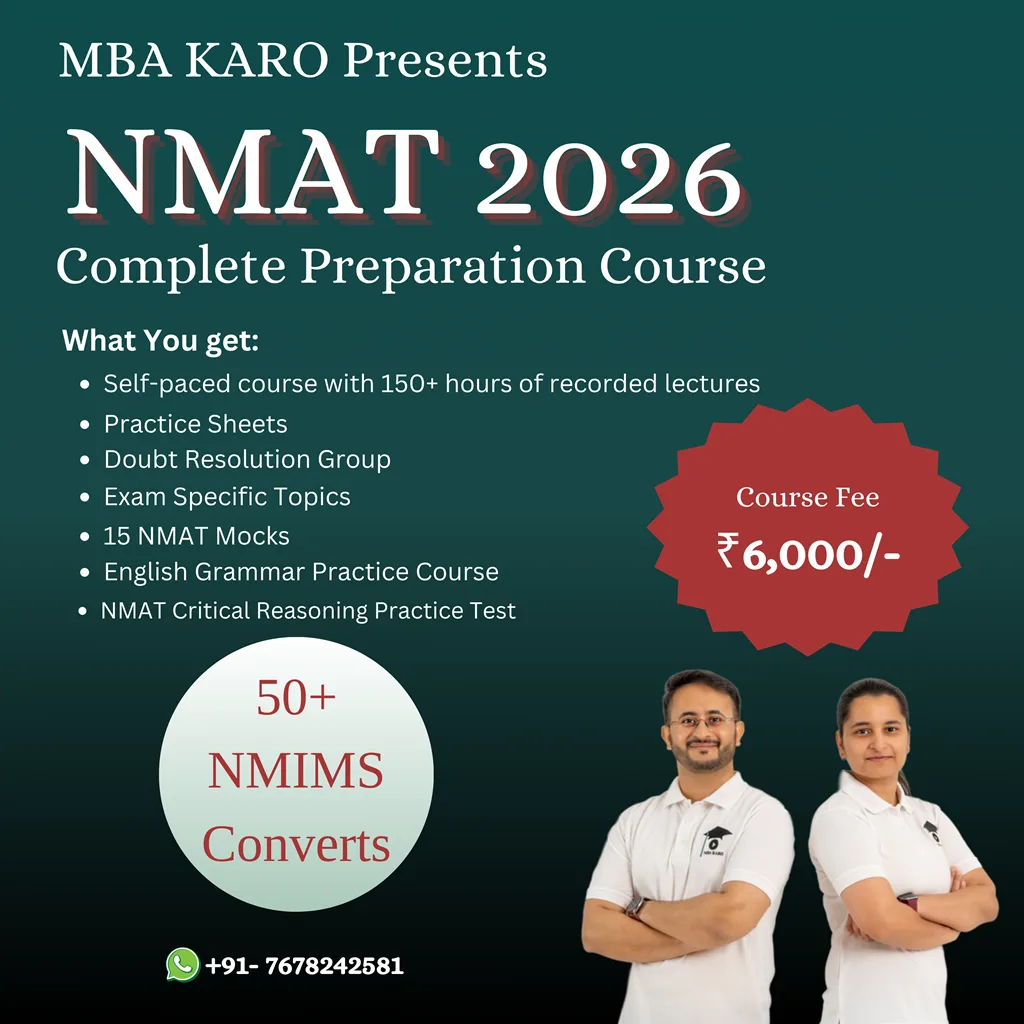
For candidates looking for structured preparation, the MBA Karo NMAT 2026 Course can help organise topic-wise learning, practice and revision in one place.
FAQs on NMAT 2026 Important Topics
Q. Which is the most important topic in NMAT 2026?
A. Critical Reasoning, Data Interpretation, Arithmetic and Reading Comprehension should receive high priority because they can contribute a significant number of questions.
Q. How many questions are there in NMAT 2026?
A. NMAT 2026 has 108 questions across Language Skills, Quantitative Skills and Logical Reasoning, with 36 questions in each section.
Q. Does NMAT 2026 have negative marking?
A. No. NMAT 2026 does not have negative marking, so candidates should make effective use of the available questions and avoid leaving opportunities unanswered.
Q. Which Quant topics should I prepare first for NMAT 2026?
A. Start with Data Interpretation and Arithmetic, followed by Data Sufficiency, Permutations and Combinations, Probability, and Number System.
Q. Which Logical Reasoning topic has the highest expected weightage?
A. Critical Reasoning is the biggest priority in Logical Reasoning, with around 15-18 questions expected from argument-based concepts such as assumptions, inferences, strengthening and weakening conclusions.
Q. How much time is given for NMAT 2026?
A. The total test duration is 120 minutes. Language Skills has 28 minutes, Quantitative Skills has 52 minutes and Logical Reasoning has 40 minutes.