
CAT 50 Day Streak – Day 8
30 questions across VARC, DILR & QA · +3 for a correct answer · −1 for a wrong MCQ · no negative marking for TITA
VARC · Verbal Ability & Reading Comprehension
Few foods can compete with olive oil. Its salubrious properties have turned it into one of the most recognisable symbols of healthy living as well as a sign of tacit resistance to the industrialisation of food and loss of authentic flavours. Its rich history, stretching back to the Greeks, Egyptians and Babylonians, plays an enormous part in its ongoing symbolic associations. Across a range of Mediterranean cultures, olive oil has been an inordinately versatile and useful product, even regarded as a means of connecting with the divine. Today, it sells in pricy green bottles that promise a ‘Mediterranean’ lifestyle. And yet, the distinctive flavour of extra virgin olive oil is a modern invention. The trail of its peppery note leads straight to the core of the Industrial Revolution and the reinvention of olive oil as a global commodity.
Homer calls Odysseus polytropos, a man of many ways, who can transform himself and adapt to any situation. Olive oil is often involved in these transformations, as when, on his return to Ithaca, Odysseus relies on olive oil – and Athena’s intervention – to become younger, stronger and more beautiful. He also carved his wedding bed in an olive tree that had grown deeply into the ground. These references are not incidental: the olive tree and the juice of its fruit are ancient symbols of vitality and rootedness. In Mediterranean cultures they signify adaptation, gnarly endurance and endless transformative possibilities.
First domesticated somewhere in the Fertile Crescent, the tree was cultivated by Babylonians, and by the 18th century BCE the Code of Hammurabi regulated the trade in olive oil. The tree steadily inched west, with its main centres of diffusion in Palestine, Syria and Crete. By the 5th century BCE, Thucydides felt he knew what separated civilisation from barbarism: the ability to graft the olive tree. The mythical foundation of Athens begins with the goddess Athena gifting the olive tree to the Greeks. Planting an olive grove was thus a sacred act. Especially revered were those trees whose oil served as prizes for the winners of the Panathenaic Games. In the 4th century BCE, cutting down or uprooting one of those trees could be punished with exile and confiscation of property. To this day in Italy, spilling oil on the table is viewed as a bad omen.
The Romans, too, loved their olive oil, which they consumed in mindboggling amounts. Monte Testaccio in Rome looks like a natural hill, but it’s an immense pile of broken oil amphoras, which were used only once to prevent rancidness. During the imperial age, more than 1 million people lived in Rome, each one consuming an average of two litres of oil per month. How was it even possible? They appreciated oil as food, but they used it mainly for other purposes, such as lighting their houses and anointing their bodies. ‘Wine inside and oil outside,’ sums up Pliny the Elder, who considered olive oil ‘an absolute necessity’ of human life.
The first paragraph sets up the contrast: olive oil’s ancient, versatile symbolism against the fact that its distinctive flavour “is a modern invention” of the Industrial Revolution. The rest of the passage develops the ancient side of that contrast.
A and B describe parts of the passage, not its argument. C overstates: the “pricy green bottles” line is an observation, not a critique.
If the peppery flavour of extra virgin olive oil is a modern invention, the ancient oils likely lacked it. B follows directly.
A: the Romans used oil mainly for lighting and anointing, not ceremonies. C contradicts a million Romans each using two litres a month. D has no support.
If the Romans deliberately produced and prized a peppery oil, the flavour is ancient, not modern. A strikes directly at the claim.
B is about overall quality, not flavour origins. C only blocks one way of testing the claim. D is irrelevant to flavour.
The author opens with “Few foods can compete with olive oil” and praises its “salubrious properties”, its “rich history” and its “inordinately versatile” uses. The tone is admiring, i.e. laudatory.
The passage isn’t lecturing the reader (didactic), it isn’t casual or careless (perfunctory), and it isn’t mocking (sardonic).
The first three sentences are about the grandfather’s own use of proverbs. The fourth widens to the whole community (weddings, funerals, markets). The sentence “this wasn’t just his gift; it was cultural” is the pivot between the two, so it belongs at blank 3.
At blanks 1 and 2 the focus is still on him. At blank 4 the cultural point has already been made.
- A 2021 survey found that up to 82% of people have experienced what’s become known as impostor syndrome.
- The term “impostor phenomenon” was coined in 1978 by American psychologists Pauline Clance and Suzanne Imes, who noticed their female students and therapy patients were full of doubt about their abilities.
- It seems to be worse among high-achieving, very competent people who are outwardly very successful and experienced.
- But what happens when you’ve “made it” but still feel like a total fraud?
- Fake it till you make it, the saying goes.
The coherent paragraph is 5 → 4 → 2 → 1:
- 5: Opens with the saying “Fake it till you make it”.
- 4: “But” what if you’ve made it and still feel like a fraud?
- 2: Names the phenomenon and its 1978 origin.
- 1: A 2021 survey shows how common it is.
Sentence 3 (it is worse among high achievers) only repeats the idea already raised in 4. It adds a separate point about who suffers most, rather than continuing the arc from saying to definition to prevalence.
- In 1913, the value of exported goods made up 14 per cent of the world economy.
- Both moments of peak globalisation came crashing down, in epochal, generation-defining ways.
- By 1933, shattered by World War I and the Great Depression, it had slumped to 6 per cent, and it did not recover until the 1970s.
- The backlash propelled the rise of right-wing authoritarian and fascist movements that promised to reverse or seize control of the forces of globalism.
The order runs like this:
- 2: Both peaks of globalisation came crashing down.
- 1: In 1913, exports were 14% of the world economy.
- 3: “By 1933… it had slumped to 6 per cent”.
- 4: “The backlash” fed fascist movements.
D captures the shift from rural and agrarian to urban and industrial, driven by factories that drew immigrants.
A says immigrants went to rural areas, which is the opposite. B and C claim agriculture or rural life stayed dominant, contradicting “dominated by cities”.
- One of the things he hasn’t changed his mind about is “the belief that literature is the best system we have of understanding the world”.
- Barnes is an esteemed British novelist, not a social scientist.
- Research in recent decades shows that we are prone to “confirmation bias,” systematically interpreting new information in ways that favour our existing views and cherry-picking reasons to uphold them.
- Where Barnes has changed his mind, he attributes the shift to quirks of experience or feeling, not rational thought.
- But his shift in perspective resonates with a host of troubling results in social psychology.
Detailed solution coming soon.
- Over the past two centuries, nearly every society has reallocated land ownership and property rights.
- It’s helped some countries become more egalitarian and productive, whereas for others it has embedded racial hierarchies, deep inequalities and economic stagnation.
- And because of the power that land confers to those who hold it, this reshuffling has set societies on distinct trajectories of development.
- Today, we are in the middle of a ‘great reshuffle’ of land.
The order runs like this:
- 4: We are in a “great reshuffle” of land.
- 1: Over two centuries, nearly every society has reallocated land.
- 3: “And” this reshuffling has set societies on distinct paths.
- 2: “It’s helped some… whereas for others…” gives the contrasting outcomes.
DILR · Data Interpretation & Logical Reasoning
A cricket team played four matches in a series. The top 4 batsmen for the team were Jatin, Kamal, Lokesh and Mohit. The stack graph below gives the contribution of these batsmen as a percentage of runs scored by the top 4 batsmen in that match. The line graph shows the runs scored by other batsmen as a percentage of runs scored by the top 4 batsmen in that match.
For example, in Match 1, Mohit scored 20% of the runs scored by the top 4 batsmen and the remaining team scored 25% of the runs scored by the top 4 batsmen.
Total runs by the team in matches 1, 2, 3 and 4 are 275, 252, 255 and 264, respectively.
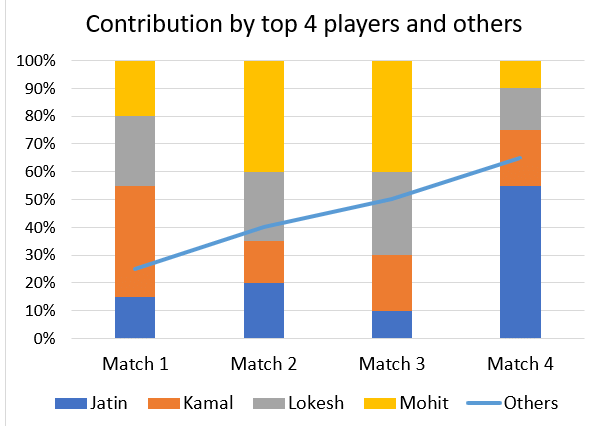
“Others” is a percentage of the top-4 total, so top-4 runs = team total ÷ (1 + others%):
- Match 1: 275 ÷ 1.25 = 220
- Match 2: 252 ÷ 1.40 = 180
- Match 3: 255 ÷ 1.50 = 170
- Match 4: 264 ÷ 1.65 = 160
Applying each batsman’s share from the stack graph:
| Match | Jatin | Kamal | Lokesh | Mohit | Others | Team |
|---|---|---|---|---|---|---|
| 1 | 15% → 33 | 40% → 88 | 25% → 55 | 20% → 44 | 25% → 55 | 275 |
| 2 | 20% → 36 | 15% → 27 | 25% → 45 | 40% → 72 | 40% → 72 | 252 |
| 3 | 10% → 17 | 20% → 34 | 30% → 51 | 40% → 68 | 50% → 85 | 255 |
| 4 | 55% → 88 | 20% → 32 | 15% → 24 | 10% → 16 | 65% → 104 | 264 |
| Total | 174 | 181 | 175 | 200 | 316 | 1046 |
Mohit scored the most runs in the series (200).
Lokesh’s scores (from the table in Q11) are 55, 45, 51 and 24. His highest, 55, came in Match 1.
Mohit and the others are both at 40% (72 runs each) only in Match 2.
Kamal scored 27 of the team’s 252 runs in that match: 27 ÷ 252 = 10.71%.
- A: Mohit’s best was 72 in Match 2, not Match 3 (68) ✗
- B: Lokesh scored 51 in Match 3, which isn’t a multiple of 5 ✗
- C: Kamal’s Match 1 score (88) is less than half of 181 (90.5) ✗
- D: Jatin scored 88 of 264 in Match 4, exactly 1/3 ✓
Kamal: 88 + 27 + 34 + 32 = 181. Lokesh: 55 + 45 + 51 + 24 = 175.
Difference = 6.
Seven teachers of an international B-school, Jen, Adam, Nina, Umar, Ava, Robin and Yana, belong to different countries, namely Brazil, Cuba, Egypt, Fiji, India, Spain and the UK. Each of these teachers teaches a different subject and has a different age (years): 43, 45, 48, 49, 53, 54 and 56.
- The teacher from Fiji is five years older than Adam.
- Only two teachers are younger than the one who teaches HRM.
- The teacher who teaches Economics is three years older than the one from Spain.
- The teacher from India is at least 7 years older than the one who teaches Branding.
- The teacher who teaches Supply Chain is from Brazil and is the youngest.
- The difference between the ages of the teachers from India and Fiji is at most 5 years.
- The teacher from the UK is younger than the one from Cuba, who is not older than the teacher from Egypt.
- Umar is from Cuba.
- The 49-year-old teacher doesn’t teach Branding.
- Jen is at least four years younger than Umar.
- Ava is younger than Robin and Nina.
- The teacher who teaches Finance is neither 53 nor 54 years old.
- The teacher who teaches International Management is younger than the one who teaches Business Ethics.
- Ava doesn’t teach Branding.
- Robin is not from Fiji.
- Fixed ages. Supply Chain = Brazil = 43. HRM has exactly two teachers younger, so HRM = 48.
- Spain and Economics. Economics = Spain + 3 gives (45, 48) or (53, 56). 48 is HRM, so Spain = 53 and Economics = 56.
- Fiji and Adam. Fiji = Adam + 5 gives (43, 48) or (49, 54).
- If Fiji = 48, India is within 5 of it (45 or 49). Branding would then have to be 42 or younger, which is impossible.
- So Fiji = 54 and Adam = 49.
- India and Branding. India is 49 or 56. India = 49 again forces Branding to 42 or younger, so India = 56. The remaining ages 45, 48 and 49 go to UK < Cuba < Egypt, so Cuba = 48 (Umar, HRM) and Egypt = 49 (Adam).
- Branding. It must be 49 or younger, and it isn’t 43, 48 or 49, so Branding = 45 (UK).
- Jen. Jen is at least 4 years younger than Umar (48), so Jen = 43.
- Ava, Robin and Nina. Ava is younger than both Robin and Nina, and isn’t 45 (Branding), so Ava = 53. Robin isn’t from Fiji (54), so Robin = 56 and Nina = 54. That leaves Yana = 45.
- Remaining subjects. Finance isn’t 53 or 54, so Finance = 49. International Management is younger than Business Ethics, so IM = 53 and BE = 54.
| Age | Teacher | Country | Subject |
|---|---|---|---|
| 43 | Jen | Brazil | Supply Chain |
| 45 | Yana | UK | Branding |
| 48 | Umar | Cuba | HRM |
| 49 | Adam | Egypt | Finance |
| 53 | Ava | Spain | International Management |
| 54 | Nina | Fiji | Business Ethics |
| 56 | Robin | India | Economics |
The oldest teacher (56) is from India.
From the table in Q16, the UK teacher is 45 years old: Yana.
Ava (53) is younger than both Robin and Nina, so they are 54 and 56. Robin isn’t from Fiji (54), so Robin = 56 and Nina = 54.
Ages 49, 53 and 54 share Finance, IM and BE. Finance isn’t 53 or 54, so it is 49. IM is younger than BE, so Ava (53) teaches International Management.
Economics is taught by the 56-year-old, who is Robin (India).
QA · Quantitative Ability
Write the roots as α = 1 + 1/k and β = 1 + 1/(k + 1). Then (α − 1)(β − 1) = 1/(k(k + 1)), and α − β = 1/k − 1/(k + 1) = 1/(k(k + 1)). So the two are equal.
a + b + c = a(1 − α)(1 − β), since the quadratic equals a(x − α)(x − β) at x = 1. And b2 − 4ac = a2(α − β)2.
Since (α − 1)(β − 1) = α − β, (a + b + c)2 = b2 − 4ac.
All three = 6, exactly two = k + 2k + 3k = 6k, and guitar only = 40. So violin only + flute only = 120 − 46 − 6k = 74 − 6k. This is always ≡ 2 (mod 6): 68, 62, 56, 50, 44, 38, …
- 8 : 11 (sum 19): 38 = 19 × 2 ✓
- 7 : 10 (sum 17): 68 = 17 × 4 ✓
- 4 : 7 (sum 11): 44 = 11 × 4 ✓
- 4 : 5 (sum 9): every multiple of 9 is ≡ 0 or 3 (mod 6), never 2 ✗
So 4 : 5 is impossible.
Using the AP sum formula for all 40 instalments: 20(2a + 39d) = 3,60,000, so 2a + 39d = 18,000.
The first 30 instalments cover two-thirds of the debt, i.e. 2,40,000: 15(2a + 29d) = 2,40,000, so 2a + 29d = 16,000.
Subtracting: 10d = 2000, so d = 200. Then 2a = 18,000 − 7,800, giving a = Rs 5,100.
Let n be the number of tests and m the overall average.
Dropping the first 10 (total 200): (nm − 200)/(n − 10) = m + 1. Dropping the last 10 (total 300): (nm − 300)/(n − 10) = m − 1.
Subtracting the two: 100/(n − 10) = 2, so n = 60. Check: the total is 1500 and the average 25; 1300/50 = 26 ✓ and 1200/50 = 24 ✓.
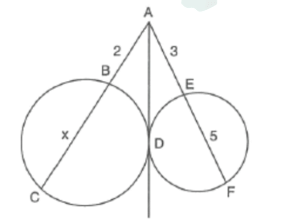
AD is tangent to both circles at D. By the tangent–secant theorem applied to each circle:
AD2 = AB × AC = AE × AF, so 2(2 + x) = 3 × (3 + 5) = 24.
2 + x = 12, which gives x = 10.
Let A take t days, so B takes 1.25t. Together for 4 days they do 4(1/t + 0.8/t) = 7.2/t of the job.
0.5 + 7.2/t + 0.05 = 1 gives 7.2/t = 0.45, so t = 16.
Check the 13 days: 8 (A alone) + 4 (together) + 0.05 × 20 = 1 (B alone) = 13 ✓. B alone takes 20 days.
Detailed solution coming soon.
pqr = 100(2x) + 10 × 2(x + y) + 2y = 220x + 22y = 22(10x + y) = 22 × xy.
So ab = 22.
Each term is ±1, and the last term is the product of the first three signs.
- All positive: 1 + 1 + 1 + 1 = 4
- One negative: 1 + 1 − 1 − 1 = 0
- Two negative: 1 − 1 − 1 + 1 = 0
- All negative: −1 − 1 − 1 − 1 = −4
The set is {4, 0, −4}, which has 3 values.
12/(5 − s) − 12/(5 + s) = 1 gives 24s = 25 − s2, so s = 1 km/h. Upstream speed is 4 km/h and downstream 6 km/h.
Round trip: N/4 + N/6 = 5N/12 ≥ 2, so N ≥ 4.8.
Correct: 0 · Wrong: 0 · Accuracy: 0%
Keep the streak alive. See you tomorrow for Day 9.