The SNAP EMV Mock Test 2026 was conducted on October 7, 2026, for candidates who completed their SNAP 2026 payment by October 5.
The mock has 10 questions to be attempted in 10 minutes, with 1 mark for each correct answer and 0.25 marks deducted for every wrong response.
The MBA Karo team has appeared for the EMV Mock Test to understand the actual test interface, question style, difficulty level and time pressure.
After the test, this page will be updated with the MBA Karo SNAP EMV Mock Test analysis, memory-based questions, answers and detailed video solutions.
SNAP EMV Mock Test 2026: Key Details
Check the key details of the SNAP EMV mock test shared below:
| Particular | Details |
| EMV Mock Test Date | October 7, 2026 |
| Test Window | 12 Noon to 9 PM |
| Section | Ethics, Morality and Values |
| Number of Questions | 10 |
| Duration | 10 minutes |
| Marks per Correct Answer | 1 mark |
| Negative Marking | 0.25 marks for each wrong answer |
| Question Type | MCQ |
| Options per Question | 4 |
| Maximum Marks | 10 |
| Impact on SNAP Score | No impact |
| Question Bank | October 8, 2026 |
The EMV Mock Test is separate from the main SNAP examination. Its score is meant only for the candidate’s reference and will not affect the final SNAP 2026 score or selection process.
MBA Karo SNAP EMV Mock Test Video
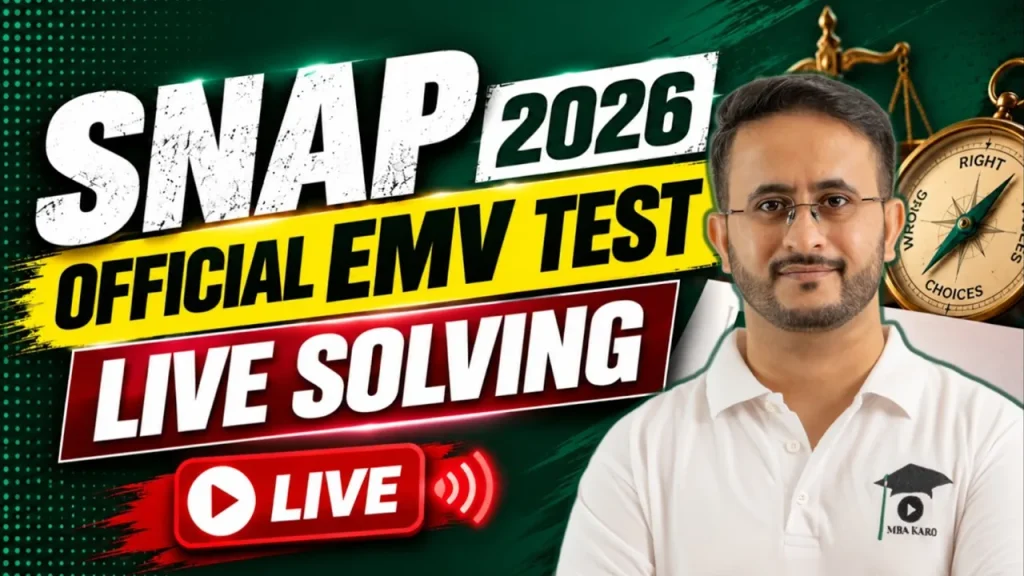
The video includes questions from the test along with their solutions and explanations. Candidates can use it to understand how the EMV section is being tested and how to approach similar questions.
SNAP EMV Mock Test 2026: Questions and Solutions
The questions below have been added based on the MBA Karo team’s experience of the test.
Q1. As a team lead, you’re asked by your manager to give a slightly inflated performance rating to a team member so the team’s average rating stays high enough to protect the whole team’s bonus pool this quarter. The employee’s actual performance was average.
A. Give the inflated rating this once, protecting the team’s collective interest is a legitimate part of your role as a lead
B. Refuse, rate the employee accurately, and raise the bonus-pool structure itself as a concern with HR if you believe it unfairly links unrelated employees’ pay
C. Give the accurate rating but privately tell the employee you tried to get them a higher one, to preserve the relationship
D. Ask your manager to make the call directly so the decision doesn’t rest on you
Q2. You’re an analyst on a due-diligence team. Deep in a dataset, you spot a discrepancy that could reduce your own team’s valuation of the deal, but the deal timeline is tight, senior leadership is confident, and raising it now will likely delay signing by weeks.
A. Flag the discrepancy to your immediate lead in writing, with your analysis, and let it go up the chain from there
B. Mention it verbally and informally, so it’s on record without formally slowing the process down
C. Assume senior leadership has already accounted for it, since they’ve seen more of the deal than you have
D. Keep digging until you’re fully certain before saying anything, since a premature flag could be embarrassing if you’re wrong
Q3. Your startup is close to running out of runway. Your CEO wants to tell a prospective investor that a large enterprise client is “in advanced talks to sign,” when in reality that client has only had one exploratory call and shown no real commitment.
A. Support the framing, investors expect founders to project confidence, and the client conversation is technically ongoing
B. Suggest describing the client relationship accurately (an early exploratory conversation) while making the strongest honest case for the pipeline elsewhere
C. Stay silent in the meeting, since it’s the CEO’s call and not yours to challenge in front of an investor
D. Raise your concern with the CEO afterward, but say nothing if they decide to proceed with the framing again next time
Q4. You manage a small vendor budget. A long-standing vendor, run by a close personal friend of yours, who has always delivered reliably is now, for the first time, quoting notably higher than two new competitors for the same scope.
A. Stay with the existing vendor; relationship continuity and proven reliability justify some cost premium
B. Switch to the cheapest new vendor, since your responsibility is to minimise cost for the business
C. Share the competing quotes with the existing vendor, give them a fair chance to respond, and decide based on the best combination of cost and reliability after that conversation
D. Split the work between the old vendor and a new one to hedge the risk without a direct comparison
Q5. During a campus placement interview panel (as a company representative and recent alum), you notice the panel is unconsciously favoring candidates from your own undergraduate college, including in cases where another candidate’s answers were objectively stronger.
A. Say nothing in the room, but privately vote for the objectively stronger candidates on your own scorecard
B. Raise the pattern with the panel directly, using specific scoring comparisons, and ask that decisions be re-anchored to the evaluation criteria
C. Recuse yourself from the panel to avoid being seen as personally biased, since you share the same college background
D. Let the process play out this round, and raise it as broader feedback to campus-recruitment leadership afterward
Q6. Each gives statements to be taken as true. Based only on the statements, determine which conclusion(s) necessarily follow; do not import outside assumptions about intent.
Statements:
1. A firm’s conflict-of-interest policy requires disclosure only when an employee holds a direct financial stake in a counterparty.
2. Rohan’s spouse (not Rohan) holds shares in a vendor competing for a contract Rohan is evaluating.
3. Rohan did not disclose this.
Conclusions:
I. Rohan violated the letter of the policy.
II. Rohan violated the spirit of the policy.
A. Only I follows
B. Only II follows
C. Both I and II follow
D. Neither follows
Q7. Each gives statements to be taken as true. Based only on the statements, determine which conclusion(s) necessarily follow; do not import outside assumptions about intent.
Statements:
Company policy states that client-facing communication must be accurate “to the best of the employee’s knowledge at the time.”
An account manager told a client a shipment “should arrive by Friday,” based on the courier’s own tracking estimate.
The shipment was delayed due to a warehouse issue neither party could have anticipated, and arrived the following Tuesday.
Conclusions:
I. The account manager’s statement violated company policy.
II. The account manager should have withheld any delivery estimate at all.
A. Only I follows
B. Only II follows
C. Both I and II follow
D. Neither follows
Q8. Each gives statements to be taken as true. Based only on the statements, determine which conclusion(s) necessarily follow; do not import outside assumptions about intent.
Statements:
1. The organisation’s escalation policy states that any issue with client-impact must be reported to the account owner “within a reasonable time of discovery.”
2. An associate discovered a billing error on a Friday evening and reported it to the account owner the following Monday morning, the next working day.
Conclusions:
I. The associate violated the escalation policy.
II. “Reasonable time” in this policy is left to professional judgment rather than a fixed deadline.
A. Only I follows
B. Only II follows
C. Both I and II follow
D. Neither follows
Q9. Rank the given considerations in the order a sound business judgment would weigh them, from the factor that should be decided first to the one that should be decided last, for the situation described.
A product team must decide whether to ship a feature with a known minor UX flaw to hit a public launch date that has already been externally communicated to customers.
Considerations:
1. Whether the flaw could cause customers real harm or financial loss (not just inconvenience)
2. Whether the flaw can be fixed quickly post-launch without further customer impact
3. Whether missing the launch date damages credibility with customers who were told the date
4. Whether the internal team would prefer more time to polish the feature
A. 1-2-3-4
B. 4-1-2-3
C. 3-1-2-4
D. 1-3-2-4
Q10. Rank the given considerations in the order a sound business judgment would weigh them, from the factor that should be decided first to the one that should be decided last, for the situation described.
A manager must decide how to respond after learning a high-performing employee has been consistently taking credit for a quieter colleague’s work in team meetings.
Considerations:
1. Verifying the facts directly rather than acting on secondhand impressions
2. Addressing the pattern privately with the high performer
3. Ensuring the quieter colleague’s contribution is visibly recognised going forward
4. Deciding whether this affects the high performer’s upcoming review
A. 2-1-4-3
B. 1-2-3-4
C. 3-1-2-4
D. 4-2-1-3
What Happens After the SNAP EMV Mock Test?
The score is displayed after the test is completed by selecting END TEST followed by VIEW RESULT. The mock does not generate a percentile.
If the test closes because of a technical or connectivity issue, candidates can check their internet connection and device before logging in again. Their saved progress can be resumed after re-entry, subject to the test system.
The EMV Question Bank is scheduled to be sent to registered candidates on October 8, 2026. It can provide additional practice after the mock.
SNAP 2026 Exam Pattern
The actual SNAP 2026 test will have 60 questions to be attempted in 60 minutes. Each correct response carries one mark, while an incorrect answer leads to a deduction of 0.25 marks.
SNAP 2026 is an objective computer-based test, with four answer choices for every question.
| Section | Questions | Marks per Correct Answer | Total Marks |
| General English | 10 | 1 | 10 |
| Analytical & Logical Reasoning | 20 | 1 | 20 |
| Quantitative, Data Interpretation & Data Sufficiency | 20 | 1 | 20 |
| Ethics, Morality and Values | 10 | 1 | 10 |
| Total | 60 | – | 60 |
SNAP 2026 Exam Dates
SNAP 2026 will be conducted in three sessions. Candidates can appear for the test according to the attempt options available to them.
| SNAP Test | Date | Day |
| SNAP 01 | December 13, 2026 | Sunday |
| SNAP 02 | December 19, 2026 | Saturday |
| SNAP 03 | December 26, 2026 | Saturday |
Conclusion
The EMV Mock Test gives candidates an early opportunity to understand how the Ethics, Morality and Values section may feel in a timed environment.
For broader SNAP preparation, MBA Karo’s SNAP Mock Test can help candidates practise the complete 60-question format, work on speed and analyse their performance across sections.
MBA Karo’s SNAP preparation also covers the areas tested in the full examination, allowing candidates to combine concept preparation with timed mock practice. Regular mock attempts can help identify weak areas and improve question selection before the December sessions.
For candidates preparing seriously for SNAP 2026, the MBA Karo EMV Course offers structured preparation along with practice and mock-based learning to support preparation for the complete exam.