CAT 50 Day Streak – Day 50
30 questions across VARC, DILR & QA · +3 for a correct answer · −1 for a wrong MCQ · no negative marking for TITA
VARC · Verbal Ability & Reading Comprehension
The scale of these transformations is so huge that they defy our imagination. While we might be able to appreciate how our morning coffee impacts farmers in El Salvador, the diversity and quantity of commodities that we use, along with their global reach, make it difficult to really see how our consumption relates to commodity-producing regions across the world. Further complicating the picture, the transformation of the countryside goes beyond what is visible to the naked eye. Plants are genetically transformed to make them more disease resistant, raise their yields and better serve the purpose of their industrial processing. In a development that started with the establishment of experimental agricultural stations across the globe in the late 19th century and was fuelled by breakthroughs in biotechnology, a handful of globally operating corporations have increasingly monopolised the seeds for the world’s most important agricultural crops with their genetically modified variants.
The relentless reshaping of the world’s countryside contributes significantly to overcoming the tendency of commodity prices to rise because of scarcity. Commodities crucial to our daily needs, including sugar, soy and palm oil, have stayed relatively cheap despite staggering demand, increasing environmental costs, and the expenditures associated with long-distance transport. Behind this paradox is a relentless logic with deep historical roots of incorporating ever more land and labour, a logic that just as often escapes the attention of historians as it eludes consumers and economic statistics. Only by looking at commodity frontiers broadly, globally and historically can we get a handle on this process of world historical importance. We can begin to understand not only how our consumption patterns relate to the current global ecological predicaments, but also how, over the past centuries, capitalism has dramatically changed through crises, social resistance and consumer movements. Thus, the past provides us with clues about how we can play a role as citizens, workers and consumers in bending the course of economic development in such a way that one planet is enough. History does not repeat, but it reveals some patterns that are helpful for coming to terms with our present.
To fully grasp a reality so profound and consequential, we need to think about history at a global scale, and about capitalism. While there is a tradition of looking at capitalism historically – for instance, by the economist Werner Sombart, the historian Fernand Braudel, and the sociologist Immanuel Wallerstein – these scholars tend to focus on the ways that European agency has transformed the world, paying too little attention to agency in other parts of the world. At the same time, when analysts study our increasingly globalised economies, they usually focus on urban merchants, industry, state bureaucrats, soldiers and lawmakers, thus overlooking the crucial role of the world’s countryside and its inhabitants in sustaining and channelling the staggering growth of the world economy with its ever more extensive commodity frontiers.
Paragraph 1 sets out the problem: the countryside’s transformation is vast and partly invisible. Paragraph 2 explains the mechanism: a “relentless logic” of incorporating ever more land and labour keeps commodities cheap. Paragraph 3 calls for a new approach: global history of capitalism that includes the countryside. That is D.
A: the passage lists no benefits of genetic modification and never says scarcity is solved. B: nothing predicts capitalism’s collapse. C: regulation is never advocated.
“Behind this paradox is a relentless logic… of incorporating ever more land and labour.” B restates this.
A: biotechnology is part of the transformation, but the passage names the land-and-labour logic as the cause. C: subsidies are never mentioned. D: seed monopolies are mentioned, but not as setting prices.
These scholars “focus on the ways that European agency has transformed the world, paying too little attention to agency in other parts of the world”. That is C.
A is the criticism of analysts of globalised economies, a separate group. B and D are never raised against these three.
The author says the transformation goes “beyond what is visible to the naked eye” (genetic modification) and “eludes consumers”. If most consumers actively check labels to avoid GM ingredients, they clearly do notice this hidden change, which weakens the claim.
B shows the scale of change; it doesn’t show consumers see it. C (who funded the stations) and D (new competitors) don’t bear on visibility.
- The self, the place where we live, is a place of illusion.
- “Good is a transcendent reality” means that virtue is the attempt to pierce the veil of selfish consciousness and join the world as it really is.
- This is the non-metaphysical meaning of the idea of transcendence to which philosophers have so constantly resorted in their explanations of goodness.
- Goodness is connected with the attempt to see the unself, to see and to respond to the real world in the light of a virtuous consciousness.
The order runs like this:
- 1: The self is a place of illusion.
- 4: Goodness means seeing the “unself”, the contrast to sentence 1.
- 3: “This” is the non-metaphysical meaning of transcendence.
- 2: Explains the phrase “Good is a transcendent reality” in those terms.
Sweet-only amygdala neurons activate BNST neurons, and blocking those BNST neurons reduced sweet-water drinking. A captures the pathway and its effect.
B: the neurons responded only to sweet. C: mice drank less; nothing says they stopped tasting sweetness. D contradicts the result.
- Gabriel Garcia Marquez is known for his short stories and novels, especially ‘One Hundred Years of Solitude,’ which has magical vitality and a great abundance of remarkable characters and incidents.
- Garcia Marquez, a good friend of Santiago Nasar, is identified with him, even mistaken for him by Santiago Nasar's old, dying mother in a brief hallucination.
- Therein, he is further identified with the victim because Maria Alejandrina Cervantes was once Santiago Nasar's great passion.
- He remembers being awakened from sleep in the apostolic lap of Maria Alejandrina Cervantes by ‘the clamour of alarm bells.’
- But when the murder occurs, Garcia Marquez is out of things, recovering from the wedding festivities of the previous night.
The coherent paragraph is 2 → 5 → 4 → 3:
- 2: Garcia Marquez, as narrator, is identified with Santiago Nasar.
- 5: “But when the murder occurs”, he is recovering from the wedding.
- 4: He remembers waking in Maria Alejandrina Cervantes’s lap.
- 3: “Therein” he is further identified with the victim, because she was Santiago’s great passion.
Sentence 1 is a general note about his fame and a different novel. It doesn’t belong in this discussion of the narrator and the murder.
“When it came, their confrontation” refers to the parties “turning on each other”. The point about how much power the RSF had built up then leads into the next sentence: the war was between “two armies”, not an army and an upstart militia.
At blank 1 the parties haven’t yet turned on each other. At blanks 3 and 4 the paragraph has moved on to the war and its human toll.
The writer finds reflection “more paralyzing than motivating” but fears that dropping guilt would make them complacent. D captures this tension.
A says reflection is motivating, the opposite of the passage. B: the writer doesn’t conclude people should ignore the rituals. C: guilt causes too much self-scrutiny, not a failure to see mistakes.
- In researching the story of that messenger, I have come to a bleak conclusion.
- People do not always want to believe the bearer of desperate news—and even when they do believe, they are very capable of looking the other way.
- At the time, I was immersed in the story of a whistleblower who had revealed to the world a central part.
- The conviction that galvanised him—and doubtless galvanised the source of those distressing images of Uyghur prisoners—rests on a frail foundation.
- Because the faith that once people know, they’ll act misses something unsettling about human nature.
The coherent paragraph is 1 → 4 → 5 → 2:
- 1: Researching the messenger’s story led to “a bleak conclusion”.
- 4: The conviction that galvanised “him” rests on a frail foundation.
- 5: “Because” the faith that knowing leads to action misses something unsettling about human nature.
- 2: What it misses: people don’t always believe the bearer of desperate news, and even when they do, they look the other way.
Sentence 3 is background about what the author was working on. Its “At the time” has nothing to refer to, and it ends unfinished (“a central part” of what?). The other four sentences build one argument without it.
DILR · Data Interpretation & Logical Reasoning
The table shows the marks secured by eight students in an entrance examination conducted by a reputed B school. There were three subjects, viz. Verbal, Reasoning and Quant having three papers each – I, II and III. Each paper was of 20 marks. The table also gives the average marks obtained in three papers of each of the subjects, and the last column represents the sum of these average marks. All students appeared in all the papers, and no student scored zero marks in any of the given papers. The following information is also available:
- The average marks of all students in Verbal I, Quant III, Verbal (overall), and Reasoning (overall) are 16, 10, 14, and 14, respectively.
- Except for the marks already mentioned in the table, no student secured 20 out of 20 in any of the papers.
- Alam and Hem secured equal average marks, a prime number, in Verbal.
- Geetha scored a total of 47 marks in Verbal II, III and Quant I papers altogether.
- The average marks secured by Alam and Hem in Reasoning are distinct prime numbers.
- The marks secured by the students in all papers and the averages are all integers.
| Verbal | Reasoning | Quant | |||||||||||
|---|---|---|---|---|---|---|---|---|---|---|---|---|---|
| Name | I | II | III | Average | I | II | III | Average | I | II | III | Average | Total |
| Alam | 13 | 12 | 11 | 11 | 8 | 9 | 36 | ||||||
| Bhushan | 20 | 16 | 1 | 9 | 20 | 40 | |||||||
| Cush | 18 | 15 | 11 | 15 | 5 | 42 | |||||||
| Dhanya | 14 | 19 | 16 | 14 | 3 | 9 | |||||||
| Eesh | 20 | 2 | 15 | 16 | 18 | 5 | 42 | ||||||
| Falak | 17 | 17 | 5 | 18 | 20 | 16 | 7 | 43 | |||||
| Geetha | 19 | 16 | 4 | 19 | 19 | 20 | 48 | ||||||
| Hem | 10 | 16 | 6 | 11 | 19 | 15 | |||||||
- Verbal I. The average is 16, so the total is 128. Known marks add to 97, so Dhanya V1 + Eesh V1 = 31.
- Verbal averages. Alam (25 + V3)/3 and Hem (26 + V3)/3 must be the same prime: 11 or 13. Eesh (V1 + 22)/3 must be an integer with V1 ≥ 12, so V1 = 14 or 17 (average 12 or 13), and Dhanya V1 = 17 or 14.
- Verbal overall. The averages sum to 8 × 14 = 112. Bhushan 16 + Cush 15 + Geetha 16 + Falak 13 = 60, so 2p + Eesh + Dhanya = 52. If p = 11, Dhanya would need V3 = 23 ✗. So p = 13: Alam V3 = 14, Hem V3 = 13, and Dhanya V3 = 11 (Eesh/Dhanya averages 12/14 or 13/13).
- Reasoning overall. The averages also sum to 112. Bhushan 9 + Cush 15 + Dhanya 16 + Eesh 16 + Geetha 14 = 70, so Alam + Falak + Hem = 42. Alam’s average is 11 or 13, Hem’s is 7 or 11, and Falak’s is 13 to 19 (R3 ≤ 19). The only combination with distinct primes is Alam 13 (R1 = 17), Hem 11 (R3 = 16), Falak 18 (R3 = 16).
- Quant from totals. Alam’s Quant average is 36 − 26 = 10, so Q3 = 13. Falak’s is 12, so Q2 = 13. Geetha’s is 18; from IV, Q1 = 47 − 29 = 18 and Q3 = 16. The Quant III total is 80, so Hem Q3 = 11, Hem Q2 = 15, and Hem’s total = 13 + 11 + 15 = 39.
| Name | V-I | V-II | V-III | V avg | R-I | R-II | R-III | R avg | Q-I | Q-II | Q-III | Q avg | Total |
|---|---|---|---|---|---|---|---|---|---|---|---|---|---|
| Alam | 13 | 12 | 14 | 13 | 17 | 11 | 11 | 13 | 8 | 9 | 13 | 10 | 36 |
| Bhushan | 20 | sum 28 | 16 | sum 26 | 1 | 9 | sum 25 | 20 | 15 | 40 | |||
| Cush | 18 | sum 27 | 15 | 11 | sum 34 | 15 | sum 31 | 5 | 12 | 42 | |||
| Dhanya | 17 / 14 | 14 | 11 | 14 / 13 | R-I + R-III = 29 (R-II 19) | 16 | 14 | 10 | 3 | 9 | 39 / 38 | ||
| Eesh | 14 / 17 | 20 | 2 | 12 / 13 | 15 | sum 33 | 16 | 19 / 16 | 18 | 5 | 14 / 13 | 42 | |
| Falak | 17 | 17 | 5 | 13 | 18 | 20 | 16 | 18 | 16 | 13 | 7 | 12 | 43 |
| Geetha | 19 | sum 29 | 16 | 4 | 19 | 19 | 14 | 18 | 20 | 16 | 18 | 48 | |
| Hem | 10 | 16 | 13 | 13 | 6 | 11 | 16 | 11 | 19 | 15 | 11 | 15 | 39 |
Paired values (e.g. 17 / 14) move together across the row. Falak + Hem in Reasoning = 18 + 11 = 29.
From the table in Q11, Dhanya’s Verbal average is 14 (V1 = 17) or 13 (V1 = 14). Of the options, only 13 is possible.
From the table in Q11, Hem’s averages are Verbal 13, Reasoning 11 and Quant 15. Total = 39.
Falak’s total is 43 = 13 (Verbal) + 18 (Reasoning) + Quant average, so the Quant average is 12 and the Quant total is 36.
Quant II = 36 − 16 − 7 = 13.
From the table in Q11, Alam scored 13 and Hem scored 11 in Quant III. Sum = 24.
A student named Aryabhatt filled numbers in an infinite grid in the following manner:
| 1 | 2 | 3 | 4 | 5 | ||
|---|---|---|---|---|---|---|
| 1 | 1 | 3 | 5 | 7 | 9 | … |
| 2 | 2 | 6 | 10 | 14 | 18 | |
| 3 | 4 | 12 | 20 | 28 | 36 | |
| 4 | 8 | 24 | 40 | 56 | 72 | |
| 5 | 16 | 48 | 80 | 112 | 144 | |
| … |
For any number:
- The Kshaw value is the row number in which it is present.
- The Traw value is the column number in which it is present.
- The Gyaw value is the sum of the Kshaw and Traw values. For example, the Gyaw value of 40 is 4 + 3 = 7.
- The numbers surrounding the number are called its Bandhu. For example, the Bandhu of 6 are 1, 3, 5, 2, 10, 4, 12, 20.
- The Yog is the sum of the number and its Bandhu. For example, the Yog of 6 is 63.
- The rule. Row 1 holds the odd numbers, and each row doubles the one above. So the number in row r, column c is 2r−1 × (2c − 1).
- Reading a number. Write N = 2k × odd. Then Kshaw = k + 1 and Traw = (odd + 1)/2.
1000 = 23 × 125, so Kshaw = 4 and Traw = 126/2 = 63. Gyaw = 4 + 63 = 67.
Inside cells have 8 Bandhu and the corner (1) has 3. Edge cells in row 1 or column 1 (other than 1 itself) have exactly 5.
- Row 1, column ≥ 2: odd numbers 3, 5, …, 99 → 49
- Column 1, row ≥ 2: 2, 4, 8, 16, 32, 64 → 6
Total = 55.
- 1164 = 22 × 291 → row 3, column 146 ✗
- 3840 = 28 × 15 → row 9, column 8 ✗
- 2176 = 27 × 17 → row 8, column 9 ✗
- 1920 = 27 × 15 → row 8, column 8 ✓
The answer is 1920.
120 = 23 × 15, so it sits in row 4, column 8. Its Yog is the sum of the 3 × 3 block covering rows 3–5 and columns 7–9.
Each cell is a row factor times a column factor, so the block sum = (13 + 15 + 17) × (4 + 8 + 16) = 45 × 28 = 1260. (Check with 6: (1 + 3 + 5)(1 + 2 + 4) = 63 ✓.)
Row r + column c = 10, and the number is 2r−1(2c − 1):
- (1, 9) → 17 ✓; (2, 8) → 30 ✓; (3, 7) → 52 ✓; (4, 6) → 88 ✓
- (5, 5) → 144, and every later cell is larger ✗
There are 4 two-digit numbers.
QA · Quantitative Ability
Treat the numbers as 000 to 299 (300 adds nothing, since E(300) = 0).
- Units place: each digit appears 30 times → (0 + 2 + 4 + 6 + 8) × 30 = 600
- Tens place: also 600
- Hundreds place: 2 appears 100 times → 200
Total = 1400.
Car CP = 22k and motorcycle CP = 5k. Satwik sells the motorcycle to Ritwik for 6k.
Ritwik receives 1.25 × 22k + 1.5 × 6k = 27.5k + 9k = 36.5k = 65700, so k = 1800.
Car SP = 27.5k = 49500; Satwik bought the motorcycle for 5k = 9000. Difference = Rs. 40500.
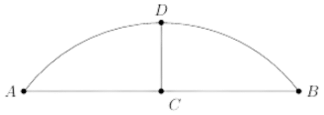
The segment from the chord’s midpoint to the arc’s midpoint is perpendicular to AB and passes through the centre. Half-chord = 6, height = 3.
With radius r, the centre is r − 3 below the arc’s midpoint: r2 = 62 + (r − 3)2, so 6r = 45 and r = 7.5 cm.
The first car takes t hours and the second t − 6 hours (it is 12 km/h faster).
2160/(t − 6) − 2160/t = 12, so t(t − 6) = 1080 and t = 36.
Speeds: 2160/30 = 72 and 2160/36 = 60. Ratio = 6 : 5.
Let a = 2x. Since a4 + a2 + 1 = (a2 + a + 1)(a2 − a + 1), the LHS = a2 − a + 1.
The RHS = (a3 + 1)/65 = (a + 1)(a2 − a + 1)/65. Cancelling: a + 1 = 65, so a = 64 = 26 and x = 6.
CP of an apple = 23/1.15 = ₹20; CP of an orange = 10/1.25 = ₹8.
23a + 10o = 653 requires a ending in 1: a = 21, o = 17 (a = 11 gives o = 40, but she bought more apples).
CP = 420 + 136 = 556, profit = 97, profit % = 97/556 × 100 ≈ 17.4%.
|x2 − 8x + 15| = 2x − 7, so x ≥ 3.5.
- x ≥ 5: x2 − 10x + 22 = 0, x = 5 ± √3. Only 5 + √3 is ≥ 5 ✓.
- 3 < x < 5: −(x2 − 8x + 15) = 2x − 7, so x2 − 6x + 8 = 0, x = 2 or 4. Only 4 lies in range ✓.
Sum = 4 + 5 + √3 = 9 + √3.
The 8 rooms form 4 opposite pairs. No two guests can share a pair, so each pair holds exactly one guest.
Neighbouring pairs can’t both use the same side, so the sides must alternate: 2 patterns. The 4 guests can be arranged in 4! = 24 ways.
Total = 2 × 24 = 48.
11p + 13n = 1000. Modulo 11: 2n ≡ 10, so n ≡ 5 (mod 11).
n = 5, 16, 27, 38, 49, 60, 71 gives p = 85, 72, 59, 46, 33, 20, 7. n = 82 would exceed 1000.
Number of ways = 7.
Original TSA = 2πr(r + h) = 2 × (22/7) × 7 × 28 = 1232.
- The cut parallel to the base adds two circles: 2πr2 = 308.
- The axial cut adds two rectangles of 14 × 21: 588.
Increase = 896, so the percentage increase = 896/1232 × 100 = 72.73%.
Correct: 0 · Wrong: 0 · Accuracy: 0%
You’ve completed the 50 Day Streak! Team MBA Karo wishes you all the best for CAT 2025!