CAT 50 Day Streak – Day 49
30 questions across VARC, DILR & QA · +3 for a correct answer · −1 for a wrong MCQ · no negative marking for TITA
VARC · Verbal Ability & Reading Comprehension
Why did the United States intervene in the Second World War? The question is rarely asked because the answers seem so obvious: Hitler, Pearl Harbour, and what more needs to be said? To most Americans, World War II was the quintessential “war of necessity.” As the late Charles Krauthammer once put it, “wars of choice,” among which he included Vietnam and the first Gulf War, are “fought for reasons of principle, ideology, geopolitics or sometimes pure humanitarianism,” whereas a “war of necessity” is a “life-or-death struggle in which the safety and security of the homeland are at stake.” If World War II is remembered as the “good war,” the idea that it was “necessary” is a big part of the reason why. The enemies were uniquely wicked and aggressive; Americans were attacked first; they had no choice but to fight.
This perception of World War II has had a paradoxical effect on the broader American foreign policy debate. On the one hand, writers of an anti-interventionist bent rightly perceive that the war’s reputation as “necessary” and therefore “good” has encouraged Americans to believe that other wars can be “necessary” and therefore “good,” too. (Krauthammer believed the “war on terror” was also one of “necessity,” and Richard Haass put the Gulf War in the “necessary” category, and in 1965 even David Halberstam and The New York Times editorial page believed that American intervention in Vietnam was necessary.) On the other hand, anti-interventionists are not alone in believing that, even if World War II was necessary, the circumstances were unique and therefore irrelevant to subsequent foreign policy discussions. There will never be another Hitler, and the idea that a foreign great power (as opposed to a terrorist group) might launch a direct attack on the United States seems far-fetched even today. World War II thus stands apart, bracketed from further relevance, as perhaps the only widely agreed “necessary” foreign war and therefore the only “good” foreign war that the United States has ever fought.
But what if even America’s intervention in World War II was not “necessary,” as most Americans would define the term? What if it, too, was a “choice” that Americans made, based on calculations not so different from those that produced the later wars of choice in Iraq, the Balkans, and Vietnam?
Many Americans who opposed American involvement in Europe and Asia in the late 1930s and early 1940s certainly did not believe the war was necessary. This was not because they were ignorant of the potential risks posed by Hitler and the Japanese Empire. The America First Committee, a group that combined corporate elites such as the chairman of Sears Roebuck with scions of the eastern establishment such as Joseph Kennedy and Chester Bowles, launched itself in September 1940, three months after the unexpected conquest of France by the German blitzkrieg. Its founders understood the implications of France’s defeat. They not only believed but predicted that Britain would be the next to fall, leaving the United States without a single meaningful ally in the European theatre.
The author asks whether the war was really “necessary”. The committee shows that well-informed Americans at the time, who fully understood the threat, still did not see it as a war of necessity. So that view was not a given then.
B contradicts the passage (“not because they were ignorant”). C: the fall of France is background, and nothing says it shocked all Americans. D: the author reports the committee’s prediction but does not argue it was right.
The paragraph ends by calling World War II “perhaps the only widely agreed ‘necessary’ foreign war and therefore the only ‘good’ foreign war” the US has fought. C follows directly.
A: the paragraph never says the definition is disputed between the two camps. B: no claim about an aggressive policy caused by victory. D: anti-interventionists see that the war’s reputation encouraged belief in other “necessary” wars; nothing is said about fearing what victory would lead to.
The paragraph says many Americans did not think the war necessary, “not because they were ignorant” of the risks, and uses the America First Committee as proof. That is B.
A is only the committee’s prediction, a detail. C is the point of the second paragraph. D reverses the paragraph; these Americans opposed intervention.
Krauthammer defines a war of necessity as a “life-or-death struggle in which the safety and security of the homeland are at stake”. Wars of choice are fought for principle, ideology, geopolitics or humanitarianism. The dividing line is a direct threat to national survival.
A: public support is never the criterion. B: humanitarianism and geopolitics are both reasons for wars of choice. C: the enemy’s wickedness explains why WWII is remembered as “good”, not how the two kinds of war are defined.
Newton removed calculus and used geometry, probably to suit his audience. “However”, calculus still drives many of those proofs. The next sentence, “This is especially clear… in his treatment of generated quantities”, needs that claim as its antecedent. So the sentence goes at blank 2.
At blank 1 it would interrupt Newton’s reason for using geometry. At blanks 3 and 4 it would break the explanation of “generated quantities”.
The project is free, runs for seven days, and sends one short, simple “micro act” each day. C captures all of this.
A is wrong; the activities are predetermined. B mistakes the opening laughter clip for the whole method. D contradicts “short, simple” 5–10 minute acts.
- One of the more bizarre aspects of relativity that strikes readers right at the beginning is how the geometry of spacetime can be counterintuitive.
- The effects of curvature can be neglected and the principles of Euclidean geometry applied in small spaces can be used.
- It is only a paradox if you aren’t steeped in the new view of the world that relativity conjures up.
- For instance, the shortest distance between two points in ordinary space is a straight line, but it turns out that in spacetime, this straight line corresponds to the longest time.
- This is a paradox unless you realize that space has a curvature.
The coherent paragraph is 1 → 4 → 5 → 3:
- 1: Spacetime geometry is counterintuitive.
- 4: “For instance”: the straight line corresponds to the longest time.
- 5: “This is a paradox” unless you realise space is curved.
- 3: “It is only a paradox” if you don’t see the world the way relativity does.
Sentence 2 is about when curvature can be ignored. The paragraph is about why the paradox arises, so 2 drifts to a different point.
“Such actions” needs the measures to have been described first. The paragraph lists them step by step, ending with the three forms of support. The sentence then closes with an evaluation, so it belongs at blank 4.
At blank 1 no actions have been named yet. At blanks 2 and 3 it would interrupt the description of the strategy, which continues with “As a starting point” and “That support”.
- The core question of existentialism is to understand the nature of human freedom and responsibility.
- It asserts that "existence precedes essence," meaning we are born a blank slate without inherent purpose.
- Consequently, humans are entirely free to define their own meaning through their choices and actions.
- This profound freedom, however, leads to anxiety and a sense of anguish, as we bear total responsibility.
The order runs like this:
- 1: Introduces existentialism and its core question.
- 2: “It asserts” existence precedes essence.
- 3: “Consequently”, humans are free to define their meaning.
- 4: “This profound freedom, however” brings anguish.
- What is attractive about Epicurus is the vision of a good life that emerges from his work and life.
- This is not because he had compelling arguments for his views because the fragments of original texts that we have, and the unreliability of many of the commentaries of his contemporaries, leave us with little knowledge of his actual arguments.
- On that score, if we’re playing the game of choosing your favourite ancient philosopher, I would say I’m most inspired by the vision of Epicurus.
- If philosophy is not only an academic, theoretical discipline but a way of life, as many Ancient Greek and Roman philosophers thought, one way of evaluating a philosophy is in terms of the kind of life it entails.
- The obvious rejoinder to Epicurus’s defence of pleasure is to point out that some pleasures are thoroughly destructive.
The coherent paragraph is 4 → 3 → 1 → 2:
- 4: A philosophy can be judged by the kind of life it entails.
- 3: “On that score”, the author is most inspired by Epicurus.
- 1: What attracts him is Epicurus’s vision of a good life.
- 2: “This is not because” of his arguments, which are mostly lost.
Sentence 5 raises an objection to Epicurus’s defence of pleasure. The paragraph is about why the author admires Epicurus’s vision, not about criticising it.
DILR · Data Interpretation & Logical Reasoning
Six players played a tournament of Rock-Paper-Scissors, in which each player played exactly one game of Rock-Paper-Scissors against every other player. In each game, each of the two players simultaneously chose exactly one sign among rock, paper, and scissors.
In any game, a player who chose rock won against a player who chose scissors; a player who chose scissors won against a player who chose paper, and a player who chose paper won against a player who chose rock. No two players chose the same sign in a game.
The following table provides the number of games in which each person chose each sign:
| Rock | Paper | Scissors | |
|---|---|---|---|
| Vishnu | 0 | 0 | 5 |
| Omkar | 0 | 1 | 4 |
| William | 5 | 0 | 0 |
| Ehsan | 4 | 1 | 0 |
| Lokesh | 1 | 3 | 1 |
| Subodh | 0 | 4 | 1 |
It is known that Ehsan won all the games he played.
- Ehsan. He won every game. William always plays rock, so Ehsan’s one paper was against William. His four rocks beat Vishnu, Omkar, Lokesh and Subodh, who all played scissors against him.
- Lokesh and Subodh. That uses up their only scissors. Subodh plays paper in all other games, including against Lokesh. Lokesh can’t also play paper there, so he plays his one rock against Subodh, and paper against Vishnu, Omkar and William.
- Omkar. Vishnu always plays scissors, so Omkar can’t play scissors against him. Omkar’s one paper is against Vishnu, and he plays scissors everywhere else.
| Player ↓ vs → | Vishnu | Omkar | William | Ehsan | Lokesh | Subodh | Wins |
|---|---|---|---|---|---|---|---|
| Vishnu | — | Scissors · W | Scissors · L | Scissors · L | Scissors · W | Scissors · W | 3 |
| Omkar | Paper · L | — | Scissors · L | Scissors · L | Scissors · W | Scissors · W | 2 |
| William | Rock · W | Rock · W | — | Rock · L | Rock · L | Rock · L | 2 |
| Ehsan | Rock · W | Rock · W | Paper · W | — | Rock · W | Rock · W | 5 |
| Lokesh | Paper · L | Paper · L | Paper · W | Scissors · L | — | Rock · L | 1 |
| Subodh | Paper · L | Paper · L | Paper · W | Scissors · L | Paper · W | — | 2 |
Each cell shows the row player’s sign and result. Vishnu beat Omkar, Lokesh and Subodh: 3 wins.
From the table in Q11, Subodh’s paper beat William’s rock and Lokesh’s rock: 2 wins.
Vishnu plays scissors in every game, and the two players must choose different signs. So Omkar’s only non-scissors game, his one paper, was against Vishnu.
From the table in Q11, Lokesh played paper against Vishnu, Omkar and William, scissors against Ehsan, and rock against Subodh.
From the table in Q11, the wins are Vishnu 3, Omkar 2, William 2, Ehsan 5, Lokesh 1 and Subodh 2. Lokesh won the fewest.
On the occasion of the Diwali celebration, the HR head of a company organized a game called ‘Har Ghadi Badal Rahi Hai Roop Zindagi’. The game is based on the position one takes in a clock (as shown in the figure). They can move one step clockwise, 1 step anticlockwise, or to a place diametrically opposite theirs. For example, from 3 O’clock, they can move to 4 O’clock, 2 O’clock, or 9 O’clock.
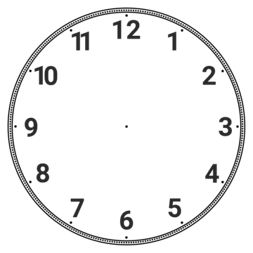
- At the start of a game, the player is at the 1 O’clock position and their score is zero.
- If they move a step clockwise, they add the time value in that position to their score to get the new score.
- If they move a step anticlockwise, they add the time value in that position and subtract 5 from their score.
- If they move a step diametrically opposite, they add the time value in that position to their score and subtract 3 to get the new score.
- Players cannot return to a position they have already visited.
| Move | From position p | Score change |
|---|---|---|
| Clockwise | p + 1 | + new value |
| Anticlockwise | p − 1 | + new value − 5 |
| Opposite | p ± 6 | + new value − 3 |
- Move 1: 1 → 12.
- Move 2: 12 → 11 or 6 (1 is already visited).
- Move 3: 11 → 10 or 5; 6 → 7 or 5.
- Move 4: 10 → 9 or 4; 5 (via 11) → 6 or 4; 7 → 8 (6 and 1 visited); 5 (via 6) → 4 (6 visited; opposite 11 is free, so also 11).
Positions possible after move 4: 9, 4, 6, 8, 11. 7 O’clock cannot be reached.
After 1 move: 2, 12 or 7. After 2 moves: 3, 8, 11 or 6. None is 5.
In 3 moves: 1 → 7 (opposite) → 6 → 5. Shortest = 3 moves.
Low-scoring routes, with the score after each move:
- 1 → 7 → 6 → 5: 4, 5, 5 (moving anticlockwise to 5 adds 5 − 5 = 0).
- 1 → 2 → 3 → 4: 2, 5, 9.
- 1 → 2 → 8 → 7: 2, 7, 9.
- 1 → 12 → 6 → 5: 7, 10, 10.
Every other route starts higher or adds more. The minimum after 3 moves is 5.
The aim is to reach the high numbers early and then collect them clockwise, with no penalty.
- Via 7: 1 → 7 → 8 → 9 → 10 → 11 gives 4, 12, 21, 31, 42.
- Via 2: best is 1 → 2 → 8 → 9 → 10 → 11 = 37.
- Via 12: best is 1 → 12 → 6 → 7 → 8 → 9 = 34.
Maximum = 42.
Only clockwise and opposite moves are allowed. From 11 he can go to 12 (+12) or 5 (+2).
- 11 → 12 → 6 → 7 → 8: 12 + 3 + 7 + 8 = 30
- 11 → 12 → 1 → 7 → 8: 12 + 1 + 4 + 8 = 25
- 11 → 12 → 1 → 2 → 3: 18
- 11 → 5 → 6 → 7 → 8: 2 + 6 + 7 + 8 = 23
Maximum = 30.
QA · Quantitative Ability
Let log2|x| = t, so |x| = 2t and 3log2|x| = 3t.
The equation becomes 2t − 3t = 6t. Dividing by 2t: (3/2)t + 3t = 1.
The left side is strictly increasing in t, goes to 0 as t → −∞ and equals 2 at t = 0. So there is exactly one t (negative), giving one value of |x| and two values of x (±). Answer: 2.
Mango stays the same, so scale both ratios to equal mango: 5:7:9 → 25:35:45 and 9:7:5 → 81:63:45.
X = 81 − 25 = 56 and Y = 63 − 35 = 28, so X : Y = 2 : 1.
Manish: P(0, 1, 2 heads) = 1/4, 1/2, 1/4. Danish: P(0, 1, 2 heads) = 1/8, 3/8, 3/8.
P(same) = (1/4)(1/8) + (1/2)(3/8) + (1/4)(3/8) = 1/32 + 6/32 + 3/32 = 10/32 = 5/16.
Try a perfect cube that makes x + 9 a perfect square. For x = 27: √(27 + 9) = 6, so the LHS = √(3 + 6) = 3, and ∛27 = 3 ✓.
As x grows, the LHS grows roughly like x1/4 while the RHS grows like x1/3, so the RHS overtakes the LHS only once. x = 27.
The ratio is [n(n + 1)(2n + 1)/6] ÷ [n(n + 1)/2] = (2n + 1)/3.
This is an integer when 2n + 1 ≡ 0 (mod 3), i.e. 2n ≡ 2, so n mod 3 = 1. (C is only a special case; n = 4 also works.)
Let each final amount be A. The principals are A/1.1, A/1.15 and A/1.2, i.e. A × (10/11, 20/23, 5/6).
Sum = A × (1380 + 1320 + 1265)/1518 = A × 3965/1518 = 79300, so A = 20 × 1518 = 30360.
Xavier’s loan = 30360/1.1 = ₹27600.
Let the sides be n and 4n. Interior angles: 180(n − 2)/n and 180(4n − 2)/(4n).
Ratio: 4(n − 2)/(4n − 2) = 8/11, so 44n − 88 = 32n − 16 and n = 6.
Sides 6 and 24, sum = 30.
Conditions: x + 18 ≥ 0 (x ≥ −18) and 2 − x > 0 (x < 2).
Squaring: x + 18 < x2 − 4x + 4, so x2 − 5x − 14 > 0, i.e. (x − 7)(x + 2) > 0, giving x < −2 or x > 7.
Combining: [−18, −2).
Let him have P pebbles and collect c. After throwing away one-fifth: 0.8(P + c) = 1.2P.
P + c = 1.5P, so c = 0.5P = 50%.
- Half the curved surface: πrh = π × 6 × 18 = 108π
- Two semicircular ends: πr2 = 36π
- Rectangular cut face: 2r × h = 12 × 18 = 216
Total = (144π + 216) sq cm.
Correct: 0 · Wrong: 0 · Accuracy: 0%
Keep the streak alive. See you tomorrow for Day 50.