
CAT 50 Day Streak – Day 4
30 questions across VARC, DILR & QA · +3 for a correct answer · −1 for a wrong MCQ · no negative marking for TITA
VARC · Verbal Ability & Reading Comprehension
Whether your experience of puberty was mostly positive, mostly negative, or somewhere in between, you probably remember undergoing both biological and social transformations. Your skin changed, you grew taller, and you developed sexual and physical characteristics. But perhaps you also experienced changes in mood and sleep, changes in your social life, your first romantic relationships and other grown-up roles.
Of course, even among kids who are the same age, there can be large developmental differences. Maybe you suddenly got taller one year, and your best friend stayed the same height. This reflects what scientists call ‘pubertal timing’ – how early or late one individual develops compared with others of the same age and sex. For girls, some of the physical developmental changes that take place can be especially visible, making certain girls look a lot older than others. The physical changes of puberty typically start to emerge between ages eight and 13 for girls, on average – driven by underlying increases in the body’s hormone levels – and these changes unfold during the biggest period of neural development since infancy.
With their bodies, brains and lives in flux, some adolescents thrive while others experience a new set of social and psychological challenges. From puberty onwards, girls are two to three times more likely than boys to experience depression. And research has shown that, when girls or boys go through puberty earlier than their peers, they’re at higher risk for depression and anxiety. This increased risk persists through adolescence, so those who started puberty earlier continue to be more likely to develop depression and anxiety than peers who started puberty later.
There are several theories about why early timing of puberty is linked to these negative mental health outcomes. These mechanisms might differ between boys and girls because girls have different experiences from boys, both socially and physically, during puberty. While pubertal processes are important for well-being in boys and gender-diverse adolescents – and further studies involving these understudied populations are critical – more research to date has focused on the reasons why earlier-developing girls are at increased risk for depression and anxiety. One theory is that increased levels of the hormones that skyrocket at puberty can affect the developing brain directly. Although it’s mostly based on animal research, the idea is that the brain might be more sensitive to these hormonal changes at an earlier age, changing the brain in ways that make it more reactive to stressful experiences.
Yet early biological changes can affect adolescents’ social lives, too. For example, some girls who develop earlier might have more negative feelings about their bodies because they don’t look like their friends do. Also, girls who look a lot older than they are might be treated differently by peers or adults who overestimate how socially or cognitively mature they are. That could include, for instance, being treated as people who are ready for sexual experiences when they are not. In short, they might be receiving attention that affects them negatively.
The author notes that boys and gender-diverse adolescents are “understudied populations” and that “more research to date has focused on” earlier-developing girls. That gap is exactly C.
A: animal research is mentioned for one theory, but it isn’t presented as the research’s main weakness. B: developmental differences are simply what pubertal timing describes. D: the passage discusses both hormonal and social theories.
If girls with little social exposure show the same elevated depression rates, then social treatment can’t be what drives the risk. A removes the proposed cause and the effect remains, which weakens the social theory most directly.
B concerns a boy/girl difference, which may have other explanations. C weakens the hormonal theory, not the social one. D is suggestive, but the girls in D still face peer and adult treatment, so it is weaker than A.
The passage moves in four steps. It opens with puberty in general, narrows to pubertal timing, links early timing to depression and anxiety, and then offers hormonal and social explanations. That is B.
A: there are no anecdotes and no call to action. C: the passage doesn’t critique methods or propose an agenda. D: the passage isn’t a boy-versus-girl comparison.
The passage stresses “large developmental differences” even among kids of the same age, so D contradicts it.
A is the passage’s definition of pubertal timing. B is stated for “girls or boys”. C is the hormonal theory.
The Dutch East India Company is the prime example of economic power shifting “to northern Europe”, so the sentence follows the claim about new maritime routes. It then leads into the wider point that merchants in Amsterdam, London and Lisbon commanded ocean-spanning networks.
At blank 1 the shift hasn’t been introduced yet. At blanks 3 and 4 the paragraph has already generalised and concluded.
- For example, Network Rail recently sent 200 workers to a meeting by road rather than rail because they deemed the train too expensive.
- The mixed message sent is deeply demotivating for the general public, especially when getting people to behave differently is up against so much else.
- Culturally, we are constantly and disproportionately prompted to behave primarily as self-absorbed consumers, and only remotely as engaged, publicly-minded citizens.
- Almost the whole of economic policy is geared toward growth and promoting energy-intensive material consumption.
- Economically, price signals don’t work because they exclude climate costs.
Sentences 5, 1, 4 and 3 list the structural barriers to climate-friendly behaviour, in the order 5 → 1 → 4 → 3:
- 5: “Economically”, price signals exclude climate costs.
- 1: “For example”, Network Rail chose road because rail was pricier.
- 4: Economic policy as a whole is geared toward growth and consumption.
- 3: “Culturally”, we are prompted to act as consumers, not citizens.
Sentence 2 refers to “the mixed message” and to public motivation. It has no clear antecedent and shifts from describing barriers to their effect on the public.
A captures the three moves: popular usage equates narcissism with selfishness, psychology separates the trait from the disorder, and research has found hidden, insecure narcissists.
B makes social media the cause, which the passage doesn’t claim. C says “all” narcissists are insecure, but the passage says they exist “as well”. D says narcissists are easy to identify, which contradicts “hidden from public view”.
The first line mentions “one of the most revolutionary inventions” without naming it. The missing sentence names the printing press and states its core impact. The next sentence can then refer back to it as “Gutenberg’s press” and give the details.
At blanks 2–4, the press has already been discussed, and the sentence would repeat or interrupt the development.
- Relativity shattered this idea by showing that time depends on the observer’s motion and position.
- The result is a concept of time that is far stranger and less absolute than our everyday experience.
- Quantum mechanics further complicated the picture, suggesting that time may emerge from deeper, timeless processes.
- Physicists once assumed time was an objective backdrop against which events unfolded.
The order runs like this:
- 4: The old view: time as an objective backdrop.
- 1: Relativity “shattered this idea”.
- 3: Quantum mechanics “further complicated the picture”.
- 2: “The result” is a stranger, less absolute concept of time.
- This analysis implicated the axons (output connections) of neurons as well as parts of the cortex and deeper “subcortical” brain regions like the striatum, involved in movement.
- These findings tally with brain-imaging studies suggesting dysfunction of some regions in insomnia, and with animal studies implicating these cells in sleep regulation.
- It also tagged “medium spiny neurons,” which occupy most of the striatum as well as neurons in other regions, including the hypothalamus.
- The researchers then investigated which brain regions and cells these genes frequently turn up in.
- In fact, it is probable that insomnia is not a singular condition but a cluster of symptoms grouped together, which can have a range of underlying causes.
The coherent paragraph is 4 → 1 → 3 → 2:
- 4: Researchers checked where the genes turn up.
- 1: “This analysis” implicated axons, cortex and striatum.
- 3: “It also” tagged medium spiny neurons.
- 2: “These findings” tally with imaging and animal studies.
Sentence 5 makes a general claim that insomnia is a cluster of symptoms. It breaks away from the gene-mapping thread.
DILR · Data Interpretation & Logical Reasoning
Seven employees of a company, Ajay, Bhanu, Chetan, Deepa, Ekta, Falguni and Garima, retired in different months of different years. The months are among February, March, June, July, September, October and December, and the years are from 2005 to 2011.
- Falguni retired in a year which is divisible by 3.
- Bhanu and Chetan retired in February and October, respectively, and one of them retired in a leap year.
- Four persons retired between the retirement years of Ajay and Deepa.
- Ekta retired in June in the year just after the year in which Chetan retired.
- Ajay retired in a month having 31 days, while Garima retired in a month having 30 days.
- Bhanu retired before Garima but not immediately after Ajay.
- One of the persons retired in July 2005.
- Garima’s month has 30 days, so it is June or September. June is Ekta’s, so Garima retired in September.
- Ajay’s month has 31 days: March, July or December (October is Chetan’s). Ajay, Deepa and Falguni share March, July and December.
- Ajay and Deepa are 5 years apart: (2005, 2010) or (2006, 2011). July 2005 must be Ajay or Deepa, since Falguni’s year is a multiple of 3. So Ajay and Deepa are 2005 and 2010, and Falguni is 2007.
- The years left are 2006, 2008, 2009 and 2011. Chetan and Ekta need consecutive years, so Chetan = 2008 (the leap year) and Ekta = 2009. Bhanu retired before Garima, so Bhanu = 2006 and Garima = 2011.
- Bhanu is not immediately after Ajay, so Ajay ≠ 2005. That gives Deepa = July 2005 and Ajay = 2010.
| Year | Person | Month |
|---|---|---|
| 2005 | Deepa | July |
| 2006 | Bhanu | February |
| 2007 | Falguni | March / December |
| 2008 | Chetan | October |
| 2009 | Ekta | June |
| 2010 | Ajay | March / December |
| 2011 | Garima | September |
Bhanu retired in 2006.
Ajay (2010) and Falguni (2007) share March and December in either order. Ajay’s month cannot be determined.
Garima retired last, in September 2011, so all the other 6 retired before her.
Bhanu retired in 2006 and Ekta in 2009. Only Falguni (2007) and Chetan (2008) are in between, which is 2 people, not 3. So C is definitely false.
A is possible (Ajay could be December). B and D are true.
From Ajay (2010) to Garima (September 2011) is 18 months, so Ajay retired in March 2010. That puts Falguni in December 2007.
December 2007 to October 2008 (Chetan) is 10 months.
Don, Gary, Kane, Phil, Sam, and Tony are 6 friends. The bar graph gives their annual expenditures, and the pie chart gives the income distribution of Gary.
Income = Expenditure + Salary
Assume the expenses are evenly distributed every month.
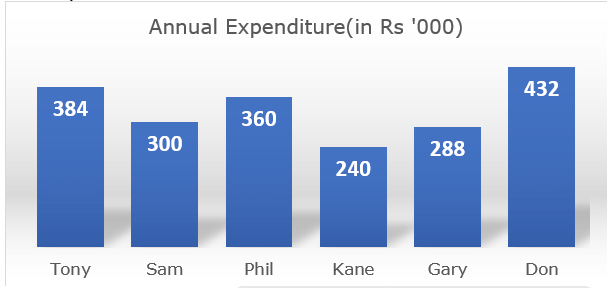
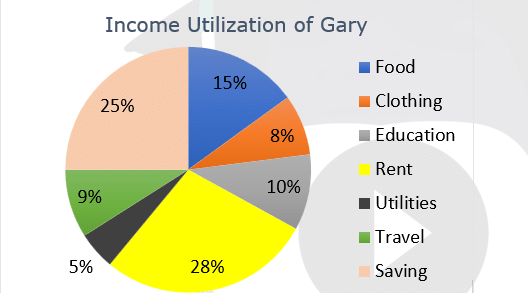
Gary’s income. Gary saves 25%, so his expenditure is 75% of his income. The bar graph gives his expenditure as 288 (Rs ’000), so his income = 288 ÷ 0.75 = 384.
| Gary’s head | % of income | Amount (Rs ’000) |
|---|---|---|
| Food | 15% | 57.6 |
| Clothing | 8% | 30.72 |
| Education | 10% | 38.4 |
| Rent | 28% | 107.52 |
| Utilities | 5% | 19.2 |
| Travel | 9% | 34.56 |
| Saving | 25% | 96 |
| Income | 100% | 384 |
Education total for Phil, Sam and Tony = 5 × 38.4 = 192. Tony’s share = 8/20 × 192 = 76.8.
As a share of Tony’s expenditure (384): 76.8 ÷ 384 = 20%.
Gary’s rent is 107.52 and his utilities are 19.2 (Rs ’000), from the table in Q16.
Phil’s rent = 1.25 × 107.52 = 134.4, and Phil’s utilities = 19.2.
134.4 ÷ 19.2 = 7 times.
Tony’s travel = 1.5 × 34.56 = 51.84. This is 12% of his income, so his income = 51.84 ÷ 0.12 = 432.
His expenditure is 384, so he saves 432 − 384 = 48.
48 ÷ 432 = 11.11%.
Gary’s food expense is 57.6 (Rs ’000).
- Kane: 1.25 × 57.6 = 72
- Phil: 1.20 × 57.6 = 69.12
- Sam: 1.15 × 57.6 = 66.24
Total food = 207.36. Total expenditure of the three = 240 + 360 + 300 = 900.
207.36 ÷ 900 = 23.04%.
In this set, Income = Expenditure + Salary, so “salary” is the part of income that isn’t spent, i.e. the amount saved.
Gary saves 96,000 a year, which is Rs. 8,000 a month. So Don’s monthly salary = 8,000 ÷ 2 = Rs. 4,000, and Kane’s = 2 × 8,000 = Rs. 16,000.
Difference = 16,000 − 4,000 = Rs. 12,000.
QA · Quantitative Ability
Let the daily rates be a, b and c, with a + b + c = 1/45.
B takes 3 times as long as A + C, so a + c = 3b. Then 4b = 1/45, giving b = 1/180.
C takes 4 times as long as A + B, so a + b = 4c. Then 5c = 1/45, giving c = 1/225.
b + c = 1/180 + 1/225 = 9/900 = 1/100, so B and C together take 100 days.
The terms are a, ar, ar2. For a to be the median, r must be negative, and r ≠ −1 since the terms are distinct.
The sum is a(1 + r + r2) = ±42, so (1 + r + r2) must divide 42:
- r = −2: 3, so a = ±14 and b = ∓28
- r = −3: 7, so a = ±6 and b = ∓18
- r = −5: 21, so a = ±2 and b = ∓10
The possible |b| values are 28, 18 and 10. 12 is not possible.
Syrup is 5/8 of the mixture. Replacing a fraction f with water leaves (5/8)(1 − f) syrup.
(5/8)(1 − f) = 1/2 gives 1 − f = 4/5, so f = 1/5.
Since AB ∥ CD, ∠A = 180° − 130° = 50° and ∠B = 180° − 140° = 40°. Extend AD and BC to meet at X. Then ∠X = 90°.
In a right triangle, the median to the hypotenuse is half of it. So XP = 16/2 = 8, and in the similar triangle XDC, XQ = 10/2 = 5.
X, Q and P are collinear (the common median), so PQ = 8 − 5 = 3.
LCM(9, 10, 12, 25) = 900, so N = 900k + 4, which gives 904 or 1804 below 2000.
904 ÷ 11 is not an integer, but 1804 = 11 × 164. So N = 1804.
Let Charan’s speed be v and the pickup point be x km from P.
Charan covers 2.5 + (2.5 − x) + (5 − x) = 10 − 2x. This equals 1.6 × 5 = 8 km, so x = 1.
Charan reaches the pickup after 4 km, i.e. at time 4/v. Dinesh has walked 1 km by then, so his speed is v/4.
Walking all the way would take 5 ÷ (v/4) = 20/v. The actual time is 8/v, so he saves 12/v = 2/3 h. That gives v = 18 km/h.
Dinesh’s speed = 18/4 = 4.5 km/h.
Rewrite as (x − 5)2 + y2 = 9, a circle with centre (5, 0) and radius 3.
y/x is the slope m of a line through the origin. It is largest when the line y = mx is tangent to the circle: 5|m| / √(1 + m2) = 3.
That gives 16m2 = 9, so the maximum m = 3/4.
MP = 1.25 × 1234 = 1542.50. After a 12% discount: 1542.50 × 0.88 = 1357.40.
SP = 1234 − 12.34 = 1221.66. Then 1221.66 / 1357.40 = 0.90, so x = 10.
O is equidistant from AB and BC (both are tangents), so O lies on the bisector of ∠B.
By the angle-bisector theorem, AO : OC = AB : BC = 22 : 33 = 2 : 3. So AO = 30 × 2/5 = 12.
The denominators are 3·7, 7·11, 11·15, 15·19, 19·23 and 23·27, each a product of numbers 4 apart.
Use 1/(n(n + 4)) = (1/4)(1/n − 1/(n + 4)). The sum telescopes to (1/4)(1/3 − 1/27) = (1/4)(8/27) = 2/27.
x × 2/27 = 100, so x = 1350.
Correct: 0 · Wrong: 0 · Accuracy: 0%
Keep the streak alive. See you tomorrow for Day 5.