CAT 50 Day Streak – Day 28
30 questions across VARC, DILR & QA · +3 for a correct answer · −1 for a wrong MCQ · no negative marking for TITA
VARC · Verbal Ability & Reading Comprehension
Every now and then, life asks us a question we aren’t quite sure how to answer. Which career should we pursue? Should we have children? Should we move to the coast, or closer to our friends? We gather information, read testimony, and place our exhaustively researched options on either side of the scales, but the scales never settle. One option seems better in some ways, the other seems better in others, and we find ourselves stuck between them. The ‘best’ answer eludes us. This is what the philosopher Ruth Chang calls a ‘hard choice’. Chang proposes that what makes these kinds of choices hard is not so much their content but their structure: they don’t fit into our standard trichotomy of value in decision making.
Usually, we compare two options using ‘better’, ‘worse’, or ‘equal to’. If there are better reasons to do X than Y, then the rational thing is to pick X; meanwhile, if X and Y are equal, then it doesn’t matter which one we pick. But hard choices defy this evaluative framework. They involve cases where choices are no better or worse than each other. Our dilemma surely exists, we might think, because the options are equally good and we can’t decide between them. But Chang suggests this is a mistake. One option is no better or worse than the other, but they lead to different — often mutually exclusive — kinds of futures, and we cannot decide which kind of future to have. When it comes to hard choices, Chang thus argues, the standard trichotomy of ‘better’, ‘worse’, and ‘equal to’ is insufficient. To aid our thinking, she introduces a fourth dimension: parity. We should think of the options not as equal but as on par.
Thinking in terms of parity can help us clarify what’s at stake in hard choices. Suppose a young person is stuck between pursuing a career in forestry or law. They see the former as better in some ways, and law as better in others. They’ve researched the decision as much as they possibly can. They’ve garnered testimony from foresters and lawyers. But still they can’t decide. The young person might think, “if only I could see how my life would go in forestry, and then in law, so I could compare the two and make a more informed choice about which is better or worse…” But Chang argues that even if the young person could do this, it wouldn’t help them decide. They would simply bear witness to two different kinds of life, both with their own rewards and hardships, and watch themselves become a different version of themselves in each.
This is the crux of a hard choice: when options are on a par, we hunt for a definitive reason, given to us by the world, for picking one over the other. The way isn’t signposted. External reasons have ‘run out’. But rather than feel mired in gloom or anxiety by this, Chang notes, we might actually see it as quite powerfully liberating. If external reasons have run out, then perhaps we can choose to be guided by internal ones.
The passage says the opposite of C. The young person has “researched the decision as much as they possibly can”, and Chang argues that even seeing both lives “wouldn’t help them decide”. Hard choices come from their structure, not from missing information.
A matches the claim that the trichotomy “is insufficient”. B matches “different — often mutually exclusive — kinds of futures”. D matches “better in some ways… better in others” while the scales “never settle”.
Chang never says rational choice becomes impossible. When external reasons run out, we can still be guided by internal ones, and she calls that “liberating”. So D is not implied.
A follows from “hard choices defy this evaluative framework”. B is the definition of parity as a fourth dimension. C is the passage’s final line.
Chang says that even seeing how life would go down each path wouldn’t help. A shows that simulating both futures, which is close to that exact thought experiment, does produce clarity. That directly undercuts her claim.
B is about eventual satisfaction, not about resolving the choice. C concerns advice from family, not extra information about the options. D, if anything, supports parity (different options, similar well-being).
Parity only makes sense if two different lives can each be valuable in their own way, “both with their own rewards and hardships”, without one being better overall. That is the unstated premise.
A contradicts the argument, since a single metric would allow ranking. C isn’t needed; Chang actually suggests internal reasons can be liberating. D contradicts her view that the choice is meaningful and can be guided by our own values.
The sentence introduces parents’ worry “for good reason”. The next sentence supplies those reasons: biking is risky and safe practice spaces are hard to find. Then “But if parents can find safe environments…” answers the worry. So it opens the paragraph at blank 1.
At blanks 2–4 the paragraph has already moved past the worry to the benefits of freedom, decision-making and spatial maps, so a fresh worry would break the flow.
- The good news is, lots of other people want to be more sociable too.
- I study not just what choices people make during their social interactions, but also how they might make better ones.
- These puzzles guide my research into conversation.
- Some people take conversations for granted because the best ones feel easy and natural.
- And yet I’m often surprised by the opportunities people miss to enjoy one another’s company, to learn from each other, and to start building new, meaningful connections.
The coherent paragraph is 1 → 5 → 3 → 2:
- 1: Many people want to be more sociable (“the good news”).
- 5: “And yet” they miss chances to connect, which contrasts with that wish.
- 3: “These puzzles” (the missed opportunities) guide the author’s research.
- 2: What that research studies: the choices people make and how to make better ones.
Sentence 4 offers a reason why people take conversation for granted. Nothing else in the chain picks up that idea, so it is the odd one out.
- Because A.I. can generate abridgments, summaries, and other condensed editions on demand, we may even switch between versions as circumstances dictate.
- We may routinely start with alternative texts and only later decide to seek out originals, in roughly the same way that we now download samples of new books to our Kindles before committing to them.
- But over the next decade or so, that polarity may well reverse.
- In our current reading regime, summarized or altered texts are the exception, not the rule.
The order runs like this:
- 4: Today, altered texts are the exception, not the rule.
- 3: “But… that polarity may well reverse” refers back to exception vs. rule.
- 2: What the reversal looks like: we start with alternative texts and seek originals later.
- 1: “We may even switch between versions” takes the idea one step further.
B captures all three elements: Flores’s late recognition, the nature of kené (communal, matrilineal, dismissed as folkloric), and its move onto the international stage.
A turns Norzi into the main point and draws a general lesson the passage doesn’t make. C invents “large cultural institutions”; it was one artist. D invents signing and commercialisation.
The sentence splits the cost between NASA and ISRO. It must come right after NASA finds a partner “to share the work and cost” in India, which puts it at blank 3.
At blanks 1 and 2, India hasn’t been introduced yet, so “ISRO’s contribution” would have nothing to refer to. Blank 4 follows the Shukla astronaut example, which is a different topic.
- One way I might describe it is to say that I study symmetries of mathematical objects.
- But when I went to college at Harvard, I took a course in topology, which is the study of spaces.
- There are a lot of other ways symmetries come up, and they can get really, really complicated.
- This comes about when you’re interested in things like our universe, where the Earth is rotating, and it’s also rotating around the sun, and the sun is in a larger system that is rotating.
- All those rotations are symmetries.
The coherent paragraph is 1 → 4 → 5 → 3:
- 1: The author studies symmetries of mathematical objects.
- 4: “This comes about” with the example of a rotating universe.
- 5: “All those rotations are symmetries.”
- 3: “A lot of other ways” symmetries come up, beyond rotations.
Sentence 2 is a biographical aside about a college topology course. Its “But” has nothing to contrast with, and it breaks the explanation of symmetry.
DILR · Data Interpretation & Logical Reasoning
Each of the four professors - Anwar, Badal, Casper, and Daljeet - taught for an integral number of years in each of the three colleges - IIT X, IIT Y, and IIT Z. The total time spent in the three colleges together was distinct for the four professors. The total time spent by the four professors together in IIT X, IIT Y, and IIT Z was 12, 13, and 14 years respectively. No professor spent an equal number of years in any two colleges. No two professors spent an equal number of years in any college. Each professor taught for at least one year in each college. It is also known that:
- Among the three colleges, Daljeet spent the least time in IIT Y and the maximum time in IIT Z.
- The number of years spent by Anwar and Casper in IIT Z was 4 and 2 respectively.
- The total time spent in the three colleges together by Casper was more than that by Anwar.
- The total time spent by Badal in the three colleges together was 16 years.
- The difference between the number of years spent by Anwar in IIT X and the number of years spent by Casper in IIT Y was 2.
- Possible column values. Each college has four distinct values, each at least 1. For IIT X (sum 12), the sets are {1,2,3,6} or {1,2,4,5}. For IIT Y (sum 13), they are {1,2,3,7}, {1,2,4,6} or {1,3,4,5}. So X ≤ 6 and Y ≤ 7.
- IIT Z. Anwar and Casper have 4 + 2, so Badal + Daljeet = 8 with values other than 2 and 4. Daljeet’s Z is his maximum, so Daljeet’s Z ≥ 3. That leaves (Badal, Daljeet) = (1, 7), (3, 5) or (5, 3).
- Badal = 16. If Badal’s Z were 1, he’d need 15 from X + Y, which is above the maximum 6 + 7 = 13 ✗. If it were 3, he’d need X = 6 and Y = 7, which leaves Casper only {1, 3} in X and Y. Then |Anwar’s X − Casper’s Y| = 2 can’t be met ✗. So Badal’s Z = 5 and Daljeet’s Z = 3.
- Daljeet. His Z = 3 is his maximum and Y is his minimum, so Y = 1, X = 2, total 6.
- Badal. He needs X + Y = 11 with no value repeating his 5, which forces X = 4 and Y = 7. So X = {1,2,4,5} and Y = {1,2,3,7}.
- Anwar and Casper. They share X {1, 5} and Y {2, 3}. Casper’s Z is 2, so Casper’s Y = 3 and Anwar’s Y = 2. |Anwar’s X − 3| = 2 gives Anwar’s X = 1 or 5. If it were 5, Casper would total 6, less than Anwar ✗. So Anwar’s X = 1 and Casper’s X = 5.
| Professor | IIT X | IIT Y | IIT Z | Total |
|---|---|---|---|---|
| Anwar | 1 | 2 | 4 | 7 |
| Badal | 4 | 7 | 5 | 16 |
| Casper | 5 | 3 | 2 | 10 |
| Daljeet | 2 | 1 | 3 | 6 |
| Total | 12 | 13 | 14 | 39 |
Badal spent 5 years at IIT Z.
From the table in Q11, the highest single value is Badal’s 7 years at IIT Y.
From the table in Q11, Casper: 5 + 3 + 2 = 10 years.
From the table in Q11, the IIT X values are Anwar 1, Badal 4, Casper 5 and Daljeet 2. The least is Anwar.
From the table in Q11, the values used are 1, 2, 3, 4, 5 and 7. No professor spent 6 years in any college.
Eight customers - Pushkar, Quinton, Rehman, Sandeep, Tilak, Uday, Veer, and Wahab ordered one food item each from Chicken, Burger, Pizza, Biryani, Noodles, Pasta, Idli, and Fries using different coupon codes - Happy Hours, Desi, Stay Home, Match Day and BOGO from a food delivery app.
Four delivery boys, Ahmad, Bhanu, Charanjeet, and David, delivered orders to these customers. No more than two people order food using the same code. Each delivery boy delivered two customer orders. Quinton ordered the food using the code Desi, but the order was not delivered by Bhanu. Sandeep ordered Noodles, and the order was delivered by Ahmad. Veer used the code Happy Hour, and his order was delivered by Charanjeet. Biryani was ordered using the code Happy Hour and was delivered by Charanjeet. Rehman is the only person who used the BOGO code, and he ordered a Burger. Pushkar ordered Fries, and the order was delivered by Bhanu. Both Sandeep and Tilak used the same code. The same was the case with Pushkar and Uday. Idli was ordered using the Match Day code. Wahab did not order Pizza. Pizza was ordered using the Happy Hour code. Chicken and the food ordered using the code BOGO were delivered by David. Ahmad did not deliver the order to Quinton or Tilak. Ahmad did not deliver the Pasta.
- Happy Hours. Pizza and Biryani both used Happy Hours, and so did Veer. The code allows only two people, so Veer and one other person ordered Pizza and Biryani.
- The second Happy Hours customer. It can’t be Sandeep/Tilak or Pushkar/Uday, because each pair shares a code and that would make three. It can’t be Quinton (Desi) or Rehman (BOGO). So it is Wahab. Wahab didn’t order Pizza, so Wahab has Biryani and Veer has Pizza. Charanjeet delivered both.
- Other codes. Desi can’t take either pair (that would be 3 with Quinton), so Desi is used only by Quinton. The two pairs take Stay Home and Match Day.
- Deliveries. David has Rehman plus the Chicken order. Quinton, Tilak and Uday fill the remaining slots with Ahmad, Bhanu and David. Ahmad can’t take Quinton or Tilak, so Ahmad delivers Uday. Quinton isn’t Bhanu’s, so David delivers Quinton, who therefore has Chicken. Bhanu delivers Tilak.
- Foods and codes. Ahmad didn’t deliver Pasta, so Uday has Idli and Tilak has Pasta. Idli used Match Day, so Pushkar and Uday used Match Day, and Sandeep and Tilak used Stay Home.
| Customer | Food | Code | Delivered by |
|---|---|---|---|
| Pushkar | Fries | Match Day | Bhanu |
| Quinton | Chicken | Desi | David |
| Rehman | Burger | BOGO | David |
| Sandeep | Noodles | Stay Home | Ahmad |
| Tilak | Pasta | Stay Home | Bhanu |
| Uday | Idli | Match Day | Ahmad |
| Veer | Pizza | Happy Hours | Charanjeet |
| Wahab | Biryani | Happy Hours | Charanjeet |
Tilak ordered Pasta.
From the table in Q16, Pushkar and Uday took Match Day (Uday ordered Idli), so Sandeep and Tilak used Stay Home.
From the table in Q16, Match Day, Stay Home and Happy Hours were each used twice. Desi was used only by Quinton. BOGO was also used once, but it isn’t among the options.
From the table in Q16, Tilak’s Pasta was delivered by Bhanu.
From the table in Q16, Uday was delivered by Ahmad, who didn’t deliver Pasta. So Uday ordered Idli.
QA · Quantitative Ability
Let the first pipe take a hours. Then the second takes a − 5 and the third takes a − 9.
1a + 1a − 5 = 1a − 9, so (2a − 5)(a − 9) = a(a − 5).
This gives a2 − 18a + 45 = 0, i.e. (a − 15)(a − 3) = 0. Here a = 3 would make the other times negative, so a = 15 hours.
Let the base side be x and the height h, with x2h = 72.
Cost = 800 × 2x2 + 300 × 4xh = 1600x2 + 1200 × 72x = 1600x2 + 86400x.
Setting the derivative to zero: 3200x = 86400x2, so x3 = 27 and x = 3 (h = 8).
Minimum cost = 1600 × 9 + 86400/3 = 14400 + 28800 = Rs. 43,200.
f(x) + f(y) = log (1 + x)(1 + y)(1 − x)(1 − y) = log 1 + xy + x + y1 + xy − x − y.
Divide the numerator and denominator by (1 + xy) and let t = x + y1 + xy. The expression becomes log 1 + t1 − t = f(t).
So f(x) + f(y) = f((x + y)/(1 + xy)).
Let Sajal’s speed be s and the walkway’s speed w = s/2. Rahul’s effective speed is R = r + w.
In 18 s, Rahul covers 18R and Sajal covers 18s. After crossing, each covers the other’s distance:
Sajal’s time − Rahul’s time = 18Rs − 18sR = 27.
With k = R/s: k − 1/k = 1.5, so 2k2 − 3k − 2 = 0 and k = 2. So R = 2s.
Rahul’s walking speed r = 2s − 0.5s = 1.5s. Ratio r : s = 3 : 2.
Every fourth power is also a perfect square, so we only need squares or cubes.
There are 1000 squares (12 to 10002) and 100 cubes (13 to 1003). Numbers that are both are sixth powers: 16 to 106, which is 10.
Total = 1000 + 100 − 10 = 1090.
Subtracting the two equations: x + yz − xy − z = 1, so (x − z)(1 − y) = 1.
Since y ≥ 1, the factor 1 − y ≤ 0. So both factors must be −1: y = 2 and z = x + 1.
Then 2x + x + 1 = 2020, so x = 673 and z = 674. Check: 673 + 2 × 674 = 2021 ✓.
The largest value is 674.
P(7 or more heads) = (10C7 + 10C8 + 10C9 + 10C10)/210 = (120 + 45 + 10 + 1)/1024 = 176/1024.
P(at most 6) = 1 − 176/1024 = 848/1024 = 53/64.
The cone has radius 8 and height 48. Let the cylinder have radius r and height 2r.
By similar triangles, r/8 = (48 − 2r)/48, so 48r = 384 − 16r and r = 6. The cylinder’s height is 12.
Cone = ⅓π × 64 × 48 = 1024π. Cylinder = π × 36 × 12 = 432π.
Required volume = 1024π − 432π = 592π cm3.
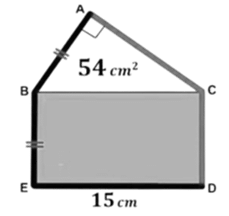
BC = ED = 15, and the right angle is at A. So AB2 + AC2 = 225 and ½ × AB × AC = 54, i.e. AB × AC = 108.
(AB + AC)2 = 225 + 216 = 441, so AB + AC = 21. (AC − AB)2 = 225 − 216 = 9, so AC − AB = 3. That gives AB = 9 and AC = 12.
BE = AB = 9, so the area of EBCD = 15 × 9 = 135 sq cm.
After the two water replacements: milk = 200 × (4/5)2 = 128 L.
First milk replacement: 128 × ¾ + 50 = 96 + 50 = 146 L.
Second milk replacement: 146 × ¾ + 50 = 109.5 + 50 = 159.5 L.
Correct: 0 · Wrong: 0 · Accuracy: 0%
Keep the streak alive. See you tomorrow for Day 29.