
CAT 50 Day Streak – Day 27
30 questions across VARC, DILR & QA · +3 for a correct answer · −1 for a wrong MCQ · no negative marking for TITA
VARC · Verbal Ability & Reading Comprehension
Americans spend billions of dollars each year on books and seminars claiming to help people change their personalities. These books are built on the assumptions that personality can change, and that changing personality is good: Altering the basics of who you are will make you a better, healthier, happier person. Last week, I wrote about how the latest science of personality suggests that personality can indeed change—either through natural maturation, new responsibilities, or intentional strategies. But would changing your personality actually make you happier?
Recently, a series of studies in Australia looked to see whether changes in personality were associated with increases in life satisfaction. The series drew on the country’s HILDA Survey (Household, Income and Labour Dynamics in Australia), which annually assesses the personality, life satisfaction, positive affect, and negative affect of a large, nationally representative sample of Australia’s population. In one of the studies, researchers examined the data from 11,104 Australians, ages 18 to 79, over the course of four years. They found that increases in extraversion, conscientiousness, and agreeableness were all associated with increased life satisfaction, whereas increases in neuroticism were associated with decreased life satisfaction.
Another study, conducted on more than 8,000 Australians, found that personality changes during this same time period occurred as often as changes in socio-economic factors, such as income, unemployment, and marital status. Together, these two studies add to a growing body of literature suggesting that personality changes are related to changes in life satisfaction, and that personality change can even be a better predictor of life satisfaction than many of the external variables that are normally considered in economic models of happiness.
Changes from within do matter—and these changes may indeed be undervalued in their role in determining happiness. In fact, they may even have strong economic consequences. Considering the average U.S. household income is around $88,000, a little less anxiety perhaps could be worth leaps up the economic ladder. Not only can a personality makeover affect happiness, but a change in happiness, regardless of the source, can also have a big impact on personality. It’s possible, for instance, that circumstances that consistently make a person feel negative can lead that person to be more anxious or cautious than they would be otherwise. Environments that support well-being may encourage someone to keep acting the way they do, or even to become more conscientious, agreeable, and so forth.
In another study drawing on the HILDA dataset from 2005 to 2009, the psychologist Christopher Soto investigated this possibility among a sample of 16,367 Australians, ages 15 to 93. Consistent with the other studies reviewed here, personality traits predicted subsequent changes in well-being. However, well-being also predicted subsequent changes in personality. People who began the study with high levels of extraversion, agreeableness, conscientiousness, and emotional stability showed increases in happiness, more frequent positive emotions, and less frequent negative emotions. But the reverse direction was also true: those with initially high levels of happiness tended to show growth in agreeableness, conscientiousness, emotional stability, and introversion over time.
The passage asks whether changing personality makes people happier. It then reviews the HILDA studies, which link personality change to life satisfaction in both directions. That is a description of recent evidence.
A: the passage says personality can change. C: this reverses the finding that personality may predict satisfaction better than external variables. D: the self-help industry is only the opening hook; the author never calls its claims unfounded.
The second study found that personality changes occurred “as often as” socio-economic changes, not more often. So C misstates the finding.
A and B are stated in the first study’s results. D matches the claim that personality change “can even be a better predictor of life satisfaction” than external variables.
Increases in conscientiousness were “associated with increased life satisfaction”. So someone who becomes more conscientious is likely to be more satisfied.
B: personality changed “as often as” income or marital status. C: the passage never names economic conditions as the main cause of personality change. D: the studies tracked change in adults aged up to 79 and 93.
The passage describes a two-way loop. Environments that support well-being encourage people to become more conscientious and agreeable, and those traits in turn predict greater happiness. Programs building teamwork and resilience fit this loop.
A: the passage says personality can change. B: nothing limits change to older employees. C: this contradicts the link between well-being and personality.
- There are situations in which we may not know what is happening because the outcome of the event hasn’t been determined yet.
- But uncertainty can also occur when we don’t yet know what an outcome is, even though it has been determined.
- One domain in which uncertainty can increase effort in this way is romantic relationships.
- It’s important to recognise that not all uncertainty is the same, and how people respond to uncertainty depends in part on the type of uncertainty they experience.
- Our responses to both these types of uncertainty illustrate the unexpected usefulness of experiencing uncertainty.
The coherent paragraph is 4 → 1 → 2 → 5:
- 4: Not all uncertainty is the same.
- 1: First type: the outcome hasn’t been determined yet.
- 2: “But” uncertainty “also” occurs when the outcome is determined but unknown.
- 5: Our responses to “both these types” show that uncertainty is useful.
Sentence 3 refers to uncertainty increasing effort “in this way”, but no sentence describes increased effort. It belongs to a different paragraph about romantic relationships.
- As the river deposited alluvial silt, raising the level of the floodplain, and land was reclaimed from marsh, the area available for cultivation in the Nile valley and delta increased, while pastoralism declined slowly.
- In addition to grain crops, fruit and vegetables were important, the latter being irrigated year-round in small plots.
- Basin irrigation was achieved by simple means, and multiple cropping was not feasible until much later times, except perhaps in the lakeside area of Al-Fayyūm.
- Fish was also vital to the diet.
The order runs like this:
- 3: How farming worked: simple basin irrigation, no multiple cropping.
- 1: How the cultivable area grew in the Nile valley and delta.
- 2: “In addition to grain crops”, fruit and vegetables mattered.
- 4: Fish was “also” vital, closing the list of food sources.
The paragraph first observes that stimuli “elicit utterances, but not cause them”. The missing sentence turns this into a general principle: language use is “not directly caused by situations”. “Among other things, this means…” then draws the consequence: people can speak about far-removed or imaginary contexts. So it fits at blank 2.
At blank 1, the conclusion about causation would come before the paragraph introduces stimuli at all. Blanks 3 and 4 sit in the contrast with animal communication, where a general statement about human language would break the comparison.
- Five major Chinook hatcheries release tens of millions of juveniles annually, but this earnest production isn’t helping wild salmon.
- Wild salmon have a phenotypic plasticity that helps them adapt to habitat changes.
- Hatchery fish compete with wild kin for food, mates, and nest sites, and when a hatchery spawner chooses a wild partner, their domesticated genetics get passed on.
- A rich portfolio of life history options stabilizes populations by spreading environmental risk across habitats and over time.
- They can colonize a new stream if one becomes blocked or delay migration if a stream gets too warm.
- Maintaining this natural diversity is crucial for the long-term survival of salmon populations in the face of environmental challenges.
The order runs like this:
- A: Hatcheries aren’t helping wild salmon.
- 2: Why: hatchery fish compete with wild kin and dilute their genetics.
- 1: What is at risk: the wild salmon’s phenotypic plasticity.
- 4: “They” (wild salmon) can colonise new streams or delay migration.
- 3: This “rich portfolio” of options stabilises populations.
- F: Maintaining “this natural diversity” is crucial.
The passage says quantum computing threatens maths-based protection, and quantum cybersecurity promises security whatever computing power attackers have. D captures both the threat and the shift.
A overstates (“all… obsolete”, “rebuild global networks”). B is about speed and replacing supercomputers, which the passage never discusses. C is wrong: the scientists demonstrated a cybersecurity advance, not quantum computers.
“They” needs a plural referent: “the researchers” mentioned just before blank 3. The sentence expands on their “multifaceted benefits” (potential beyond China). It also leads into the global view in the next sentence (10 billion people, unpredictable climate).
At blank 1, “they” has no referent. At blank 2, the paragraph is still on the emissions challenge, before the turn to benefits. At blank 4, the sentence would split the researchers’ global conclusion from the closing caution.
DILR · Data Interpretation & Logical Reasoning
Six badminton players, Neha, Lata, Jaya, Mamata, Kavita and Oorja participated in a tournament which was played across 5 days, and each player played exactly one match on each day. Every player played exactly one match against every other player during the course of the tournament. Each match consists of only one set. Each set has multiple games. The person who wins 11 games first with a lead of at least 2, is the winner of a particular match. If no one manages to win 11 games with a lead of 2, then the match continues till one of the players has managed such a lead. The following table gives the number of games won by each player on each of the given days.
| Mon | Tue | Wed | Thu | Fri | |
|---|---|---|---|---|---|
| Jaya | 13 | 12 | 11 | 12 | 4 |
| Kavita | 9 | 11 | 9 | 11 | 8 |
| Lata | 11 | 8 | 7 | 14 | 11 |
| Mamata | 11 | 13 | 11 | 11 | 11 |
| Neha | 8 | 11 | 9 | 7 | 11 |
| Oorja | 11 | 14 | 11 | 5 | 6 |
- Valid scores. A match ends either 11 against 9 or less, or in extra play as n against n − 2 (n ≥ 12).
- Tue and Thu. On Tuesday, Jaya’s 12 can only be the loser’s score against 14, so Oorja beat Jaya 14–12. Mamata’s 13 beat an 11 (Kavita or Neha), and Lata’s 8 lost to the other 11. On Thursday, Lata beat Jaya 14–12.
- Rest of Jaya’s matches. Monday: Jaya’s 13 beat an 11 (Lata, Mamata or Oorja). Lata and Oorja already play her on other days, so Jaya beat Mamata 13–11. Friday: Jaya’s 4 lost to an 11 (Lata, Mamata or Neha); only Neha is left. Wednesday: Jaya beat Kavita 11–9.
- Lata’s schedule. Lata must meet Kavita, Mamata, Neha and Oorja once each on Mon, Tue, Wed and Fri. Mon and Tue give her Kavita and Neha (in some order), so Wed is Lata–Mamata and Fri is Lata–Oorja. That forces Wed Oorja–Neha and Fri Mamata–Kavita.
- Mon, Tue and Thu. Oorja cannot meet Neha twice, so Mon is Lata–Neha and Oorja–Kavita. Then Tue is Lata–Kavita and Mamata–Neha. Kavita still needs Neha, so Thu is Kavita–Neha and Mamata–Oorja.
| Day | Match 1 | Match 2 | Match 3 |
|---|---|---|---|
| Mon | Jaya 13–11 Mamata | Lata 11–8 Neha | Oorja 11–9 Kavita |
| Tue | Oorja 14–12 Jaya | Mamata 13–11 Neha | Kavita 11–8 Lata |
| Wed | Jaya 11–9 Kavita | Mamata 11–7 Lata | Oorja 11–9 Neha |
| Thu | Lata 14–12 Jaya | Kavita 11–7 Neha | Mamata 11–5 Oorja |
| Fri | Neha 11–4 Jaya | Lata 11–6 Oorja | Mamata 11–8 Kavita |
(Winner listed first.) Every pairing and result is forced, so all 15 matches are uniquely determined.
Detailed solution coming soon.
From the table in Q11, Lata’s 14 and Jaya’s 12 on Thursday can only be the same match (14–12 in extra play).
From the table in Q11, Friday’s matches were Neha–Jaya, Lata–Oorja and Mamata–Kavita, so the answer is Neha vs Jaya.
The other pairs were played on other days: Lata–Kavita on Tuesday, Mamata–Oorja on Thursday, Lata–Jaya on Thursday.
Karun, Lakshan and Manas appeared in an exam that had three sections- A, B and C. Each section has 20 questions. The marking scheme is:
| Section | Marks awarded for Correct Answer | Marks deducted for Incorrect Answer |
|---|---|---|
| A | 3 | 1 |
| B | 4 | 1 |
| C | 5 | 2 |
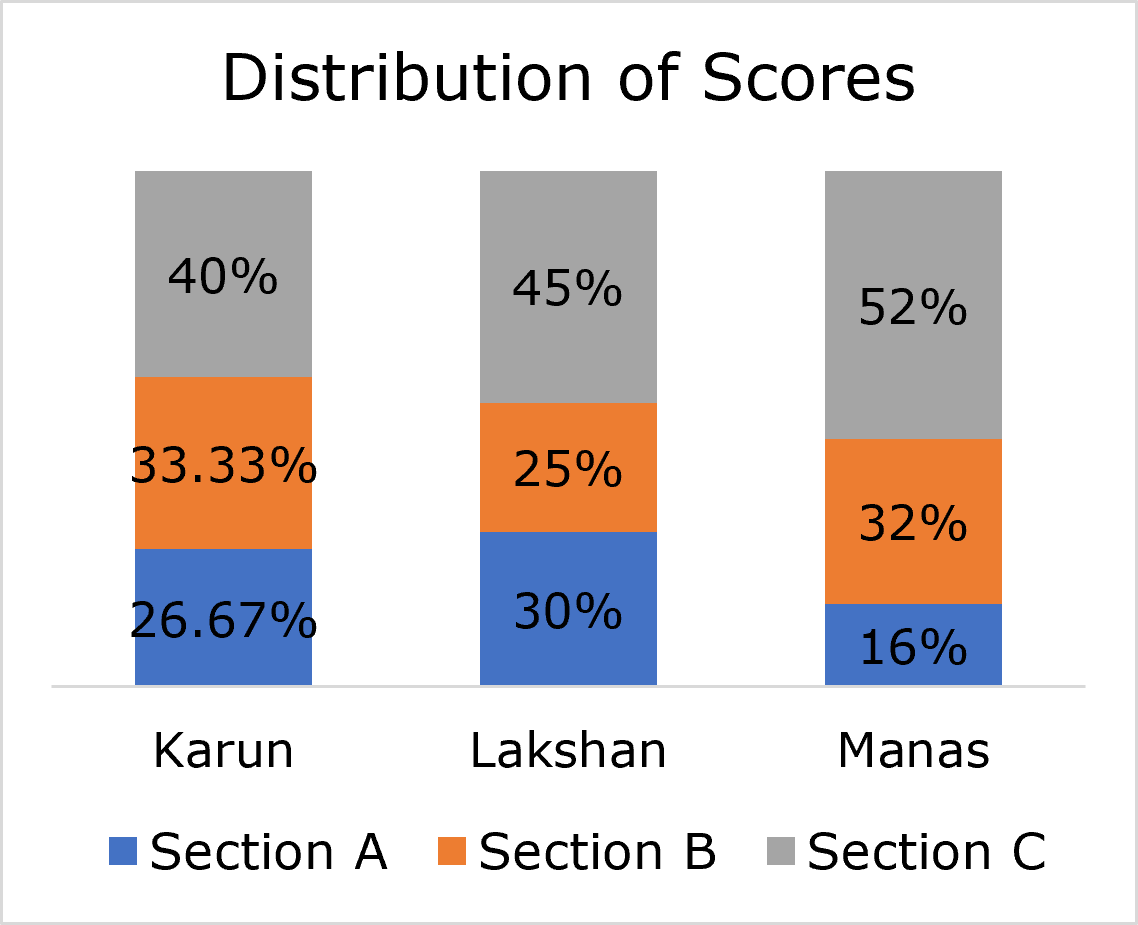
Each one of them attempted all the questions in the paper. The bar graph gives the marks obtained in a section as a percentage of the total marks obtained for each of the students.
- Possible section scores (c = number correct out of 20):
- Section A: 3c − (20 − c) = 4c − 20, a multiple of 4 from −20 to 60.
- Section B: 5c − 20, a multiple of 5 from −20 to 80.
- Section C: 7c − 40, which leaves remainder 2 when divided by 7, from −40 to 100.
- Karun (26.67% : 33.33% : 40% = 4 : 5 : 6). A = 4k, B = 5k and C = 6k. C must leave remainder 2 on division by 7, which needs k = 7m + 5. With the ranges, k = −2, 5 or 12, giving totals −30, 75 or 180.
- Lakshan (30% : 25% : 45%). A = 12j, B = 10j and C = 18j (the A multiple-of-4 rule forces this form). C’s remainder rule needs j = 7m + 4. Only j = 4 fits the ranges, so the total is 160.
- Manas (16% : 32% : 52%). A = 20p, B = 40p and C = 65p (the B multiple-of-5 rule forces this form). C’s remainder rule needs p = 7m + 1. Only p = 1 fits, so the total is 125.
| Student | A | B | C | Total |
|---|---|---|---|---|
| Karun (k = −2) | −8 | −10 | −12 | −30 |
| Karun (k = 5) | 20 | 25 | 30 | 75 |
| Karun (k = 12) | 48 | 60 | 72 | 180 |
| Lakshan | 48 | 40 | 72 | 160 |
| Manas | 20 | 40 | 65 | 125 |
Karun’s minimum possible score is −30 (3, 2 and 4 correct in A, B and C).
From the table in Q15, Lakshan scored 48 + 40 + 72 = 160. Check: 48 is 30%, 40 is 25% and 72 is 45% of 160.
From the table in Q15, Manas scored A = 20, B = 40 and C = 65.
Correct answers: A: 4c − 20 = 20, so c = 10. B: 5c − 20 = 40, so c = 12. C: 7c − 40 = 65, so c = 15.
Total = 10 + 12 + 15 = 37.
Lakshan + Manas = 160 + 125 = 285. Karun is −30, 75 or 180, so the total is 255, 360 or 465.
The only option that cannot occur is 325.
From the table in Q15:
- D: Lakshan and Manas both scored 40 in B, and Karun’s B (−10, 25 or 60) is never 40. So exactly two are always equal ✓.
- A: Karun’s C could be −12 or 30, which is below Manas’s 65 ✗.
- B: Karun’s B could be 60 ✗.
- C: if Karun’s A is −8, no two A scores (−8, 48, 20) are equal ✗.
Lakshan’s C = 72, so Karun’s C = 6k = 72 and k = 12. Karun’s total is then 180.
Difference = 180 − 160 = 20.
QA · Quantitative Ability
Interest for 2 years = 92,400 − 81,840 = 10,560, so ₹5,280 per year.
Principal = 81,840 − 3 × 5,280 = 66,000. Rate = 5,280/66,000 = 8%.
At 8% compound interest, (1.08)9 ≈ 1.999 ≈ 2. This is also the rule of 72: 72/8 = 9. The sum doubles in about 9 years.
The sum of fourth powers is smallest when the integers are as close to each other as possible: 10/3 ≈ 3.33, so take 3, 3, 4.
34 + 34 + 44 = 81 + 81 + 256 = 418.
570570 = 2 × 3 × 5 × 7 × 11 × 13 × 19 (seven distinct primes).
Squaring gives each prime the power 2, so the number of factors = 37 = 2187.
48 man-days = 60 woman-days = 72 child-days. Take the work as 720 units: a man does 15, a woman 12 and a child 10 units per day.
The job = (15 + 12 + 10) × 10 = 370 units. 2 women + 5 children do 24 + 50 = 74 units per day.
Time = 370/74 = 5 days.
Field area = 156 × 81 = 12,636 m2. Well area = 13 × 12 = 156 m2, so the remaining area = 12,480 m2.
Mud spread = 12,480 × 0.25 = 3,120 m3 = 156 × depth.
Depth = 3,120/156 = 20 m.
Combined (relative) speed = 36 km/h = 600 m/min. In the first 8 minutes they close 4,800 m together. That halves in every interval: 2,400, 1,200, … The total combined distance can never exceed 4,800 × 2 = 9,600 m.
They meet when the combined distance reaches 750 m and then every 1,500 m after that: 750, 2,250, 3,750, 5,250, 6,750, 8,250. The next meeting would need 9,750 m, which is more than 9,600 m.
So they meet 6 times.
Detailed solution coming soon.
Square at the right angle: x = (3 × 4)/(3 + 4) = 12/7.
Square on the hypotenuse: the height to the hypotenuse is h = 12/5. So y = (5 × h)/(5 + h) = 12 ÷ (37/5) = 60/37.
x/y = (12/7) × (37/60) = 37/35.
Expected multiplier = 0 × 0.4 + 1 × 0.5 + 2 × 0.1 = 0.7.
On Rs. 100, the expected return = Rs. 70.
Water in new M1 = 0.4(1000 − x) + 0.7x = 400 + 0.3x.
Water in new M2 = 0.7(1000 − x) + 0.4x = 700 − 0.3x.
Setting them equal: 0.6x = 300, so x = 500 ml.
Correct 0 · Wrong 0 · Accuracy 0%
Keep the streak alive. See you tomorrow for Day 28.