
CAT 50 Day Streak – Day 26
30 questions across VARC, DILR & QA · +3 for a correct answer · −1 for a wrong MCQ · no negative marking for TITA
VARC · Verbal Ability & Reading Comprehension
It’s impossible to forget just how much the sun affects life on our planet. It’s overwhelmingly the source of our light and heat, providing just enough to maintain the delicate climatic balance we enjoy. That’s not a coincidence; life on Earth evolved under the sun’s influence and, given time, adjusts to any changes. Adapting to the whims of a star is no small task, however. The sun may appear to be constant from day to day, but let time stretch out for millions or even billions of years, and things will change—a lot. And not always for the better.
For example, in its thermonuclear-driven core, the sun fuses about 700 million tons of hydrogen into 695 million tons of helium every second. The missing five million tons are converted into energy. This energy is enough, it turns out, to power a star. If you like mind-boggling numbers, the sun produces 4 × 1026 watts of power—400 trillion trillion watts. In other words, the energy our star emits in a single second is sufficient to satisfy humanity’s total consumption for about 650,000 years.
It’s also enough to warm our planet to its current comfy clime. In fact, by using some basic physics principles, it’s possible to mathematically calculate how warm the Earth should be given the sun’s energy emission rate. Solar energy flows into space in all directions around the sun, and a tiny fraction (about half of one billionth) of it is intercepted by Earth, heating our planet. Just how much heating takes place is a bit complicated and depends on the actual radiant flux from the sun, Earth’s distance from it and reflectivity, and more. When we run the numbers, Earth’s average calculated temperature today is approximately –15 degrees Celsius, colder than the freezing point of water.
Actual measurements of Earth’s temperature, however, give a much warmer average: about 15 degrees C. The difference exists because greenhouse gases in the air essentially trap heat from the sun, warming Earth above the calculated temperature. This warming is mostly from natural greenhouse gases, mind you, but we’re adding approximately 40 billion tons of carbon dioxide into the atmosphere every year, significantly increasing the warming effect. Note that this increase has occurred over the past century or so, a timescale far too short for there to have been any change in the sun; Earth’s current climate change is all us.
But the sun’s production of energy does change noticeably—over hundreds of millions of years. That helium created in the core is inert; think of it as ash from the nuclear fusion. It settles in the center of the sun, building up over time at the rate of 695 million tons per second! As it gains mass, it also gets squeezed by the tremendous weight of the sun’s layers above it and becomes compressed. A basic law of physics is that compressing a gas heats it, so even though the fusion rate is mostly the same, the core of the sun is still slowly heating up over time—which means the sun itself is getting more luminous.
Without the trapping effect, Earth would fall back toward its calculated temperature of about –15 °C. That is below the freezing point of water. The word “likely” matches the passage’s approximate figures.
B: the passage says the Sun changes only over hundreds of millions of years and does not react to Earth. C: the calculation is only approximate and depends on many factors, so “would become equal” claims more than the passage supports. D: this reverses the passage, since greenhouse gases warm Earth.
The author rules out the Sun because a century is “far too short” for any solar change. If solar output had in fact risen sharply in that century, the Sun could share the blame, and the claim would collapse.
A: volcanoes have always emitted gases, so this does not explain a change over the past century. C: redistributing heat is not a cause of overall warming. D: regional cooling does not contradict global warming or its cause.
In the passage, temperature depends on the star’s radiant flux, raised further by greenhouse trapping. Less starlight means a colder planet, unless greenhouse gases make up the difference.
A: this contradicts the passage, where the Sun is “overwhelmingly” the source of heat. B: nothing in the passage supports spontaneous heat generation. C: the planet’s distance is never given, so “identical” is an unsupported assumption.
Detailed solution coming soon.
- And like many emotional topics, a lot of people would rather avoid thinking about it.
- Budgets ensure that we are not overspending, and that your money is going where you need it to go.
- Money is emotional - it determines where we live, what we eat, the education and healthcare we can access, how we socialize, what hobbies we can take up and how much we can travel.
- But avoiding a budget is often more of a headache than making one.
- By reviewing your past spending, you can begin to reflect on whether your spending behaviours are aligned with your financial goals.
The coherent paragraph is 3 → 1 → 4 → 2:
- 3: Money is emotional.
- 1: “And like many emotional topics”, people avoid thinking about it.
- 4: “But” avoiding a budget is more of a headache than making one.
- 2: Budgets make sure money goes where it should, which explains why.
Sentence 5 is a specific how-to step (reviewing past spending). It belongs to a later discussion of budgeting methods, not to this argument for why a budget is worth making.
- On rare occasions, some body parts—particularly hard ones such as shells, teeth, or bones—are preserved by being buried in mud or protected in some other way from predators and weather.
- Eventually, they may become petrified and preserved indefinitely with the rocks in which they are embedded.
- Methods such as radiometric dating—measuring the amounts of natural radioactive atoms that remain in certain minerals to determine the elapsed time since they were constituted—make it possible to estimate the time period when the rocks and the fossils associated with them were formed.
- The earliest fossils resemble microorganisms such as bacteria and cyanobacteria (blue-green algae); the oldest of these fossils appear in rocks 3.5 billion years old.
The order runs like this:
- 1: Hard body parts are sometimes preserved in mud.
- 2: “Eventually, they” (those parts) become petrified within rocks.
- 3: Radiometric dating estimates the age of “the rocks and the fossils associated with them”.
- 4: Using such dating, the oldest fossils appear in 3.5-billion-year-old rocks.
- Over the years, I started hoarding languages, perhaps to redeem myself after losing my first: Spanish, Italian and – in one half-hearted attempt – Catalan.
- Consequently, many do not feel the need to learn the language, but I wanted to be a ‘good immigrant’ and assimilate.
- I love their sounds, but they never quite fit in my mouth, so I kept trying to find a language other than English in which I’d make sense.
- But I’ve only ever achieved a passable fluency that can support my survival for maybe five minutes.
- Beyond that, the conversation is perforated by silences – much like the ones that pockmarked my last trip to Vietnam.
The coherent paragraph is 1 → 3 → 4 → 5:
- 1: The writer hoards languages (Spanish, Italian, Catalan).
- 3: “I love their sounds”, but they never fit.
- 4: “But” only a passable fluency, good for about five minutes.
- 5: “Beyond that”, the conversation falls into silences.
Sentence 2 starts with “Consequently” with no cause in the paragraph, and “the language” has no referent. It is about immigrants assimilating, not the writer’s personal language-hoarding.
- It is characterized by intentional violence on the part of large bodies of individuals organized and trained for that purpose.
- War, a state of conflict, generally armed, between two or more entities.
- On the national level, some wars are fought internally between rival political factions (civil war); others are fought against an external enemy.
- Wars have been fought in the name of religion, in self-defense, to acquire territory or resources, and to further the political aims of the aggressor state’s leadership.
The order runs like this:
- 2: A definition of war, written as a dictionary-style opener.
- 1: “It” (war) is characterised by organised, intentional violence.
- 3: Types of war: internal (civil) or against an external enemy.
- 4: The reasons wars have been fought.
“If we did nothing for months… we would not be able to complete” the marathon states the problem. The missing sentence gives the remedy: build up strength “little by little”. Then “The same is true for our moral fortitude” applies the whole lesson to ethics. So it belongs at blank 3.
Blank 1 comes before the marathon analogy, where “the necessary shape” has nothing to refer to. At blank 2 it would give the conclusion before the illustration. At blank 4 the paragraph is about heroism and courage, not physical training.
A captures both parts of the passage: open-source tech requires community involvement, and that openness empowers people and builds trust, unlike opaque proprietary systems.
B reverses the author’s view; the passage criticises the “meagre” fixed privacy settings. C contradicts the passage, which says the idea “isn’t so outlandish” and only feels impossible. D makes an unsupported prediction (“replace all”) and sets transparency against privacy, which the passage does not do.
DILR · Data Interpretation & Logical Reasoning
The crossword below consists of numbers. No number starts with a zero.
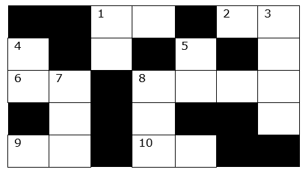
The hints are:
Across:
- 1: A two-digit number
- 2: Rearrange the digits of 6 across
- 6: Rearrange the digits of 1 across
- 8: 5 times 7 down
- 9: Ascending consecutive digits
- 10: 1 across plus 10
Down:
- 1: 1 across plus 5
- 3: Rearrange the digits of 8 across
- 4: Rearrange the digits of 6 across
- 5: 6 across plus 9
- 7: 11 times 4 down
- 8: 5 times 4 down
- 1 across is in the 40s. 10 across (= 1 across + 10) starts with the last digit of 8 down (= 5 × 4 down), which is 0 or 5. It can’t be 0, so 10 across is in the 50s and 1 across is in the 40s. 1 down (= 1 across + 5) starts with the same digit, so 1 across is 40–44.
- 4 down is 41 or 43. 8 down must end in 5, so 4 down is odd. 4 down rearranges 6 across, which rearranges 1 across, so its digits are 4 and b. It must be ≥ 20 because 8 down has three digits. That leaves 41 or 43.
- 9 across fixes it. 7 down = 11 × 4 down = 451 or 473. Its last digit is the second digit of 9 across (consecutive ascending digits). 451 would make 9 across “01” ✗. So 4 down = 43, 7 down = 473 and 9 across = 23.
- The rest follows. 6 across = 34 (it starts with 4 down’s last digit). Then 1 across = 43, 1 down = 48, 5 down = 43, 8 down = 215, 10 across = 53 and 8 across = 5 × 473 = 2365. Checks: 2365 starts with 2 (8 down) and its second digit 3 matches 5 down.
- 3 down is not fixed. 2 across is 34 or 43. 3 down rearranges 2365 and starts with the second digit of 2 across, so that digit must be 3 and 2 across = 43. 3 down has 5 in its third place (from 8 across), so it is 3256 or 3652.
| Row | C1 | C2 | C3 | C4 | C5 | C6 | C7 |
|---|---|---|---|---|---|---|---|
| 1 | ■ | ■ | 4 | 3 | ■ | 4 | 3 |
| 2 | 4 | ■ | 8 | ■ | 4 | ■ | 2 / 6 |
| 3 | 3 | 4 | ■ | 2 | 3 | 6 | 5 |
| 4 | ■ | 7 | ■ | 1 | ■ | ■ | 6 / 2 |
| 5 | 2 | 3 | ■ | 5 | 3 | ■ | ■ |
Of the 12 numbers, only 3 down (3256 or 3652) is not unique: all but one.
From the table in Q11, 7 down = 11 × 43 = 473. Its second digit is 7.
From the table in Q11, 8 across = 2365, so the digit sum is 2 + 3 + 6 + 5 = 16.
3 down is 3256 or 3652. The last two digits are 56 or 52, both divisible by 4, so it is a multiple of 4 either way.
A: it ends in 6 or 2. B: the digit sum is 16, which is not divisible by 3.
From the table in Q11: 1 across = 43 and 5 down = 34 + 9 = 43, so they are equal.
A: 48 vs 43. B: 34 vs 53. C: 23 vs 34.
In a reality show called Whale Tank, five investors (called Whales), W1, W2, W3, W4, W5, invested a total of Rs. 50 Crores in 10 businesses – B1 through B10, such that each investor invested in exactly 3 businesses. All the amounts were integral multiples of 1 Cr.
- Only B1, B6 and B7 had multiple investors. Each investor had an equal stake in a business that had multiple investors.
- B1 received the highest investment of 12 Cr, while the highest investment by a single investor was 7 Cr in B3.
- The biggest investment of W5 was 5 Cr in B4. He also invested in B2 and B10.
- W3 did not invest in B3.
- W2 made the highest investment of 12 Cr, while W1 was one of the two investors who invested the least, i.e. 8 Cr.
- W1 and W4 invested in both B6 and B7.
- Except for W5, each investor invested a distinct amount in all three businesses.
- B5 received twice the money received by B8. W1 and W3 invested in these businesses, respectively.
- A total of 6 Cr was invested in B6.
- Investor totals. W1 = 8 and W2 = 12, so W3 + W4 + W5 = 30. Exactly two investors invested 8, and everyone else is between 8 and 12. So W3, W4 and W5 are 8, 11 and 11 in some order.
- Who is where. W1 is in B5, B6 and B7, so W1 is full. W5 is in B2, B4 and B10. So B1’s investors come from W2, W3 and W4. B3 (7 Cr, single investor, not W3) belongs to W2 or W4.
- B3 is not W4’s. If it were, W4 = 7 + B6 share + B7 share would force shares of 3 and 1. Then W1’s B5 = 4 and B8 = 2. B1 would have to be W2 and W3 at 6 each, and both would also enter B7 at 1 each. That makes W3 = 6 + 2 + 1 = 9 ✗.
- So W2 holds B3 (7). W2’s other two investments total 5. A B1 share of 6 is impossible for W2, and if W2 skipped B1, then B1 = W3 + W4 at 6 each gives W1’s B5 = 3 and B8 = 1.5 ✗. So B1 has three investors (W2, W3, W4) at 4 each, and W2’s last investment is 1.
- W4 and W1. W4 = 4 + B6 share + B7 share = 8 or 11. Shares of 3 + 1 give W4 = 8. The 2 + 5 option makes B5 = 1 and B8 = 0.5 ✗. So the B6 shares are 3 each (W1, W4 only), the B7 shares are 1 each, W1’s B5 = 4 and B8 = 2.
- W3 and W5. W3 = 11 = 4 + 2 + 5, with the 5 in B9 (a B7 share would only be 1). W2’s 1 is in B7. Then W5 = 11, so B2 + B10 = 6.
| Business | Investor(s) | Amount (Cr) |
|---|---|---|
| B1 | W2, W3, W4 (4 each) | 12 |
| B2 | W5 | B2 + B10 = 6 |
| B3 | W2 | 7 |
| B4 | W5 | 5 |
| B5 | W1 | 4 |
| B6 | W1, W4 (3 each) | 6 |
| B7 | W1, W2, W4 (1 each) | 3 |
| B8 | W3 | 2 |
| B9 | W3 | 5 |
| B10 | W5 | B2 + B10 = 6 |
Investor totals: W1 = 8, W2 = 12, W3 = 11, W4 = 8, W5 = 11. B9 was funded by W3.
Detailed solution coming soon.
From the table in Q16, B1 was funded by W2, W3 and W4 at 4 Cr each: 3 investors.
From the table in Q16, W3 invested in B1 (4), B8 (2) and B9 (5), a total of Rs. 11 Cr.
From the table in Q16: B1 (12), B3 (7) and B6 (6). B2 and B10 total 6 with each at least 1, so neither exceeds 5. The answer is 3 businesses.
QA · Quantitative Ability
1/x + 1/y = 4/y, so 1/x = 3/y and y = 3x. Hitesh takes y − x = 2x days.
Efficiencies H : I : J = 1/(2x) : 1/(3x) : 1/x = 3 : 2 : 6, so the answer is 3 : 2 : 6.
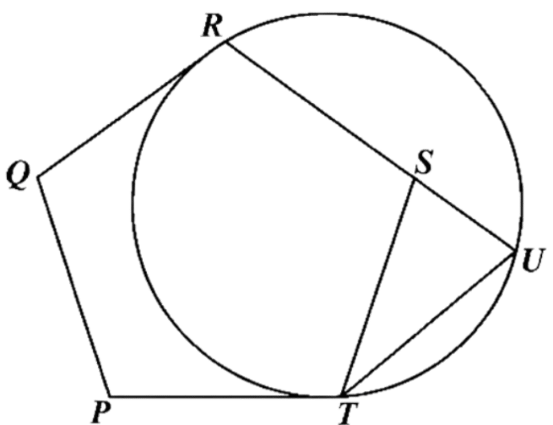
In a regular pentagon, the diagonals split each 108° angle into three 36° parts, so ∠QRT = 72°.
QR is tangent at R, so by the alternate segment theorem ∠RUT = ∠QRT = 72°.
R, S, U are collinear, so ∠TSU = 180° − 108° = 72°. In triangle STU, ∠STU = 180° − 72° − 72° = 36°.
Put x = 2: f(4) + f(4) = 4 + 2 + 14 = 20.
So f(4) = 10.
Speeds: 72 km/h = 20 m/s (shorter train) and 96 km/h = 80/3 m/s (longer train).
Same direction: relative speed = 20/3 m/s, so the longer train’s length = 20/3 × 90 = 600 m. The shorter train is 600 × 7/10 = 420 m.
Opposite direction: relative speed = 20 + 80/3 = 140/3 m/s. Time = 420 ÷ 140/3 = 9 seconds.
−198 < x3 − 44 < 198, so −154 < x3 < 242.
(−5)3 = −125 works but (−6)3 = −216 does not. 63 = 216 works but 73 = 343 does not. So x runs from −5 to 6: 12 integers, minus x = 0, gives 11.
45.45% = 5/11, so “45.45% more” means × 16/11.
Rounds = total ÷ average. Bimal’s rounds ÷ Amit’s rounds = (Bimal’s total ÷ Amit’s total) × (Amit’s avg ÷ Bimal’s avg) = 16/11 × 16/11 = 256/121 ≈ 2.1157.
That is about 211%.
A cyclic trapezium is isosceles. Each oblique side of 8 at 60° gives height 8 sin 60° = 4√3 and a horizontal overhang of 8 cos 60° = 4 on each side.
If the shorter parallel side is a, the longer is a + 8. Area = (2a + 8)/2 × 4√3 = (a + 4) × 4√3 = 96√3, so a = 20.
Longest side = 20 + 8 = 28 units.
The cube root of 26880 is about 30, so try 28 × 30 × 32 = 26880 ✓.
The largest number is 32, and 322 = 1024.
Let the amount be M. A pen costs M/12 and a pencil M/28.
Spent: 15M/28 + 3M/12 = 22M/28 = 11M/14. Cab fare: 3M/20. Together that is (110M + 21M)/140 = 131M/140.
Left: 9M/140 = 27, so M = 420. Price of a pen = 420/12 = Rs. 35.
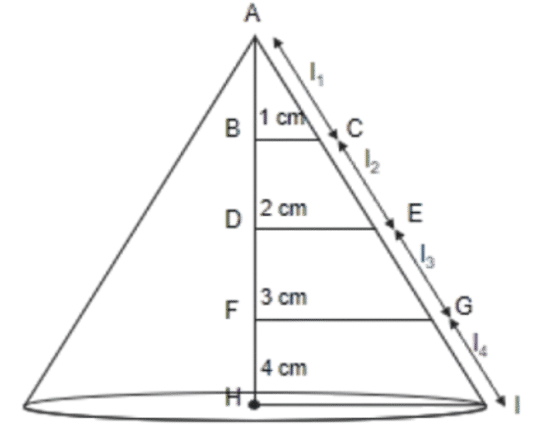
By similar triangles, slant height from the apex is proportional to radius: L, 2L, 3L, 4L. So l1 = l2 = l3 = l4 = L.
CSA of the top cone = π(1)L. The frustums have CSA π(r1 + r2)L: 3πL, 5πL and 7πL.
Second largest ÷ smallest = 5πL ÷ πL = 5 : 1.
Correct 0 · Wrong 0 · Accuracy 0%
Keep the streak alive. See you tomorrow for Day 27.