CAT 50 Day Streak – Day 25
30 questions across VARC, DILR & QA · +3 for a correct answer · −1 for a wrong MCQ · no negative marking for TITA
VARC · Verbal Ability & Reading Comprehension
Acts of selflessness are at the center of many ancient teachings and religious traditions, both Abrahamic and karmic. Kolbe’s own Christian faith teaches, “Greater love hath no man than this, that a man lay down his life for his friends.” Charity toward others is one of the Five Pillars of Islam. Dharma in Hinduism refers to the righteous path that a person’s life should take, which includes being honest, avoiding causing harm, and showing generosity toward others.
Although self-sacrifice might seem unnatural and against human nature, the reverse is true. Some evolutionary biologists contend that altruism is an innate trait that evolved to foster cohesion in kinship groups; they note that the characteristic is also found among nonhuman primates. This behavior extends even to laying down one’s life for friends and kin, a phenomenon that scholars believe occurs because of what they call “identity fusion”: I am willing to die for you because I believe my membership in this community is paramount, so defending it is worth my sacrifice; in that sense, I am dying for me, too.
Such courage and self-sacrifice toward kin can certainly be inspiring, but moral beauty is most striking in acts of goodness toward others with whom one does not have obvious ties, exhibiting a degree of altruism that is clearly contrary to one’s individual interests. This occurs when a person helps another for no reason at all, forgives someone who truly does not deserve it, or—in the most extreme circumstances—gives up their life for a stranger. Witnessing this kind of moral beauty elicits what the social psychologist Jonathan Haidt calls “moral elevation,” which is experienced both psychologically and neurologically. Indeed, researchers writing in the journal Brain Research have identified specific areas of the brain that are stimulated by moral beauty.
The psychologist Rhett Diessner has written a great deal about moral beauty and elevation. With his co-authors, he notes that this association induces “pleasant feelings of warmth in the chest, feeling uplifted, moved.” Further, as Diessner told me by email, new research undertaken in his laboratory at Lewis-Clark State College, in Idaho, demonstrates that these “magical” feelings lead to a desire to be better people ourselves and to help others. This results in prosocial actions, which can provide higher levels of individual and collective happiness.
Happiness derived from self-sacrifice is much deeper than plain positive feelings. Psychologists writing in 2016 showed that people feel that their life has more significance when they either help another person, without self-aggrandizement or any expectation of gain, or work to make the world a better place. The scholars found that this has the greatest benefit when people are suffering from a loss of their sense of significance, perhaps after being rejected in a relationship or losing a job.
Putting all the research together, we know that witnessing acts of moral beauty can elevate us to higher happiness, all the more so if we imitate these acts. We should seek out moral beauty in our lives, especially in times of suffering, when we need inspiration and a reminder that there is good in the world.
Kin-based sacrifice is explained by “identity fusion”: “I am dying for me, too.” Moral beauty involves people “with whom one does not have obvious ties” and is “clearly contrary to one’s individual interests”. The difference is the lack of group-identity self-interest.
A: religion isn’t what separates them. B: the passage doesn’t say kin altruism produces no elevation; it calls it “inspiring”. D confuses who benefits most with who performs the act.
The chain is: witnessing moral beauty → elevation (warmth, feeling moved) → desire to be better and help others → prosocial actions. So an emotional response leads to real behaviour.
A reverses the cause and effect. B: the desire comes from the feelings. C: “necessary and sufficient” is far too strong.
The greatest benefit comes when people who have lost their sense of significance (e.g. by “losing a job”) help others “without self-aggrandizement or any expectation of gain.” B fits exactly.
A and D involve self-promotion (a named building, filming the act). C is kin- or group-based sacrifice and involves no loss of significance.
Paragraph 4 claims the warm feelings “lead to a desire … to help others”, which results in prosocial action. If people who feel that warmth are no more likely to give, the link from feeling to action breaks.
B doesn’t deny the effect. C concerns a narrow subgroup. D compares motivators but doesn’t deny that elevation works.
- A rapid transformation in social context and reality, a rising number of political parties, frequent elections and bye-elections, an increase in the number of eligible voters and continuous updating of electoral rolls have led to new challenges for election management bodies of today.
- Over the last six decades, the structure and functions of the Election Commission have undergone major changes, and thus, the management of elections has become increasingly complex.
- The Election Commission of India (ECI) established the India International Institute of Democracy and Election Management (IIIDEM) to advance its professional competence in election management.
- This initiative aims to promote people’s participation, contribute to developing stronger democratic institutions and support the efforts of ECI in carrying out its mandate and functions.
The order runs like this:
- 2: Election management has become increasingly complex.
- 1: The specific new challenges.
- 3: The ECI responded by setting up IIIDEM.
- 4: “This initiative” aims to strengthen democratic institutions.
The “faraway object” comparison is about spatial distance. The sentence moves from that to temporal distance, which the dentist appointment “six months from now” then illustrates. It also pairs with “Another problem” later in the paragraph.
At 1 it would come before the spatial analogy it refers to. At 3 and 4 the dentist example and the second problem have already begun.
- Although the group did eventually succeed in finding 10 questions that stymied the bot, the researchers were astonished by how far AI had progressed in the span of one year.
- By the end of the meeting, the group started to consider what the future might look like for mathematicians.
- If AI reaches that level, the role of mathematicians would undergo a sharp change.
- Discussions turned to the inevitable “tier five”—questions that even the best mathematicians couldn’t solve.
- For instance, mathematicians may shift to simply posing questions and interacting with reasoning bots to help them discover new mathematical truths.
The coherent paragraph is 2 → 4 → 3 → 5:
- 2: The group considered the future for mathematicians.
- 4: Discussions turned to “tier five” questions.
- 3: “If AI reaches that level”, the role of mathematicians would change.
- 5: “For instance”, mathematicians might simply pose questions.
Sentence 1 reports what the testing found earlier (10 questions stumped the bot). The other four are all about speculating on the future.
Labels “only scratch the surface”, and the passage asks deeper questions about what it means to be human. C captures this.
A: AI is mentioned only as something our understanding affects. B contradicts the passage. D: the passage asks whether we are “just organisms” without asserting it.
“They” refers to the Egyptian radar stations that the Israeli aircraft were monitoring. Once it was confirmed they were down, the go-ahead followed. That is the logical last step.
At 1–3 the monitoring that confirms the radars are down hasn’t happened yet.
- What is the unique position of Ethiopia?
- It is one of the very few places that managed to sustain an unbroken chain of historical civilisation free of foreign “corruption”.
- Since the country has never been colonised, it boasts a history of independence that stretches back to distant antiquity.
- The Africanist approach sees itself as the saviour of, specifically, Africa and Ethiopia’s history.
- As the historian Teshale Tibebu wrote: ‘Ethiopia is a historically antique polity.’
The coherent paragraph is 1 → 3 → 2 → 5:
- 1: What is Ethiopia’s unique position?
- 3: Never colonised, with independence stretching back to antiquity.
- 2: An unbroken chain of civilisation free of foreign influence.
- 5: Tibebu: “a historically antique polity.”
Sentence 4 is about a scholarly approach (Africanism), not Ethiopia’s own historical position.
DILR · Data Interpretation & Logical Reasoning
The Indian Women’s Cricket Team played a 5-match ODI series. In all five matches, only 5 batters got a chance to bat, and all the batters had a distinct score in a match. The table below gives the runs scored by the top 3 batters in each of the matches and the percentage contribution of the top 3 batters in the total score of the match. Data for the other two is missing. No extra runs were scored.
| Player | Match 1 | Match 2 | Match 3 | Match 4 | Match 5 |
|---|---|---|---|---|---|
| Smriti | 64 | 59 | 48 | ||
| Pratika | 78 | 55 | 55 | ||
| Jemimah | 56 | 60 | 42 | ||
| Harmanpreet | 54 | 68 | 50 | ||
| Richa | 48 | 50 | 65 | ||
| Contribution of top 3 | 75% | 80% | 87.5% | 83.33% | 85% |
For example, Smriti, Jemimah and Richa were the top three batters in match 1, and their contribution to the total score was 75%.
Total = top-3 sum ÷ contribution. The two missing scores in each match add up to the rest, and each must be below the lowest top-3 score (and different from each other).
| Match | Top-3 sum | Total | Missing pair | Each below |
|---|---|---|---|---|
| 1 | 168 | 224 | Pratika + Harmanpreet = 56 | 48 (so each 9–47) |
| 2 | 192 | 240 | Smriti + Richa = 48 | 54 |
| 3 | 182 | 208 | Jemimah + Richa = 26 | 55 |
| 4 | 140 | 168 | Pratika + Harmanpreet = 28 | 42 |
| 5 | 170 | 200 | Smriti + Jemimah = 30 | 50 |
Known totals: Smriti 171, Pratika 188, Jemimah 158, Harmanpreet 172, Richa 163.
The maximum is Pratika: 188 + 47 (M1, with Harmanpreet 9) + 28 (M4, with Harmanpreet 0) = 263. The next best is Smriti at 171 + 48 + 30 = 249.
- A: in Match 2, Smriti + Richa = 48, so neither exceeds 50 ✓ (true)
- B: Jemimah can total 158 + 0 + 0 = 158, the lowest possible ✓ (true)
- C: only Pratika (up to 263) can pass 250 ✓ (true)
- D: in Match 1 the missing pair adds to 56 with each ≤ 47, so the lowest score there is 9, not 0 ✗ (false)
Pratika − Harmanpreet = 16 + (difference in M1) + (difference in M4).
Largest: M1 47 − 9 = 38 and M4 28 − 0 = 28, giving 16 + 38 + 28 = 82. The reverse direction reaches at most 50.
Richa needs 74 from M2 + M3, which is only possible as 48 + 26 (the maximums). That leaves Smriti 0 in M2 and Jemimah 0 in M3.
Smriti + Jemimah = 171 + 158 + (M5 pair = 30) = 359.
Smriti ranges from 171 to 249, and Pratika from 197 to 263.
- 83 : 87 → 249 : 261 ✓
- 95 : 98 → 190 : 196 (Pratika below 197) or 285 : 294 (both too high) ✗
- 86 : 99 → 172 : 198 ✓
- 100 : 101 → 200 : 202 ✓
95 : 98 is impossible.
8 students, A, B, C, D, E, F, G, and H, appeared for a competitive examination. The bar graph below shows the differences in the number of marks between A, B, C, and D, compared to the marks scored by E, F, G, and H. The marks scored by all students were positive integers.
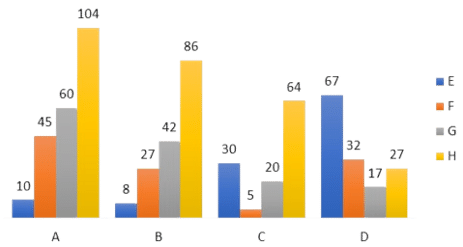
For example, the difference between the marks scored by A and E is 10, the difference between the marks scored by A and F is 45 and so on.
A’s and B’s differences to F, G and H are both spaced 15 and 44 apart (F→G, G→H). So F, G, H lie on the same side of both A and B, and every difference fits a single line of marks. Placing A at a:
| Student | A | E | B | C | F | G | D | H |
|---|---|---|---|---|---|---|---|---|
| Offset from A | 0 | 10 | 18 | 40 | 45 | 60 | 77 | 104 |
The marks are either a + offset (H top, ranking H, D, G, F, C, B, E, A) or a − offset (A top, ranking A, E, B, C, F, G, D, H). So 3rd place is G or B.
F is 4th only in the “H top” order, so marks = a + offset. A score of 56 gives a = 56, 46, 38, 16 or 11.
With a = 16 the marks are 16, 26, 34, 56, 61, 76, 93, 120, which includes 76. None of 43, 110 or 145 appears for any valid a.
D is 7th only in the “A top” order, so marks = a − offset with a ≥ 105. The only way to get 8 is H = a − 104, so a = 112.
Marks: A 112, E 102, B 94, C 72, F 67, G 52, D 35, H 8. 70 is not among them.
|G − F| = 60 − 45 = 15 (also 42 − 27 from B’s bars).
Detailed solution coming soon.
QA · Quantitative Ability
A: 8 km/h = 20/9 m/s, so 100 m takes 45 s. B runs 96 m in 45 + 15 = 60 s, i.e. 1.6 m/s.
1.6 × 3.6 = 5.76 km/h.
x2 + 6x + 5 = (x + 5)(x + 1). Taking logs: (x + 5) log 2 = (x + 5)(x + 1) log 3.
x = −5 is the integer root. Otherwise, x + 1 = log32, so x = log32 − 1 = log3(2/3).
Such numbers are ≡ 17 (mod 20): 17, 37, …, 497. This is an AP, so the average = (17 + 497)/2 = 257.
Each installment earns SI until the due date: x(1.4) + x(1.3) + x(1.2) + x(1.1) + x = 6x = 8400.
x = Rs. 1400.
Add 1/4 to both sides: (f + ½)2 = (5x + 1)24. So f = 5x/2 or f = −(5x + 2)/2.
f(3) < 0 rules out 5x/2 (which gives 7.5), so f(x) = −(5x + 2)/2 and f(10) = −26.
a, 2ar, ar2 in AP gives 4ar = a + ar2, so r2 − 4r + 1 = 0. The GP is increasing, so r = 2 + √3.
ar3 = 3r2 gives a = 3/r. Then d = a(2r − 1) = 6 − 3/r = 6 − 3(2 − √3) = 3√3.
r2 − d = (7 + 4√3) − 3√3 = 7 + √3.
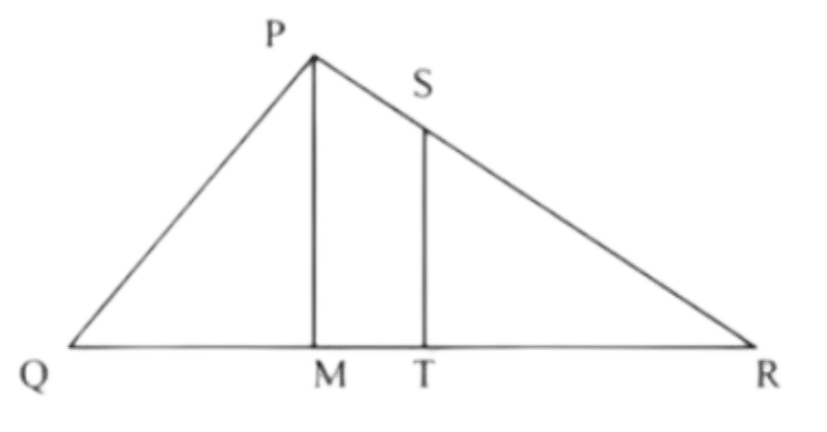
The 13–14–15 triangle has area 84 and altitude PM = 12, so QM = 5 and MR = 9. Area of ΔPMR = ½ × 9 × 12 = 54.
ST halves the triangle, so ΔSTR = 42. PMTS = ΔPMR − ΔSTR = 54 − 42 = 12.
The first digit is at least 1. Taking 1 from it leaves 3 to spread over 8 digits: 10C7 = 120 possible numbers.
He can be wrong at most 120 − 1 = 119 times.
Pratyusha’s cost = 1330/1.4 = 950. With A = 6k and B = 7k: (2 × 6k + 7k)/3 = 950, so k = 150. Colour A costs 900.
Alligation for A: red : white = (900 − 800) : (1200 − 900) = 1 : 3. With 20 L of red, white = 60 L.
Secants from P: PB × PA = PC × PD, with PA = 12.6 + 15.4 = 28.
12.6 × 28 = 11.2 × PD, so PD = 31.5 and CD = 31.5 − 11.2 = 20.3 cm.
Correct: 0 · Wrong: 0 · Accuracy: 0%
Keep the streak alive. See you tomorrow for Day 26.