CAT 50 Day Streak – Day 20
30 questions across VARC, DILR & QA · +3 for a correct answer · −1 for a wrong MCQ · no negative marking for TITA
VARC · Verbal Ability & Reading Comprehension
Many people in the twenty-first century spend a great deal of time thinking about their emotions: where they come from, how they show up in our bodies, and whether they drive us toward productive or destructive acts. As historians Damien Boquet and Piroska Nagy write, ideas about this topic in Europe changed dramatically in the High Middle Ages. Intellectual life in medieval Europe was thoroughly bound up in Christianity, and, early on, this often translated to viewing human feelings in stark terms of good and evil. For example, Gregory the Great, a Church Father from the early medieval period, wrote that even though it was necessary to slake one’s thirst, the pleasure of tasting a drink could contain an element of sin.
Boquet and Nagy write that this began to change in the late eleventh century, thanks partly to new translations of Arabic texts. Christian intellectuals increasingly accepted input from classical and contemporary non-Christian sources, particularly in emerging urban schools, which were beginning to replace monastic cloisters as centers of learning in Europe. In this context, feelings like anger, joy, sadness, fear, and shame could be understood through humoral medicine, a longstanding framework for addressing the body’s needs. Joy, for example, represented the movement of the body’s heat outward from the heart—something that was beneficial to the body in small doses but potentially dangerous or even lethal in sudden, sharp bursts.
Around the same time, Boquet and Nagy write, Christian thinkers increasingly came to view emotional feeling as an aspect of human nature that did not necessarily have a moral weight in and of itself. As French philosopher and theologian Peter Abelard wrote in the 1130s, “the sin is not the desire for the wife of another, but rather to consent to this desire.” For Abelard, having tendencies toward wrong thoughts or actions might be a natural defect of the soul, but it was not itself evil—and, in fact, it provided the opportunity for a person to virtuously triumph over their innate drive toward wrath, luxury, or other evils.
Working with emotion to improve virtue became part of the job of religious authorities. For example, William of Auvergne, who served as bishop of Paris in the thirteenth century, described the need to convert fleeting passions such as love and joy into lasting dispositions—and to avoid allowing hate, pain, or anger to congeal similarly. This process might involve cultivating appropriate feelings during penance, such as promoting “virtuous shame,” which encourages contrition, and avoiding “arrogant shame,” which discourages it. In place of a stoic effort to avoid the influence of emotion, thirteenth-century thinkers, including Thomas Aquinas, sought to use reason to direct the passions correctly, turning them into tools for self-improvement. “The way to salvation proposed by late medieval thinkers was no longer bound in an austere dialectic opposing spiritual and carnal man but instead proceeded from the new understanding of the divine project as expressed by the physical world,” Boquet and Nagy write.
Gregory wrote that even though drinking is necessary, “the pleasure of tasting a drink could contain an element of sin.” D restates this.
A (“virtuous shame”) comes from William of Auvergne in the 13th century. B draws on humoral medicine, which entered later and wasn’t used to explain sin. C is Abelard’s 1130s view.
The quote says salvation was “no longer bound” to setting spiritual against carnal man, and now came from the divine project “as expressed by the physical world”. In other words, the body and its passions became part of God’s design rather than just an obstacle.
B: salvation itself remains the goal. C: “superior” overstates a reconciliation. D: the austere dialectic was left behind, not perfected.
In humoral medicine, joy was heat moving outward from the heart, “beneficial … in small doses but potentially dangerous or even lethal in sudden, sharp bursts.”
A is William of Auvergne’s religious view, not humoral medicine. C is Abelard’s idea about wrong tendencies. D contradicts the heat-based physical description.
The passage credits the change “partly to new translations of Arabic texts”, which brought in frameworks like humoral medicine. If those translations covered only maths and astronomy, they couldn’t have shaped thinking about emotion, and the explanation is undercut.
A: whether humoral theory is true today is irrelevant to its historical influence. B: disagreements on other matters don’t matter here. D: urban schools only “were beginning to replace” cloisters, so continued monastic work doesn’t contradict the passage.
- The two basic types of writing—hieroglyphs, which were used for monuments and display, and the cursive form known as hieratic—were invented at much the same time in late predynastic Egypt.
- Writing was chiefly used for administration, and until about 2650 BCE, no continuous texts are preserved.
- Writing was a major instrument in the centralization of the Egyptian state and its self-presentation.
- The only extant literary texts written before the early Middle Kingdom seem to have been lists of important traditional information and possibly medical treatises.
The order runs like this:
- 3: Writing was central to the Egyptian state’s centralisation and self-presentation (general thesis).
- 1: The two types of writing (hieroglyphs and hieratic) were invented together.
- 2: Writing was used mainly for administration, with no continuous texts before 2650 BCE.
- 4: The only early literary texts are lists and possibly medical treatises.
- The accommodations I received in school, like my black-and-white enlarged textbooks or a seat at the front of the room, made me feel different and alone.
- Seeing disability in this more empowering light, I feel it as just one part of my identity that makes me resilient and resourceful.
- I wanted my books in colour and to sit with my friends.
- Three times a week, that rubber ball reminded me that, just because I was born a certain way, my world and my potential had limits.
- During gym class, when we played softball, I hit the ball off a tee.
The coherent paragraph is 1 → 3 → 5 → 4:
- 1: School accommodations made the author feel different and alone.
- 3: The author wanted coloured books and to sit with friends.
- 5: In gym class, the author hit the ball off a tee.
- 4: “That rubber ball” reminded the author of limits.
Sentence 2 refers to “this more empowering light”, which is never set up. It belongs to a later, positive reframing, while the other four recall feeling limited.
Once “unsocialized” citizens are introduced, the sentence says it is “not merely a personal failing”. The next sentence explains why: “He claims unsocialized citizens create externalities”, meaning costs for others.
At 1, the term hasn’t been introduced yet. At 3 and 4, the externalities argument is already under way.
- Medicine, social reform, benevolent people and institutions had relaxed the struggle for existence.
- For others who were inspired by Darwin and Malthus, the problem was exactly the opposite: human societies had become unlike processes of the natural world.
- Malthus’s ideas emerged at a time when Britain was being socially reconfigured.
- In 1867, the poet Matthew Arnold felt this loss when he described the spiritual emptiness created by evolution in terms of a retreating ocean heard only as a ‘melancholy, long, withdrawing roar’.
- For Arnold, the fact that humans were part of an aimless natural process was a source of anguish.
The coherent paragraph is 4 → 5 → 2 → 1:
- 4: Arnold felt the spiritual loss caused by evolution.
- 5: For Arnold, being part of an aimless natural process was anguish.
- 2: “For others”, the problem was the opposite: society had become unlike nature.
- 1: Medicine and reform had relaxed the struggle for existence (why society was unlike nature).
Sentence 3 changes the subject to the historical setting of Malthus’s ideas. It doesn’t fit the contrast between the two reactions to evolution.
Memory for meaningless sound fades fast, so listeners “race to extract meaning from the first sounds”. B says exactly this.
A reverses the syllables example. C advises speakers, which the passage never does. D: the passage stresses meaning over phonetic detail.
- “The Enigma of Reason,” “The Knowledge Illusion,” and “Denying to the Grave” were all written before the November election.
- And yet they anticipate Kellyanne Conway and the rise of “alternative facts.”
- Rational agents would be able to think their way to a solution.
- These days, it can feel as if the entire country has been given over to a vast psychological experiment being run either by no one or by Steve Bannon.
- But, on this matter, the literature is not reassuring.
- The books suggest that rational thinking might be less common than we assume.
The order runs like this:
- A: The books were written before the election.
- 1: “And yet they anticipate” alternative facts.
- 3: Today it feels like a vast psychological experiment.
- 2: Rational agents would think their way out.
- 4: “But” the literature is not reassuring.
- F: Rational thinking may be rarer than we assume.
DILR · Data Interpretation & Logical Reasoning
There are some pens in a box. Each pen has either a transparent or an opaque body, is either a gel pen or a ball pen, and is either red or blue. Further, it is known that:
- 3/5 of the pens in the box have a transparent body.
- 2/7 of the opaque pens are red, and 3/7 of the red pens have a transparent body.
- 3/8 of the opaque pens are gel, whereas 2/5 of the gel pens are opaque.
- 1/8 of the number of blue ball pens is equal to red gel pens.
- 1/8 of the red pens are gel and have an opaque body.
- Body. Transparent = 3N/5, opaque = 2N/5.
- Red. Opaque red = 2/7 × 2N/5 = 4N/35. That is 4/7 of all red pens, so red = N/5 and transparent red = 3N/35.
- Gel. Opaque gel = 3/8 × 2N/5 = 3N/20, which is 2/5 of all gel pens, so gel = 3N/8.
- Red gel. Opaque red gel = N/40. Let red gel = r. Blue ball = (4N/5 − 3N/8) + r = 17N/40 + r = 8r, so r = 17N/280.
Writing everything in units of u = N/280:
| Category | Transparent | Opaque |
|---|---|---|
| Red gel | 10u | 7u |
| Red ball | 14u | 25u |
| Blue gel | 53u | 35u |
| Blue ball | 91u | 45u |
| Total | 168u | 112u |
Every count is a whole number only if u is a whole number, so the minimum is N = 280.
From the table in Q11: 10u : 25u = 2 : 5.
The four options are 91u, 10u, 25u and 45u, so transparent blue ball pens (91u) are the largest.
- opaque red ball pens
- opaque blue ball pens
- opaque blue gel pens
Opaque red ball = 25u, opaque blue ball = 45u, opaque blue gel = 35u. All three are multiples of 5 for any whole u, so the answer is all of them.
u = 840/280 = 3, so transparent blue gel = 53 × 3 = 159.
A math teacher invited five students to participate in a calculation game.
60 seconds were given to answer every question.
The first, second, third, fourth and fifth students to answer the question correctly were awarded 50, 40, 30, 20 and 10 points, respectively.
In addition to the above, 1 extra point was awarded for each second saved. For example, if a person answered in 42 seconds, they would be awarded 18 bonus points.
The table below gives the time taken by students to answer these questions:
| Q1 | Q2 | Q3 | Q4 | Q5 | |
|---|---|---|---|---|---|
| Pushkar | 30 | 52 | 58 | 46 | |
| Qadir | 28 | 35 | 48 | 42 | |
| Riya | 45 | 42 | 39 | 52 | |
| Sakshi | 52 | 31 | 57 | 33 | |
| Tejas | 45 | 57 | 56 | 58 |
- The total number of points scored in the quiz was 1126.
- Qadir came 1st with a score of 286, and Tejas was 5th with 178 points.
- 254 points were scored for question 1 and 193 points for question 3.
Each question pays 50 + 40 + 30 + 20 + 10 = 150 in rank points, plus 300 − (sum of times) in bonus. So the points for a question = 450 − (sum of the five times).
- Q1. 450 − (155 + Riya) = 254, so Riya = 41.
- Q3. 450 − (205 + Sakshi) = 193, so Sakshi = 52.
- Total. 2250 − (all times) = 1126, so all times = 1124. This leaves Tejas (Q2) + Pushkar (Q4) + Qadir (Q5) = 125.
- Qadir (286). Q1 (82) + Q3 (52) leave 152 for Q2 + Q4 + Q5. Checking his possible ranks, the only fit is Qadir taking 51 s on Q5 (3rd, 39 points), so Tejas (Q2) + Pushkar (Q4) = 74.
- Tejas (178). Q1 (35), Q3 (23) and Q5 (12) leave 108 for Q2 + Q4. The only consistent case is Tejas fastest on Q2 in 26 s (84 points) and 4th on Q4 (24 points). That makes Pushkar’s Q4 time 48.
| Points (time) | Q1 | Q2 | Q3 | Q4 | Q5 | Total |
|---|---|---|---|---|---|---|
| Pushkar | 70 (30) | 18 (52) | 12 (58) | 42 (48) | 54 (46) | 196 |
| Qadir | 82 (28) | 55 (35) | 52 (48) | 58 (42) | 39 (51) | 286 |
| Riya | 49 (41) | 35 (45) | 68 (42) | 71 (39) | 28 (52) | 251 |
| Sakshi | 18 (52) | 69 (31) | 38 (52) | 13 (57) | 77 (33) | 215 |
| Tejas | 35 (45) | 84 (26) | 23 (57) | 24 (56) | 12 (58) | 178 |
| Total | 254 | 261 | 193 | 208 | 210 | 1126 |
The least time is Tejas’s 26 seconds on Q2.
Sakshi took 52 s on Q3 and was 3rd (after Riya 42 and Qadir 48). Points = 30 + 8 = 38.
Q4 times are 48, 42, 39, 57 and 56 (sum 242), so the points are 450 − 242 = 208.
70 + 18 + 12 + 42 + 54 = 196.
Riya’s points in order are 28, 35, 49, 68, 71, so the median is 49.
QA · Quantitative Ability
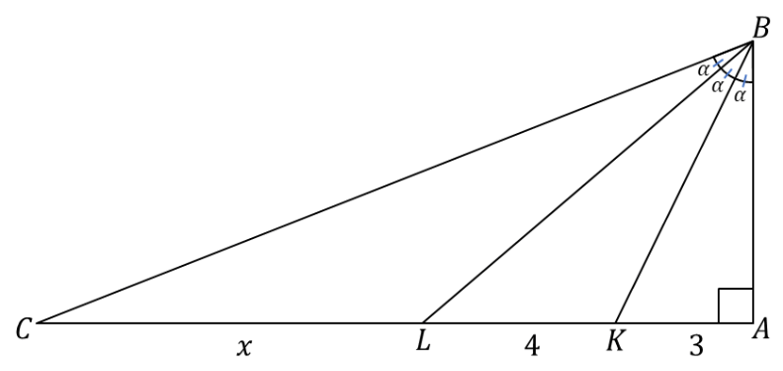
Let AB = h and each part of angle B = α. Then tan α = 3/h and tan 2α = 7/h.
tan 2α = 2 tan α1 − tan2α gives 6hh2 − 9 = 7h, so h2 = 63 and tan α = 1/√7.
tan 3α = 3t − t31 − 3t2 with t = 1/√7 gives 5/√7. So AC = h tan 3α = 3√7 × 5/√7 = 15.
CL = 15 − 7 = 8.
- 1, 1, 1, 1: 10C4 = 210
- 2, 1, 1: 10 × 9C2 = 360
- 2, 2: 10C2 = 45
Total = 615.
M ≡ 2 (mod 4) and M ≡ 3 (mod 5) give M ≡ 18 (mod 20). Checking 18, 38, 58, … for M ≡ 5 (mod 7), the first fit is M = 138.
a = 34, b = 27, c = 19, so a + b + c = 80. 138 : 80 = 69 : 40, and x + y = 109.
New prices: A = 6k × 4/5 = 4.8k, B = 4k × 14/15 = 56k/15, C = k.
Revenue ratio: 10 × 4.8 : 15 × 56/15 : 24 × 1 = 48 : 56 : 24 (total 128).
A’s share = 150240 × 48/128 = Rs. 56340.
From the second condition, 2x+2 = 8 × 2x−1 ≤ 8y. So y2 + 16 ≤ 8y, which means (y − 4)2 ≤ 0 and y = 4.
Then 2x+2 = 32, so x = 3. Product = 3 × 4 = 12.
Base: x − 1 > 0 and x − 1 ≠ 1, so x > 1 and x ≠ 2. Argument: 13 − 2x > 0, so x < 6.5.
The square root needs logx−1(13 − 2x) ≥ 1. For x > 2 (base > 1), this means 13 − 2x ≥ x − 1, so x ≤ 14/3. There are no integers between 1 and 2.
Integers in the domain: 3 and 4 (check: log27 ≥ 1 ✓, log35 ≥ 1 ✓, log43 < 1 ✗). Difference = 1.
Remaining = N × 0.8 × 0.75 × 0.9 = 0.54N. Males are 1/4 of this: 0.135N = 3780.
N = 28000.
Half-chord = 12. Distance from each centre to the chord: √(152 − 122) = 9 and √(132 − 122) = 5.
With the centres on opposite sides of the chord, the distance = 9 + 5 = 14 cm.
SI per year = 10800. CI − SI over 2 years = 2700, which is interest on the first year’s interest: 10800r = 2700, so r = 25% and P = 43200.
3-year CI = 43200 × (1.253 − 1) = 41175. 3-year SI = 32400. Difference = Rs. 8775.
s + k + b = 90 and s + 2k + 3b = 170.
3s + 2k + b = 4(s + k + b) − (s + 2k + 3b) = 360 − 170 = 190. She has 170, so she must borrow Rs. 20.
Correct: 0 · Wrong: 0 · Accuracy: 0%
Keep the streak alive. See you tomorrow for Day 21.