
CAT 50 Day Streak – Day 16
30 questions across VARC, DILR & QA · +3 for a correct answer · −1 for a wrong MCQ · no negative marking for TITA
VARC · Verbal Ability & Reading Comprehension
Dust controls numerous atmospheric and surface processes on Mars. In the atmosphere, suspended dust can lead to substantial temperature variations, can perturb atmospheric dynamics, and can lead to local, regional, and even global dust storms. On the surface, seasonal and post–storm dust settling has been tied to the occurrence and modification of surface features such as slope streaks and recurring slope lineae. The role of dust in controlling the temperature of the atmosphere and surface makes it a central part of the weather and climate system. In addition, dust might affect Mars’ past and current habitability through the exchange and distribution of nutrients and shielding of ultraviolet radiation. Dust has a direct effect on the exploration of Mars as well, by affecting remote sensing observations, surface hardware, crew operations, and the power efficiency of solar panels; in particular, large-scale dust storms and planet-encircling dust events can severely affect operations on Mars. The National Aeronautics and Space Administration’s most recent Mars Exploration Program specifically calls out the need for a better understanding of the dynamics and interactions of Mars’ dusty surface and atmosphere in the context of sustainable, future exploration.
Most likely, martian dust is the result of aeolian processes eroding exposed bedrock over geologic time frames. Past work established that wind stress exerted by (i) “vortical” processes, such as convective vortices and dust devils, and (ii) “nonvortical” processes, such as (straight-line) wind gusts, convection cell fronts, and meridional circulation, is responsible for the bulk injection of dust into the atmosphere. Dust particles are difficult to lift directly into the thin Martian atmosphere due to cohesive forces, especially if they do not form dust aggregates. However, the saltation of larger grains is easier to initiate on Mars at wind shear velocities beyond the “static threshold”. In turn, saltating sand particles can directly and efficiently inject finer-sized particles into the atmosphere upon reimpact on the surface.
Early modeling efforts and wind tunnel experiments suggested that the static threshold of ~100- to ~200-μm-sized martian grains is located at wind shear velocities between ~1.5 and ~2 m/s, which can be converted to wind velocities between ~15 and ~22 m/s at an altitude of ~1.5 m above the surface, assuming an average aerodynamic surface roughness and a convectively stable atmosphere. However, the atmospheric data collected by missions on Mars seemed to suggest that winds do not—or only rarely—exceed this threshold, despite frequent observations of active aeolian surface processes from orbit, a discrepancy termed the “martian sand transport puzzle”. More recent in situ measurements on Mars—most prominently by the InSight lander (Interior Exploration using Seismic Investigations, Geodesy and Heat Transport) and Perseverance rover—showed that wind velocities can be substantially higher and that sand and dust transport can be initiated at lower wind shear velocities than anticipated earlier.
Models and wind-tunnel work put the threshold at about 15–22 m/s. Mission data suggested winds “do not—or only rarely—exceed this threshold”, yet sand was clearly moving. That mismatch between the predicted high threshold and the lower measured winds is the puzzle.
A: the puzzle concerns sand transport, not a lack of surface dust. C describes a mechanism, not the discrepancy. D: the passage never sets wind tunnels against aerodynamic principles.
Cohesive forces make fine dust “difficult to lift directly”. The next sentence then says “However, the saltation of larger grains is easier to initiate”. The mention sets up the contrast between hard-to-lift dust and easier-to-move grains.
B: there is no comparison with Earth sand. C: aggregates are mentioned only in passing. D: cohesive forces hinder lifting; they are not an injection mechanism.
In saltation, wind moves larger grains, and these grains then strike the surface and knock finer particles loose. A cue ball (the moving grain) striking a tightly packed rack (the cohesive fine particles) and scattering it matches this impact-driven transfer of energy.
A and B describe direct lifting or washing by the fluid itself, which is exactly what the passage says is hard for fine dust. D involves no impact that ejects other particles.
The resolution rests on in situ measurements by InSight and Perseverance showing that winds can be “substantially higher”. If those sensors over-reported wind speeds, the evidence for the resolution falls away and the puzzle returns.
A changes model assumptions, not the new measurements. B offers a different way sand might move, so it doesn’t undercut the measured data. C is local and leaves the measured high winds intact.
- Many of us still know something about these treatments: studies estimate that as much as 80 per cent of the world’s population still use traditional plant- and animal-based medicines.
- We treated insomnia with lettuce and halitosis with parsley – according to a 10th-century cookbook from Baghdad, which devotes an entire chapter to the humoral properties of different vegetables.
- We treated pain with willow bark and terminated pregnancies with abortifacient herbs.
- At one point or another, we all knew something about how to heal ourselves using the plants and animals that surround us, at least somewhat.
- Lately, we often relegate this kind of intelligence to laboratories.
The coherent paragraph is 4 → 3 → 2 → 1:
- 4: We all once knew how to heal ourselves with plants and animals.
- 3 and 2: Examples (“We treated…”): willow bark, abortifacient herbs, lettuce and parsley.
- 1: “Many of us still know something about these treatments”, since about 80% still use them.
Sentence 5 shifts to modern laboratories. That contrast is never developed, and it cuts against sentence 1’s point that such knowledge is still widely used.
The passage builds from a basic tenet (win the physical battle, win the match) to its real point: some players believe that winning a fight can change the momentum of a match, “perhaps even a series”. C captures both layers.
A stops at the basic tenet and misses the momentum claim. B says fights rarely affect outcomes, which is the opposite of the claim. D introduces a decline in sportsmanship that the passage never mentions.
The sentence refers to a “juxtaposition” of “arrested development” and “numerical facility”. Both halves are first laid out in the sentence before blank 3: he could calculate large numbers, but he could barely eat unassisted or recognise faces. The new sentence then sums up why that made the feats impressive, which leads naturally into “How can you account for it?”
At blanks 1 and 2 his developmental limits haven’t been mentioned yet. Blank 4 would wedge the sentence between the question and its answer.
- While a new Alzheimer’s drug, Leqembi, has recently been approved by the FDA, it is available only for a small portion of people living with dementia.
- People living with dementia also require significantly more hours of care than older adults without dementia.
- Direct medical spending for dementia is relatively small because there aren’t many treatments available.
- While many elderly adults eventually need help with activities of daily living, such as eating and bathing, people living with dementia often need constant or near-constant supervision.
The order runs like this:
- 3: Medical spending on dementia is small because few treatments exist.
- 1: Qualifies this: a new drug exists, but only for a small portion of patients.
- 2: “Also” moves to a second cost driver: many more hours of care.
- 4: Explains why: constant or near-constant supervision.
- For the first couple of centuries after the invention of the printing press, reading remained largely an elite pursuit.
- It was an age of monumental works of thought and knowledge.
- People alive at the time understood that something momentous was going on.
- But by the beginning of the 1700s, the expansion of education and an explosion of cheap books began to diffuse reading rapidly down through the middle classes and even into the lower ranks of society.
- Suddenly, it seemed that everyone was reading everywhere: men, women, children, the rich, the poor.
The coherent paragraph is 1 → 4 → 5 → 3:
- 1: Reading was an elite pursuit for two centuries after the printing press.
- 4: “But” by the 1700s it spread to the middle and lower classes.
- 5: “Suddenly” everyone was reading everywhere.
- 3: People sensed “something momentous was going on”.
Sentence 2 is about the content of the age (monumental works), not the spread of reading, so it breaks the thread.
The sentence extends the opening line. “The ubiquity of a rambunctious drinking culture” becomes “the collective sense of what was meant by a night out”. “Recovering alcoholics notwithstanding” adds the obvious caveat to her nostalgia. The next sentence (“These are not the rantings…”) then defends that nostalgia.
Blanks 2–4 fall inside her complaints about the new sobriety (its language, mocktails, abstinence talk), where a fond memory of nights out would interrupt the flow.
DILR · Data Interpretation & Logical Reasoning
In an Avenger fan club which has 3000 kids, a survey was conducted for their liking of Captain America, Thor or Iron Man. The ratio of boys to girls in the club is 5:3. On the day of the survey, 75 boys and 75 girls were absent. The results obtained from the remaining kids were:
- Each kid liked at least one superhero.
- 50% of the boys liked Captain America, while 50% of the girls liked Thor.
- 3% of the boys liked all three superheroes, while this percentage was 4% among girls.
- The number of boys liking only Thor was 50% more than the number of boys liking only Iron Man.
- The number of girls liking only Captain America was the same as the number of girls liking only Iron Man.
- The percentage of boys liking only Captain America and Thor was 7%, only Thor and Iron Man was 5%, and only Iron Man and Captain America was 9%. The respective percentages in girls were 8%, 6% and 6%.
- Surveyed. Boys = 1875 − 75 = 1800; girls = 1125 − 75 = 1050; total 2850.
- Boys. Captain America (CA) = 900. All three = 54, CA&T only = 126, T&IM only = 90, IM&CA only = 162. Only CA = 900 − 54 − 126 − 162 = 558. Only T + only IM = 1800 − 558 − 432 = 810 with only T = 1.5 × only IM, so only IM = 324 and only T = 486.
- Girls. Thor = 525. All three = 42, CA&T only = 84, T&IM only = 63, IM&CA only = 63. Only T = 525 − 42 − 84 − 63 = 336. Only CA + only IM = 1050 − 336 − 252 = 462, so each is 231.
| Category | Boys | Girls | Total |
|---|---|---|---|
| Only CA | 558 | 231 | 789 |
| Only Thor | 486 | 336 | 822 |
| Only Iron Man | 324 | 231 | 555 |
| CA & Thor only | 126 | 84 | 210 |
| Thor & IM only | 90 | 63 | 153 |
| IM & CA only | 162 | 63 | 225 |
| All three | 54 | 42 | 96 |
| Total | 1800 | 1050 | 2850 |
Boys liking Iron Man = 324 + 90 + 162 + 54 = 630. Boys liking Thor = 486 + 126 + 90 + 54 = 756. Ratio = 630 : 756 = 5 : 6.
From the table in Q11: 231 (only IM) + 63 (T&IM) + 63 (IM&CA) + 42 (all three) = 399.
Only CA = 558 + 231 = 789. Only Thor = 486 + 336 = 822. Difference = 33.
All three = 54 + 42 = 96 out of 2850 surveyed. 96/2850 × 100 ≈ 3.37%.
Boys liking CA = 900. Girls liking CA = 231 + 84 + 63 + 42 = 420. Total = 1320.
Six friends, Parag, Harsh, Roopa, Azam, Siddhi, and Edwin, are natives of different cities from among Patiala, Hisar, Rourkela, Agra, Siliguri and Erode. Each of them works in a different city from among Rome, Auckland, Istanbul, Seoul, Edinburgh and Delhi, with a different annual CTC (in Rs. lakhs) out of 20, 25, 30, 35, 40 and 45. It is also known that:
For each person, the initials of name, native place and city in which they work are different.
- Azam works in Seoul.
- Neither of the persons who work in Auckland and Istanbul have the highest or the lowest CTC. The sum of the CTC of these two persons is equal to the sum of the CTC of the persons who are natives of Hisar and Patiala.
- The CTC of Edwin, who works in Rome, is less than the CTC of the person from Agra.
- The person with the lowest CTC is from Siliguri and works in Delhi.
- The CTC of the person working in Istanbul is Rs. 35 lakhs.
- The CTC of each of Siddhi, Parag, Azam and the person who is from Agra is less than the CTC of Roopa.
- Delhi / Siliguri / 20. This person can’t be Siddhi (initial S), Azam (Seoul), Edwin (Rome) or Roopa (she out-earns four people). So it is Parag or Harsh.
- Edwin’s native place. It can’t be Erode (E), Rourkela (he works in Rome), Agra (he earns less than the Agra person) or Siliguri. So Edwin is from Patiala or Hisar.
- Roopa. She earns more than Siddhi, Parag, Azam, the Agra person and therefore Edwin, so her CTC is 40 or 45. She can’t be in Istanbul (35).
- If Roopa = 45: she can’t work in Auckland (highest CTC), so she works in Edinburgh, and her native place must be Patiala or Hisar. Hisar + Patiala = Edwin + 45 = Auckland + 35, so Auckland = Edwin + 10. That forces Auckland = 40 and Edwin = 30, leaving 25 for Azam.
- If Roopa = 40: only Harsh can earn 45, so Harsh works in Edinburgh and Roopa in Auckland (40). Then Hisar + Patiala = 75 = Edwin + 45, so Harsh is from Patiala/Hisar, Edwin = 30 and Azam = 25.
- Agra. The Agra person earns more than 30 and less than Roopa, and can’t work in Auckland (initial A). In both cases that makes the Agra CTC 35.
Total CTC = 195, so Erode + Rourkela = 195 − 20 (Siliguri) − 75 (Hisar + Patiala) − 35 (Agra) = Rs. 65 lakhs.
Detailed solution coming soon.
Azam works in Seoul. As shown in Q16, both possible cases for Roopa give Edwin = 30 and leave Rs. 25 lakhs for Azam.
Detailed solution coming soon.
Detailed solution coming soon.
QA · Quantitative Ability
Unit digits repeat in cycles of 4. Since 48 ≡ 0 and 33 ≡ 1 (mod 4), compare the unit digit of d4 with d itself, where d is the unit digit of p.
- d = 0, 1, 5, 6: difference ends in 0.
- d = 2: 6 − 2 → 4. d = 3: 1 − 3 → 8. d = 7: 1 − 7 → 4. d = 8: 6 − 8 → 8.
- d = 4: 6 − 4 → 2 ✓. d = 9: 1 − 9 → 2 ✓.
So p = 24 or 29, and the sum is 53.
|2 − y| = 3 gives y = 5 or y = −1.
- y = 5: ||x| − 3| = 3, so |x| = 6 or 0, giving x = 6, −6, 0.
- y = −1: ||x| − 3| = 0, so |x| = 3, giving x = 3, −3.
Total = 5 values of x.
Let the escalator length be L, her speed v and the escalator’s speed e. Then v + e = L/27 and 2v + e = L/18.
Subtracting: v = L/18 − L/27 = L/54, so e = L/27 − L/54 = L/54.
Standing still, time = L/e = 54 seconds.
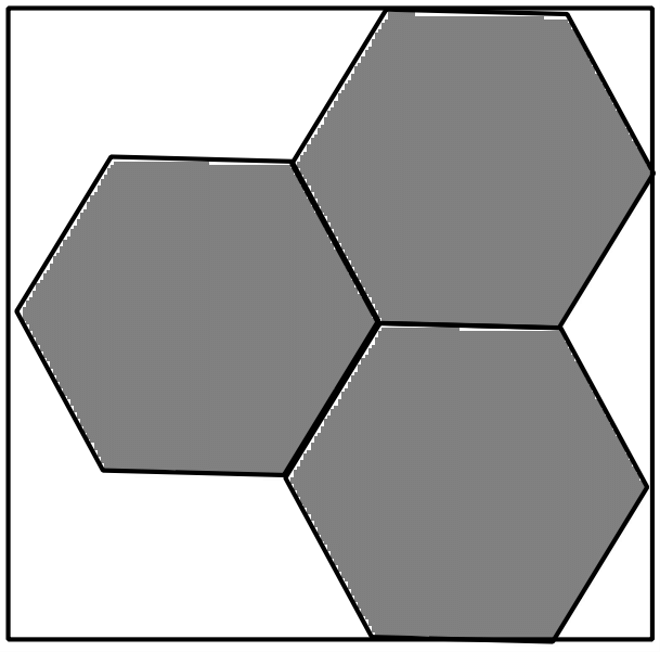
Let each hexagon have side a. Area = 3√32a2 = 12, so a2 = 8√3.
The three hexagons meet at one point. The left hexagon spans 2a horizontally, and the two right hexagons reach 1.5a beyond the meeting point. So the side of the square = 3.5a.
Area = 12.25a2 = 12.25 × 8√3 = 98√3 ≈ 56.6, so the closest option is 56 sq cm.
Year 1 interest = 0.1P. Amount after year 1 = 1.1P, and after paying 10000, 1.1P − 10000 remains.
Year 2 interest = 0.08(1.1P − 10000). So 0.1P : 0.08(1.1P − 10000) = 3 : 2, which gives 0.2P = 0.264P − 2400.
0.064P = 2400, so P = Rs 37500.
Inverting (fog)−1: (fog)(x) = 2x3 + 7.
Also (fog)(x) = a(xb + c) − 3 = axb + ac − 3. Comparing coefficients: a = 2, b = 3, and 2c − 3 = 7, so c = 5.
(gof)(3) = g(f(3)) = g(2·3 − 3) = g(3) = 33 + 5 = 32.
P(no success) = 0.64 = 0.1296.
P(at least one) = 1 − 0.1296 = 0.8704 ≈ 87%.
A → B: B = 400 papaya + 100 carrot (500 ml). 100 ml of this = 80 papaya + 20 carrot.
B → C: C = 400 orange + 80 papaya + 20 carrot (500 ml). 100 ml of this = 80 orange + 16 papaya + 4 carrot.
C → A: A gains 80 ml orange. C keeps 80 − 16 = 64 ml papaya.
Ratio = 80 : 64 = 5 : 4.
2x = 22y = 23z, so x = 2y = 3z. Let x = 6k, y = 3k, z = 2k.
xyz = 36k3 = 288, so k3 = 8 and k = 2. That gives x = 12, y = 6, z = 4.
124 + 124 + 132 = 8 + 396 = 1196.
Radius = OA = √((4 − 2)2 + 0) = 2.
OB = 2: (x − 2)2 + (5 − 3)2 = 4, so (x − 2)2 = 0 and x = 2.
Correct: 0 · Wrong: 0 · Accuracy: 0%
Keep the streak alive. See you tomorrow for Day 17.







