
CAT 50 Day Streak – Day 14
30 questions across VARC, DILR & QA · +3 for a correct answer · −1 for a wrong MCQ · no negative marking for TITA
VARC · Verbal Ability & Reading Comprehension
Several years ago, a colleague teaching at Miami University, a large state school in Ohio, kindly invited me to give a talk there. After picking me up at the airport, he suggested that we have lunch at a Sichuan restaurant near campus. I was skeptical. Sichuan, in small-town Ohio? “Trust me,” he said. “It’s fantastic.” And it was. The reason a first-class Sichuan cook had set up shop in this unlikely location soon became clear. At the time, the university was enrolling large numbers of Chinese students — more than 1,400 in 2014, for example. In fact, my colleague went on to tell me, significant social tensions had arisen, since the Chinese students were much wealthier than the American ones, to say nothing of the townspeople. As he said this, he pointed to a Chinese student driving past in a Maserati.
The Trump administration’s attempt to keep Harvard from enrolling foreign students has drawn new attention to the remarkable internationalization of American higher education over the past two generations. In the 2023-24 school year, no fewer than 1.1 million international students were enrolled in colleges and universities in the United States, or almost four times the number in the 1979-80 school year. Like many large social changes, this one happened without much conscious planning or debate. Foreign students kept applying in ever greater numbers, and universities happily admitted them, since non-Americans receive merit- and need-based financial assistance at much lower rates than Americans do. It has taken Donald Trump’s crude and vengeful swipe at Harvard to draw much attention to the subject.
Now it seems that a serious debate may finally start. Has the internationalization of the American student body been a good development? Should it continue? To be sure, no one should take the Trump administration’s position on the issue seriously. In announcing the suspension of Harvard’s participation in the Student Exchange and Visitor Program, Kristi Noem, the homeland security secretary, said, “It is a privilege, not a right, for universities to enroll foreign students and benefit from their higher tuition payments to help pad their multibillion-dollar endowments.”
This is the Trumpian viewpoint in a nutshell: The enrollment of foreign students is basically an elite scam. And the Trumpian solution, at least in Harvard’s case, is to shut things down as brutally as possible, regardless of the consequences for the students who cannot complete their degrees, the labs that need these students to conduct research and the university that is losing the tuition income.
But the fact that the Trump administration is handling the issue crudely doesn’t mean it’s not a real issue. Strikingly, the progressive historian Daniel Steinmetz-Jenkins and the conservative law professor Adrian Vermeule both suggested on X after Mr. Trump’s move against Harvard that perhaps international enrollments should not continue at the same level. By some measures, the opening of American higher education to international students is an obvious, unqualified good. By others, it is much more problematic.
Universities “happily admitted them, since non-Americans receive merit- and need-based financial assistance at much lower rates”. In other words, international students pay more, so the motive is financial.
The passage never mentions diversity (A), social pressure (B) or declining American enrollment (D).
The Maserati comes right after the colleague says tensions arose because Chinese students were “much wealthier” than American students and townspeople. It is a vivid example of that wealth gap.
B and C are about economic contributions, which the image doesn’t address. D: the passage never argues about whether these students need aid.
The author’s sign of a coming “serious debate” is that a progressive and a conservative “strikingly” reached the same view. If they actually propose mutually exclusive, ideology-driven solutions, that common ground disappears. The issue then looks set for partisan conflict rather than serious debate.
A: the author says the issue is real regardless of how Trump handles it, so a court win doesn’t end it. B adds evidence to the debate; it doesn’t stop it. C: the author already dismisses the administration’s position.
The passage never mentions a judge or any court ruling, so D is not presented at all.
A and B are stated directly as figures. C is stated just as flatly by the author: “Donald Trump’s crude and vengeful swipe”, and the administration “is handling the issue crudely”.
B covers both halves: an informal gathering with unusually strong criticism, and Xi’s furious reply that the problems were left behind by his predecessors.
A says the aide “blamed” Xi for the crises and calls the gathering a “summit”; in fact the aide warned about what would happen if turmoil continued. C invents “efforts at reform”. D states Xi’s claim as fact (“solely responsible”).
“Some of this” refers to the students’ dislike in the first sentence and explains part of it as simple annoyance. The next sentence, “But some students may struggle with the practicalities”, contrasts that annoyance with real difficulty. So the sentence belongs at blank 1.
At blanks 2–4 the paragraph is already listing concrete difficulties (cursive, timed essays, reliance on A.I.), so a remark about mere annoyance would break the flow.
- Eighty years on from the end of the war, many of its battlegrounds and graves have become solemn sites of national remembrance.
- Today, they constitute some of the most challenging heritage sites in the world: politically sensitive, environmentally unstable and long neglected due to the complexities of managing sovereign craft, unexploded ordnance, leaking oil and human remains in foreign waters.
- It has been all too easy for both flag and coastal states to ignore these wrecks.
- This is not the case for the sunken warships of Southeast Asia.
The order runs like this:
- 1: Battlegrounds and graves have become sites of remembrance.
- 4: “This is not the case” for the sunken warships of Southeast Asia.
- 2: “Today, they” (the warships) are among the hardest heritage sites to manage.
- 3: Hence it has been easy for states to ignore “these wrecks”.
- The cost of firewood was stable until the 1540s, yet it quadrupled by the 1580s and reached ten times its old level by the 1620s.
- Charcoal, though rather less seriously affected, followed the same pattern in a sixfold increase by the 1660s.
- This growing shortage of wood manifested itself in a price inflation of astonishing magnitude.
- The whole period was, of course, one of general and rapid inflation, modest by modern standards but severe by comparison with anything before it.
The order runs like this:
- 3: The wood shortage showed up as huge price inflation.
- 1: Evidence: firewood prices rose tenfold.
- 2: Charcoal “followed the same pattern”.
- 4: Context: the whole period had general inflation (“of course”).
- Grass’ examination of horse teeth helps us better understand animals that have been regularly found in the pit, including two similar genera of native American horses.
- They concluded that their diets were much like those of the wildebeests and zebras of the modern African Serengeti.
- Grass found that the enamel patterns on what is called the occlusal, or biting, surface of the tooth are different for each species.
- Only careful lab work will identify the horse’s correct genus, species and age.
- Researchers Lillian Spencer and Eric Scott also studied the ways horse teeth and those of bighorn sheep were worn down differently from different foods.
The coherent paragraph is 1 → 3 → 5 → 2:
- 1: Grass’ study of horse teeth from the pit.
- 3: Her finding: enamel patterns differ for each species.
- 5: Spencer and Scott “also” studied tooth wear.
- 2: “They” concluded the diets resembled those of Serengeti grazers.
Sentence 4 is a general remark about lab identification. It adds no finding and breaks the chain of research results.
- She may be at the forefront of a revolution in how we think about light and a huge class of diseases.
- And I guess I hadn’t really thought about it.
- “I was in a meeting, and someone said to me, ‘Wow, you seem like you’re pretty high energy!’” Young says.
- And then two days later, my daughter said to me, ‘Mom, what are you on?’
- For years, Young had been forced to rest in bed many times a day, but that stopped with what she calls her UV-fueled rebirth.
The coherent paragraph is 5 → 3 → 2 → 4:
- 5: Young’s years of bed rest ended with her “UV-fueled rebirth”.
- 3: A colleague remarks on her high energy.
- 2: “And I guess I hadn’t really thought about it.”
- 4: “And then two days later”, her daughter notices too.
Sentence 1 is a sweeping claim about a revolution in medicine. It doesn’t fit this personal anecdote.
DILR · Data Interpretation & Logical Reasoning
In the Hockey World Cup, 5 teams of group 1 (A, B, C, D, E) have played exactly one match against every team of group 2 (F, G, H, I, J). The points table is given below:
| Vs F | Vs G | Vs H | Vs I | Vs J | Points | |
|---|---|---|---|---|---|---|
| A | T | 4 | ||||
| B | L | L | 5 | |||
| C | 9 | |||||
| D | W | 10 | ||||
| E | W | W | 8 | |||
| Points | 7 | 6 | 8 | 5 | 7 |
- The table to be read as – B lost to G, E won against J.
- Team D did not win against team H.
- 3 points were awarded for a win, 1 point to each team for a tie and no points for a loss.
- Count. Total points = 36 + 33 = 69 over 25 matches. With W wins and T ties: 3W + 2T = 69 and W + T = 25, so W = 19 and T = 6.
- J. J lost to D and E, so it needs 7 points from A, B and C: two wins and a tie.
- B. B’s 5 points (after losing to G and I) must be one win and two ties from F, H and J. If J beat B, B could get only 4. If B beat J, J couldn’t reach 7. So B tied J, and J beat A and C.
- H. H lost to E, so its 8 points from A–D are two wins and two ties, with no losses. B didn’t beat H, so B tied H and beat F.
- C. C lost to J, so its 9 points must be three wins and two losses; it has no ties. H can’t lose, so H beat C, and C beat F, G and I.
- I and E. I (tie A, beat B, lost to C) needs one more point from D and E. E needs 2 points from F, G and I with no wins there, so E tied I and D beat I.
- The remaining ties. Only 6 ties exist and D needs exactly one, so D tied H and H beat A. F needs 7 from A, D and E (two wins and a tie), so E tied F, F beat A and D, and E lost to G. Finally A beat G (A needs 3 from F, G and H), and D beat G.
| Vs F | Vs G | Vs H | Vs I | Vs J | Points | |
|---|---|---|---|---|---|---|
| A | L | W | L | T | L | 4 |
| B | W | L | T | L | T | 5 |
| C | W | W | L | W | L | 9 |
| D | L | W | T | W | W | 10 |
| E | T | L | W | T | W | 8 |
The ties are A–I, B–H, B–J, D–H, E–F and E–I: 6 matches.
From the table in Q11, Team D won against G.
B tied with H and J and beat F.
A’s only win was against G (3 points, plus 1 from the tie with I, gives 4).
H tied with B and D. Of the options given, that is B.
In a toy shop, there are 5 toys: Doll, Teddy Bear, Remote Car, Board Game and an Airplane. The cost price and selling price are among ₹ 950, ₹ 1000, ₹ 1050, ₹ 1150 and ₹ 1200. The selling prices are different for all toys, and cost prices are different for all toys. The cost price of Remote Car is equal to the selling price of Airplane and on the sale of both the shop incurred a loss. On selling Teddy Bear the shop earned a profit. The profit earned by selling any article is more than ₹ 50 and the profit is not same for any product. Similarly, the loss incurred for any two products are not same. The toy shop earned a profit on only 2 products. It is also known that the Cost Price of the Board Game is lowest while the selling price of Teddy Bear is ₹ 1150. The Profit/Loss made on selling Doll and Teddy Bear are equal in absolute terms.
- Starting points. Board Game has the lowest CP (₹950). Teddy sells at ₹1150 at a profit over ₹50, so its CP is ₹1000 or ₹1050.
- Who profits. Remote Car and Airplane make losses, and Teddy makes a profit. Doll’s profit or loss equals Teddy’s, so it isn’t zero. If Board Game broke even (SP ₹950), Doll would have to be the second profit, and no arrangement then works. So Board Game is the second profit and Doll makes a loss.
- Teddy CP ₹1000 (profit 150). Doll would lose 150, either CP 1200 / SP 1050 or CP 1150 / SP 1000. Neither leaves a way for Remote Car’s CP to equal Airplane’s SP with both at a loss and all losses different ✗.
- Teddy CP ₹1050 (profit 100). Board Game’s profit must be different, so its SP is ₹1200 (profit 250). Doll loses 100: CP 1150, SP 1050. That leaves CPs 1000 and 1200 and SPs 950 and 1000. So Remote Car’s CP = Airplane’s SP = ₹1000, Remote Car sells at ₹950 and Airplane costs ₹1200 ✓.
| Toy | CP (₹) | SP (₹) | Profit / Loss (₹) |
|---|---|---|---|
| Doll | 1150 | 1050 | Loss 100 |
| Teddy Bear | 1050 | 1150 | Profit 100 |
| Remote Car | 1000 | 950 | Loss 50 |
| Board Game | 950 | 1200 | Profit 250 |
| Airplane | 1200 | 1000 | Loss 200 |
The Remote Car sells for ₹ 950.
From the table in Q16: 1200 − 950 = ₹250.
From the table in Q16, the Doll sells at ₹1050.
- A: The Board Game sells at ₹1200 ✗
- B: The Doll makes a loss of ₹100, not a profit ✗
- C: Airplane CP = Board Game SP = ₹1200 ✓
- D: Board Game profit 250 ≠ Airplane loss 200 ✗
The losses are Doll 100, Remote Car 50 and Airplane 200. The maximum is the Airplane.
QA · Quantitative Ability
Let L1 take t hours, so L2 takes t + 12. L2 reaches the midpoint at (t + 12)/2 = t − 8, which gives t = 28.
L2 takes 40 hours, so its speed is 1400/40 = 35 km/hr.
Full pyramid: ⅓ × 25 × 15 = 125. The piece cut off the top has height 9 and base side 5 × 9/15 = 3, so its volume is ⅓ × 9 × 9 = 27.
Frustum = 125 − 27 = 98 cm3.
Rationalising: f(x) = √(x + 1) − √x. The sum telescopes to √(n + 1) − 1 = 8.
√(n + 1) = 9, so n = 80.
Let k = (1 + r)3. Interest after 3 years: P(k − 1) = 1,00,000. After 6 years: P(k2 − 1) = 2,50,000.
Dividing: k + 1 = 2.5, so k = 1.5 and P = 1,00,000/0.5 = 2,00,000.
Amount in 2023 (after 9 years) = 2,00,000 × 1.53 = ₹6,75,000.
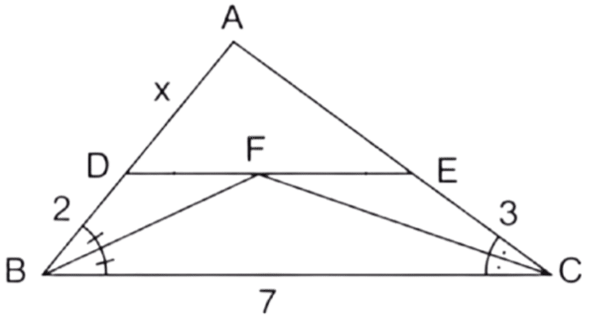
Since DE ∥ BC, ∠DFB = ∠FBC = ∠DBF, so triangle DBF is isosceles and DF = DB = 2. In the same way FE = EC = 3, so DE = 5.
By similar triangles, AD/AB = DE/BC: x/(x + 2) = 5/7, so 7x = 5x + 10 and x = 5.
M is 44% A and 56% B. N is 14% A, 36% B and 50% C.
For A: 44m + 14n = 34(m + n), so 10m = 20n and M : N = 2 : 1.
B% = (2 × 56 + 36)/3 = 148/3 = 49.33%.
The numbers have the form aba with a ≠ 5 (otherwise divisible by 5), and 2a + b < 20.
- a = 1, 2, 3, 4: all 10 values of b work → 40
- a = 6: b ≤ 7 → 8
- a = 7: b ≤ 5 → 6
- a = 8: b ≤ 3 → 4
- a = 9: b ≤ 1 → 2
Total = 60.
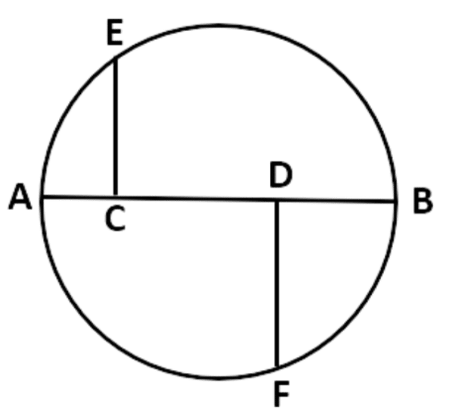
A half-chord perpendicular to a diameter satisfies (half-chord)2 = product of the two parts of the diameter.
EC2 = AC × CB: 16 = 2 × CB, so CB = 8 and AB = 10.
DF2 = AD × DB = 7 × 3 = 21, so DF = √21.
Let t = 2−x > 0. Then 4−x + 0.5 = 2t2, and the inequality becomes 2t2 − 7t − 4 < 0, i.e. (2t + 1)(t − 4) < 0.
Since t > 0, this means t < 4: 2−x < 22, so x > −2, i.e. (−2, ∞).
Work is proportional to workers × hours. The second phase did 80% of the work, four times the first phase’s 20%:
(n − 6) × (20/3) × 81 = 4 × n × 7.5 × 16, so 540(n − 6) = 480n.
60n = 3240, so n = 54.
Correct: 0 · Wrong: 0 · Accuracy: 0%
Keep the streak alive. See you tomorrow for Day 15.







