With CMAT 2027 scheduled for February 11, 2027, candidates have limited time to strengthen their preparation and improve their scores.
However, studying for long hours does not always translate into better performance. Ignoring a section, skipping revision or attempting questions without considering negative marking can affect your final score.
The Common Management Admission Test (CMAT) 2027 will have 100 questions across five sections: Quantitative Techniques and Data Interpretation, Logical Reasoning, Language Comprehension, General Awareness, and Innovation and Entrepreneurship.
Each section carries 80 marks, and candidates will get 180 minutes to complete the computer-based examination.
If you are preparing for CMAT 2027, avoid these five common preparation mistakes. Correcting them during your preparation can help you use your study time more effectively and approach the exam with better accuracy.
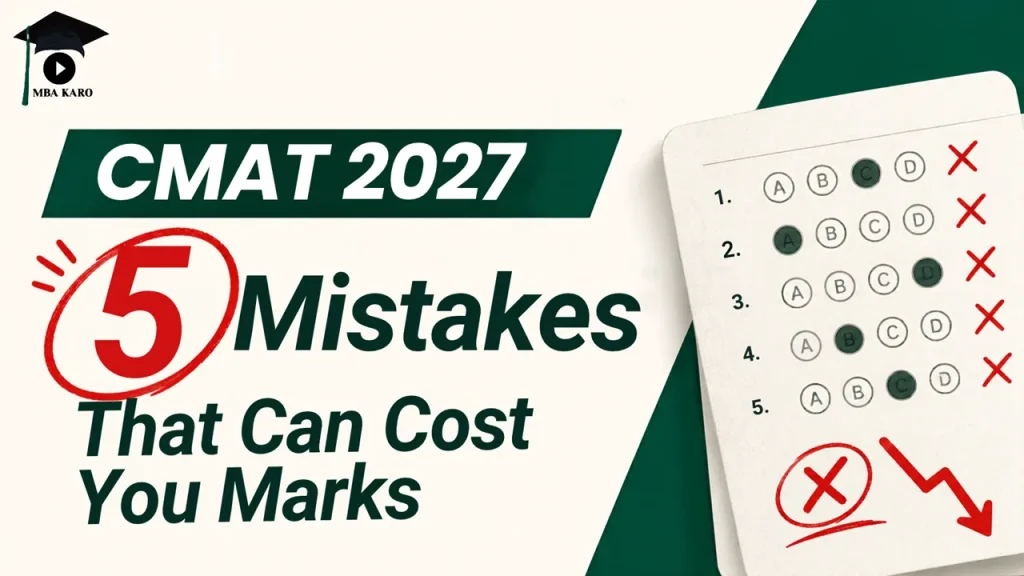
5 Mistakes That Can Cost You Marks in CMAT 2027 Exam
Here are 5 mistakes that can cost you marks in your CMAT 2027 and how to avoid them:
1. Ignoring One or More CMAT Sections During Preparation
One of the biggest mistakes in CMAT preparation is focusing heavily on Quantitative Techniques or Logical Reasoning while leaving General Awareness, Language Comprehension or Innovation and Entrepreneurship for the final weeks.
The CMAT exam pattern gives equal weightage to all five sections.
Each section has 20 questions and carries 80 marks. Therefore, neglecting even one section leaves a significant part of the paper unprepared.
| CMAT 2027 Section | Questions | Marks |
| Quantitative Techniques and Data Interpretation | 20 | 80 |
| Logical Reasoning | 20 | 80 |
| Language Comprehension | 20 | 80 |
| General Awareness | 20 | 80 |
| Innovation and Entrepreneurship | 20 | 80 |
| Total | 100 | 400 |
How to avoid this mistake: Divide your daily study time across all five sections. For Quantitative Techniques, cover arithmetic, algebra, number systems, modern maths, geometry and DI.
For Logical Reasoning, practise arrangements, coding-decoding, syllogisms, and statement-based questions. Give regular time to reading comprehension, grammar, static GK, current affairs and entrepreneurship concepts as well.
2. Studying CMAT Syllabus Without Solving Enough Questions
Reading concepts and memorising formulas are important, but they do not show whether you can apply what you have learnt.
Candidates who spend most of their preparation time studying theory may struggle when they encounter mixed questions during the actual examination.
For example, knowing the percentage formula is different from solving a question that requires percentage calculations within a DI set.
Similarly, understanding the rules of grammar does not automatically improve your ability to identify errors or arrange sentences correctly.
How to avoid this mistake: Follow every concept-building session with question practice. Solve topic-wise questions first and then move to mixed practice.
In Quantitative Techniques and DI, practise caselets, tables, line graphs, bar graphs and pie charts. In Logical Reasoning, combine analytical questions with syllogisms, assumptions, conclusions and arguments.
For Language Comprehension, include regular reading comprehension practice in your routine. You can use MBA Karo Daily Reading Comprehension Practice to maintain consistency and improve your RC preparation.
3. Delaying Mock Tests Until the Last Few Days
Another common CMAT 2027 preparation mistake is waiting until the syllabus is completely finished before attempting a mock test.
This delays your understanding of exam-level performance and leaves less time to identify weak areas.
CMAT 2027 is a 180-minute examination with 100 questions. You need to practise managing your time across all five sections, not just solving questions correctly during untimed practice.
How to avoid this mistake: Begin with topic-wise tests while building your concepts. Once you have covered the basics, introduce full-length mock tests.
During the final phase of preparation, attempt mocks in a timed environment to become familiar with the three-hour exam duration.
Do not judge your preparation only by your mock score. Check which sections need more work and whether you are losing marks because of conceptual gaps, calculation errors or poor question selection.
4. Ignoring Negative Marking While Practising Questions
CMAT 2027 marking scheme states that four marks will be awarded for every correct answer and a deduction of one mark for every incorrect answer. Unanswered questions receive zero marks.
Candidates who attempt questions randomly may lose marks even when they have answered several questions correctly. The pressure to attempt more questions can also lead to avoidable errors.
How to avoid this mistake: Practise making careful question-selection decisions. Attempt questions when you understand the method or can eliminate incorrect options with a reasonable basis.
During mock analysis, identify whether your incorrect answers came from guesswork, misreading the question or a lack of conceptual clarity.
Keep track of accuracy along with the number of questions attempted. Your preparation should focus on improving both, not simply increasing attempts.
5. Skipping Revision of GK, Formulas and Important Concepts
Covering the entire CMAT syllabus once is not enough. Candidates may forget formulas, GK facts, grammar rules and entrepreneurship concepts if they do not revisit them.
This is particularly important for General Awareness, which includes both static GK and current affairs.
The CMAT General Awareness syllabus covers history, art and culture, geography, Indian polity, books and authors, important dates, national and international events, appointments, awards, sports, science and technology, and business and economy. Innovation and Entrepreneurship also requires revision of topics such as types of entrepreneurs, innovation frameworks, entrepreneurship challenges and start-up funding.
How to avoid this mistake: Reserve time every day for revision. Maintain short notes for formulas, difficult concepts and GK topics.
Revisit incorrect mock questions and revise the topics responsible for those mistakes. Do not leave the entire revision workload for the last few days.
CMAT 2027 Preparation Checklist: What Should You Follow?
Use this checklist to review your preparation routine and identify areas that need attention.
- Section-wise coverage: Give regular time to all five sections
- Concept building: Complete topic-wise learning before mixed practice
- Question practice: Solve questions from different syllabus areas
- Reading Comprehension: Practise RC regularly
- General Awareness: Revise static GK and current affairs
- Mock tests: Attempt tests in a timed environment
- Mock analysis: Review incorrect and unattempted questions
- Revision: Revisit formulas, concepts and GK notes
Conclusion
Avoiding these mistakes can make your CMAT preparation more organised and help you use your remaining study time effectively.
Focus on all five sections, practise questions after learning concepts, revise regularly and analyse your mock test performance. Do not measure preparation only by study hours or the number of questions attempted.
If you want structured support for your preparation, explore the MBA Karo CMAT 2027 course. Combine your learning with consistent practice and revision to prepare for the February 11 examination with a clear strategy.