SNAP Daily Practice – Day 6
25 questions across General English, Logical Reasoning, Quant & Decision Making · +1 for a correct answer · −0.25 for a wrong answer
“Can you…?” is a common modal form for politely asking someone to do something, so A is a polite request.
B questions whether something is necessary and shows mild surprise or regret. C gives advice using “should”. D states a future event using “will”.
“Exalt” means to praise highly or raise in rank or status, so “praise” is the closest synonym.
“Challenge” means to dispute or test. “Condemn” means to criticise strongly, which is nearly the opposite. “Extract” means to pull out.
- In 1944, he was honoured by King George VI with a Knighthood and became Sir Alexander Fleming.
- On receiving this great honour, Fleming said in his usual modest way, “Wherever I go, people thank me for saving their lives. I didn’t do anything; I just found a remedy that was there.”
- Fleming became famous overnight and was regarded as one of the most distinguished scientists of his time.
- The next year, he and his fellow bacteriologists, whose combined efforts had led to the great discovery, were honoured with a joint Nobel Prize.
- C opens: it introduces Fleming by name and describes his fame.
- A follows: “he” was knighted in 1944.
- D comes next: “The next year” points back to 1944.
- B closes: “this great honour” refers to the Nobel Prize, followed by his modest response.
A and B separate or misplace the A–D time link. C starts with “he”, which has no clear reference yet.
Personification gives a human action to something non-human. Here, silence, an abstract idea, is said to have “screamed”.
An oxymoron places two contradictory words side by side, usually as a phrase such as “deafening silence”. A metaphor says one thing is another, which this sentence doesn’t do. Alliteration needs nearby words that begin with the same sound as a deliberate effect, and that is not the main device here.
“Were … being baked” is the passive form of the past continuous. In the active voice it becomes were + subject + verb-ing + object: “Were they baking the cakes?”
A changes the tense to past perfect continuous. C turns the direct question into a statement with a question tag. D is wrong because B is correct.
Each letter moves backward by 2, 4, 6 and 8 places, in that order.
- UNIQ: U−2 = S, N−4 = J, I−6 = C, Q−8 = I ✓
- MODE: M−2 = K, O−4 = K, D−6 = X (wrapping past A), E−8 = W
So MODE is written as KKXW.
- Some Sofas are Stools
- All Stools are Thrones
- All Thrones are Chairs
- All Stools are not Chairs
- Some Sofas are not Thrones
- Conclusion I fails: all Stools are Thrones and all Thrones are Chairs, so all Stools are Chairs. This contradicts I.
- Conclusion II fails: we know only that some Sofas are Stools, and so some Sofas are Thrones. Nothing shows that any Sofa lies outside Thrones. All Sofas could be Thrones.
Therefore, neither conclusion follows.
- Firms in cities should be barred from hiring rural workers.
- New schemes that can help generate employment in rural areas should be launched.
- It should be compulsory for workers in cities to also work in rural areas for some duration.
- I does not follow: a hiring ban is discriminatory and restricts workers’ opportunities without solving the problem.
- II follows: rural jobs address a root cause of migration and give workers a practical reason to stay.
- III does not follow: compulsory rural work is coercive and impractical, and it doesn’t reduce the need to migrate.
2 2 2 2 = 0
4 4 4 4 = 8
6 6 6 6 = 24
8 8 8 8 = ?
The four numbers follow the pattern n × n − n − n.
- 2 × 2 − 2 − 2 = 0 ✓
- 4 × 4 − 4 − 4 = 8 ✓
- 6 × 6 − 6 − 6 = 24 ✓
- 8 × 8 − 8 − 8 = 48
If the first half of the series from the left end is reversed, then which element will be sixteenth from the right end?
The series has 24 elements, so the first half is the first 12.
Reversed first half: 4 5 1 2 3 6 9 8 5 4 2 7
16th from the right = (24 − 16 + 1) = 9th from the left. The 9th element of the new series is 5.
Deregulation can reduce losses only if companies can charge market-linked prices without losing much sales volume. If consumption barely changes with price, they can recover costs through higher prices, so B supports the plan.
A weakens the claim because a sharp fall in demand could hurt revenue. C points to lower future fuel demand, if anything. D is a general fact that has no direct link to company losses.
- Shubham is Karuna’s child, and Karuna is Ajay’s sister, so Shubham is the child of Ajay’s sibling.
- That makes Shubham either Ajay’s nephew or niece, depending on Shubham’s gender.
- The statement that Rajeev is Shubham’s brother tells us Rajeev’s gender, not Shubham’s.
Since Shubham’s gender isn’t given, the exact relation cannot be determined.
The hour hand moves 30° per hour, which is 0.5° per minute.
Time for 50° = 50 ÷ 0.5 = 100 minutes = 1 hour 40 minutes.
9:30 am + 1 hour 40 minutes = 11:10 am.
Let the marked prices of the chair and table be 200 and 300, so the total is 500.
Total discount = 26% of 500 = 130. Discount on chair = 20% of 200 = 40.
Discount on table = 130 − 40 = 90, which is 90300 × 100 = 30%.
Add each partner’s capital across the four quarters:
- A: 4 + 2 + 1 + 0.5 = 7.5
- B: 2 + 4 + 8 + 16 = 30
- C: 9 + 9 + 9 + 9 = 36
Profit ratio = 7.5 : 30 : 36 = 5 : 20 : 24, for a total of 49 parts.
A’s 5 parts = 24,000, so 1 part = 4,800. Total profit = 49 × 4,800 = 2,35,200.
Using 2 log a = log a2, the equation becomes log (2x2 + 17) = log (x – 3)2.
So 2x2 + 17 = x2 – 6x + 9, which gives x2 + 6x + 8 = 0, or (x + 2)(x + 4) = 0.
Therefore, x = -2 or -4, the intended answer.
Note: strictly, log (x – 3) requires x > 3, and neither value meets this condition. These values work only in the squared form, log (x – 3)2, so the question as printed has no valid real solution. Among the options, B is the only pair that satisfies the squared equation.
Combined filling rate = 225 + 125 = 325 per hour, so the pipes alone take 253 hours = 8 hours 20 minutes.
With the leak, time = 8 hours 20 minutes + 1 hour 40 minutes = 10 hours, so the net rate is 110 per hour.
Leak rate = 325 − 110 = 150 per hour, so the leak empties the cistern in 50 hours.
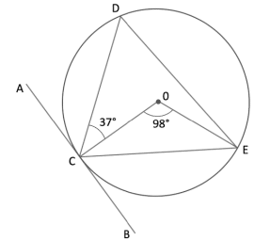
In triangle OCE, OC = OE (radii), so ∠OCE = (180° − 98°) ÷ 2 = 41°.
A radius is perpendicular to the tangent at the point of contact, so ∠OCB = 90°.
∠ECB = ∠OCB − ∠OCE = 90° − 41° = 49°.
Check: by the alternate segment theorem, ∠ECB = ∠CDE = ½ × 98° = 49°. The 37° angle isn’t needed.
Seat the 6 men first. Around a round table, this can be done in (6 − 1)! = 5! ways.
The men create 6 gaps. Placing the 5 women in different gaps can be done in 6P5 = 6! ways.
Total = 5! × 6! = 6! × 5!.
- 1537 = 29 × 53, so it is not prime.
- 2337: the digit sum is 15, so it is divisible by 3.
- 4137: the digit sum is 15, so it is divisible by 3.
- 3037: √3037 is about 55, and no prime up to 53 divides it, so it is prime.
So xy = 30.
Graduated accountability balances integrity with fairness. The friend gets a chance to correct the wrong, while escalation ensures that the violation can’t simply continue.
A skips the opportunity to correct the reports. C lets a clear breach stand and treats the small amount as an excuse. D avoids personal responsibility by using an indirect, anonymous route.
The scenario sets two values against each other: much-needed jobs and income for a depressed region, and environmental harm from increased pollution. This is development versus sustainability.
A is wrong because the jobs are high-paying and no labour law breach is mentioned. B describes a legal or political dispute that the scenario doesn’t raise. C focuses on shareholders and branding, not on the people and environment affected.
Your duty is to avoid taking part in a falsehood. Setting that boundary directly with the colleague protects your integrity and gives a proportionate response to a minor issue.
B and D both involve knowingly supporting a false account, and doing so once or for a short absence doesn’t make it honest. C goes straight to the manager when nobody has asked you and the colleague hasn’t yet heard your position.
Welfare eligibility should depend on each person’s own circumstances. Using postal code history as a proxy holds people responsible for what others did and carries past patterns into new decisions.
A treats blanket suspicion as efficiency and ignores eligible citizens who are wrongly denied. C is wrong because a system without feelings can still produce biased outcomes from biased data. D is not a stated or reasonable aim, and many affected people can’t simply move.
- Determining how this strategy document changes her own approach to the upcoming trial.
- Recognizing that reading the document breaches the ethical rules regarding inadvertently disclosed information.
- Deleting the email or returning it to opposing counsel unread.
- Notifying opposing counsel of her mistake so they can secure her communications.
- 2: first recognise the ethical duty, since it governs everything that follows.
- 3: stop any further exposure by deleting or returning the email unread.
- 4: notify opposing counsel so the mistake can be contained.
- 1: trial advantage comes last, and the document should not be used to gain one.
A acts before identifying the governing duty. B notifies before securing the document. D starts by exploiting the document, which reverses the correct priorities.
Correct 0 · Wrong 0 · Accuracy 0%
Keep the streak alive. See you tomorrow for Day 7.