SNAP Daily Practice – Day 4
25 questions across General English, Logical Reasoning, Quant & Decision Making · +1 for a correct answer · −0.25 for a wrong answer
“Would you mind + verb-ing” is the fixed, standard form of a polite request, so “Would you mind lending…” is correct.
“Could” works in “Could you lend…”, but it does not pair with “mind” in this expression. “Need” expresses necessity, not a request. “May” is used with “I” or “we” to ask permission, as in “May I borrow…”.
An allusion is an indirect reference to a well-known person, place or event. Here, the name “Einstein” is used to suggest that the student is exceptionally intelligent.
Personification gives human qualities to something non-human, but Einstein and the student are both people. Hyperbole relies on obvious exaggeration, while this sentence depends on the reference to a famous figure. D is wrong because allusion fits.
“A hair in the butter” refers to a delicate, tricky matter. A hair is hard to remove from butter cleanly, just as such a situation is hard to handle.
A takes the slipperiness of butter too literally. B says the opposite of the idiom. C has no connection with debt.
“Will be sent” is the simple future passive. Its active form is subject + will + base verb + object, which gives “They will send wedding invitations.”
B is still passive and changes the meaning, because “they” now receive the invitations. C shifts to future perfect. D shifts to future continuous.
An aristocracy is a system of government run by the nobility.
A democracy is government by the people. An oligarchy is rule by a small group, who need not be nobles. A monarchy is rule by a king or queen.
- Solar energy production in the country is likely to rise.
- Fossil fuel imports will drop next year.
- I follows: the policy aims to raise solar generation, and “likely to rise” is a suitably cautious conclusion.
- II does not follow: the statement says nothing about fossil fuel imports, and “will drop next year” is a definite claim with no support.
Children of first cousins are second cousins, because they share a set of great-grandparents.
Third cousins would need their parents to be second cousins. Siblings share the same parents, which is not the case here.
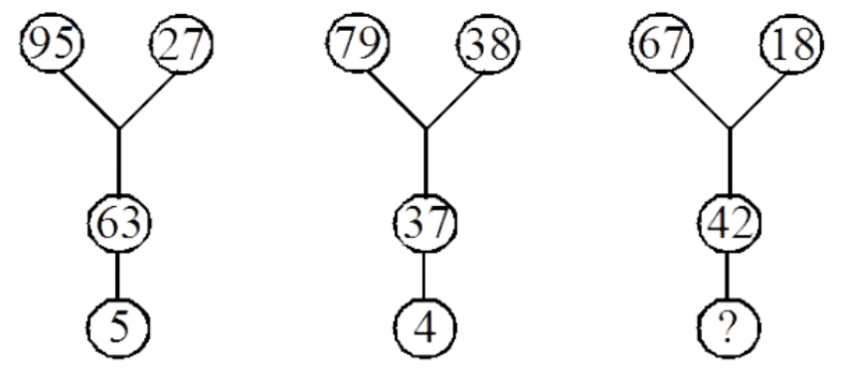
Bottom number = top-left number − top-right number − middle number.
- 95 − 27 − 63 = 5 ✓
- 79 − 38 − 37 = 4 ✓
- 67 − 18 − 42 = 7
The relationship is product : place of production. Paddy is grown in a field, and steel is made in a factory.
Ore and iron are raw materials for steel, not places. A mine produces ore, not finished steel.
Apply the rules to each digit, treating 2 as prime:
| Original | 4 | 8 | 6 | 2 | 9 | 5 | 7 | 3 |
|---|---|---|---|---|---|---|---|---|
| New | 3 | 7 | 5 | 3 | 7 | 6 | 8 | 4 |
In ascending order: 3, 3, 4, 5, 6, 7, 7, 8. The 4th digit from the left is 5.
The digit 2 is also even. If it is treated as even instead, it becomes 1, the order is 1, 3, 4, 5, 6, 7, 7, 8, and the 4th digit is still 5.
Only the turns affect the final direction: 2 right turns and 4 left turns in total (right, left, right, left, left, left).
- Net turn: 4 lefts − 2 rights = 2 lefts, which is a 180° turn.
- Final direction: he therefore faces the opposite of his starting direction.
- Start: the opposite of west is East.
Check: E 3 km → S 5 km → E 4 km → S 6 km → E 7 km → N 15 km → W 4 km, so he ends up facing west ✓
In every term, the number = the letter’s alphabet position − 6.
- A (1) → 1 − 6 = –5; F (6) → 0; C (3) → –3
- Z (26) → 20; Y (25) → 19
- H (8) → 8 − 6 = 2, which gives 2H ✓
The others break the rule: K (11) should give 5, G (7) should give 1, and I (9) should give 3.
- Online learning platforms provide a wider range of courses than traditional universities.
- People value convenience in education.
- I is not implicit: the passage discusses growth and credibility, but it never compares the range of courses with that of universities.
- II is implicit: the growth is attributed to people seeking flexible ways to upgrade their skills, which shows they value convenience.
The number must be divisible by both 11 and 3.
By 11: the alternating sum 4 − A + B − B + 8 − A = 12 − 2A must be a multiple of 11. For a non-zero digit A, this is possible only when 12 − 2A = 0, so A = 6.
By 3: the digit sum 4 + 6 + B + B + 8 + 6 = 24 + 2B must be a multiple of 3, so B must be a multiple of 3.
Non-zero values of B are 3, 6 and 9, which gives 3 values.
First article: CP = 365 ÷ 0.8 = 456.25, SP = 365.
Second article: CP = 365, SP = 365 × 1.2 = 438.
Total CP = 821.25 and total SP = 803, so the loss = 18.25.
Loss % = 18.25821.25 × 100 = 2.22% loss.
From the third equation, x = 17 − y − 3z.
Substituting in the second: 3(17 − y − 3z) + 2y + z = 29, so y = 22 − 8z.
Substituting in the first: 2(17 − y − 3z) + 3y − 5z = 18, so y = 11z − 16.
Equating: 22 − 8z = 11z − 16, so z = 2. Then y = 6 and x = 5.
xy + yz + zx = 30 + 12 + 10 = 52.
Pipe A runs for all 12 minutes and fills 1218 = 23 of the tank.
Pipe B must fill the remaining 13, which takes 13 × 24 = 8 minutes.
8 minutes is not among A–C, so the answer is None of these.
By the converse of the angle bisector theorem, AB/AC = BD/DC means that AD bisects ∠A.
∠A = 180° − 68° − 52° = 60°, so ∠BAD = 60° ÷ 2 = 30°.
Express everything in terms of D:
- C = 1.3D = 13D10
- B = 0.6C = 0.78D = 39D50
- A = 1.25B = 0.975D = 39D40
All four are integers only if D is a multiple of LCM(10, 50, 40) = 200, so the smallest D is 200.
Then C = 260, B = 156 and A = 195. Minimum sum = 195 + 156 + 260 + 200 = 811.
The first digit cannot be 0, so it has 9 choices. The second digit can now include 0, so it also has 9 choices. The third has 8 and the fourth has 7.
Total = 9 × 9 × 8 × 7 = 4536.
3024 (9 × 8 × 7 × 6) leaves out 0 altogether. 5040 (10 × 9 × 8 × 7) wrongly allows 0 in the first place.
Consumer protection exists to shield buyers from exploitative practices. Random rewards work like gambling and can push vulnerable people into spending far more than they intended.
A is about game balance, C is about gameplay experience, and D is about content accuracy. None of them addresses financial harm to consumers.
A personal reflection essay is meant to show the student’s own thinking and voice. Submitting an AI-written essay as her own breaks that expectation, even if the facts are accurate.
A is ruled out because the narrative accurately reflects her story. B does not fix the authorship problem, since it just moves it to another assignment. C is irrelevant because paying for the tool has no ethical bearing here.
A framework built on moral responsibility to society puts saving children’s lives ahead of profit from a cosmetic product, so it directly opposes the board’s choice.
A does not clearly oppose the decision, because a hair-loss treatment could benefit a large number of people. B and D support the board’s profit-led and demand-led choice.
- Planning the phrasing of how to politely refuse the department head.
- Determining whether the request constitutes a misrepresentation of fact.
- Securing a time-stamped copy of the original data on a secure server.
- Considering the department head's underlying anxieties about job security that prompted the request.
- 2: first establish the core issue, which is whether the request misrepresents facts.
- 3: once it is clear that it does, protect the integrity of the original data.
- 4: then consider the human context behind the request.
- 1: the wording of the refusal comes last, because it depends on everything before it.
B secures the data before identifying the issue. C puts the manager’s anxieties ahead of protecting the data. D starts with motives instead of facts.
A large retainer for little work creates a financial tie to the company whose drug she prescribes. Declining removes the conflict at its source and protects her clinical judgment and her patients’ trust.
A could deny patients a drug that is right for them, which also harms care. C relies on willpower, which does not remove the conflict or its appearance. D keeps the financial tie and only changes how the money is spent.
Correct 0 · Wrong 0 · Accuracy 0%
Keep the streak alive. See you tomorrow for Day 5.