
SNAP Daily Practice – Day 26
25 questions across General English, Logical Reasoning, Quant & Decision Making · +1 for a correct answer · −0.25 for a wrong answer
To “ride roughshod over” someone means to treat their views or feelings with contempt and disregard. The image is of a horse with spiked shoes trampling everything in its way.
B and C mean the opposite: they suggest respect and attention. D (repeating their ideas) has nothing to do with the idiom.
To “keep something at bay” means to hold it off or stop it from overwhelming you. Holding off one's fears is exactly what the sentence describes.
“Keep off” means to stay away from something (“keep off the grass”). “Back up” means to support. “Put down” means to criticise or humiliate someone, or to crush a revolt, and it is not used idiomatically with fears.
Verbs of demand, suggestion or insistence (demand, insist, recommend) take the subjunctive, which is the base form of the verb with no “-s”. The correct sentence is: “He demanded that she leave immediately.”
A is a correct third conditional (would have + past participle … if + past perfect). B correctly uses the subjunctive “were” after “as if”. D correctly uses the past perfect for the earlier of two past actions.
- to mitigate the impact of the economic downturn
- the government implemented several fiscal policies
- on the small business sector effectively
- despite the rising inflation rates
“Despite the rising inflation rates (S), the government implemented several fiscal policies (Q) to mitigate the impact of the economic downturn (P) on the small business sector effectively (R).”
The key link is P → R: “the impact … on the small business sector” must stay together. A puts S between P and R and splits that phrase. B and D place R before P, so “on the small business sector” has nothing to attach to.
After “a major”, the blank needs a noun. The noun meaning “an important discovery” is the single word “breakthrough”.
“Break through” (two words) is a phrasal verb (“to break through a barrier”), so it cannot follow an article and adjective. “Break-through” is not the standard spelling. Since A is correct, D is wrong.
Take the start as (0, 0), with east as +x and north as +y.
- South 30 m takes him to (0, −30).
- Left turn while facing south means he faces east. 50 m takes him to (50, −30).
- Right turn while facing east means he faces south. 40 m takes him to (50, −70).
- Right turn while facing south means he faces west. 40 m takes him to (10, −70).
Distance = √(102 + 702) = √5000 = 50√2 m.
- All successful entrepreneurs are risk-takers.
- Some risk-takers are not successful entrepreneurs.
Premise 2 tells us that some risk-takers lie outside the “successful entrepreneurs” circle. Those risk-takers could be unsuccessful entrepreneurs, or they could be people who are not entrepreneurs at all. So it is possible that some risk-takers are not entrepreneurs, which is exactly what B says with “may”.
- A directly contradicts Premise 2.
- C contradicts Premise 1, which says every successful entrepreneur is a risk-taker.
- D also contradicts Premise 1, because successful entrepreneurs are themselves risk-takers.
AZD FUI HSK OLP TGW
Every group follows two rules: the 2nd letter is the alphabetical opposite of the 1st (their positions add up to 27), and the 3rd letter is 3 places after the 1st.
- AZD: A(1) + Z(26) = 27; A + 3 = D ✓
- FUI: F(6) + U(21) = 27; F + 3 = I ✓
- HSK: H(8) + S(19) = 27; H + 3 = K ✓
- OLP: O(15) + L(12) = 27, but O + 3 = R, not P ✗
- TGW: T(20) + G(7) = 27; T + 3 = W ✓
So OLP is the outlier.
If B is selected and Y is rejected, the team will consist of
- B is selected, and B cannot play with W, so W is out.
- Y is rejected, so the remaining choices are A, C, X and Z, and three of them are needed.
- C cannot play with Z, so C and Z can't both be in the team.
Among the options, only A, B, C and X breaks no rule, and it has three males, which meets the “at least 2 males” condition.
A includes W, who cannot play with B. B puts C and Z together. D includes Y, who was rejected, and leaves out B, who was selected.
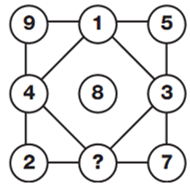
Every row and every column adds up to 15.
- Rows: 9 + 1 + 5 = 15 and 4 + 8 + 3 = 15, so 2 + ? + 7 = 15.
- Columns: 9 + 4 + 2 = 15 and 5 + 3 + 7 = 15, so 1 + 8 + ? = 15.
Both equations give ? = 6.
- B is not a neighbour of G.
- F is to the immediate right of G and a neighbour of E.
- G is not at any extreme end.
- A is sixth to the left of E.
- H is sixth to the right of C.
Number the positions 1 to 8 from the people's own left to their own right.
- A sixth to the left of E: (A, E) is either (1, 7) or (2, 8).
- H sixth to the right of C: (C, H) is either (1, 7) or (2, 8).
- If E = 8: then A = 2, C = 1 and H = 7. F must be next to E, so F = 7, but H already holds 7. This case fails.
- So E = 7: then A = 1, C = 2 and H = 8. F is next to E, so F = 6, and G is immediately to its left at 5.
- B and D fill 3 and 4. B cannot be next to G at 5, so B = 3 and D = 4.
| Position | 1 | 2 | 3 | 4 | 5 | 6 | 7 | 8 |
|---|---|---|---|---|---|---|---|---|
| Person | A | C | B | D | G | F | E | H |
G (5) is immediately to the right of D (4), so C is correct.
A is wrong because A is to the immediate left of C, not the other way round. B is wrong because D's neighbours are B and G. D is wrong because the ends are A and H.
The relationship is “workplace : the professional who practises their trade there”. A mechanic works in a garage, and a lawyer practises in a courtroom.
A patient and a student receive a service rather than provide it. A cleaner works in a temple, but cleaning isn't the temple's defining profession the way repair work defines a garage.
First differences: 7, 19, 39, 67.
Second differences: 12, 20, 28. These rise by 8 each time, so the next second difference is 36.
The next first difference is 67 + 36 = 103, so the next term is 145 + 103 = 248.
The pipe's radius is 0.07 m, so its cross-section area = 227 × 0.072 = 0.0154 m2.
Water delivered per hour = 0.0154 × 5000 = 77 m3.
Volume needed = 50 × 44 × 0.07 = 154 m3.
Time = 154 ÷ 77 = 2 hours.
The potatoes are 5, 8, 11, …, 5 + 19 × 3 = 62 m from the bucket.
Sum of these one-way distances = 202 × (5 + 62) = 10 × 67 = 670 m.
Each potato is a round trip, so the total = 2 × 670 = 1340 m.
Alcohol fraction: A = 58, B = 14, target = 12.
By alligation, A : B = (12 − 14) : (58 − 12) = 14 : 18 = 2 : 1.
Amount from A = 23 × 2.1 = 1.4 litre.
Let the cost be kV2 and take the original volume as 10 units, so the original cost = 100k.
After the split, the packages are 2, 3 and 5 units, so the new cost = k(4 + 9 + 25) = 38k.
Savings = 100k − 38k = 62k = 2790, so k = 45.
Original cost = 100 × 45 = Rs. 4500.
Let the maximum marks be M. Then pass mark = 0.3M + 50 = 0.4M − 20.
So 0.1M = 70, which gives M = 700.
Pass mark = 0.3 × 700 + 50 = 260.
| End of year | Country 1 (600 × 1.1n) | Country 2 (700 × 1.05n) |
|---|---|---|
| 1 | 660.0 | 735.0 |
| 2 | 726.0 | 771.8 |
| 3 | 798.6 | 810.3 |
| 4 | 878.5 | 850.9 |
Country 1 first moves ahead at the end of year 4.
Let the present ages be a (A) and b (B). A was b years old (a − b) years ago, and at that time B was b − (a − b) = 2b − a.
The statement gives 2b − a = a2 − 4, so b = 0.75a − 2.
Since a + b = 61: 1.75a − 2 = 61, so a = 36 and b = 25.
- Checking the company's IT security policy to see if uploading client data to unvetted third-party AI is permitted.
- Submitting an IT ticket to have the software officially installed and approved.
- Reviewing the software's feature list to ensure it can generate the specific tone of voice needed for the clients.
- Reviewing the department budget to see if they can afford the monthly subscription.
- 1 (security policy): this is a gatekeeping question. If uploading client data isn't permitted, nothing else matters.
- 3 (features): once the tool is allowed, check that it actually meets the business need.
- 4 (budget): only a tool that is both permitted and suitable is worth costing.
- 2 (IT ticket): formal installation is the final execution step.
A and B start with features and push data protection later. C checks the budget before knowing whether the tool even fits the need.
Legal compliance is a minimum, not the moral ceiling. The company knows its product is expected to kill a child, and knowingly leaving a fatal hazard in the market cannot be justified by cost. A strict moral view puts human life ahead of profit, so the recall is the duty.
B hides behind a regulator's threshold, and a fatal fire is hardly a “minor flaw”. C conceals a known danger. D treats a foreseeable death as a budget line, which is the classic Ford Pinto error.
Honesty and fair competition require the representative to tell the truth when directly asked and to win on the merits of their own offering, not on a competitor's false misfortune.
A is an outright lie. B is deception by insinuation, because it plants doubt the representative knows is false. D swaps one falsehood for another by inventing a flaw.
- The remote work policy states: "Employees must be available and actively monitoring their communication channels between the core hours of 10:00 AM and 3:00 PM."
- A remote employee finishes all her assigned tasks for the week by Thursday at 1:00 PM.
- The employee logs off at 2:00 PM on Thursday to go to the gym.
- The employee is highly efficient at her job.
- The employee violated the remote work policy.
II follows: the policy requires availability until 3:00 PM no matter how much work is done. Logging off at 2:00 PM breaks it.
I does not follow: finishing early may reflect efficiency, but it could equally mean a light workload. We know nothing about the quality or volume of her work, so “highly efficient” is an assumption.
Blind auditions already remove bias at the point of selection. If outcomes still don't change, the problem probably lies earlier in the pipeline: who learns these instruments, who gets training, and who applies at all. The robust response diagnoses those structural barriers instead of overriding a fair process.
A and B sacrifice procedural fairness and merit for outcomes. C introduces unequal standards, which is both unfair and patronising.
Correct 0 · Wrong 0 · Accuracy 0%
Keep the streak alive. See you tomorrow for Day 27.