
SNAP Daily Practice – Day 23
25 questions across General English, Logical Reasoning, Quant & Decision Making · +1 for a correct answer · −0.25 for a wrong answer
Synecdoche uses a part to stand for the whole. Here “hands” (a part) stands for the people (the whole) doing the work.
Metonymy swaps a thing for something closely associated with it, but not a part of it (“the Crown” for the monarchy). A pun plays on two meanings of a word, and there is no wordplay here. A simile needs “like” or “as”.
The clause “or you will lose marks” spells out a penalty, so the sentence states an obligation. “Must” is the modal for obligation.
“May” and “might” express possibility or permission. “Can” expresses ability. None of these fits a rule with a penalty attached.
Which proverb is most appropriate in this context?
“A stitch in time saves nine” means that fixing a small problem early prevents a much bigger one later. Amit failed to fix the small crack, and now he faces costly repairs.
A warns against rushing, but Amit didn’t rush; he neglected the crack. C is about patience with big achievements. D describes quiet people who have hidden depth.
A hound is a hunting dog that tracks by scent. A beagle is a breed of hound, so it is the closest in meaning.
As a verb, “hound” means to harass someone, but that doesn’t make it mean “critic”. “Migrate” and “variable” are unrelated to the word.
“Grateful” is the correct spelling; “greatful” is a common misspelling. A council is an official body that can approve grants. Counsel means advice, or a legal adviser.
A and B use the misspelling. C uses “counsel”, which can’t approve a grant.
- Grandparents: Ruchi’s grandmother and Chirag’s grandfather are siblings.
- Parents: their children (Ruchi’s parent and Chirag’s parent) are first cousins.
- Ruchi and Chirag: children of first cousins are second cousins.
- Next generation: children of second cousins are third cousins.
- Sentences 1 & 2: the common word is “fly” and the common code is “zo”, so fly = zo.
- Sentences 1 & 3: the common word is “birds” and the common code is “la”, so birds = la.
- Sentences 2 & 3: the common word is “planes” and the common code is “ka”, so planes = ka.
- In sentence 2, the only code left is “ni”, so fast = ni.
- Most people take television to be a means of entertainment.
- The educational value of television is not realized properly.
- I is implicit: the phrase “apart from the entertainment value” takes it for granted that TV is generally seen as entertainment.
- II is implicit: nobody would need to say the educational value “cannot be ignored” unless it was being overlooked.
Both are unstated beliefs behind the statement, so both are implicit.
An epitaph is an inscription on a tomb. “Legend” has the same technical meaning: an inscription, such as the explanatory text on a map (or on a coin or medal). So Legend : Map is the closest match.
A title names a book and a label identifies a bottle’s contents; both identify rather than inscribe. A caption describes a photo. It is close, but “legend” is the option that literally means an inscription.
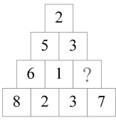
Each number equals the difference between the two numbers directly below it.
- Third row: 8 − 2 = 6 ✓, 3 − 2 = 1 ✓, 7 − 3 = 4
- Check, second row: 6 − 1 = 5 ✓, 4 − 1 = 3 ✓
- Check, top: 5 − 3 = 2 ✓
With 4, every row fits the pattern. Any other option breaks it: 3, 5 or 6 in that spot would make the 3 above it come out as 2, 4 or 5.
Multiply by n and subtract n2, for n = 2, 3, 4, 5:
- 9 × 2 − 22 = 18 − 4 = 14
- 14 × 3 − 32 = 42 − 9 = 33
- 33 × 4 − 42 = 132 − 16 = 116
- 116 × 5 − 52 = 580 − 25 = 555
- Up to 2000: 2000 years give 0 odd days.
- 2001–2007: 7 years with 1 leap year (2004) give 7 + 1 = 8 odd days, which reduces to 1 odd day.
- 1 Jan – 26 Nov 2008: Jan 3, Feb 1 (leap year), Mar 3, Apr 2, May 3, Jun 2, Jul 3, Aug 3, Sep 2, Oct 3, Nov 26 → 5. Total = 30, which reduces to 2 odd days.
Total = 1 + 2 = 3 odd days. Counting 0 = Sunday, 3 = Wednesday.
The statement has the form “If P, then Q” (P = caught, Q = killed). The only valid inference from it is the contrapositive, “If not Q, then not P”: he was not killed, so he was not caught.
A denies the condition (“not P, so not Q”), which is a fallacy. B affirms the result (“Q, so P”), which is also a fallacy; he could have been killed without being caught.
By Pythagoras, XZ2 − YZ2 = XY2 = 24. Factorising: (XZ − YZ)(XZ + YZ) = 24, so 2(XZ + YZ) = 24 and XZ + YZ = 12.
With XZ − YZ = 2, this gives XZ = 7 and YZ = 5.
At angle X: adjacent side = XY = 2√6, opposite side = YZ = 5, hypotenuse = XZ = 7.
sec X + tan X = 72√6 + 52√6 = 122√6 = 6√6 = √6.
Four years hence: (A + 4) + (B + 4) = B + C + 16, which simplifies to A − C = 8.
Four years ago: (A − 4) + (C − 4) = 32, which simplifies to A + C = 40.
Adding the two equations: 2A = 48, so A = 24 and C = 16 years.
Let the cost price of each article be x. Then SP1 = 1.12x and SP2 = 1.12x + 90.
The overall profit is 15%, so total SP = 2x × 1.15 = 2.30x.
2.24x + 90 = 2.30x, so 0.06x = 90 and x = Rs 1500.
Let the boat’s speed be 10k and the current’s speed be k. Then downstream speed = 11k and upstream speed = 9k.
D / 11k(D − 45) / 9k = 32, which gives 18D = 33(D − 45).
15D = 1485, so D = 99 km.
Let the square’s side be s. The rectangle’s length is 0.75s, and with L : B = 3 : 2 its breadth is 0.5s.
Rectangle perimeter = 2(0.75s + 0.5s) = 2.5s. Square perimeter = 4s.
4s − 2.5s = 36, so 1.5s = 36 and s = 24. Rectangle perimeter = 2.5 × 24 = 60, so the triangle’s perimeter = 60 cm.
4-digit numbers: the first digit must be 7, 8 or 9 (3 choices). The remaining three places can be filled in 4 × 3 × 2 = 24 ways. Total: 3 × 24 = 72.
5-digit numbers: every one exceeds 7000, so 5! = 120.
Total = 72 + 120 = 192.
Let the ratio be m : n. By the section formula, x = 7m + 1nm + n = 2.
7m + n = 2m + 2n, so 5m = n and m : n = 1 : 5.
Check with y: 10(1) + 4(5)6 = 5 ✓. B reverses the ratio.
- In 2025, a new law passes stating: "Generative AI models must not be trained on copyrighted material without providing creators a functional opt-out mechanism."
- Company X trained its AI model in 2023 on the entire public internet, which included millions of copyrighted images.
- In 2026, Company X implements a portal where artists can click "Opt-Out," ensuring their images will not be used in future training runs.
- Company X violated the law when it initially trained the model in 2023.
- The opt-out portal implemented in 2026 removes the copyrighted images from the original 2023 model.
I fails: the law was passed in 2025, and the training happened in 2023. A law can’t be broken before it exists, and nothing says it applies retroactively.
II fails: the portal only keeps images out of future training runs. Nothing says it removes them from the model already trained in 2023.
Honesty in self-representation means showing real progress without overstating it. Marking the certification “in progress” is truthful and still credits the work already done.
A misrepresents an unearned credential. B is honest but needlessly hides genuine effort. D creates a false impression and only corrects it if someone happens to ask.
Environmental and distributive justice require that environmental burdens be shared fairly. Here the people who generate the most waste escape the burden, and the least powerful community is chosen precisely because it can’t resist.
A: the plan’s problem isn’t secrecy. C applies to companies, not city planners. D is an economic idea, not an ethical principle being violated.
The core problem is structural. The manager controls the subordinate’s appraisals, pay and promotions, so real consent is compromised by the power imbalance, and every career decision becomes a conflict of interest.
B, C and D describe possible side effects (perceptions, blurred boundaries, team friction). Those can arise between any two colleagues; they don’t explain why a manager–subordinate relationship in particular is highly problematic.
- Examining the systemic processes and safety checklists that failed to prevent the error.
- Assessing the individual negligence or liability of the specific surgeon involved.
- Disclosing the error transparently to the patient and their family with an apology.
- Implementing new, rigorous pre-operative verification protocols to prevent recurrence.
- 3: the patient’s right to know comes first, so disclose and apologise promptly.
- 1: a “just culture” approach examines the system failures before blaming an individual.
- 2: individual liability is judged only once the systemic context is understood.
- 4: new protocols are built on what the investigation finds.
A and C put blame on the surgeon ahead of the systems review. B delays disclosure to the patient.
Correct 0 · Wrong 0 · Accuracy 0%
Keep the streak alive. See you tomorrow for Day 24.