25 questions across General English, Logical Reasoning, Quant & Decision Making · +1 for a correct answer · −0.25 for a wrong answer
0/25Attempted
0Correct
0Wrong
0Score / 25
Q1Fill in the Blank
Following detailed deliberations, the meeting has been ____ till next week.
Aproposed
Breviewed
Ccancelled
Dadjourned
Solution Answer: D
“Adjourned” means suspended to resume at a later time. It fits both the meeting already underway (“following detailed deliberations”) and “till next week”.
“Cancelled” means called off entirely, which clashes with “till next week”. A meeting is not “proposed” or “reviewed” till a date.
Q2Error Spotting
Mark the option with an error in it.
AThe harder we
Bthought, more confused
Cwe became about our plan.
DNo error
Solution Answer: B
A “the + comparative …, the + comparative …” structure needs “the” in both halves. The first half has it (“The harder we thought”), so the second must read “the more confused we became”.
Parts A and C are correct as written, so D (No error) is wrong.
Q3Figure of Speech
Identify the figure of speech in the sentence:
Sentence"He’s so brave that lions would tremble before him."
ASimile
BIrony
CHyperbole
DPersonification
Solution Answer: C
Hyperbole is deliberate exaggeration for emphasis. Saying lions would tremble before him wildly overstates his bravery.
There is no “like/as” comparison (simile). The words mean what they say, so it isn't irony. Lions trembling is something animals actually do, so they aren't given human qualities (personification).
Q4One-Word Substitution
Lack of interest, enthusiasm or concern
ASympathy
BApathy
CEmpathy
DAntipathy
Solution Answer: B
“Apathy” (a- = without, pathos = feeling) is a lack of interest, enthusiasm or concern.
“Sympathy” is feeling sorry for someone. “Empathy” is sharing another's feelings. “Antipathy” is strong dislike, an active feeling rather than an absence of one.
Q5Confusing Words
Her ______ about my outfit perfectly ______ the bright colors I was wearing.
Acompliment, complemented
Bcomplement, complemented
Ccompliment, complimented
Dcomplement, complimented
Solution Answer: A
Compliment (with an “i”) is a remark of praise, so it fills the first blank. Complemented (with an “e”) means went well with or completed, so her praise matched the bright colours.
B and D use “complement” (something that completes) for a remark. C and D use “complimented” (praised), and a remark can't praise colours.
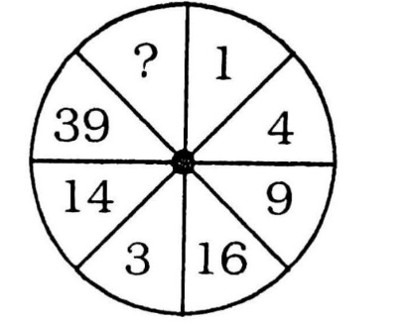
Q6Missing Number
Find the missing number:
A72
B75
C80
D84
Solution Answer: D
One half of the circle holds the squares 1, 4, 9, 16. Each number in the other half comes from the square directly opposite it:
1 × 2 + 1 = 3
4 × 3 + 2 = 14
9 × 4 + 3 = 39
16 × 5 + 4 = 84
Q7Analogy
ANCHOR : SHIP
ABrake : Vehicle
BRudder : Boat
CKey : Door
DLock : Box
Solution Answer: A
An anchor is the part used to stop a ship and hold it in place. A brake does the same job for a vehicle.
A rudder steers a boat rather than stopping it. A key opens a door and a lock secures a box; neither is about halting motion.
Q8Weaken the Argument
StatementArjun, a Fitness Blogger: ‘Six months ago, I weighed 70 kg and often felt tired. Now I weigh 75 kg, and I feel more energetic throughout the day. Clearly, the weight gain has improved my health. I believe that gaining another 5 kg will make me even healthier.’
Which of the following, if true, most seriously weakens Arjun’s conclusion?
AArjun used the same weighing scale to record his weight on both occasions.
BArjun’s daily workout routine did not change during the last six months.
CArjun’s diet during the last six months was similar to what he ate earlier.
DArjun’s earlier low weight was due to an infection that reduced his weight temporarily.
Solution Answer: D
Arjun assumes the weight gain itself made him healthier, so more gain means more health. D gives another explanation: he was ill and underweight, and has simply recovered to normal. The energy came from recovery, not weight gain, so adding another 5 kg need not help.
A, B and C rule out other explanations (a faulty scale, a new workout, a new diet). That makes the weight-gain explanation look stronger, not weaker.
Q9Venn Diagram
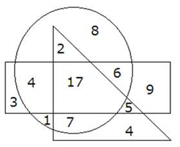
In the following diagram, the triangle represents 'Lawyers', the circle represents 'Teachers' and the rectangle represents 'Scientists'. The numbers in the various segments represent the number of people. How many people are teachers and scientists but not lawyers?
A10
B11
C12
D17
Solution Answer: A
Look for segments that lie inside the circle and the rectangle but outside the triangle:
4: left of the triangle, inside both the circle and the rectangle.
6: right of the triangle's slanted side, inside both the circle and the rectangle.
Total = 4 + 6 = 10. Note that 17 lies inside all three shapes, so it includes lawyers (option D).
Q10Syllogism
Read the statements and decide which conclusions follow.
Statements
All pencils are sticks.
Some sticks are notes.
All diaries are notes.
Conclusions
Some notes are diaries.
Some sticks are pencils.
Some diaries are sticks.
AAll follow
BOnly I follows
COnly I and II follow
DOnly II follows
Solution Answer: C
I follows: “All diaries are notes” converts to “Some notes are diaries”.
II follows: “All pencils are sticks” converts to “Some sticks are pencils”.
III fails: diaries are linked to sticks only through notes, and “some sticks are notes” may involve notes that are not diaries. There is no definite overlap.
Q11Ranking & Order
In a row of children facing the same direction, Bharat is eleventh from the right end and is third to the right of Samir, who is fifteenth from the left end. How many children are there in the row?
A29
B28
C30
D27
Solution Answer: B
Samir is 15th from the left, and Bharat is 3 places to his right, so Bharat is 18th from the left.
Bharat is also 11th from the right. Total = 18 + 11 − 1 = 28.
Q12Cause & Effect
Read the two statements and decide how they are related.
When you need cash, you just turn to the nearest ATM, but the bank places limits on the amount you can withdraw.
You cannot withdraw more than a few thousand rupees in any 24 hours.
AStatement I is the cause, and statement II is its effect
BStatement II is the cause, and statement I is its effect
CBoth statements I and II are effects of some common cause
DBoth statements I and II are effects of independent causes
Solution Answer: A
Statement I says the bank imposes a withdrawal limit. Statement II describes the result for the customer: they cannot take out more than a few thousand rupees in 24 hours. The limit causes the restriction, so I is the cause and II is the effect.
B reverses the logic, since the customer's inability cannot create the bank's policy. C and D miss the direct link between the two.
Q13Number Series
1605, 1678, 1757, 1840, 1929, ?
A2024
B2026
C2020
D2030
Solution Answer: B
The differences are 73, 79, 83, 89, which are consecutive prime numbers. The next prime is 97.
1929 + 97 = 2026.
Q14Operations
If Δ is an operation such that for positive integers a and b, a Δ b = (3b - a)(a + 2b), then the value of 45 Δ 32 is
The sides of a triangular park are 35 m, 53 m and 66 m. The cost of levelling the park at the rate of 9.25/m2 is:
A8210
B8184
C8621
D8547
Solution Answer: D
Use Heron's formula. Semi-perimeter s = (35 + 53 + 66) ÷ 2 = 77, so s − a = 42, s − b = 24, s − c = 11.
Area = √(77 × 42 × 24 × 11) = √853776 = 924 m2.
Cost = 924 × 9.25 = 8547.
Q17Time & Speed
A 270 metres long train running at the speed of 120 kmph crosses another train running in the opposite direction at the speed of 80 kmph in 9 seconds. What is the length of the other train?
A230 m
B240 m
C260 m
D320 m
Solution Answer: A
Opposite directions, so relative speed = 120 + 80 = 200 km/h = 200 × 518 = 5009 m/s.
Distance covered in 9 s = 500 m = sum of both lengths.
Other train = 500 − 270 = 230 m.
Q18HCF
What is the least number of square tiles required to pave the floor of a room 15 m 17 cm long and 9 m 43 cm broad, such that the dimensions of the tiles (in cm) are integers?
A861
B851
C759
D777
Solution Answer: B
Fewest tiles means the largest square tile, whose side is HCF(1517, 943) in cm.
By successive subtraction or division, HCF = 41 cm (1517 = 37 × 41 and 943 = 23 × 41).
Number of tiles = 37 × 23 = 851.
Q19Time & Work
A company contracts to paint 3 houses. Mr. Brown can paint a house in 6 days, while Mr. Green would take 8 days and Mr. Blue 12 days. After 8 days, Mr. Brown goes on vacation and Mr. Green begins to work for a period of 6 days. How many days will it take Mr. Blue to complete the contract?
A7
B8
C11
D12
Solution Answer: C
Brown in 8 days: 8 × 16 = 43 houses.
Green in 6 days: 6 × 18 = 34 house.
Done so far = 43 + 34 = 2512. Left = 3 − 2512 = 1112 house.
Blue paints 112 house a day, so he needs 11 days.
Q20Mensuration
A right triangle with sides 3 cm, 4 cm and 5 cm is rotated about the side of 3 cm to form a cone. The volume of the cone so formed is
A10π cm3
B15π cm3
C12π cm3
D16π cm3
Solution Answer: C
Detailed solution coming soon.
Q21Whistleblowing
A manager discovers that his company is secretly dumping industrial waste in violation of environmental regulations. Reporting the violation could jeopardise the manager's career and potentially affect the livelihoods of colleagues who depend on the company for employment. What is the most ethically appropriate course of action?
AReport the violation through established internal channels or approach the relevant regulatory authorities.
BRemain silent, as reporting the violation could threaten the jobs of innocent employees who are not responsible for the company's actions.
CResign from the organisation thereby avoiding personal involvement in the company's unethical practices.
DAnonymously leak the evidence to the media to expose the company.
Solution Answer: A
Illegal dumping harms the public and the environment, and a manager who knows about it has a duty to act. The responsible route uses proper channels: internal reporting first, or the regulator if needed. This stops the harm and keeps the process fair and accountable.
B lets ongoing public harm continue. C avoids personal involvement but leaves the wrongdoing unaddressed. D skips due process and may cause more damage than needed before the company can respond.
Q22Privacy & Consent
A street photographer captures a candid photograph of a stranger crying on a public bench. Although taking the photograph is legally permissible, the photographer intends to display it in an art exhibition. What is the most ethical consideration before publishing the photograph?
APublish the photograph, since taking it in a public place is legally permissible and does not require further justification.
BBalance artistic value against potential harm, respecting the subject's dignity, privacy, and consent.
CAvoid displaying the photograph, as capturing emotionally vulnerable individuals is inherently unethical.
DPublish the photograph but conceal the subject's identity, since anonymisation resolves any ethical concerns.
Solution Answer: B
Legal is not the same as ethical. The subject was caught in a vulnerable, private moment, so the photographer should weigh the work's artistic value against possible harm, and respect the person's dignity and, ideally, seek their consent.
A treats legality as the end of the question. C is an absolute rule that would rule out much legitimate documentary art. D assumes anonymising solves everything, but the dignity concern remains.
Q23Accountability
An employee was wrongfully terminated due to a manager's bias. Years later, the company discovers the error, but the employee has since moved on. What is the most ethical response?
ATake no action, as the employee has already secured another job.
BHold the former manager responsible, fine or fire him, and close the internal investigation.
CSend a formal apology to the former employee without reopening the matter, and offer him financial compensation.
DAcknowledge the error, offer appropriate compensation, and review the process that enabled the bias.
Solution Answer: D
A full ethical response does three things: admits the wrong, repairs the harm to the victim, and fixes the system so it doesn't happen again. D covers all three.
A ignores the injustice. B punishes one person but neither compensates the victim nor fixes the process. C makes amends but skips the systemic review.
Q24Fairness & Merit
A prestigious university gives preferential admission to the children of its alumni, even when other applicants have stronger academic profiles. Critics argue that this practice reinforces existing social inequalities. What is the strongest ethical argument against legacy-based admissions?
AGiving preference based on family connections rewards inherited privilege rather than individual merit.
BUniversities should prioritise academically exceptional students, regardless of their family backgrounds or financial circumstances.
CUniversities should discontinue alumni engagement programmes because they create conflicts of interest in admission decisions.
DAlumni contributions should not influence university policies, as educational institutions must operate independently of donors.
Solution Answer: A
The core objection is fairness: admission is a scarce opportunity, and legacy preference awards it on birth rather than ability. That entrenches existing advantage, which is exactly the inequality critics point to.
B states a general admissions principle rather than naming what is wrong with legacy preference. C attacks alumni engagement as a whole, which is broader than the issue. D is about donor influence, not the merit problem at the centre of the practice.
Q25Technology Ethics
A company developing autonomous vehicles designs its accident-response algorithm to prioritise the safety of passengers over pedestrians when an unavoidable collision presents a risk to both. The company justifies this decision on the grounds that customers are more likely to purchase vehicles that prioritise their own safety. What is the strongest ethical concern with this approach?
APrioritising passengers is justified because customers should be able to expect maximum protection from products they purchase.
BPrioritising occupants raises concerns of equal human worth, which cannot be decided solely by commercial interests.
CAutonomous vehicles should not be permitted on public roads until all possibilities of accidents have been eliminated.
DThe algorithm should make such decisions randomly to ensure that neither passengers nor pedestrians receive preferential treatment.
Solution Answer: B
Pedestrians and passengers have equal moral worth. Deciding whose life to protect because it boosts sales puts commercial gain above that equality, and pedestrians never agreed to bear the extra risk.
A simply restates the company's sales justification. C sets an impossible standard (zero accidents). D swaps a moral judgment for chance, which doesn't address the concern.
Day 22 complete! 🔥
0 / 25
Correct 0 · Wrong 0 · Accuracy 0%
Keep the streak alive. See you tomorrow for Day 23.