SNAP Daily Practice – Day 12
25 questions across General English, Logical Reasoning, Quant & Decision Making · +1 for a correct answer · −0.25 for a wrong answer
A compound word joins two independent words into one: snow + man = snowman.
“Beautiful” is beauty + the suffix -ful, and “movement” is move + the suffix -ment; suffixes are not standalone words. “Behind” is a single word built from the old prefix be-, not two free words joined together.
“Was read” is simple past passive (was + past participle). The active form keeps the simple past: “I read the newspaper.”
B shifts to the future, C to the past perfect and D to the past continuous.
To “weather the storm” is to get through a difficult period without serious damage, the way a ship survives rough seas.
A and C call the situation “simple”, but a storm implies difficulty. B adds “without thinking”, which the phrase does not mean.
An interjection is a word that expresses sudden emotion and is usually followed by an exclamation mark. “Wow!” expresses surprise and admiration.
“That” is a pronoun, “amazing” is an adjective and “performance” is a noun.
Apposite (double “p”, single “s”, single “t”) means apt or appropriate, as in “an apposite remark”.
A changes “t” to “r”. B doubles the “t”. D drops one “p”.
Take the house as (0, 0), with east and north positive.
- 20 m east → (20, 0)
- 10 m south → (20, −10)
- 35 m west → (−15, −10)
- 5 m north → (−15, −5)
- 15 m east → (0, −5)
He ends 5 m directly south of the house, so the distance is 5 m.
Number the seats 0–7, counting to the right from Bunty.
- Bunty = 0, so Manav (immediate right) = 1, and Kavya = 0 − 4 = 4.
- Payal is 2nd to the left of Bunty, so Payal = 6. Wasir = Payal − 4 = 2.
- Seats 3, 5 and 7 remain for Himmat, Dev and Qasturba. Himmat = 3, Dev = 5, Qasturba = 7 is the only order that fits (Dev 2nd right of Himmat, Qasturba 2nd right of Dev).
| Seat | 0 | 1 | 2 | 3 | 4 | 5 | 6 | 7 |
|---|---|---|---|---|---|---|---|---|
| Person | Bunty | Manav | Wasir | Himmat | Kavya | Dev | Payal | Qasturba |
3rd to the right of Bunty is seat 3: Himmat.
Detailed solution coming soon.
- 1 is adjacent to 2, 3 and 5, so the face opposite 1 is either 4 or 6.
- Whichever of 4 and 6 is opposite 1, the other is adjacent to 1. So 4 and 6 are never opposite each other.
- On a cube, two faces that are not opposite are adjacent, so 4 is adjacent to 6 in every case.
B is not certain, because 2 and 5 could be opposite. C and D each hold in only one of the two cases.
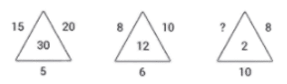
Rule: left + right − bottom = number inside.
- 15 + 20 − 5 = 30 ✓
- 8 + 10 − 6 = 12 ✓
- ? + 8 − 10 = 2, so ? = 4
- Cloud
- Rainbow
- Devastation
- Rain
- Low Pressure
- Flood
Low pressure (5) draws in moist air, which forms clouds (1). Clouds bring rain (4), and sunlight through raindrops makes a rainbow (2). Heavy rain causes floods (6), and floods cause devastation (3).
B puts the rainbow before the rain. C puts clouds before low pressure. D puts rain before clouds and devastation before the flood.
- The list of accepted participants will include all applicants who turn 25 later in the competition year.
- The list of accepted participants will include every applicant who is currently under 25.
Registration is simply “open” to those who meet the age rule. No other selection criterion is mentioned, so every eligible applicant is accepted.
- I follows: the “however” clause explicitly keeps those who turn 25 during the year eligible.
- II follows: anyone currently under 25 meets the main rule.




- Every lizard is a reptile, so the Lizard circle sits inside the Reptile circle.
- Mammals are neither reptiles nor lizards, so the Mammal circle stands apart.
That is option C. A shows lizards outside reptiles. B and D show overlaps between mammals and reptiles that don’t exist.
Let the smaller number be S. Then the larger is 6S + 15, and (6S + 15) − S = 1365, so 5S = 1350 and S = 270. The larger number is 1635.
By the Euclidean algorithm, HCF(1635, 270) = HCF(270, 15) = 15, since 270 = 15 × 18.
Relative speed (same direction) = 45 − 9 = 36 km/h = 36 × 518 = 10 m/s.
Distance to cover = 240 (gap) + 120 (train length) = 360 m.
Time = 360 ÷ 10 = 36 seconds.
Let the present ages be F and S.
F − 10 = 3(S − 10), so F = 3S − 20. Also F + 10 = 2(S + 10), so F = 2S + 10.
3S − 20 = 2S + 10 gives S = 30 and F = 70. Ratio = 70 : 30 = 7 : 3.
Over 2 years the rates become 28% (A) and 22% (B).
If all Rs 13900 were in A, the interest would be 0.28 × 13900 = 3892. The actual interest is 3508, which is 384 less.
Each rupee moved to B earns 6% less, so B = 384 ÷ 0.06 = Rs 6400.
Let the tower height be h and the distance from A be d.
tan 45° = h + 6d, so d = h + 6. tan 30° = hd, so d = h√3.
h√3 = h + 6, so h = 6√3 − 1 = 3(√3 + 1) ≈ 3 × 2.732 ≈ 8.2 m.
Find the measure of angle CBO.
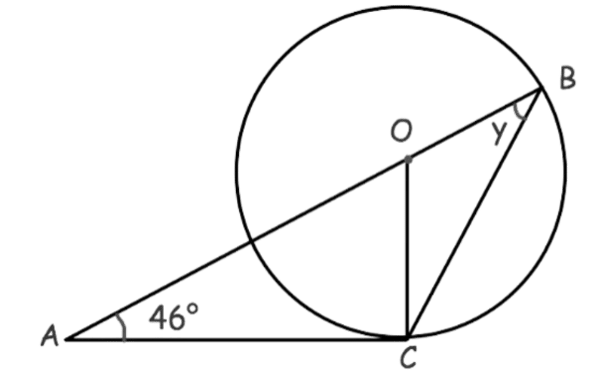
- A tangent is perpendicular to the radius at the point of contact, so ∠OCA = 90°.
- In △AOC: ∠AOC = 180° − 90° − 46° = 44°.
- AOB is a straight line, so ∠COB = 180° − 44° = 136°.
- OB = OC (radii), so △OBC is isosceles: y = 180° − 136°2 = 22°.
- (11x − 5)2 = 121x2 − 110x + 25
- (10x − 1)2 = 100x2 − 20x + 1
- (3x − 20)(7x + 10) = 21x2 − 110x − 200
Left side = (121 − 100 − 21)x2 + (−110 + 20 + 110)x + (25 − 1 + 200) = 20x + 224.
20x + 224 = 124, so 20x = −100 and x = −5.
Stewardship means using the organisation’s resources responsibly and avoiding needless environmental harm. A small one-time cost that stops recurring waste is clearly the responsible choice.
A ignores the waste just because someone else pays. C wastes even more energy. D burdens employees to justify a fault instead of fixing it.
Deciding to take a human life requires moral judgment: weighing proportionality, recognising surrender, and bearing responsibility. A machine cannot do this, so removing the human from the decision is the core ethical objection.
A and D are security and reliability risks. B is a cost argument. None of them is the primary moral issue.
Two ethical claims collide. The employee saw confidential payroll data she was not authorised to view (a privacy issue). That same data reveals an apparent gender-based pay gap (a pay-equity issue). Acting on the information means weighing one wrong against the other.
A trivialises the situation. B treats a likely equity violation as mere negotiation. D is a budgeting matter, not an ethical tension.
- A company’s code of conduct prohibits employees from falsely taking primary authorship for a work product created by a peer.
- A senior consultant added her name as co-author on a report written entirely by her junior colleague, but listed the junior colleague as the primary author.
- The junior colleague approved this listing.
- The senior consultant violated the company's code of conduct.
- The senior consultant acted unethically by coercing her junior colleague.
I fails: the code bans falsely taking primary authorship. She listed the junior as primary author and herself only as co-author, so the rule as stated isn’t breached.
II fails: the junior approved the listing, and nothing in the statements shows coercion. Assuming it goes beyond the facts.
- Reverting the software update to restore critical network functionality immediately.
- Publishing a transparent public statement explaining the cause of the outage.
- Offering pro-rated refunds to customers for the downtime they experienced.
- Conducting a root-cause analysis to fire the specific engineer responsible for the update.
- 1: restore service first; people cannot reach emergency services, so lives are at risk.
- 2: then be transparent with the public about what happened.
- 3: compensate customers for the downtime.
- 4: blame-hunting comes last. A sound root-cause analysis should fix systems, not single out one engineer.
B and D delay restoring life-critical service. C compensates before explaining.
Correct 0 · Wrong 0 · Accuracy 0%
Keep the streak alive. See you tomorrow for Day 13.