SNAP Daily Practice – Day 11
25 questions across General English, Logical Reasoning, Quant & Decision Making · +1 for a correct answer · −0.25 for a wrong answer
“A bad egg” is a person who cannot be trusted: someone dishonest, unreliable or a bad influence. A rotten egg looks fine from outside but is spoiled within, and the idiom borrows that image.
A describes carelessness, not bad character. C reads the idiom literally. D is about luck, which the idiom has nothing to do with.
Antithesis sets contrasting ideas side by side in a balanced, parallel structure. Here “speech” is set against “silence” and “silver” against “golden”, in two matching clauses joined by “but”.
A: calling speech “silver” is figurative, but the defining feature of the sentence is the balanced contrast, not a single comparison. C: there is no “like” or “as”. D: an epigram is a short, witty, often paradoxical remark; this proverb’s force comes from its contrast, which makes antithesis the best answer.
Detailed solution coming soon.
To “abolish” is to formally end a system, practice or institution, e.g. abolishing slavery or the death penalty.
A: “rescind” means to revoke a specific law, order or contract, not a whole system. B: “extirpate” means to root out or destroy completely, with no sense of formal ending. D: “obfuscate” means to make something unclear.
- This has an impact not just on global poverty, but also on Indians' awareness of the country's poverty for the first time in a decade.
- And, for the first time in a decade, this update includes India's poverty data.
- From 15 September, a new global poverty line has been established, with the World Bank revising its data in the Poverty and Inequality Platform on this basis.
- According to Sunitha Sinha, Roy and Roy van der Weide of the World Bank's Policy Research Working Paper, "poverty in India had dropped over the recent decade, although not as much as previously thought."
- C opens the paragraph: it introduces the new poverty line and the World Bank’s data revision.
- B follows with “And… this update”, referring back to the revision in C.
- A (“This has an impact…”) explains why including India’s data matters.
- D closes with the actual finding about poverty in India.
B and C start with D, which presents a finding before the context is set. D (CADB) puts A’s “impact” before B mentions India’s data, so “this” has nothing to refer to.
Angle between the hands = |30H − 5.5M| = |30 × 10 − 5.5 × 25| = |300 − 137.5| = 162.5°.
Reflex angle = 360° − 162.5° = 197.5°.
D (162.5°) is the smaller angle, not the reflex one.
- The government should ban all construction work in the area.
- Tourism in the area should be banned until illegal construction work stops completely.
- I fails: the problem is illegal construction. Banning all construction, legal work included, is an extreme step that goes beyond the cause.
- II fails: tourists are not causing the illegal construction. Banning tourism punishes the wrong party and hurts the local economy without stopping the builders.
The practical course would be to stop and penalise the illegal construction itself, which neither option says.
Step I: south but 32 71 glory fair 65 84
Step II: south 84 but 32 71 glory fair 65
Step III: south 84 glory but 32 71 fair 65
Step IV: south 84 glory 71 but 32 fair 65
Step V: south 84 glory 71 fair but 32 65
Step VI: south 84 glory 71 fair 65 but 32
Step VI is the last step of the rearrangement.
Step III of an input is: year 92 ultra 15 23 strive house 39.
How many more steps will be required to complete the rearrangement?
Pattern: moving left to right, the arrangement alternates words and numbers. Words are taken in reverse alphabetical order (south, glory, fair, but) and numbers in descending order (84, 71, 65, 32), one element per step.
- Step III: year 92 ultra 15 23 strive house 39
- Step IV: year 92 ultra 39 15 23 strive house
- Step V: year 92 ultra 39 strive 15 23 house
- Step VI: year 92 ultra 39 strive 23 15 house
- Step VII: year 92 ultra 39 strive 23 house 15 (final)
Steps IV to VII are needed, so 4 more steps.
- All rings are necklaces.
- All those necklaces that are not rings are earrings.
- No earring is a bracelet.
- Some bracelets are necklaces.
- No ring is a bracelet.
- Every necklace is a ring or an earring (statements 1 and 2).
- No earring is a bracelet, so any bracelet that is a necklace must be a ring.
- If I is true (some bracelet is a necklace), that bracelet is a ring, so II is false.
- If I is false (no bracelet is a necklace), then no ring can be a bracelet, since every ring is a necklace, so II is true.
Neither conclusion is certain alone, but exactly one of them must hold. Hence either I or II follows.
- Common words “they have” ↔ common codes “na da”.
- So “come back” ↔ “ja sa”, in some order.
Nothing separates “come” from “back”, so “come” is sa or ja. B (na) belongs to “they/have”, and A or C alone cannot be confirmed.
| 4 | 9 | 20 |
| 8 | 5 | 14 |
| 10 | 3 | ? |
In each row, third number = first2 + 2 × second.
- Row 1: 4 ÷ 2 + 2 × 9 = 2 + 18 = 20 ✓
- Row 2: 8 ÷ 2 + 2 × 5 = 4 + 10 = 14 ✓
- Row 3: 10 ÷ 2 + 2 × 3 = 5 + 6 = 11
- Motorists may reduce the use of mobile phones while driving in the future.
- People are willing to pay fines for using mobile phones while driving.
I is implicit: a drive with heavy fines only makes sense if the department expects penalties to deter phone use while driving.
II is not implicit: the drive assumes fines will discourage the behaviour, not that people are happy to pay them. If anything, it assumes the opposite.
| Letter | P | E | R | F | O | R | A | T | E |
|---|---|---|---|---|---|---|---|---|---|
| Alphabet no. | 16 | 5 | 18 | 6 | 15 | 18 | 1 | 20 | 5 |
A pair qualifies when the gap between positions in the word equals the gap in the alphabet.
- P–R (positions 1 and 3): one letter between in the word (E) and one in the alphabet (Q) ✓
- R–T (positions 6 and 8): one letter between in the word (A) and one in the alphabet (S) ✓
No other pair matches, so there are two pairs.
With rational coefficients, irrational roots come in conjugate pairs, so the other root is 2 − √3.
Sum = 4, product = (2 + √3)(2 − √3) = 4 − 3 = 1.
Equation: x2 − (sum)x + product = 0, i.e. x2 − 4x + 1 = 0.
A has sum −4. C and D have the wrong product.
S11 = S19 gives 112(2a + 10d) = 192(2a + 18d).
22a + 110d = 38a + 342d → 16a = −232d → 2a + 29d = 0.
S30 = 302(2a + 29d) = 15 × 0 = 0.
Shortcut: if Sm = Sn (m ≠ n), then Sm+n = 0.
- 10 men and 10 women together can complete the work in 337 days.
- If 10 men work for 3 days and thereafter 10 women replace them, the remaining work is completed in 4 days.
Let m and w be the daily work of 10 men and 10 women.
- I alone: m + w = 724. One equation, two unknowns, so not sufficient.
- II alone: 3m + 4w = 1. Again one equation, two unknowns, so not sufficient.
- Together: 3(m + w) = 78, so w = 1 − 78 = 18. 10 women take 8 days.
Both statements are needed.
13πr2 × 8 = 96π → r2 = 36 → r = 6 cm.
Slant height l = √(62 + 82) = 10 cm.
TSA = πr(l + r) = π × 6 × 16 = 96π cm2.
A (60π) is only the curved surface area.
- 3 men, 2 women: 7C3 × 6C2 = 35 × 15 = 525
- 4 men, 1 woman: 7C4 × 6C1 = 35 × 6 = 210
- 5 men: 7C5 = 21
Total = 525 + 210 + 21 = 756.
Divisible by 9: digit sum = 5 + 3 + p + 2 + 6 + p + 3 = 19 + 2p must be a multiple of 9. With p a digit, 19 + 2p = 27, so p = 4.
Divisible by 8: the last three digits 7q4 must be divisible by 8. 704, 744 and 784 all work, so the smallest q is 0.
Minimum p + q = 4 + 0 = 4.
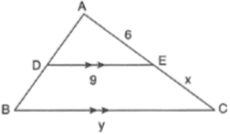
4AD = 3DB gives AD : DB = 3 : 4, so AD : AB = 3 : 7.
Since DE ∥ BC, triangle ADE ~ triangle ABC, so AEAC = DEBC = 37.
- AC = 6 × 73 = 14, so x = EC = 14 − 6 = 8.
- y = BC = 9 × 73 = 21.
y − x = 21 − 8 = 13.
- The non-disclosure agreement (NDA) of a company states: "Confidential product information may only be shared with individuals currently employed by the company."
- An engineer discusses confidential specifications for a new engine with his wife over dinner.
- The wife is a graphic designer for an unrelated advertising agency.
- The engineer breached the NDA.
- The spouse is likely to use the information for financial gain.
I follows: the NDA allows sharing only with current employees. The wife works for an unrelated agency, so sharing confidential specifications with her is a breach, whatever the setting or intent.
II does not follow: nothing in the statements suggests she intends to profit. That is pure speculation.
Accountability follows the decision to deploy. By releasing a system they could neither explain nor control, the executives accepted responsibility for its outcomes. Its opacity was a reason for more testing and oversight, not an excuse.
A lets humans hide behind machines. C misses that accurate historical data can still encode past discrimination. D proposes one crude fix rather than identifying the real failure, which is deploying without oversight.
After a year of coaching and support, due process has been followed. Fiduciary duty means acting on the objective performance record. Empathy shapes how it is done (privately, respectfully, with transition support), not whether it is done.
A neglects the duty to the organisation. B abandons empathy and dignity. C is dishonest and misleads the organisation.
“Dark patterns” are design tricks that steer users against their own interests. Making cancellation far harder than sign-up (a “roach motel” design) traps customers and undermines free, informed consent.
A concerns ownership of creative work. B concerns duties to shareholders, not customers. D is an economic concept, not an ethical one.
- Securing the robot's sensor data and decision logs before they can be overwritten or altered.
- Ensuring emergency medical services are immediately dispatched to assist the pedestrian.
- Analyzing the code to determine if this is a systemic flaw that requires recalling all other robots.
- Contacting the company's legal counsel to prepare a defense against potential lawsuits.
- 2: human life comes first; get medical help to the pedestrian.
- 1: preserve the logs immediately, before evidence is lost or altered.
- 3: use that evidence to check for a systemic flaw and protect the public.
- 4: the company’s legal defence is self-interest and comes last.
B and D put data before the injured person. C analyses code before securing the evidence it depends on.
Correct 0 · Wrong 0 · Accuracy 0%
Keep the streak alive. See you tomorrow for Day 12.