
SNAP Daily Practice – Day 10
25 questions across General English, Logical Reasoning, Quant & Decision Making · +1 for a correct answer · −0.25 for a wrong answer
“Put something by” means to save money for a later purpose. She saved money during her internship to pay for her MBA applications.
“Put something down” means to place something or pay a deposit. “Put through something” means to make someone experience something difficult. D repeats the incorrect phrase from the sentence.
“The former” and “the latter” are used only when choosing between two items. With three items, the correct word is “the first”: “Of the three, women, wine and song, the first brought about his ruin.”
Parts A, B and D are grammatically correct.
“Fundamental” describes the noun “skill”. It tells us what kind of skill it is, so it is an adjective.
It is not naming anything, so it is not a noun. It does not modify a verb, so it is not an adverb. It does not join clauses, so it is not a conjunction.
“Expatiate” means to speak or write about something at length and in detail. It is a one-word replacement for “provide a detailed explanation”.
“Obfuscate” means to make something unclear, which is the opposite. “Circumscribe” means to restrict or limit. “Dissemble” means to hide one’s true feelings or motives.
Four changes are needed:
- “said to” becomes “told”
- “you/your” becomes “they/their”
- “cannot” becomes “could not”
- “here” becomes “there”
A keeps “here”. C changes “can” to “should”, which alters the meaning from prohibition to advice. D changes the modal to “must” and also keeps “here”.
At 4:00 the hour hand is at 120° and the minute hand is at 0°. The minute hand gains 5.5° per minute on the hour hand.
For the hands to point in opposite directions, the minute hand must be 180° ahead: 5.5m − 120 = 180, so 5.5m = 300.
m = 60011 = 54611 min. past 4.
835, 734, 642, 751, 853, 981, 532
In each number, the first digit equals the sum of the other two:
- 835: 3 + 5 = 8 ✓ · 734: 3 + 4 = 7 ✓ · 642: 4 + 2 = 6 ✓
- 853: 5 + 3 = 8 ✓ · 981: 8 + 1 = 9 ✓ · 532: 3 + 2 = 5 ✓
- 751: 5 + 1 = 6 ≠ 7 ✗
So 751 is the odd one out.
- P % Q: P is east of Q.
- Q + R: Q is north of R, so R is directly south of Q.
- R – S: R is west of S, so S is east of R.
S is south of Q (at R’s level) and to the east, so S is South-East of Q.
What is B's position with respect to G?
Number the seats 1–8 clockwise. Everyone faces the centre, so moving to a person’s left is clockwise and moving to their right is anticlockwise.
- H and D: fourth to the right in a circle of 8 means directly opposite. H = 1, so D = 5.
- B: D is second to the left of B, so B = 3. F is opposite B, so F = 7.
- E: it cannot be next to B (seats 2 and 4) or D (seats 4 and 6). Of the empty seats 2, 4, 6 and 8, only seat 8 is left, so E = 8. C is opposite E, so C = 4.
- A and G: A cannot be next to D, so A cannot take seat 6. A = 2 and G = 6.
| Seat (clockwise) | 1 | 2 | 3 | 4 | 5 | 6 | 7 | 8 |
|---|---|---|---|---|---|---|---|---|
| Person | H | A | B | C | D | G | F | E |
Counting from G to its right (anticlockwise): 6 → 5 (D) → 4 (C) → 3 (B). B is third to the right of G.
Each letter moves 4 places forward: C→G, O→S, R→V, N→R, E→I, R→V.
CENTRAL: C→G, E→I, N→R, T→X, R→V, A→E, L→P = GIRXVEP.
A shifts each letter by only 1. B follows no consistent rule.
29 February exists only in leap years, so his birthdays fall in 1928, 1932, …, 2024. Every year in this range divisible by 4 is a leap year, including 2000.
Four years = 1461 days = 208 weeks + 5 days, so each leap-year birthday moves forward 5 weekdays. After 7 such steps (28 years), it lands on the same weekday again.
Friday birthdays: 1924 + 28 = 1952, 1980 and 2008. The next would be 2036, after his death in 2025. That makes 3 Friday birthdays.
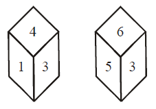
- View 1: 4 and 1 are shown next to 3, so both are adjacent to 3.
- View 2: 6 and 5 are shown next to 3, so both are adjacent to 3.
- A face of a cube has exactly four neighbours. For 3 these are 1, 4, 5 and 6.
The only number left, 2, must be opposite 3.
6 (A) and 1 (B) appear beside 3 in the figure, so they cannot be opposite it. The answer can be determined, so D is wrong.
A contradiction would have to say the opposite of the statement, for example that the job market has kept pace with MBA seats.
A is a plausible inference from expanding seats without matching jobs. B follows naturally from more graduates competing for fewer roles. C is unrelated to the statement but does not contradict it. None of them contradicts the statement, so the answer is None of these.
After n years: X = 420 + 40n and Y = 630 + 15n.
X − Y = 40 → 25n − 210 = 40 → n = 10.
2012 + 10 = 2022. Check: X = 820 and Y = 780.
Let the capitals be 4x and 5x.
A: 4x for 3 months, then 3x for 7 months = 12x + 21x = 33x.
B: 5x for 3 months, then 4x for 7 months = 15x + 28x = 43x.
A’s share = 3376 × 49400 = 33 × 650 = Rs. 21450.
DETAIL has 3 vowels (E, A, I) and 3 consonants (D, T, L). There are exactly 3 odd positions (1, 3 and 5).
Vowels in the odd positions: 3! = 6 ways. Consonants in the even positions: 3! = 6 ways.
Total = 6 × 6 = 36.
If all three numbers leave the same remainder, N must divide the differences between them:
4665 − 1305 = 3360, 6905 − 4665 = 2240 and 6905 − 1305 = 5600.
HCF(3360, 2240, 5600) = 1120, so N = 1120. Sum of digits = 1 + 1 + 2 + 0 = 4.
In both cases the train covers its own length at its speed relative to the walker, so the two products must be equal:
(v − 4.5) × 8.4 = (v − 5.4) × 8.5 → 8.4v − 37.8 = 8.5v − 45.9.
0.1v = 8.1, so v = 81 km/hr.
A 12% stock pays Rs. 12 a year on a face value of Rs. 100. For that Rs. 12 to be a 10% yield, the price must be:
Market price = 1210 × 100 = Rs. 120.
A (83.33) inverts the ratio.
Height h = 1500√3 m.
At 60°: horizontal distance = htan 60° = 1500√3√3 = 1500 m.
At 30°: horizontal distance = htan 30° = 1500√3 × √3 = 4500 m.
Distance flown = 3000 m in 15 s, so speed = 200 m/s.
Plastic packaging imposes an environmental cost on society that the company never paid for. This is a negative externality. By paying more for biodegradable packaging out of its own margins, the company internalises that cost instead of passing it on to society or customers.
A would argue against reducing profits. B does not apply, because no regulation required the switch. D is not an ethical principle at all, and there is no evidence of deception.
- Reviewing the signed contract to establish the agreed-upon payment terms.
- Processing the payment immediately with an apology if the company is indeed at fault.
- De-escalating the vendor's anger on the phone by promising to look into the matter immediately.
- Investigating the warehouse receiving logs to verify that the shipment actually arrived.
- 3: the vendor is angry on the phone right now, so acknowledge the concern and commit to looking into it, without admitting fault yet.
- 1: establish what was agreed, including the payment terms and due date.
- 4: verify the facts against those terms by confirming the shipment actually arrived.
- 2: once fault is confirmed, pay promptly and apologise.
B and D leave an angry vendor waiting on the line while records are checked. C checks the logs before knowing what the contract requires.
Fairness here means each person bears the cost of what they chose. One person ran up half the bill, so an equal split would make students on tight budgets subsidise his premium order.
A puts comfort ahead of fairness and burdens those who can least afford it. C imposes redistribution that nobody agreed to. D is retaliation rather than a fair solution.
A twenty-year close friendship makes impartiality impossible, both in fact and in how others see it. The only way to protect the complainant, the accused and the process is to declare the conflict and step aside in favour of an independent investigator.
A is framed around protecting the COO, which shows bias. B swaps one bias for another. D bypasses due process and pressures the complainant to settle informally.
The false claim has already reached everyone in the group, and someone could skip real treatment because of it. Physical safety outweighs social discomfort, so the correction must reach the same audience. It can still be done respectfully.
B is polite but leaves every other member misinformed. C puts harmony ahead of people’s health. D abandons the group without correcting anything.
Correct 0 · Wrong 0 · Accuracy 0%
Keep the streak alive. See you tomorrow for Day 11.