SNAP Daily Practice – Day 1
25 questions across General English, Logical Reasoning, Quant & Decision Making · +1 for a correct answer · −0.25 for a wrong answer
General English
“A long shot” is an attempt that has only a slim chance of succeeding, like a shot taken from a great distance.
A takes the image literally as accuracy. C has nothing to do with profit. D implies certainty, the opposite of the idiom.
A relative pronoun like “which” must refer to a noun. Here it grammatically points to “thesis” (or “Gandhi”), but what provoked the counterattack was her attack, which appears only as a verb. A correct version: “Her attack on my thesis on Gandhi provoked my counterattack.”
Parts A and B are grammatically sound on their own, so D (No error) is wrong.
A simile compares two unlike things directly using “as” or “like”. Here, her smile is compared to the sun with “as bright as”.
A metaphor would drop “as/like” (“Her smile is the sun”). A euphemism softens a harsh idea, which doesn’t apply here.
“Forbade” means refused to allow. Its opposite is “sanctioned”, meaning gave permission or approval.
“Prescribed” means laid down as a rule, which is not a direct opposite. “Obstructed” and “deterred” are close in meaning to “forbade”.
The active sentence is in the past perfect (“had passed”). Its passive form is object + had been + past participle + by + subject, so “A decree had already been passed by the ruler…”.
A drops “been”, which makes it ungrammatical. B shifts to past continuous. C shifts to simple past.
Analytical & Logical Reasoning
Code = sum of the letters’ alphabet positions + number of letters.
- SOLID: 19 + 15 + 12 + 9 + 4 = 59; 59 + 5 = 64 ✓
- POUR: 16 + 15 + 21 + 18 = 70; 70 + 4 = 74 ✓
- TON: 20 + 15 + 14 = 49; 49 + 3 = 52
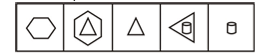


The series alternates between a shape on its own and that same shape, rotated 90°, holding a new shape inside:
- 1 → 2: the hexagon rotates 90° and holds a new shape, a triangle.
- 3: that triangle appears on its own.
- 4: the triangle rotates 90° and holds a new shape, a cylinder.
- 5: that cylinder appears on its own.
So the 6th figure should be a cylinder rotated 90° (lying horizontally) with a brand-new shape inside. That is option A.
B and D keep the cylinder upright, so the rotation is missing. C has the rotation, but its inner shape is the triangle, which has already appeared, so it isn't new.
5, 12, 22, 46, 90, ?
Double each term, then alternately add and subtract 2: 5×2+2 = 12, 12×2−2 = 22, 22×2+2 = 46, 46×2−2 = 90, 90×2+2 = 182.
- The government should immediately start a work program in the district to put a halt to the exodus.
- The government should make an effort to provide potable water to these districts.
- The government should start investing in projects for the effective use of resources during drought times.
- I gives people a livelihood, which directly tackles the exodus.
- II meets the immediate basic need created by the drought.
- III is a long-term measure to soften future droughts.
All three are practical and address different parts of the problem, so all follow.
- D is B’s son and F is D’s sister, so F is also B’s child.
- A is F’s mother, so A is B’s wife.
- E is the mother-in-law of B’s wife, so E is B’s mother.
- C is B’s father, so C is E’s husband.
- Some vowels are digits.
- Some digits are consonants.
- No consonant is a vowel.
- No digit is a vowel.
- Some consonants are vowels.
II contradicts Statement 1 (“Some vowels are digits”), so it fails.
There is no definite link between consonants and vowels, so neither I nor III follows on its own. But I (“No consonant is a vowel”) and III (“Some consonants are vowels”) form a complementary pair, so exactly one must be true. Hence either I or III follows.
- Fix D and C. Put D at seat 1; C is opposite at seat 4.
- A between D and F. A is at seat 2 and F at seat 3 (the mirror image gives the same neighbours).
- E not next to D. Seat 6 touches D, so E takes seat 5 and B takes seat 6.
| Seat | 1 | 2 | 3 | 4 | 5 | 6 |
|---|---|---|---|---|---|---|
| Person | D | A | F | C | E | B |
C (4) and E (5) are neighbours. A–B, B–F and A–C are not. So the answer is C and E.
- It is the aim of the city’s civic authority to reduce air pollution by 20% in the next two months.
- The number of asthma cases in the city is constantly increasing.
Air pollution is a major trigger of asthma. A steady rise in asthma cases (II) is a public-health warning that would prompt the authority to set a pollution-reduction target (I). So II is the cause and I is the response.
A is impossible, because an aim to cut pollution cannot raise asthma cases. D ignores the clear link between the two.
Quantitative Ability
Let the speed be v and the time t, so distance = vt.
(v + 6)(t − 4) = vt → 6t − 4v = 24 → 3t − 2v = 12.
(v − 6)(t + 6) = vt → 6v − 6t = 36 → v = t + 6.
Substituting: 3t − 2t − 12 = 12, so t = 24 h and v = 30 km/h. Distance = 30 × 24 = 720 km.
Pipe radius = 0.07 m, so its area = 227 × 0.072 = 0.0154 m2.
Flow per hour = 0.0154 × 5000 = 77 m3. Volume needed = 50 × 44 × 0.07 = 154 m3.
Time = 154 ÷ 77 = 2 hours = 120 minutes, which is not among A–C. So the answer is None of these.
Simplify each term: √2 = 1√2, √8 = 2√2, √18 = 3√2, √32 = 4√2, … so the nth term is n√2.
Sum = √2 × (1 + 2 + … + 30) = √2 × 30 × 312 = √2 × 465 = 465√2.
A and C forget the √2 factor. D doubles the sum of 1 to 30.
Alcohol fraction: A = 58, B = 14, target = 12.
Alligation: A : B = (12 − 14) : (58 − 12) = 2 : 1.
From A: 23 × 2.4 = 1.6 litres.
P(at least one head) = 1 − (½)n > 0.95, so (½)n < 0.05, i.e. 2n > 20.
24 = 16 is too small and 25 = 32 works, so n = 5.
logy x = 4 gives x = y4. log10y 25x = 2 gives 25x = 100y2.
So 25y4 = 100y2, which gives y2 = 4 and y = 2. Then x = 24 = 16.
LCM(3, 5, 9) = 45 hours. 48 hours after 6 p.m. Monday is 6 p.m. Wednesday, so 45 hours is 3 hours earlier: 3 p.m. Wednesday.
Decision Making & Ethics
- A civil service regulation mandates that officers must recuse themselves from adjudicating tenders if they have a direct financial interest in any of the bidding entities.
- Officer Sharma is adjudicating a tender. His estranged brother, with whom Sharma has had no contact or financial entanglement for a decade, is the CEO of a bidding entity. Sharma does not recuse himself.
- Sharma violated the mandatory recusal regulation.
- Sharma's decision not to recuse himself guarantees an objective adjudication of the tender.
I fails: the rule applies only to a direct financial interest. Sharma has had no financial entanglement with his brother for a decade, so the regulation isn’t triggered.
II fails: not recusing cannot “guarantee” objectivity, and nothing in the statements supports such certainty.
Workplace justice requires decisions on job-relevant criteria: performance and contribution. Penalising A for family wealth, or rewarding B for personal circumstances, brings in factors unrelated to work. Compassion for B can be shown through severance or outplacement support.
B uses a non-work criterion. C wrongly treats the two claims as equal in a workplace decision. D is impractical and avoids the decision.
- Deciding which client relationship is more financially valuable to the advisor's firm.
- Formally withdrawing from advising one or both clients to cure the conflict.
- Identifying that a concurrent conflict of interest has materialized.
- Notifying the firm's legal/compliance department to seek guidance on disclosure rules.
- 3: first recognise that a conflict of interest exists.
- 4: escalate to legal/compliance for disclosure guidance.
- 2: act on that guidance by withdrawing to cure the conflict.
- 1: commercial value comes last and must never drive an ethical decision.
A skips identifying the conflict. B withdraws before seeking guidance. D puts money ahead of compliance.
The executives decided to use the system on real customers. Not understanding the technology doesn’t excuse them; it made it their duty to demand bias testing and oversight before deployment.
A: the data scientists share some blame, but deployment authority sits higher. C blames the victims. D ignores that algorithms reflect human design and deployment choices.
The core wrong is exploiting a vulnerability. Children under eight cannot recognise persuasive intent, so ads mixed into a game manipulate rather than inform them.
A, B and D describe side effects. Using entertainment or creating associations isn’t wrong in itself; it becomes wrong because the audience can’t recognise the persuasion.
Correct 0 · Wrong 0 · Accuracy 0%
Keep the streak alive. See you tomorrow for Day 2.