The NMAT 2026 exam window runs from 2 November to 20 December 2026. This gives candidates a fixed period to take the exam.
With 108 questions to solve in 120 minutes and no negative marking, regular mock-test practice can help candidates become familiar with the actual test format. But how many NMAT mock tests are enough?
There is no single number that works for every student. The right approach depends on your preparation level, available time, and performance in each test.
Join MBA KARO Whatsapp Community For Daily Updates
How Many NMAT 2026 Mock Tests Should You Take?
For most candidates, 10-15 full-length NMAT mock tests can provide enough practice to understand the exam format, work on time management, and identify weak areas.
Students who are already comfortable with the syllabus can focus on taking more mocks and analysing their performance.
Those still building concepts should not rush into full-length tests every day. A simple approach is:
| Preparation Stage | Mock Tests |
| Early practice | 1-2 mocks |
| Mid-preparation | 3-5 mocks |
| Final preparation | 5-8 mocks |
| Overall target | 10-15 mocks |
The important part is not just completing the tests. Mock analysis matters just as much as mock attempts.
Why Should You Take NMAT Mock Tests?
The NMAT exam has 108 questions divided across three sections, with a total testing time of 120 minutes. Each section has its own time limit.
- Language Skills: 36 questions, 28 minutes
- Quantitative Skills: 36 questions, 52 minutes
- Logical Reasoning: 36 questions, 40 minutes
Since there is no negative marking, candidates also need to think about how they use the available time and approach questions. Full-length mocks give you a chance to practise this format before the actual exam.
Taking multiple tests can also help you spot patterns in your performance. For example, you may find that Quant takes longer than expected, or that you make avoidable mistakes in Logical Reasoning.
When Should You Start Taking NMAT Mocks?
You do not need to finish the entire syllabus before taking your first mock. An early mock can work as a baseline test. It shows where you currently stand and which sections need more attention.
After that, you can gradually increase the frequency. For example:
- First stage: Take one mock to understand your current level.
- Second stage: Study the weak topics and take another mock after some practice.
- Third stage: Take mocks regularly and compare your performance.
- Final stage: Use full-length mocks to practise the complete 120-minute exam experience.
What Should You Analyse After an NMAT Mock?
Simply checking your score is not enough. After every mock, spend some time reviewing your attempt. Look at the following aspects:
- Questions you answered incorrectly
- Questions where you spent too much time
- Questions you skipped despite knowing the concept
- Topics where mistakes are repeated
- Section-wise performance
- Your overall time usage
This analysis can tell you whether the problem is knowledge, speed, accuracy, or question selection.
For example, if your Quant score is low because you are unable to complete the section within the given time, solving more questions without a time limit may not solve the actual problem.
Timed mock practice would be more useful.
MBA Karo NMAT 2026 Mock Tests for Full-Length Practice
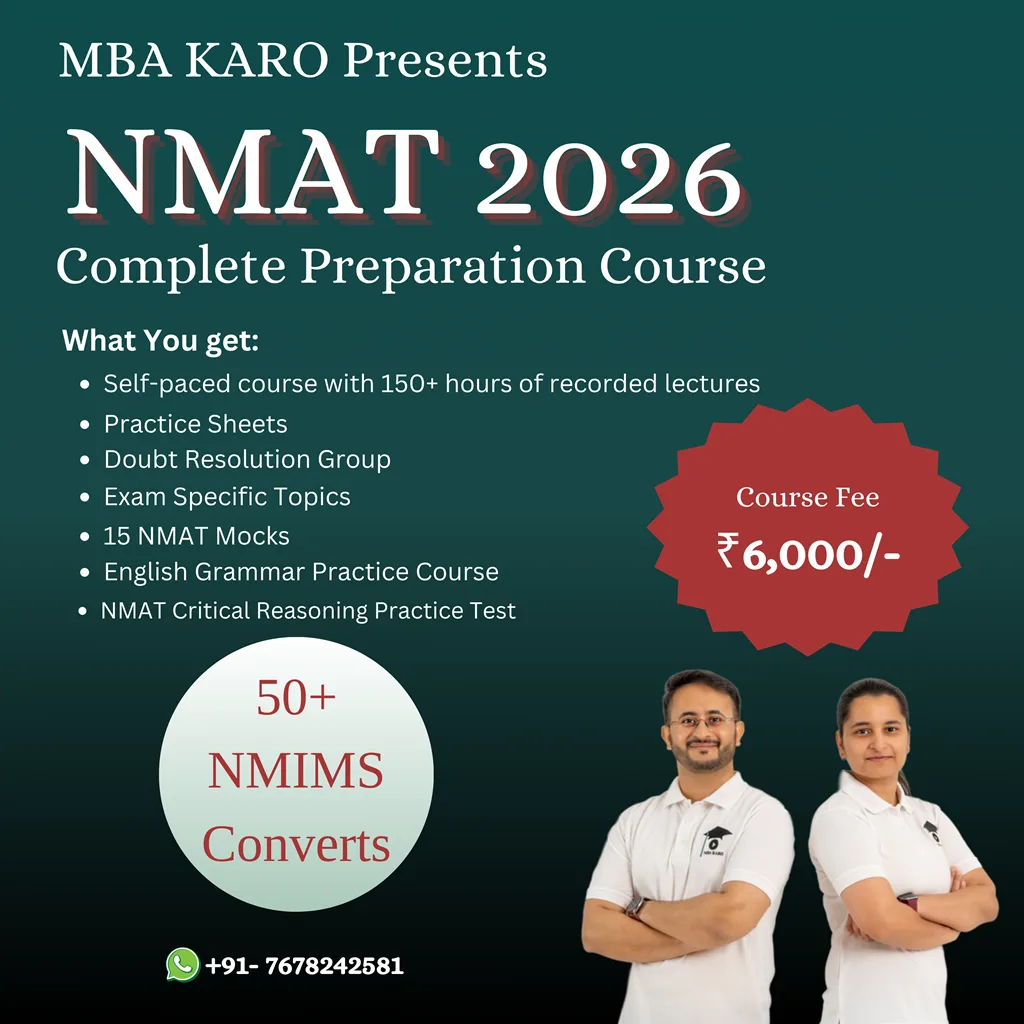
Candidates looking for dedicated NMAT practice can use MBA Karo NMAT 2026 Mock Tests, which provide 15 full-length tests based on the latest exam pattern.
The tests are designed around the actual NMAT-style interface and include 1,620 questions with a total duration of 30 hours. One mock is also available as a trial.
Each mock follows the complete structure of the exam, with 108 questions, 120 minutes, and a total score range of 36-360.
This makes the series useful for candidates who want repeated full-length practice rather than only section-wise questions.
With 15 tests available, students can space them across their preparation instead of attempting all of them close to the exam.
Is 15 NMAT Mock Tests Enough?
For many students, 15 well-analysed mocks can be sufficient. The goal should not be to collect the highest number of tests. It should be to use every test to improve the next one.
If you take 15 mocks but do not review your mistakes, the benefit may be limited. On the other hand, fewer tests with proper analysis can help you identify recurring problems and make targeted improvements.
A good target is to take your first mock early, increase testing frequency as the exam approaches, and reserve the final tests for realistic exam-like practice.
Final Takeaway
The NMAT 2026 exam window starts on 2 November 2026, so candidates have a clear timeline for planning their mock practice.
Aim for around 10-15 full-length mocks, but focus more on what you learn from each test than simply counting attempts.
A structured series such as MBA Karo NMAT 2026 Mock Tests can help provide repeated practice in the complete exam format.