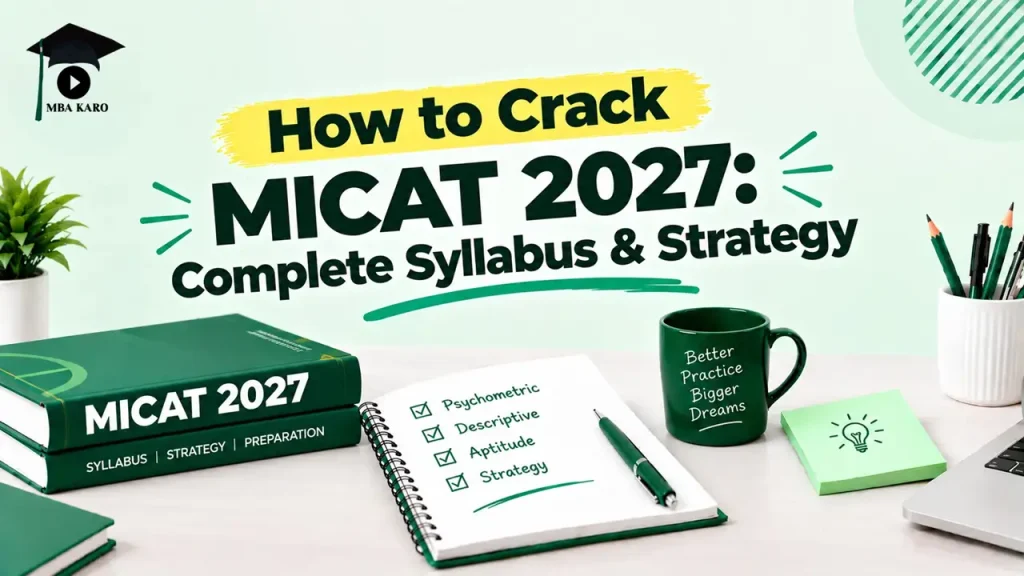
MICAT 2027 is conducted in two phases, giving candidates two opportunities to take the exam. MICAT I is scheduled for December 5, 2026, while MICAT II will be conducted on February 12, 2027. The better score of the two attempts is considered.
Unlike conventional management entrance exams, MICAT tests candidates across aptitude, descriptive writing and psychometric assessment.
For candidates targeting MICA’s flagship programmes, MICAT is also considered along with a CAT, XAT or GMAT score.
The biggest difference in MICAT preparation is therefore not just the aptitude section. Candidates also need to prepare for creative writing, story writing and the psychometric test. A candidate preparing only for aptitude may miss an important part of the selection process.
What Makes MICAT Different From Other MBA Entrance Exams?
MICAT combines different types of assessment in one examination. Its structure includes:
- Psychometric Test
- Descriptive Test
- Aptitude Test
The aptitude section covers areas that overlap with CAT preparation, but MICAT also includes reasoning, general awareness and creative-thinking-based questions.
The descriptive and psychometric sections make MICAT different. The descriptive test requires candidates to write, while the psychometric test uses situation-based questions and checks consistency in responses.
For the flagship PGDM/PGDM-C programmes, candidates also need a CAT, XAT or GMAT score along with MICAT. Therefore, MICAT preparation has to run alongside preparation for the other management entrance exams.
MICAT 2027 Exam Pattern
The previous year’s MICAT structure is shared below. Based on that structure, the examination had 152 questions to be attempted in 130 minutes.
| Section | Questions | Time |
| Psychometric Test | 68 | 25 minutes |
| Descriptive Test | 4 | Included in overall test duration |
| Aptitude Test | 70 | 80 minutes |
| Total | 152 | 130 minutes |
MICAT 2027 Syllabus: Section-Wise Topics
MICAT preparation requires a combination of CAT-level aptitude preparation, reasoning, general awareness, descriptive writing and psychometric preparation.
1. MICAT Psychometric Test
The psychometric section contains situation-based questions. Candidates are given statements or situations and have to respond using an agreement-disagreement scale.
The options can range from:
- Strongly disagree
- Moderately disagree
- Disagree
- Neither agree nor disagree
- Agree
- Moderately agree
- Strongly agree
There will be 68 questions in 25 minutes for this section. There is no conventional right or wrong answer to these questions. The important aspect is consistency.
Since 68 questions have to be answered in 25 minutes, candidates also need to be comfortable making quick responses.
How to Prepare for the Psychometric Test
Psychometric preparation is different from preparing for Quant or Verbal Ability. Candidates should understand the nature of situation-based questions and maintain consistency across their responses.
The objective should not be to memorise answers. Instead, candidates need to understand how the section works and practise responding consistently under a time limit.
2. MICAT Descriptive Test
The descriptive section is one of the most important parts of MICAT preparation. Four questions are asked in this section, including essay- and story-based tasks. One type of question discussed involves giving:
- Three positive points
- Three negative points
- Three ways in which a particular transition could impact society
Another important format involves four images, which candidates have to connect to create a story. This makes descriptive writing a major differentiating factor in MICAT.
Candidates may perform well in aptitude but still struggle if they are not comfortable with essay and story writing.
MICAT Descriptive Writing Strategy
Start practising descriptive writing before the examination rather than waiting until after CAT. For essay-based questions, practise organising ideas into a clear structure.
For image-based questions, focus on connecting the given images into a coherent story. Essay writing and story writing are areas that require dedicated preparation.
3. MICAT Verbal Ability Syllabus
The Verbal Ability section largely overlaps with the CAT syllabus. The topics include:
- Para jumbles
- Odd one out
- Sentence insertion
- Reading Comprehension
- Critical reasoning
Therefore, candidates already preparing for CAT can use their existing Verbal Ability preparation for MICAT.
However, MICAT preparation should not stop at Verbal Ability because the examination also tests other areas that require separate preparation.
4. MICAT Quantitative Ability Syllabus
The Quantitative Ability syllabus also overlaps with CAT preparation. It includes:
- Arithmetic
- Algebra
- Geometry
- Number System
- Modern Maths
Therefore, candidates preparing systematically for CAT Quantitative Aptitude will already cover a substantial part of this section. The aptitude level of MICAT is quite good and can be tougher than CAT and XAT.
5. MICAT Data Interpretation Syllabus
Data Interpretation is also included in MICAT. One to two DI sets can appear. Individual sets may involve multiple questions.
Candidates preparing for MICAT should therefore include DI practice along with Quantitative Aptitude. The key requirement is not only solving DI sets but also doing so within the time available for the aptitude section.
6. MICAT General Awareness Syllabus
General Awareness has a strong focus on brands and business-related topics. Out of around 10 questions, approximately six to seven can be brand-related. Important areas mentioned include:
- Logos
- Taglines
- CEOs of companies
- Match-the-following questions
- Business news
- Acquisitions
- Spin-offs
- Brand-name changes
- Sports current affairs
- Awards
- Obituaries
Static GK is not highlighted as a major area, although static information related to brands, such as logos and taglines, can be relevant.
For current affairs, the focus should therefore include business-related developments along with areas such as sports and awards.
7. MICAT Divergent and Convergent Thinking
MICAT also tests divergent and convergent thinking through miscellaneous reasoning questions. It includes:
- Series
- Coding-decoding
- Alphanumeric reasoning
- Blood relations
- Directions
These are different from the CAT-style Logical Reasoning preparation candidates may already be doing. Therefore, MICAT aspirants should add specific reasoning practice to their preparation.
8. MICAT Word Association Test
The Word Association Test is another distinctive part of MICAT reasoning. Candidates are given words in different columns and have to identify a word that is associated with the words in the other column.
This is a test of creative thinking and association. Around three to four questions of this type may appear in reasoning, based on the structure.
MICAT Syllabus at a Glance
| Section/Area | Major Topics |
| Psychometric | Situation-based questions, agreement-disagreement scale, consistency |
| Descriptive | Essay writing, story writing, image-based story |
| Verbal Ability | Para jumbles, odd one out, sentence insertion, RC, critical reasoning |
| Quantitative Ability | Arithmetic, Algebra, Geometry, Number System, Modern Maths |
| Data Interpretation | One to two DI sets |
| General Awareness | Brands, logos, taglines, CEOs, business news, sports, awards |
| Reasoning | Series, coding-decoding, alphanumeric reasoning, blood relations, directions |
| Word Association | Association and creative thinking |
How to Crack MICAT 2027: Preparation Strategy
MICAT preparation should not be treated as another aptitude-only exam. There will be a three-part preparation approach: aptitude, descriptive and psychometric preparation.
Start Descriptive Preparation Early
The biggest preparation mistake can be leaving descriptive writing until after CAT. MICAT I is scheduled shortly after CAT, so candidates may not have enough time to develop essay and story-writing skills in a single week.
Start practising:
- Essays
- Image-based stories
- Creative writing
- Structured responses
- Timed descriptive tasks
The objective is to become comfortable with writing under a time limit.
Use CAT Preparation for Quant and Verbal
Candidates preparing for CAT can use the same preparation for MICAT Quant and Verbal Ability. Focus on the CAT syllabus for:
- Quantitative Aptitude
- Reading Comprehension
- Verbal Ability
However, add MICAT-specific reasoning, General Awareness and DI practice to this preparation.
Build Brand and Business Awareness
General Awareness preparation should focus strongly on brands and business developments. Revise the following areas:
- Logos
- Taglines
- Company CEOs
- Business news
- Acquisitions
- Brand changes
- Sports
- Awards
- Other relevant current affairs
This can help target the brand-oriented part of the General Awareness section.
Practise MICAT-Specific Reasoning
Do not assume that CAT Logical Reasoning preparation covers everything. Include practice for:
- Coding-decoding
- Series
- Directions
- Blood relations
- Alphanumeric reasoning
- Word Association
The Word Association format, in particular, requires a different way of thinking because candidates have to identify relationships between words.
Practise Under Time Limits
The aptitude section contains 70 questions in 80 minutes. Practice should therefore include timed tests rather than only topic-wise questions.
The target should be to become comfortable with selecting questions, managing time and completing the section within the prescribed duration.
Take Both MICAT Attempts if Needed
MICAT gives candidates two opportunities. A candidate can take MICAT I and use the result to decide whether another attempt is required.
If the first performance is not satisfactory, MICAT II provides another opportunity. The better of the two scores is considered.
What Is a Good MICAT Score?
The previous year’s difficulty level should be considered while understanding the score expectations.
Out of 70 aptitude questions, a score of around 15 was described as potentially sufficient when combined with a strong CAT/XAT score. Candidates with a lower CAT/XAT percentile may need around 20+ in aptitude, based on the previous year’s difficulty level.
These figures are not fixed cut-offs. The required score can change depending on the difficulty level of the examination and the candidate’s CAT/XAT performance.
Clearing aptitude alone is not enough. Candidates need to clear the psychometric section and perform well in the descriptive section.
How Much CAT/XAT Percentile Is Needed for MICAT?
Candidates with a CAT/XAT percentile below 80 have very low chances, while the 80-85 percentile range can also involve limited chances.
However, CAT/XAT performance is only one component for candidates targeting the relevant MICA programmes.
A stronger CAT/XAT score can also help compensate for a comparatively lower aptitude score in MICAT. Therefore, candidates should not prepare for MICAT by focusing only on one score.
MICAT Preparation Timeline
A practical preparation approach based on the exam schedule would be:
Before CAT
Give dedicated time to:
- Descriptive writing
- Psychometric practice
- MICAT-specific reasoning
- Brand and business awareness
- Word Association
At the same time, continue CAT preparation for Quant and Verbal Ability.
Around MICAT I
Do not wait for CAT to finish before starting MICAT preparation.
With MICAT I scheduled for December 5, 2026, candidates need to be familiar with descriptive writing, psychometric questions and MICAT-specific aptitude before the CAT exam is over.
After MICAT I
The MICAT I scorecard is declared on December 18, 2026. Candidates can then evaluate their performance and decide whether they want to appear for MICAT II.
Before MICAT II
MICAT II is scheduled for February 12, 2027. Candidates who want to improve their performance can use the additional preparation period to work on their weak areas, particularly descriptive writing and aptitude.
MBA Karo MICAT 2026-27 Course
For candidates looking for structured MICAT preparation, the MBA Karo MICAT 2026-27 course is a one-stop solution. The course covers the three major areas highlighted for MICAT preparation:
- Aptitude
- Descriptive
- Psychometric
The programme includes a descriptive writing expert and a creative writing expert, along with workshops focused on descriptive and psychometric preparation.
The descriptive component also includes one-on-one mentorship, with support for framing essays and stories.
The course further includes:
- Writing assignments
- Descriptive practice
- Psychometric preparation
- Aptitude preparation
- 10 MCQ aptitude tests
- 10 full-length aptitude mocks
- Daily preparation targets
- Descriptive tasks through the WhatsApp community
The focus is on bringing the different parts of MICAT preparation together rather than preparing only for aptitude.
Conclusion
MICAT 2027 requires a preparation strategy that goes beyond Quant, Verbal Ability and reasoning. The examination combines psychometric assessment, descriptive writing and aptitude, while candidates targeting the flagship programmes also need a CAT, XAT or GMAT score.
With MICAT I on December 5, 2026 and MICAT II on February 12, 2027, candidates should start working on the descriptive and psychometric sections early instead of waiting until after CAT.
For candidates who want structured preparation across aptitude, descriptive writing and psychometric assessment, the MBA Karo MICAT 2026-27 course provides dedicated preparation, writing assignments, descriptive and psychometric workshops, one-on-one mentorship, aptitude tests and full-length mocks in one programme.
This can help candidates build a more structured MICAT preparation plan while continuing their CAT/XAT preparation.