NMAT by GMAC is one of the most popular MBA entrance exams in India. Every year, thousands of management aspirants appear for the test to secure admission to leading business schools.
Before starting preparation, candidates should clearly understand the NMAT exam structure, number of sections, marking scheme, and expected changes for NMAT 2026.
Based on the latest exam pattern, NMAT consists of three major sections with equal weightage. While the official NMAT 2026 notification is yet to be released, the overall structure is expected to remain similar to the previous cycle.
Read ahead to know the detailed analysis of how many sections in NMAT 2026 exam and other details.
NMAT 2026 Exam Overview
Before discussing the NMAT section-wise pattern, candidates should understand the basic framework of this entrance exam.
The NMAT exam focuses on evaluating language ability, quantitative aptitude, and reasoning skills within a fixed time duration.
The absence of negative marking makes NMAT different from several other MBA entrance exams. Candidates can attempt all questions without the risk of losing marks for incorrect answers.
| Particular | Details |
| Exam Name | NMAT by GMAC |
| Exam Mode | Computer-Based Test (CBT) |
| Total Questions | 108 |
| Score range | 36-360 |
| Duration | 120 minutes |
| Sections | Language Skills, Quantitative Skills, Logical Reasoning |
| Questions Per Section | 36 |
| Negative Marking | No negative marking |
How Many Sections in NMAT 2026?
As per the latest available pattern, NMAT 2026 is expected to have three sections. Each section contains 36 questions, making a total of 108 questions.
The weightage of all three sections is expected to remain balanced. Since every section contributes to the final score, candidates should give equal priority to all sections.
Here is the expected NMAT 2026 Section-Wise Structure for reference.
| Subject | Number of Questions | Exam Duration | Score Range |
| Language Skills | 36 questions | 28 minutes | Score range 12-120 |
| Quantitative Skills | 36 questions | 52 minutes | Score range 12-120 |
| Logical Reasoning | 36 questions | 40 minutes | Score range 12-120 |
| Total | 108 questions | 120 minutes | Score range 36-360 |
What are the NMAT 2026 Section Topics
Understanding the NMAT syllabus distribution helps candidates allocate preparation time effectively. Although GMAC does not release an official detailed syllabus, previous exam trends provide a clear picture of important topics.
Check the expected NMAT section-wise syllabus shared below:
Language Skills Topics for NMAT
- Reading Comprehension
- Error Identification
- Para Forming
- Sentence Completion
- Prepositions
- Analogies, etc
Quantitative Skills Topics for NMAT
| Topic | Syllabus |
| Number Properties | Basics of Numbers, Fractions, Decimals, Divisibility of Numbers and finding Unit Digit, Factors, Multiples, Least Common Multiples (LCM) and Highest Common Factors (HCF), Logarithm |
| Number Properties | Percentages, Profit & Loss, Discount, Simple and Compound Interest, Time and Work, Ratio & Proportion, Averages, Partnership |
| Algebra and Probability | Equations and Inequalities, Permutations and Combinations, Probability, Sequences and Series |
| DI-Caselets and Tables | – |
| DI-Graphs and Charts | – |
| Data Sufficiency | Number Properties, Arithmetic, Algebra Probability |
Logical Reasoning Topics for NMAT
| Topic | Syllabus |
| Critical Reasoning | Conclusion-based questions, Assumption-based questions, Inference-based questions, Strengthening/Weakening |
| Deductions | Statement-Conclusion, Statement-Course of Action, Statement-Assumption, Statement-Argument, Fact analysis |
| Analytical Puzzles | Analytical Puzzles, Input-Output |
| Other Reasoning | Missing value in figures, Decision Making, Syllogism, Set Theory, Venn Diagrams, Ranking Test |
Expected Changes in NMAT 2026 Exam
The official NMAT 2026 notification has not been released yet. However, based on recent years’ trends, major structural changes appear unlikely.
The NMAT exam pattern has remained relatively stable over recent years. This is why drastic modifications are less probable.
What May Remain Unchanged?
| Expected Continuity | Status |
| Three Sections | Likely |
| 108 Questions | Likely |
| 120 Minutes Duration | Likely |
| No Negative Marking | Likely |
| Equal Questions Per Section | Likely |
| Computer-Based Format | Likely |
Possible Minor Changes
| Area | Possible Adjustment |
| Question Mix | Different topic weightage |
| Difficulty Level | Slight increase or decrease |
| Reading Comprehension Length | Variable |
| Logical Reasoning Puzzles | New formats |
| Data Interpretation Sets | More calculation-intensive |
Why Understanding the NMAT Section Pattern Is Important
Knowing the exact number of sections is not enough. Candidates must also understand how sectional timing impacts performance.
A student scoring well in one section cannot compensate entirely for weak performance in another area. This is because most participating MBA colleges consider sectional performance alongside the overall score.
Therefore, balanced preparation across Language Skills, Quantitative Skills, and Logical Reasoning is essential. Candidates should also regularly attempt full-length mock tests to become comfortable with sectional transitions and timing pressure.
Conclusion
The NMAT 2026 exam is expected to continue with three sections: Language Skills, Quantitative Skills, and Logical Reasoning. It carries a total of 108 questions to be completed within 120 minutes. While minor variations in question types and difficulty level may occur, the overall structure is likely to remain stable.
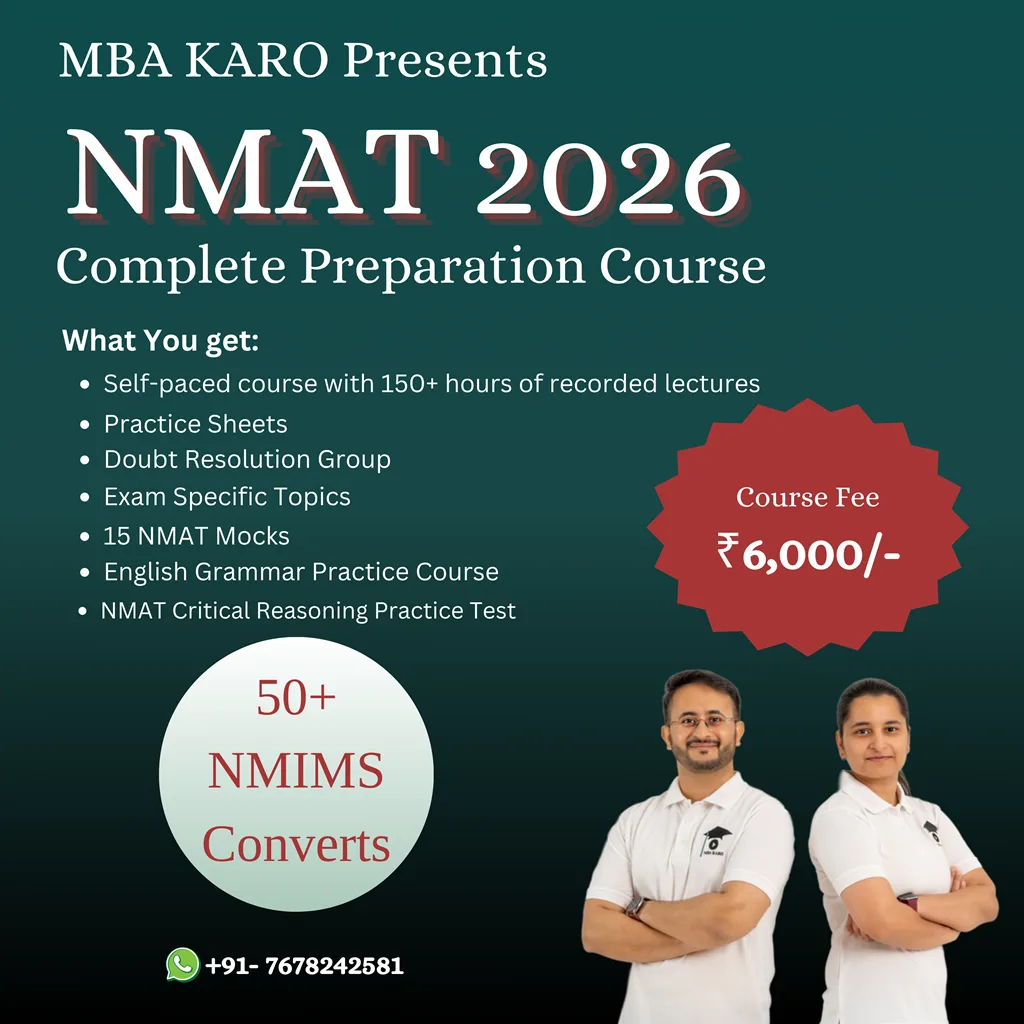
To improve your NMAT score, consistent practice, sectional tests, and full-length mock exams are crucial. Students searching for structured preparation can explore MBA KARO NMAT Online Coaching.
They offer expert guidance, NMAT-focused study plans, mock tests, performance analysis, and strategy sessions designed specifically for NMAT aspirants.
The right preparation approach and regular practice can maximise your chances of achieving an excellent NMAT score.