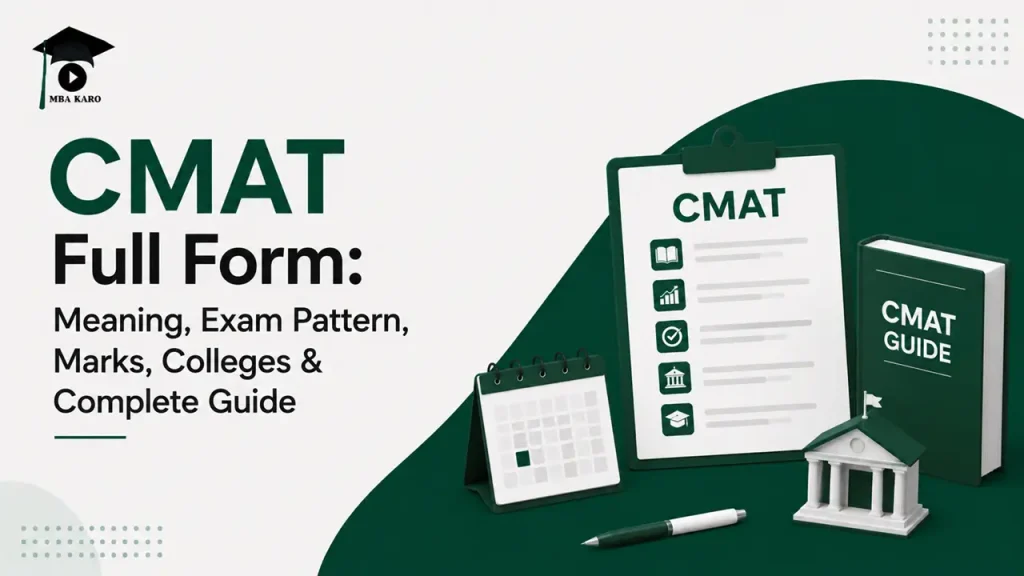
CMAT Full Form is Common Management Admission Test, a national-level MBA entrance examination conducted by the National Testing Agency (NTA).
Over 53000 candidates usually register for the exam based on past trends. The examination is conducted in Computer-Based Test (CBT) mode and consists of 100 objective questions carrying 400 marks.
The CMAT score is accepted by 1,000+ AICTE-approved institutions, university departments, constituent colleges and affiliated colleges for admission to management programmes.
If you are searching for the CMAT Full Form, this guide explains its meaning, exam pattern, marking scheme and other important details.
Join MBA KARO Whatsapp Community For Daily Updates
CMAT Full Form
The CMAT Full Form is Common Management Admission Test. It is a national-level entrance examination conducted by the National Testing Agency (NTA) for admission to management programmes.
A single CMAT score can be used for admission to 1,000+ participating colleges, making it one of the widely accepted MBA entrance examinations in India.
| Particular | Details |
| CMAT Full Form | Common Management Admission Test |
| Conducting Body | National Testing Agency (NTA) |
| Exam Level | National |
| Exam Mode | Computer-Based Test (CBT) |
| Question Type | Objective |
| Colleges Accepting Scores | 1,000+ |
| Conducted For | Admission to Management Programmes |
What is CMAT Full Form?
Understanding the CMAT Full Form also helps you understand the purpose of the examination.
The Common Management Admission Test (CMAT) is conducted to help participating institutions select suitable graduates for management programmes.
The examination follows a computer-based format and evaluates candidates through five different sections, ensuring equal weightage to every subject.
The five sections included in the examination are:
- Quantitative Techniques & Data Interpretation
- Logical Reasoning
- Language Comprehension
- General Awareness
- Innovation & Entrepreneurship
CMAT Exam: Key Highlights
Before starting your preparation, it is important to understand the overall structure of the CMAT Exam:
| Feature | Details |
| Exam Name | Common Management Admission Test (CMAT) |
| Conducting Body | National Testing Agency (NTA) |
| Examination Mode | Computer-Based Test |
| Question Type | Objective |
| Number of Sections | 5 |
| Total Questions | 100 |
| Total Marks | 400 |
| Duration | 3 Hours |
| Marks for Correct Answer | 4 |
| Negative Marking | -1 |
| Colleges Accepting CMAT Scores | 1,000+ |
CMAT Exam Pattern
The CMAT Full Form is closely associated with a paper pattern that gives equal importance to all five sections. The examination consists of 100 objective questions carrying 400 marks.
Candidates are given 3 hours to complete the paper. Every section contains 20 questions, making the total paper 100 questions.
| Section | Questions | Maximum Marks |
| Quantitative Techniques & Data Interpretation | 20 | 80 |
| Logical Reasoning | 20 | 80 |
| Language Comprehension | 20 | 80 |
| General Awareness | 20 | 80 |
| Innovation & Entrepreneurship | 20 | 80 |
| Total | 100 | 400 |
CMAT Marking Scheme
The CMAT marking scheme is as follows:
- 4 marks are awarded for every correct answer.
- 1 mark is deducted for every incorrect answer.
- The maximum score in the examination is 400 marks.
CMAT Eligibility Criteria
After understanding the CMAT Full Form, the next step is to check whether you are eligible to appear for the examination.
The eligibility is based on educational qualification and citizenship. You can apply for CMAT if you meet the following conditions:
- Hold a Bachelor’s Degree in any discipline.
- Candidates appearing in the final year of graduation are also eligible to apply.
- The applicant must be a citizen of India.
- There is no age limit for appearing in the CMAT exam.
CMAT Eligibility Overview
| Criteria | Requirement |
| Educational Qualification | Bachelor’s Degree in any discipline |
| Final-Year Students | Eligible to apply |
| Nationality | Indian Citizen |
| Age Limit | No age limit |
CMAT Syllabus
The CMAT Full Form is associated with a five-section examination that evaluates aptitude, reasoning ability, language skills, awareness and entrepreneurship concepts.
Since each section carries 20 questions, candidates should prepare all subjects instead of focusing on only one area. The CMAT syllabus is divided into the following five sections:
| Subject | Topics |
| Quantitative Techniques & Data Interpretation | Arithmetic Algebra Number System Modern Maths Geometry and Mensuration Data Interpretation |
| Logical Reasoning | Analogy Linear Arrangements Coding and decoding Numerical puzzles Circular Arrangements Matrix Arrangements Direction and Distance Blood Relationship Order and Ranking Number and Alphabet Series, etc Syllogism Statement Assumptions Statements and Conclusion Course of Action Inference Strong and Weak arguments Statements and Arguments Visual Reasoning Cause and Effects, etc |
| Language Comprehension | Synonyms and Antonyms Sentence correction Reading Comprehension One-word substitution Idioms and phrases Para jumbles Fill in the blanks Error Spotting English usage, etc |
| General Awareness | History Art and Culture Geography Indian Polity Books and Authors Important Dates, etc National and International Events Appointment Science and Technology Awards Business and Economy Sports, etc |
| Innovation & Entrepreneurship | Entrepreneur (Meaning, Types) Concepts of Innovation Entrepreneurship Challenges Theories of Entrepreneurship Innovation Framework Types of Entrepreneurs Funding of start-ups, etc |
MBA Colleges Accepting CMAT Scores
One of the biggest advantages of the CMAT Full Form is that the examination score is accepted by 1,000+ AICTE-approved institutions, university departments, constituent colleges and affiliated colleges.
The list of MBA colleges accepting CMAT scores is as follows:
| CMAT Accepting Colleges | Program Fees (Approx) |
| NIBM, Pune | INR 16 Lakh+ |
| KJ Somaiya, Mumbai | INR 23 Lakh+ |
| BIMTECH, Noida | INR 14 Lakh+ |
| PUMBA, Pune | INR 25 Lakh+ |
| Welingkar Institute, Mumbai | INR 15 Lakh+ |
| IPE, Hyderabad | INR 9.15 Lakh+ |
| NL Dalmia, Mumbai | INR 16 Lakh+ |
| Xavier Institute of Social Service (XISS), Ranchi | INR 12 Lakh+ |
| IMT, Nagpur | INR 16 Lakh+ |
| XIME Bangalore | INR 12.90 Lakh |
CMAT Full Form: Preparation Strategy
Knowing the CMAT Full Form and understanding the exam pattern is only the first step. A good score depends on covering all five sections, practising regularly and improving accuracy.
Since the examination includes 100 questions worth 400 marks, candidates should prepare each section systematically rather than focusing on a single subject.
Complete the CMAT Syllabus
Begin your preparation by covering all five sections of the examination.
- Quantitative Techniques & Data Interpretation
- Logical Reasoning
- Language Comprehension
- General Awareness
- Innovation & Entrepreneurship
Build Strong Concepts
After completing the syllabus, strengthen the basic concepts of every section before attempting advanced-level questions. Pay special attention to:
- Arithmetic fundamentals
- Logical reasoning concepts
- English language skills
- General awareness topics
- Innovation and entrepreneurship concepts
Practice Mock Tests and Previous Questions
Regular practice is essential for improving performance in a 100-question examination. During your preparation, you should:
- Attempt full-length CMAT mock tests.
- Solve previous year questions.
- Practise all five sections regularly.
- Learn to manage time across the entire paper.
Review Your Performance
After every mock test, analyse your performance instead of simply checking your score. Focus on these aspects:
- Questions answered incorrectly.
- Topics that need more revision.
- Sections where you spend the most time.
- Areas where accuracy can be improved.
Revise Consistently
Revision is essential to retain concepts throughout your preparation. During revision, you should:
- Revisit important formulas and concepts.
- Review previously studied topics.
- Strengthen weak areas identified during mock analysis.
- Continue practising questions from every section.
Conclusion
The CMAT Full Form is Common Management Admission Test, a national-level entrance examination accepted by 1,000+ management institutions across the country.
The examination follows a Computer-Based Test format with 100 objective questions, 400 marks, five sections, 3 hours, +4 marks for every correct answer and -1 mark for every incorrect response.
MBA KARO Online Coaching supports aspirants with complete syllabus coverage, expert mentorship, section-wise practice, full-length mock tests and performance analysis, helping candidates prepare for every stage.
FAQs on CMAT Full Form
Q. What is the CMAT Full Form?
A. The CMAT Full Form is Common Management Admission Test. It is a national-level MBA entrance examination conducted by the National Testing Agency (NTA).
Q. Who conducts the CMAT exam?
A. The National Testing Agency (NTA) conducts the CMAT exam.
Q. What is the mode of the CMAT exam?
A. CMAT is conducted as a Computer-Based Test (CBT).
Q. How many questions are asked in the CMAT exam?
A. The examination consists of 100 objective questions divided equally across five sections.
Q. What is the total mark for the CMAT exam?
A. The paper carries a maximum of 400 marks.
Q. Is there negative marking in CMAT?
A. Yes. One mark is deducted for every incorrect answer, while every correct answer carries 4 marks.
Q. How many colleges accept CMAT scores?
A. CMAT scores are accepted by more than 1,000 AICTE-approved institutions, university departments, constituent colleges and affiliated colleges.
Q. Who can apply for the CMAT exam?
A. Candidates with a Bachelor’s Degree in any discipline can apply. Final-year graduation students are also eligible. There is no age limit, and the applicant must be an Indian citizen.