The Data Interpretation and Logical Reasoning (DILR) section is one of the most unpredictable sections in the CAT 2026 exam. Every year, many aspirants perform well in Quant and VARC but struggle in DILR because of poor topic selection and a lack of structured preparation.
Knowing the CAT DILR syllabus and focusing on high-weightage topics can improve your score. The DILR section contains 22 questions, making it nearly one-third of the exam. Since the number of questions is limited, every correct answer has a direct impact on your percentile.
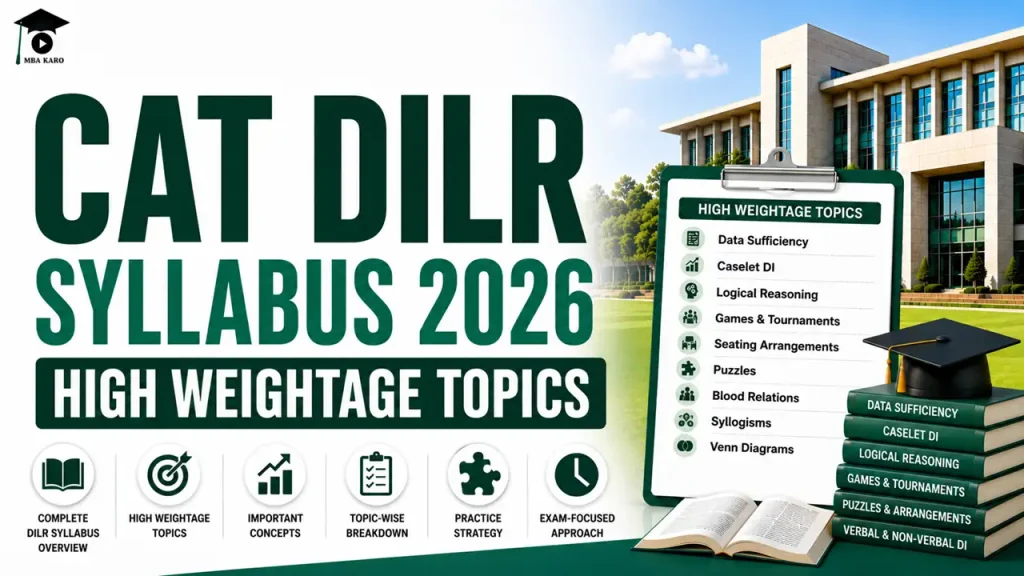
The good news is that CAT repeatedly asks questions from a few core DILR topics. Candidates who understand the weightage trend can prioritise their preparation. This can eventually improve their chances of solving more sets during the exam.
In this article, we have shared the expected CAT DILR syllabus 2026, topic-wise weightage, and the areas that deserve maximum attention.
CAT DILR Syllabus 2026 Overview
The DILR section combines Data Interpretation (DI) and Logical Reasoning (LR). Questions are generally presented in the form of sets that require candidates to analyse data, identify patterns, and draw conclusions.
A total of 22 questions are asked from different DILR topics. Some topics consistently contribute more questions than others and should therefore be prioritised.
The table below shows the approximate number of questions and the weightage of major CAT DILR topics.
| DI & LR Topics | No. of Questions (Approximate) | Approximate Weightage (%) |
| Tables and Charts | 3-6 | 45–50% |
| Puzzle and Seating Arrangements | 2-4 | 55-60% |
| Scheduling and Blood Relations | 2-4 | 5-10% |
| Games and Tournaments | 4-5 | 10-20% |
| Scheduling and Blood Relations | 4-5 | 5-10% |
| Venn Diagrams & Hybrid Sets | 2-3 | 5-10% |
Tables and Charts: The Most Important CAT DI Topic
Tables and charts are among the most important parts of the CAT DILR syllabus. These questions test your ability to interpret numerical information quickly and accurately.
Based on past trends, around 3 to 6 questions are asked from this area, contributing approximately 45% to 50% weightage. Common forms of data presentation include:
- Tables
- Bar graphs
- Line graphs
- Pie charts
- Mixed charts
Puzzle and Seating Arrangements: The Backbone of CAT Logical Reasoning
Puzzle and Seating Arrangement questions are among the most important LR topics in CAT.
These topics contribute approximately 55% to 60% of the weightage and usually account for 2 to 4 questions. These questions require candidates to arrange information logically while satisfying multiple conditions. Typical question formats include:
- Linear arrangements
- Circular arrangements
- Floor-based arrangements
- Group-based puzzles
- Conditional reasoning puzzles
Games and Tournaments: A Growing CAT Favourite
Games and Tournament-based sets have gained importance in recent CAT papers. These topics contribute approximately 4 to 5 questions with an estimated 10% to 20% weightage.
The key challenge is organising data correctly before attempting calculations. Many aspirants spend too much time solving these sets because they start calculations immediately.
Successful candidates first create a structured table and then proceed with analysis.
CAT DILR Syllabus for Scheduling and Blood Relations
Scheduling and Blood Relations form a smaller but important part of the CAT DILR syllabus. These topics contribute approximately 5% to 10% weightage and may account for 2 to 5 questions.
Blood Relation questions focus on identifying relationships among family members using logical clues.
Although their weightage is lower than major topics, they can become scoring opportunities when the set is straightforward.
CAT DILR Syllabus for Venn Diagrams and Hybrid Sets
Venn Diagrams and Hybrid Sets contribute approximately 2 to 3 questions and carry around 5% to 10% weightage.
These questions combine logical reasoning with data interpretation and often require candidates to handle overlapping information. The topic may include:
- Two-set Venn diagrams
- Three-set Venn diagrams
- Multiple-category classification
- Hybrid logical structures
Conclusion
The CAT DILR syllabus 2026 is heavily influenced by a few high-weightage topics. This includes Tables and Charts, Puzzles and Seating Arrangements, and Games and Tournaments.
Prioritising these topics can help candidates improve both accuracy and speed. A structured strategy, regular practice, and proper topic prioritisation can make DILR much more manageable.
If you are preparing for CAT 2026 and want expert guidance, comprehensive study material, mock tests, and mentorship, MBA KARO DILR CAT Coaching can help you build a strong plan and improve your overall performance.