CAT 50 Day Streak – Day 7
30 questions across VARC, DILR & QA · +3 for a correct answer · −1 for a wrong MCQ · no negative marking for TITA
VARC · Verbal Ability & Reading Comprehension
I’m not so sure impostor syndrome is entirely a bad thing. If you feel it, it means you are stretching your comfort zone, you are doing something new that you just aren’t used to yet, and these are good things to do. This is how we grow. Observe the voice saying whatever it is that your impostor syndrome tells you, but don’t take it too seriously. It doesn’t know what it’s talking about!
You’re not imagining the challenge of meetings. They’re a skill like any other, and some people have had a lifetime of practice. If you didn’t grow up in an environment where conversation and self-expression were encouraged, no wonder it feels unnatural. But unnatural doesn’t mean impossible. It just means new. That voice in your head telling you that you’re saying the wrong things, or not saying enough, is not telling the truth. It’s just old echoes of growing up in a critical environment where confidence wasn’t nurtured. You are carrying a history that some of your colleagues aren’t; it doesn’t mean you’re not capable. It just means you must approach it differently.
The psychologist Erica Boothby noticed that she felt she had made a bad impression on a new person. Her partner Gus Cooney witnessed this encounter, and he thought her exchange had been warm and friendly. They wondered whether this was a common experience for everyone. Do we consistently underestimate how much another person appreciates our presence or our input? They called this phenomenon the “liking gap”. It’s the gap between the impression we think we’ve made and the impression we actually make. Their subsequent studies showed that we humans consistently pessimistically underestimate how much other people appreciate us.
Right now, you’re exhausted: small children, broken sleep, a job that’s pushing you out of your comfort zone. Anyone would struggle in those conditions. This isn’t you failing; it is you surviving under pressure. What if you changed the goal? Instead of expecting meetings to feel natural and effortless, what if the aim was just to tolerate the discomfort for now? Not to make it go away overnight, just to get through, knowing that over time it will get easier. What if, after a meeting, instead of replaying every word, you just said: “That was enough. I am enough. I did it. On to the next.” It will feel strange or even untrue when you say it. Never mind. The old voice is also untrue; it’s just that you’re used to it. Make the “I am enough” mantra more familiar, and it will begin to feel true, and that will help your confidence.
You don’t have to feel like you belong in every room to make an impact in it. You just have to stay in the room. Keep showing up. Keep tolerating the discomfort. You might not have had parents who built your confidence, but you can build it in relationships with others, because the more you speak up, the more normal it will feel. Even if the self-doubt never fully goes away, it doesn’t have to run the show.
The voice is “just old echoes of growing up in a critical environment”, and it “is not telling the truth”. So it is a conditioned response from the past with no current validity.
A contradicts “untrue”. B overstates: the author says self-doubt “doesn’t have to run the show”. D confuses the reader’s current circumstances with the source of the voice.
The study shows that people “consistently pessimistically underestimate how much other people appreciate us”. It is evidence that the inner voice’s verdicts on meetings are distorted.
A: the researchers are cited for evidence, not introduced as authorities. C: the passage stays on meetings. D: no such comparison is made.
D brings together the author’s three moves: discomfort means “this is how we grow”, the voice “is not telling the truth”, and “keep showing up… stay in the room”.
A: the author says to stay in the room, not seek new environments. B: exhaustion is context, not the root cause. C: confidence is built “in relationships with others”.
The author acknowledges the exhaustion but urges the reader to “stay in the room” and “keep showing up”, the opposite of avoidance. C cannot be inferred.
A, B and D are all directly supported.
The sentence links “cinema” (Hollywood screenwriters) to an ancient source (the 4th century BCE). The next sentence then names that source, Aristotle’s Poetics. It bridges the two, so it goes at blank 1.
At blanks 2–4, Aristotle has already been introduced and the paragraph has moved on to later thinkers.
- An employee of Candy.ai, one of the new AI dating sites exhibiting at the conference, said the site’s AI girlfriends offered a range of services.
- It really depends on what the user needs,” he said.
- Or if you prefer to have deep conversations, that’s there as well.
- So you need to evolve the relationship with them in order to ask for something like this.
- “If you want more adult-type relationships, like porn, we have this content.
The coherent paragraph is 1 → 5 → 3 → 2:
- 1: The employee says the AI girlfriends offer a range of services.
- 5: The quote opens: “If you want more adult-type relationships…”
- 3: “Or if you prefer deep conversations…”
- 2: The quote closes: “It really depends on what the user needs,” he said.
Sentence 4 describes having to “evolve the relationship” before asking. That contradicts the on-demand “range of services” in the quote, and it breaks the quotation marks, which open in 5 and close in 2.
- But at least two people have become seriously ill from a strain of H5N1 related to the D1.1 genotype that is currently circulating in poultry and wild birds.
- Since the beginning of 2024, 70 people in the U.S. have been confirmed infected with H5N1; most of them have been dairy and poultry workers.
- Those two cases included one person in Louisiana who died from their infection.
- Infections in dairy workers have generally been mild, causing conjunctivitis and mild respiratory symptoms.
The order runs like this:
- 2: The overview: 70 infected, mostly dairy and poultry workers.
- 4: Infections in dairy workers have been mild.
- 1: “But” at least two became seriously ill from the D1.1 strain.
- 3: “Those two cases” included one death.
D lists the mechanisms the passage proposes: curiosity, attention, less mind-wandering, and a metacognitive “reality check” that exposes knowledge gaps.
A reduces pretesting to previewing and memorising answers. B adds “confidence”, which the passage never mentions. C’s “guessing correct answers” and exam focus aren’t in the passage.
- We suggest that compared with others, skilful storytellers have a stronger sense of meaning in life.
- Therefore, to excel at storytelling, individuals must develop two key skills.
- Second, they must learn to see the world through the eyes of their characters, understanding the why of what drives people.
- The typical narrative focuses on a hero who strives to achieve a goal, such as landing a job or winning someone’s heart, while facing various obstacles and challenges along the way.
- First, they need to connect the dots—the events of the story—in a meaningful way to create a coherent narrative.
The coherent paragraph is 4 → 2 → 5 → 3:
- 4: What a typical narrative looks like.
- 2: “Therefore”, storytellers need two skills.
- 5: “First”, connect the dots.
- 3: “Second”, see through the characters’ eyes.
Sentence 1 is about storytellers’ sense of meaning in life, a separate claim from what storytelling requires.
The sentence answers the question just raised: why can’t worms simply wriggle off the street? Because on the surface they get stranded. That difficulty then leads into “Their task is Sisyphean”.
At blanks 1 and 2 the question hasn’t been posed. At blank 4 the conclusion has already been drawn.
DILR · Data Interpretation & Logical Reasoning
Six schools, A, B, C, D, E and F, have a total of 2100 students. The following facts are known:
- Each school has a distinct number of students, which is more than 100.
- For any group of schools, the average number of students in them is an integer. For example, if we take schools A, C, D and F, the average number of students in these four schools should be an integer.
- Schools A and E have students in the ratio 5:7.
- The number of students in school C is equal to the sum of the number of students in schools B and D.
- School F does not have the highest number of students.
- Same remainder mod 60. Every group of 2, 3, 4 or 5 schools has an integer average. Swapping one school in a group for another shows that all six numbers leave the same remainder r mod 2, 3, 4 and 5, i.e. mod 60.
- r = 0. C = B + D means r ≡ 2r (mod 60), so r = 0. Every school has a multiple of 60 students.
- Units of 60. The six unit counts are distinct, each at least 2 (since each school has more than 100), and they sum to 2100 ÷ 60 = 35.
- A and E. A : E = 5 : 7 in multiples of 60 gives A = 5 and E = 7 units (A = 10, E = 14 leaves too little for the rest).
- C and F. Then B + C + D + F = 23 with C = B + D, so 2C + F = 23. C = 6 makes F = 11 the highest ✗. C = 8 makes F = 7, same as E ✗. C = 9 makes F = 5, same as A ✗. So C = 10 and F = 3, with B + D = 10 as {2, 8} or {4, 6}.
| School | A | B | C | D | E | F |
|---|---|---|---|---|---|---|
| Students | 300 | 120 / 480 / 240 / 360 | 600 | (the other of B’s pair) | 420 | 180 |
So {B, D} = {120, 480} or {240, 360}, and F = 180.
If {B, D} = {120, 480}, the fewest is B or D (120). If {B, D} = {240, 360}, the fewest is F (180). It cannot be determined.
School C has 600 students, more than every other school in either case (the largest alternative is 480). The maximum is 600.
(300 + 600 + 420 + 180) ÷ 4 = 1500 ÷ 4 = 375.
B + D = C = 600, so D = 600 − 240 = 360.
Hridyesh, a RAW agent, sends a secret code consisting of 12 words in the form of a 3 × 4 matrix (as shown in the figure). The 12 words are: Argon, Backout, Cameo, Design, Earplug, Fairy, Goat, Hacker, Imported, Juice, Kudos and Liberty. Each coded word has been allocated a position in the matrix (2 × 3 position represents row 2 and column 3).
| Column 1 | Column 2 | Column 3 | Column 4 | |
|---|---|---|---|---|
| Row 1 | 1 × 1 | 1 × 2 | 1 × 3 | 1 × 4 |
| Row 2 | 2 × 1 | 2 × 2 | 2 × 3 | 2 × 4 |
| Row 3 | 3 × 1 | 3 × 2 | 3 × 3 | 3 × 4 |
- The words in 1 × 2 and 1 × 3 have the same number of letters.
- Fairy is immediately above Design, and Liberty is to the immediate left of Fairy.
- The word in 3 × 4 is shorter than the word in 2 × 1.
- Kudos is separated from Earplug vertically by only one word, Backout.
- Imported is at position 3 × 2, and the word to the immediate right of it has an odd number of letters.
- Juice and Hacker are in the same column, and Juice is below Hacker.
- Goat is not in the same row or column as Cameo.
Word lengths: Argon 5, Backout 7, Cameo 5, Design 6, Earplug 7, Fairy 5, Goat 4, Hacker 6, Imported 8, Juice 5, Kudos 5, Liberty 7.
- Kudos–Backout–Earplug fill one whole column, with Backout in row 2. That column can’t be column 2, because Imported is at 3 × 2.
- That column is column 3. In column 1, Liberty/Fairy/Design can’t be placed without clashing with the 1 × 2 = 1 × 3 or odd-3 × 3 rules. In column 4, Goat and Cameo are forced into the same column.
- Column 3. Liberty/Fairy must go in columns 1–2 with Fairy at 1 × 2 and Design at 2 × 2. Then 1 × 3 must be a 5-letter word, so Kudos (5) is at 1 × 3 and Earplug (7, odd) at 3 × 3.
- Remaining words. Hacker above Juice in column 4, together with “3 × 4 shorter than 2 × 1” and the Goat–Cameo rule, leave one fit: Hacker 1 × 4, Juice 2 × 4, Goat 3 × 4, Cameo 2 × 1, Argon 3 × 1.
| Col 1 | Col 2 | Col 3 | Col 4 | |
|---|---|---|---|---|
| Row 1 | Liberty | Fairy | Kudos | Hacker |
| Row 2 | Cameo | Design | Backout | Juice |
| Row 3 | Argon | Imported | Earplug | Goat |
Position 2 × 4 holds Juice.
Row 2 is Cameo (5) + Design (6) + Backout (7) + Juice (5) = 23.
Backout is at 2 × 3, so its immediate left is 2 × 2: Design.
Goat is at 3 × 4. It is shorter than Cameo (2 × 1) and shares neither a row nor a column with it.
Argon is at 3 × 1, so its immediate right is 3 × 2: Imported.
QA · Quantitative Ability
x(y2 + y + 1) = 129 = 3 × 43. Taking x = 3 gives y2 + y + 1 = 43, so y = 6.
(xx)10 = 33, and 33 = 5 × 6 + 3, so in base 6 it is 53.
28 + 211 = 2304 = 482, so 2n = m2 − 482 = (m − 48)(m + 48).
Both factors must be powers of 2 that differ by 96: 32 and 128. So m = 80 (and n = 12).
The bus and truck are 450 m apart and close at 48 + 60 = 108 km/h = 30 m/s, so they meet in 15 s.
The car must gain 150 m on the bus in 15 s, i.e. 10 m/s = 36 km/h faster than the bus. Minimum speed = 48 + 36 = 84 km/h.
At x = 50 the terms are 493, 483, …, 0, …, (−49)3, which cancel in pairs to give 0. The left side is strictly increasing, so k = 50 is the only root.
1 + 2 + … + 50 = 50 × 51 ÷ 2 = 1275.
Let the cost of a cotton pair be c and a silk pair be s. With 1 cotton for every 2 silk: (0.3c + 2 × 0.5s) = 0.45(c + 2s), which gives s = 1.5c.
Actual sales are 3 cotton for every 2 silk. Cost = 3c + 3c = 6c, and profit = 0.9c + 1.5c = 2.4c.
Overall profit = 2.4c ÷ 6c = 40%.
DURATION has 4 vowels (U, A, I, O) and 4 consonants (D, R, T, N), all distinct.
Choose 2 vowels (4C2 = 6) and 3 consonants (4C3 = 4), then arrange the 5 letters (5! = 120): 6 × 4 × 120 = 2880.
Count by the longest side c, needing the other two to sum to more than c:
- c = 4: (2, 3). That is 1.
- c = 5: (2, 4), (3, 4). That is 2.
- c = 6: (2, 5), (3, 4), (3, 5), (4, 5). That is 4.
- c = 7: (2, 6), (3, 5), (3, 6), (4, 5), (4, 6), (5, 6). That is 6.
Total = 13.
(A + 6 + B + 6 + 12) ÷ 3 = (A + B) ÷ 2, so A + B = 48.
Four years ago their total was 40, split 3 : 2 as 24 and 16. So Bob is now 16 + 4 = 20 years.
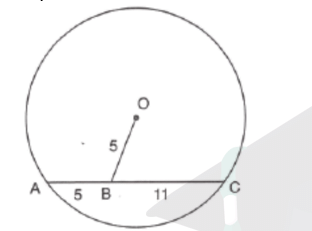
From the figure, AB = OB = 5 and BC = 11.
For a point B inside a circle on chord AC, AB × BC = r2 − OB2 (the power of a point). So 5 × 11 = r2 − 25, giving r2 = 80.
r = 4√5.
3% of the common income is 5100, so the income is 1,70,000. Together Sarthak and Saloni pay 47% of 1,70,000 = 79,900.
Sajan pays 79,900 − 21,100 = 58,800, which is 28% of his income. His income = 58,800 ÷ 0.28 = Rs 2,10,000.
Correct: 0 · Wrong: 0 · Accuracy: 0%
Keep the streak alive. See you tomorrow for Day 8.