
CAT 50 Day Streak – Day 6
30 questions across VARC, DILR & QA · +3 for a correct answer · −1 for a wrong MCQ · no negative marking for TITA
VARC · Verbal Ability & Reading Comprehension
Denialism is an expansion, an intensification, of denial. At root, denial and denialism are simply a subset of the many ways humans have developed to use language to deceive others and themselves. Denial can be as simple as refusing to accept that someone else is speaking truthfully. Denial can be as unfathomable as the multiple ways we avoid acknowledging our weaknesses and secret desires. Denialism is more than just another manifestation of the humdrum intricacies of our deceptions and self-deceptions. It represents the transformation of the everyday practice of denial into a whole new way of seeing the world and – most important – a collective accomplishment. Denial is furtive and routine; denialism is combative and extraordinary. Denial hides from the truth, denialism builds a new and better truth.
In recent years, the term has been used to describe a number of fields of “scholarship”, whose scholars engage in audacious projects to hold back, against seemingly insurmountable odds, the findings of an avalanche of research. They argue that the Holocaust (and other genocides) never happened, that anthropogenic (human-caused) climate change is a myth, that Aids either does not exist or is unrelated to HIV, that evolution is a scientific impossibility, and that all manner of other scientific and historical orthodoxies must be rejected.
In some ways, denialism is a terrible term. No one calls themselves a “denialist”, and no one signs up to all forms of denialism. In fact, denialism is founded on the assertion that it is not denialism. In the wake of Freud (or at least the vulgarisation of Freud), no one wants to be accused of being “in denial”, and labelling people denialists seems to compound the insult by implying that they have taken the private sickness of denial and turned it into public dogma.
But denial and denialism are closely linked; what humans do on a large scale is rooted in what we do on a small scale. While everyday denial can be harmful, it is also just a mundane way for humans to respond to the incredibly difficult challenge of living in a social world in which people lie, make mistakes and have desires that cannot be openly acknowledged. Denialism is rooted in human tendencies that are neither freakish nor pathological.
All that said, there is no doubt that denialism is dangerous. In some cases, we can point to concrete examples of denialism causing actual harm. In South Africa, President Thabo Mbeki, in office between 1999 and 2008, was influenced by Aids denialists such as Peter Duesberg, who deny the link between HIV and Aids (or even HIV’s existence) and cast doubt on the effectiveness of anti-retroviral drugs. Mbeki’s reluctance to implement national treatment programmes using anti-retrovirals has been estimated to have cost the lives of 330,000 people. On a smaller scale, in early 2017 the Somali-American community in Minnesota was struck by a childhood measles outbreak, as a direct result of proponents of the discredited theory that the MMR vaccine causes autism, persuading parents not to vaccinate their children.
Denialism is “the transformation of the everyday practice of denial into a whole new way of seeing the world and… a collective accomplishment”. Denial is “furtive and routine”, while denialism is “combative”. That is B.
A, C and D (evidence levels, sincerity, a leader) are never presented as the distinguishing feature.
“In some ways, denialism is a terrible term” concedes a problem with the label. The next paragraph opens with “But…” and keeps using it. So the third paragraph acknowledges an objection without abandoning the term.
B and D misread the Freud reference, which only explains why the label stings. C is too strong, since the author continues to use the term.
Funding public campaigns that dispute climate science supports an organised, collective effort to “build a new and better truth”. That fits the passage’s definition of denialism.
A: the effort is public and combative, not furtive. C: the CEO privately accepts the science, so he isn’t deceiving himself. D: the author explicitly says denialism is not freakish or pathological.
If committed denialists shared a rare cognitive disorder, denialism would be pathological and unusual. D directly contradicts the claim.
A and B describe social conditions or demographics, not pathology. C concerns insincerity, which is compatible with ordinary human deception.
The evidence builds in steps: a hidden ocean, then rock–water chemistry, then the inference that microbes could survive there. “These discoveries” then sums everything up and links it to the search for life.
At blanks 1 and 2 the evidence hasn’t been presented yet. Blank 4 comes after the conclusion.
Aristotle’s split between virtue-based friendship and friendship of utility or pleasure is a concrete example of traditions distinguishing “fleeting companionships and lasting bonds”. The paragraph then broadens to “the ancients” and friendship’s political role.
At blank 1 the distinction hasn’t been drawn yet. Blanks 3 and 4 have moved on to politics and modern debates.
- A defendant’s risk of reoffending, for example, is sometimes calculated using data that reflects racial or economic biases.
- The consequences of such errors can shape lives in profoundly damaging ways.
- As predictive algorithms become more common in the justice system, critics warn that they can perpetuate existing inequalities.
- This means that the very systems intended to improve fairness might actually reinforce prejudice.
The order runs like this:
- 3: Introduces the concern that algorithms can perpetuate inequality.
- 1: “For example”, risk scores use biased data.
- 4: “This means” fairness tools may reinforce prejudice.
- 2: “The consequences of such errors” concludes.
- If so, the familiar pattern of creative destruction may become more destructive than creative.
- The question with artificial intelligence is whether the pace of change will outstrip the ability of workers to adapt.
- Yet history shows that automation often creates new industries alongside the ones it disrupts.
- Every wave of technological change has raised fears of job destruction.
The order runs like this:
- 4: Every technological wave has raised job fears.
- 3: “Yet” history shows new industries emerge.
- 2: The AI question is whether change will outpace adaptation.
- 1: “If so”, creative destruction turns destructive.
The passage gives two arguments against shame: it is a global sense of personal failure, and it clashes with the view of addiction as a disease beyond one’s control. A captures both.
B and C claim shame can help, which is the opposite of the view described. D brings in a “some argue shame might motivate” side that isn’t in the passage, and it drops the disease argument.
- Along with his colleague Frauke Sachse of the University of Bonn, he has identified multiple dialects and languages in the same handwritten book.
- A bishop named Diego de Landa convinced a Mayan scribe, Gaspar Antonio Chi, to match, letter for letter, the signs of the Mayan script and the Spanish alphabet.
- The scribe’s frustration with de Landa is evident in the last exercise that he completed for the bishop. Asked to pen any sentence in Mayan hieroglyphs, Chi wrote: “I don’t want to.”
- When the scribe heard the Spanish pronunciation of the letter ‘b,’ says Pallán, he wrote the sign for bih, which means “road.”
- The long line of code-breakers to take on Mayan hieroglyphs started with Spanish colonists in the sixteenth century.
The coherent paragraph is 5 → 2 → 4 → 3:
- 5: Code-breaking began with Spanish colonists.
- 2: De Landa made Chi match signs to letters.
- 4: The ‘b’ → bih confusion.
- 3: Chi’s frustration: “I don’t want to.”
Sentence 1 jumps to modern research, identifying dialects in a handwritten book. It is outside the colonial-era anecdote.
DILR · Data Interpretation & Logical Reasoning
A garment store has t-shirts from 5 brands: Allen Solly, Monte Carlo, Nike, Numero Uno, and Provogue. For each of these brands, t-shirts are available in five sizes: S, M, L, XL, and XXL. Partial information is known about the number of t-shirts of these sizes. The total number of t-shirts of every brand is known, and the number of t-shirts of sizes S and M is given. Apart from that, the ratios M:XL and L:XXL are given in the table below:
| Brand | S | M | M:XL | L:XXL | Total |
|---|---|---|---|---|---|
| Allen Solly | 385 | 306 | 17:13 | 5:7 | 1501 |
| Monte Carlo | 279 | 315 | 9:7 | 13:10 | 1322 |
| Nike | 320 | 225 | 5:6 | 7:8 | 1430 |
| Numero Uno | 188 | 343 | 7:6 | 3:4 | 1413 |
| Provogue | 254 | 248 | 8:11 | 7:5 | 1371 |
For each brand: XL = M × (XL ratio part ÷ M ratio part), then L + XXL = Total − S − M − XL, split in the L:XXL ratio.
| Brand | S | M | L | XL | XXL | Total |
|---|---|---|---|---|---|---|
| Allen Solly | 385 | 306 | 240 | 234 | 336 | 1501 |
| Monte Carlo | 279 | 315 | 273 | 245 | 210 | 1322 |
| Nike | 320 | 225 | 287 | 270 | 328 | 1430 |
| Numero Uno | 188 | 343 | 252 | 294 | 336 | 1413 |
| Provogue | 254 | 248 | 308 | 341 | 220 | 1371 |
| Total | 1426 | 1437 | 1360 | 1384 | 1430 | 7037 |
Q1 (L) = 1360 < Q2 (XL) = 1384 < Q3 (XXL) = 1430, which is option D.
L sizes: 240, 273, 287, 252 and 308. Only Provogue (308) is above 300, so the answer is 1.
Sorted L values: 240, 252, 273, 287, 308. The median is 273 (Monte Carlo).
XL < XXL holds for Allen Solly (234 < 336), Nike (270 < 328) and Numero Uno (294 < 336). It fails for Monte Carlo and Provogue. The answer is 3.
XXL as a share of each brand’s total: Allen Solly 336/1501 ≈ 22.4%, Monte Carlo 210/1322 ≈ 15.9%, Nike 328/1430 ≈ 22.9%, Numero Uno 336/1413 ≈ 23.8%, Provogue 220/1371 ≈ 16.0%.
The highest is Numero Uno.
Three men, Akshay, Bipin and Charles, along with their wives, are sitting in a row. Each of them is either facing north or south. No pair of husband and wife is facing the same direction. Each of the six people belongs to a different profession: pilot, lawyer, nurse, author, singer and chef. Also:
- The chef and the lawyer are facing the same direction, and both of them are to the left of the singer.
- Tripti, the nurse, is the wife of the chef, who is sitting at one of the ends.
- The pilot is facing south, and he is the husband of Shipra, the singer.
- None adjacent to Usha is facing south, and none is sitting to the left of Akshay, the author.
“Left” and “right” are taken from each person’s own facing direction.
- Bipin and Charles are the chef and the pilot, since Akshay is the author. Usha is the lawyer and Akshay’s wife.
- The pilot faces south, so Shipra faces north. The chef and Usha are on Shipra’s left, so they also face north. Akshay and Tripti then face south.
- The chef sits at one end. Nobody is on Akshay’s left, so he sits at the other end.
- Usha’s neighbours both face north, so she sits between the chef and Shipra.
| Position | 1 | 2 | 3 | 4 | 5 | 6 |
|---|---|---|---|---|---|---|
| Person | Chef (Bipin/Charles) | Usha (lawyer) | Shipra (singer) | Tripti / Pilot | Pilot / Tripti | Akshay (author) |
| Facing | North | North | North | South | South | South |
Usha faces north at position 2, so her immediate right is position 3: Shipra.
“Left” and “right” are taken from the point of view of the person facing that way.
- Who is who. The chef and the pilot are husbands, and Akshay is the author, so Bipin and Charles are the chef and the pilot. Usha, the remaining wife, is the lawyer and Akshay’s wife.
- Directions. The pilot faces south, so Shipra faces north. The chef and Usha face the same way, so Tripti and Akshay both face the opposite way.
- Ends. The chef sits at one end. Nobody is to Akshay’s left, so he sits at the other end.
- The singer. The chef and Usha are on Shipra’s left. Shipra faces north, which fixes that the chef and Usha face north too. So Akshay and Tripti face south.
- Usha. Both her neighbours face north, so she sits between the chef and Shipra.
| Position | 1 | 2 | 3 | 4 | 5 | 6 |
|---|---|---|---|---|---|---|
| Person | Chef (Bipin/Charles) | Usha (lawyer) | Shipra (singer) | Tripti / Pilot | Pilot / Tripti | Akshay (author) |
| Facing | North | North | North | South | South | South |
Akshay faces south at position 6, so his immediate right is position 5: Tripti or the pilot (Bipin/Charles). Shipra can never be there.
Shipra (position 3) is next to Usha and to position 4. The chef at position 1 isn’t adjacent to her, so Charles must be the pilot at position 4.
Tripti then sits at position 5, next to Akshay. The answer is Tripti.
Shipra’s neighbours are Usha (always) and whoever sits at position 4: Tripti, or the pilot, who may be Charles.
Each of Usha, Tripti and Charles can be her neighbour, so the answer is none of the above.
Chef (1) and Tripti (4/5) are never adjacent. Akshay (6) and Usha (2) are never adjacent. The pilot and Shipra are adjacent only when the pilot sits at position 4.
So either 0 or 1 couple sits together. Only “at most one” is definitely true.
QA · Quantitative Ability
Start with N mangoes.
- Night 1: 0.5N remain, 0.05N spoil, 0.45N left.
- Night 2: 0.225N remain, 0.0225N spoil, 0.2025N left.
- Night 3: 0.10125N remain, 0.010125N spoil.
Total spoiled = 0.082625N = 1322, so N = 16,000.
Compare the logs (base 10):
- 34 log 3 ≈ 34 × 0.477 ≈ 16.2
- 18 log 5 ≈ 18 × 0.699 ≈ 12.6
- 16 log 7 ≈ 16 × 0.845 ≈ 13.5
- 12 log 16 ≈ 12 × 1.204 ≈ 14.4
334 is the largest.
y is largest when the denominator, a sum of distances from −2, 0, 1, 2 and 3, is smallest. That happens at the median point, x = 1.
The minimum sum is 3 + 1 + 0 + 1 + 2 = 7, so the maximum y = 70/7 = 10.
Detailed solution coming soon.
Rates: A + B = 1/35 and A + B + C = 2/35, so C = 1/35. Then D = (2/3)C = 2/105.
A + B + D = 3/105 + 2/105 = 5/105 = 1/21, so they take 21 days.
Work in base 4: log4 12 = log4 3 + 1 = 1/x + 1, and log4 20 = log4 5 + 1 = y + 1.
log20 12 = (1/x + 1)/(y + 1) = (x + 1)/(xy + x).
Let G be the initial grass and r the daily growth, both measured in cow-days: 1680 = G + 24r and 1800 = G + 60r.
So r = 10/3 and G = 1600. For 96 days: 96n = 1600 + 320 = 1920, so n = 20 cows.
The base √5 − 2 ≈ 0.236 lies between 0 and 1, so the inequality flips when comparing exponents: x2 < 4x, which means 0 < x < 4.
The integer solutions are 1, 2 and 3, with sum 6.
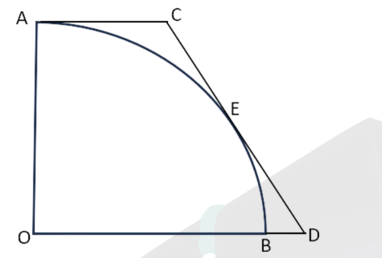
Tangents from an external point are equal, so CE = CA = 4 and CD = 4 + 6 = 10.
Place O at the origin with A(0, r) and C(4, r), and let D = (d, 0). Since D is also an external point, DE2 = d2 − r2 = 36. From CD = 10: (d − 4)2 + r2 = 100.
Adding: (d − 4)2 + d2 = 136, i.e. d2 − 4d − 60 = 0, so d = 10. Then r2 = 100 − 36 = 64, and r = 8 cm.
Top and middle: 20 × 3 + 1.6m = 2(20 + m), so m = 50.
Top and lower: 20 × 3 + 0.6l = 1 × (20 + l), so l = 100.
Middle + lower = 150.
Correct: 0 · Wrong: 0 · Accuracy: 0%
Keep the streak alive. See you tomorrow for Day 7.