CAT 50 Day Streak – Day 48
30 questions across VARC, DILR & QA · +3 for a correct answer · −1 for a wrong MCQ · no negative marking for TITA
VARC · Verbal Ability & Reading Comprehension
This year, I have been reading a selection of autobiographical writings by Jewish survivors of the Holocaust. The six writers in question came from diverse socioeconomic backgrounds and different countries across Europe. Three survived concentration camps. The significance of art, creativity and cultural life is a theme that emerges implicitly and explicitly across the various texts, and this prompted me to reflect on wider questions about the value of the arts and the humanities.
Like Frankl, Otto Dov Kulka writes of the ‘skits’ performed during his time at Auschwitz, and of the ‘special’ and ‘unique black humour’ that he developed there. Born in Czechoslovakia in 1933, as a child, Kulka was sent to Theresienstadt and then to Auschwitz. In his Landscapes of the Metropolis of Death, Kulka repeatedly mentions Herbert, a fellow inmate, who made a lifelong impression on him:
It was Herbert who gave me a copy of Dostoevsky’s Crime and Punishment, Herbert who explained to me who Beethoven was, and Goethe, and Shakespeare, and about the culture they bequeathed us – that is, European humanism.
Kulka also recalls Fredy Hirsch, another camp inmate, who devoted both himself and the team of instructors he chose to educating and looking after the youngsters. Kulka remembers history lessons and artistic performances, including plays, concerts and a children’s opera. Hirsch’s barracks became the centre of the spiritual and cultural life of the place. For Kulka, the significance of these experiences was such that they ‘unquestionably form the moral basis for my approach to culture, to life, almost to everything, as it took shape within me during those few months, at the age of 10 and 11’.
Of course, as Kulka emphasises, there was a brutal limit to cultural and artistic escapism in ‘the Metropolis of Death’ – a place from which he and the other inmates expected never to return. The lessons and performances all took place ‘150 to 200 metres from the selection platform and 300 to 400 metres from the crematoria’. Similarly, Frankl underscores that ‘any pursuit of art in camp was somewhat grotesque’, set against the ‘background of desolate camp life’. Kulka puzzles over one ‘particularly bizarre’ artistic experience. He mentions Imre, who took on the role of children’s choir conductor in the camp. Kulka wonders how to interpret Imre’s choice to teach the children a song about ‘the brotherhood of man’, which Kulka later discovered was Schiller’s ‘Ode to Joy’ from Beethoven’s Ninth Symphony. Another boy pointed out the ‘terrible absurdity’ and ‘terrible wonder’ of playing that song ‘opposite the crematoria of Auschwitz’. Was Imre expressing an undying commitment to those universal values, Kulka asks himself, or was this performance ‘an act of extreme sarcasm’?
In Behind the Secret Window: A Memoir of a Hidden Childhood During World War Two, Nelly S Toll recounts an escape attempt, where she and her mother joined a group trying to cross the border from Poland into Hungary. After a long period of hiding in a barn in a forest, Toll and two friends were eventually permitted to go outside. They were ‘ecstatic’ at being able to play, to sing, to watch the clouds and the birds – to be children.
The author reflects on the value of the arts through the survivors’ texts. Kulka’s lessons and performances became “the moral basis” for his life, yet the passage also stresses the “brutal limit” of escapism, Frankl’s “somewhat grotesque”, and the “terrible absurdity” and “terrible wonder” of Imre’s choir. D captures both sides of this paradox.
A is too narrow; the programmes are examples, not the point. B is one-sided; the author never concludes that art was futile. C overreaches; humanism is never called the “primary reason” for resilience.
The boy points to the absurdity and wonder of singing a song about “the brotherhood of man” “opposite the crematoria of Auschwitz”. The clash between the song’s message and its setting is the source of both.
A: nothing suggests Imre was uneducated. C: sarcasm is one possible reading of Imre’s intent, not what makes the scene absurd and wondrous; the skits are a separate topic. D: language and capitulation are never mentioned.
Kulka asks whether Imre was “expressing an undying commitment to those universal values” or whether the performance was “an act of extreme sarcasm”. That is genuine commitment versus bitter irony.
B: neither randomness nor politics is part of his question. C: escapism is discussed elsewhere, not in this puzzle. D: keeping children busy is never suggested.
The thesis is that art and culture created by the inmates themselves gave them meaning. The skits, cited by both Frankl and Kulka, are the first evidence for this. If guards forced the skits on inmates, they were coercion rather than creativity, which undercuts that evidence.
A only settles one ambiguous episode. B changes who paid for Hirsch’s barracks, not what the lessons meant to Kulka, which is where their significance lies. D concerns a single moment outside the camps.
The paragraph says Modi has no good options. Giving in “would make Modi look weak”; “Yet” the alternative is also costly, because no other power can replace the US. This completes the dilemma at blank 2. The next sentence then turns to China.
At blank 1, no option has been stated for “Yet” to contrast with. At blanks 3 and 4, the sentence would break the narrative about stabilising ties with China and Modi’s visit.
The core claim is that imperfect automation is not a step toward perfect automation, just as a half-jump is not a step toward clearing the canyon. A states exactly this.
B invents “human judgment” and “several decades” (the passage says most of the next decade). C praises incremental improvement, which the passage rejects. D’s “long-term research” is not suggested; the passage proposes practical alternatives such as a bridge.
- On the entry for Adolf Hitler, the führer’s leadership and “rapid economic” achievements are noted before the Holocaust.
- The Grokipedia entry for Musk himself notes a “reported 20-pound weight loss” and propensity for “weightlifting and strength training”.
- The “Islam” page questions the religion’s “inherent compatibility with liberal democracy.”
- The site uses just that term, theory, rather than conspiracy theory, as you would see on Wikipedia and elsewhere.
- Other entries on Grokipedia contain a similar slant.
The coherent paragraph is 2 → 5 → 1 → 3:
- 2: Musk’s own entry carries a flattering slant.
- 5: “Other entries” contain “a similar slant”.
- 1: Example: the Hitler entry.
- 3: Example: the “Islam” page.
Sentence 4 refers to “just that term, theory”, but no sentence mentions such a term. It belongs to a different discussion.
The paragraph first says the idea “isn’t entirely new” and gives existing industry schemes in Australia and Europe. The sentence then explains what is different about Solar Sharer: scale, blanket implementation and government leadership. “Some wonder, however…” follows naturally after that.
At blank 1 there is nothing yet to compare against. Blank 2 splits “not new” from its examples. Blank 4 separates the doubt from its “For example”.
D keeps both ideas: stories are intrinsic to doing science, and Mormon expectations made a physics career hard for women through “low expectations”.
A only says storytelling is “highlighted” and loses the claim that it is part of science. B is wrong; women were encouraged to pursue education. C sets up a “contrast” the author doesn’t draw and also misses the intrinsic role of stories.
- In psychology and philosophy, grief is portrayed as a response to a specific event – typically, the death of a loved one.
- Another aspect of the grieving process is adjusting.
- Yet this doesn’t fit well with my own experience of cultural bereavement.
- Turning over the person in your mind and reflecting on their life and legacy are all considered crucial to processing their loss.
- The trajectory of experience after cultural loss differs from most existing models of grief.
The coherent paragraph is 5 → 1 → 4 → 2:
- 5: Topic sentence: cultural loss differs from “existing models of grief”.
- 1: What those models say: grief responds to a specific event, a death.
- 4: One part of the model: turning over the person in your mind.
- 2: “Another aspect”: adjusting.
Sentence 3 repeats the point of sentence 5 in a personal voice. Placed after 2, its “this” would refer only to adjusting rather than to the whole model.
DILR · Data Interpretation & Logical Reasoning
Five athletes – Kamal, Lakshya, Manish, Nathan, and Oswal – participated in an event that consisted of 4 sports – Swimming, Long Jump, 100 m sprint, and Discus throw. They were ranked 1 to 5 in each sport.
- Lakshya got rank 1 in the Discus throw, and Manish got rank 1 in Long Jump.
- Oswal didn't get rank 5 in any sport, and Kamal didn't get rank 2 in any sport.
- The rankings of Nathan consisted of two different numbers.
- No two friends got the same rank in any sport.
- The sum of all the rankings of all five friends was in an increasing Arithmetic progression in the same order as Kamal, Lakshya, Manish, Nathan, and Oswal.
- Totals. All ranks add up to 4 × 15 = 60, so the AP is 12 − 2d, 12 − d, 12, 12 + d, 12 + 2d. Oswal never gets 5, so his total is at most 16 and d ≤ 2.
- d = 1 fails. Totals would be 10, 11, 12, 13, 14. Nathan’s 13 must be {1,4,4,4} or {3,3,3,4}. The first leaves only one 4 for Oswal, who can then reach at most 13. The second forces Oswal = {2,4,4,4}, then Kamal = {1,1,3,5}, and Lakshya cannot make 11.
- So d = 2. Totals: Kamal 8, Lakshya 10, Manish 12, Nathan 14, Oswal 16. Oswal (no 5) gets 4 in every sport.
- Kamal. 8 from ranks 1, 3, 5 only (no 2, no 4): 1+1+3+3. The 1s in Discus and Long Jump are taken, so Kamal is 1st in Swimming and 100 m, 3rd in Long Jump and Discus.
- Manish. 1 in Long Jump + 11 from the rest = {3,3,5}. The free 3s are in Swimming and 100 m, so he is 5th in Discus.
- Nathan and Lakshya. Discus rank 2 goes to Nathan. Lakshya needs 9 more from Swimming, Long Jump and 100 m, where only ranks 2 and 5 are left: 2 + 2 + 5. Nathan gets the other rank in each of those sports (5 + 5 + 2), so his ranks are {2,2,5,5} = 14 ✓.
| Athlete | Swimming | Long Jump | 100 m | Discus | Total |
|---|---|---|---|---|---|
| Kamal | 1 | 3 | 1 | 3 | 8 |
| Lakshya | 2 / 5 | 2 / 5 | 2 / 5 | 1 | 10 |
| Manish | 3 | 1 | 3 | 5 | 12 |
| Nathan | 5 / 2 | 5 / 2 | 5 / 2 | 2 | 14 |
| Oswal | 4 | 4 | 4 | 4 | 16 |
Lakshya is 5th in exactly one of Swimming, Long Jump and 100 m (2nd in the other two), and Nathan takes the opposite rank. Only Kamal, Manish and Oswal are fully fixed: 3 persons.
From the table in Q11, Kamal ranked 3 in the Long Jump.
From the table in Q11, the 100 m ranks 1, 3 and 4 are fixed: Kamal 1, Manish 3, Oswal 4.
From the table in Q11, Lakshya has exactly one 5 among Swimming, Long Jump and 100 m. If it is Swimming, he is 2nd in Long Jump and 100 m, so Nathan is 5th in both. Nathan’s 100 m rank is 5.
If Nathan is 5th in Swimming, Lakshya is 2nd there, so Lakshya’s single 5 is in either Long Jump or 100 m. Nathan’s Long Jump rank could be 2 or 5, so it cannot be determined.
Just before the Asia Cup cricket tournament, a round-robin football tournament was played between 4 cricket teams – India, Sri Lanka, Bangladesh, and Pakistan. The team with the highest number of wins was declared the winner of the tournament. In case of a tie, the team with the highest positive goal difference is the tournament champion. The following information about the tournament is given:
- The victory margin in each game ranged from 1 to 6 and each game had a different victory margin.
- Each team scored at least one goal in every match.
- Bangladesh did not win by a margin of 5 in any match.
- The number of goals by India in all matches put together was 14.
- The number of goals scored by Bangladesh against Pakistan was unique.
- Sri Lanka won against India and lost against Bangladesh. The total number of goals scored by Sri Lanka in these two matches was 4.
- India won by a 3-goal margin against Bangladesh.
- Bangladesh scored a total of 8 goals against India and Pakistan.
- India scored 7 goals against Pakistan. No other team scored 7 or more goals in a match.
- Pakistan scored the same number of goals against India and Bangladesh.
- No draws. 6 matches with margins 1–6, each used once.
- India’s goals. 7 vs Pakistan, so x (vs Bangladesh) + y (vs Sri Lanka) = 7. India beat Bangladesh by 3, so Bangladesh scored x − 3 ≥ 1. Sri Lanka beat India with s₁ > y, and s₁ + s₂ = 4 with s₂ ≥ 1 (vs Bangladesh), so s₁ ≤ 3 and y ≤ 2.
- y = 2 fails. Then India 5–2 Bangladesh, Sri Lanka 3–2 India (margin 1), Bangladesh scores 6 vs Pakistan and wins (p ≠ 6). Margins 7 − p (India–Pakistan) and 6 − p (Bangladesh–Pakistan) must avoid 1 and 3, and Bangladesh can’t win by 5: only p = 2 works (5 and 4). That leaves margins 2 and 6 for Bangladesh–Sri Lanka and Sri Lanka–Pakistan, and either needs a score of 7 ✗.
- So y = 1. India 6–3 Bangladesh, India 1 vs Sri Lanka, and Bangladesh scores 8 − 3 = 5 vs Pakistan.
- Pakistan’s goals p. Testing p against the unused margins (and Bangladesh never winning by 5) leaves only p = 1: India 7–1 Pakistan (margin 6), Bangladesh 5–1 Pakistan (margin 4). Sri Lanka–Pakistan then has margin 5, i.e. 6–1 either way. The score 5 appears only in Bangladesh vs Pakistan ✓.
| Match | Case 1 | Case 2 |
|---|---|---|
| Sri Lanka vs India | 2–1 (margin 1) | 3–1 (margin 2) |
| India vs Bangladesh | 6–3 (3) | 6–3 (3) |
| India vs Pakistan | 7–1 (6) | 7–1 (6) |
| Bangladesh vs Sri Lanka | 4–2 (2) | 2–1 (1) |
| Bangladesh vs Pakistan | 5–1 (4) | 5–1 (4) |
| Sri Lanka vs Pakistan | 6–1 or 1–6 (5) | 6–1 or 1–6 (5) |
In both cases Bangladesh beat Pakistan 5–1, a margin of 4.
From the table in Q16, India scored 1 goal against Sri Lanka in both cases.
From the table in Q16, Pakistan scored 1 against India and 1 against Bangladesh. Against Sri Lanka it scored 1 (lost 1–6) or 6 (won 6–1). Minimum = 1 + 1 + 1 = 3.
From the table in Q16, Bangladesh beat Sri Lanka 4–2 (difference 2) in Case 1 and 2–1 (difference 1) in Case 2. It cannot be determined.
- Case 1: Bangladesh 3 + 4 + 5 = 12; Sri Lanka 2 + 2 + (6 or 1) = 10 or 5 ✗.
- Case 2: Bangladesh 3 + 2 + 5 = 10; Sri Lanka 3 + 1 + 6 = 10 if Sri Lanka beat Pakistan 6–1 ✓.
So Case 2 holds, and Bangladesh scored 2 goals against Sri Lanka.
QA · Quantitative Ability
Base: x − 1 > 0 and x − 1 ≠ 1, so x > 1, x ≠ 2. Argument: 13 − 2x > 0, so x < 6.5. We also need logx−1(13 − 2x) ≥ 1.
If x > 2 (base > 1): 13 − 2x ≥ x − 1, so x ≤ 14/3. If 1 < x < 2 (base < 1): 13 − 2x ≤ x − 1, so x ≥ 14/3, which is impossible.
Domain = (2, 14/3]. Its integers are 3 and 4, so the difference is 1.
Article 1: CP = 365/0.8 = 456.25. Article 2: SP = 365 × 1.2 = 438.
Total CP = 821.25, total SP = 803, loss = 18.25.
Loss % = 18.25/821.25 × 100 ≈ 2.22% loss.
- 1+1+1+1: 10C4 = 210
- 2+1+1: 10 × 9C2 = 360
- 2+2: 10C2 = 45
Total = 615.
1/α and 1/β are roots of the reversed equation −x2 + 2x + 5 = 0, i.e. x2 − 2x − 5 = 0. Sum = 2, product = −5.
Power sums satisfy Sn = 2Sn−1 + 5Sn−2, with S1 = 2, S2 = 4 + 10 = 14.
S3 = 28 + 10 = 38, S4 = 76 + 70 = 146, S5 = 292 + 190 = 482.
Each replacement keeps a fraction (1 − removed) of the water: water left = (4/5) × (3/4) × (2/3) × (1/2) = 1/5 of the cup.
Milk = 4/5, so water : milk = 1 : 4.
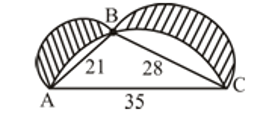
212 + 282 = 441 + 784 = 1225 = 352, so ∠B = 90° and B lies on the semicircle on AC.
Shaded = (semicircle AB + semicircle BC + triangle) − semicircle AC. The two small semicircles together equal the large one (π/8 × (212 + 282) = π/8 × 352), so the shaded area equals the triangle.
Area = ½ × 21 × 28 = 294 cm2.
By AM–GM, √t = √(t × 1) ≤ (t + 1)/2. Applying this to each term:
LHS ≤ [a + (2a − 2) + (3a − 4) + (4a − 6)]/2 = (10a − 12)/2 = 5a − 6 = RHS.
Equality needs every radicand to equal 1: a − 1 = 2a − 3 = 3a − 5 = 4a − 7 = 1, which all give a = 2. Exactly 1 value.
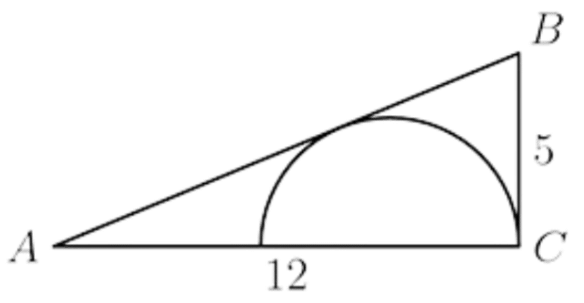
AB = 13 and sin A = 5/13. The centre O lies on AC with OC = r, so AO = 12 − r.
The semicircle touches AB, so the distance from O to AB is r: (12 − r) × 5/13 = r.
60 − 5r = 13r, so r = 60/18 = 10/3.
A walks 3.5 + 1 = 4.5 miles at 6 min/mile, taking 27 minutes. They meet 3.5 − 1 = 2.5 miles from the start.
B walks 2.5 miles in 27 − 4.5 = 22.5 minutes, so his speed = 2.5 × 60/22.5 = 6.67 miles/hr.
The x-intercept is 12/k and the y-intercept is 4.
Area = ½ × (12/k) × 4 = 24/k = 12, so k = 2.
Correct: 0 · Wrong: 0 · Accuracy: 0%
Keep the streak alive. See you tomorrow for Day 49.