
CAT 50 Day Streak – Day 46
30 questions across VARC, DILR & QA · +3 for a correct answer · −1 for a wrong MCQ · no negative marking for TITA
VARC · Verbal Ability & Reading Comprehension
Among the ocean’s menagerie of bizarre creatures, sea dragons stand out. Relatives of sea horses and pipefish, sea dragons have long, narrow snouts that they use like a straw to suck up meals of microscopic crustaceans. Instead of scales, the fish are covered in bony armour, and their backbones are kinked. Like their sea horse cousins, male sea dragons gestate a female’s fertilized eggs in a pouch.
Bill Cresko at the University of Oregon studies sea dragon genetics to answer one fundamental question: He and his colleagues want to know “how the hell” these fish came to look the way they do. “We’re just really fascinated by, ‘How can you have an organism that looks like that? What has changed in the genome?” he said.
A study tried to answer these questions. Researchers sequenced the genomes of leafy and weedy sea dragons and compared them with other fish. The strange appearance of sea dragons made the team think that there might have been something unusual happening with their fibroblast growth factor genes, “which are really important for development of things like teeth, which they don’t have, or the shape of faces or appendage outgrowth, to name just a few,” said Susie Bassham, a researcher in Dr. Cresko’s lab and an author of the paper.
But when they zeroed in on the animals’ genomes, the researchers were surprised to see that sea dragons were missing several of these key developmental genes altogether. “I didn’t really believe it at first,” said Clay Small, another author of the paper, also at the University of Oregon.
While the sea dragons were missing these growth genes, their genomes were packed with repetitive sections of code called transposons. This sort of repetitive code throughout the genome was once called “junk DNA,” as scientists were not sure what it did. But transposons, or “jumping genes,” are actually capable of cutting and pasting themselves from one spot within the genetic code to another, preventing other genes from shaping an organism’s traits.
The researchers cannot say for sure if the jumping genes are responsible for the absence of the growth factor genes. There is evidence of repeating genetic code near the spots where genes are missing, which might point to transposon activity, Dr. Small said. But scientists will need more genomes from across the fish family tree to confirm a cause-and-effect relationship.
Axel Meyer, a sea dragon researcher at the University of Konstanz in Germany, says the study furthers understanding of extreme body plans. “This is a poster child of the exuberance of evolution. It’s sort of like evolution gone crazy,” said Dr Meyer, who was not involved with the study. “The fun of being an evolutionary biologist is, you get to study these crazy animals and try to make sense of them genetically.”
Sea dragon DNA could give insights into how to conserve them, Dr Cresko says, which is critical because they are rare in the wild and hard to keep in captivity. A single fish can cost upward of $10,000, and they have proven almost impossible to breed.
For transposons to explain missing genes, they must be able to disrupt gene structure or position. The passage says they cut and paste themselves, “preventing other genes from shaping an organism’s traits”. This is the necessary assumption.
A (“all fish species”) and D (“only” body-shape genes) are far broader than the explanation needs. B is a comparison the explanation doesn’t depend on.
The passage states that transposons cut and paste themselves, “preventing other genes from shaping an organism’s traits”.
B treats an unconfirmed hypothesis as fact (the link “cannot” yet be confirmed). C misstates the mechanism: they move themselves, not “each other”. D is evidence researchers observed, not a role.
Cresko’s “one fundamental question” is “how the hell” these fish came to look the way they do. Their peculiar form is the motivation.
A is a finding, not the reason. B is unsupported. C is a later conservation benefit, not the fundamental reason.
Cresko says sea dragon DNA “could give insights into how to conserve them”.
A: the causal link is unconfirmed. B: “solely” overstates, since these genes are listed among “just a few” functions. C: they eat microscopic crustaceans, not crabs or lobsters.
- Finally, during the protests that began in the spring of 2020, I saw my students draw connections between domestic issues of racism and social inequality and the historical legacy—and present realities— of the American empire.
- When I ask students to define what an empire is, they typically picture Rome or the British Empire, not the United States.
- Much of my work as a historian and an educator focuses on conveying and exploring this fact.
- Every year, however, I witness students struggling to internalise it.
- Imperialism, expansion, and colonialism have been integral to every period of America’s existence, including the present.
The coherent paragraph is 5 → 3 → 4 → 2:
- 5: Imperialism is integral to every period of US history.
- 3: The author’s work conveys “this fact”.
- 4: “However”, students struggle to internalise “it”.
- 2: Example: they picture Rome or Britain, not the US.
Sentence 1 (“Finally…”) describes students successfully making the connection. That reverses the paragraph’s point about their struggle and comes from a different stage of the account.
The passage’s point is that the research is contradictory. Its evidence is that red and blue help in some studies and distract in others. D captures both the contradiction and the evidence.
A treats the variation as real effects on people rather than conflicting research. B states the effects as established facts. C drops “research” and the contradiction framing.
- This approach proved highly effective.
- As trade became more internationalised and competitive, innovation and the generation of new ideas became more important.
- To encourage more creativity among workers, German firms delegated decision-making power to lower levels of management.
- Germany’s business culture increasingly championed quality and empowered lower levels of management led firms to introduce more products that customers appreciated.
The order runs like this:
- 2: Context: global competition made innovation important.
- 3: German firms responded by delegating decisions.
- 1: “This approach” proved effective.
- 4: The result: more products customers valued.
“This” refers to the children’s skill of intuiting how to support their parents, and the sentence explains why they developed it. The next sentence, “Not caring … was not an option”, then reinforces the necessity.
At blank 2 “this” would point to “not caring”. At blanks 3 and 4 “this” would refer to the consequences or the lack of understanding, and neither works.
- We, therefore, welcome this multidisciplinary collection of papers to push forward the field and showcase sociology as a unique outlet for novel scholarship in this area, including empirical, methodological and theoretical work.
- There is a diverse community of policymakers, funders, scholars, and practitioners of different types, and all of them work in the field of evidence use.
- This is because multiple theories, approaches, interventions, and initiatives can be tried and developed.
- This diversity has also led to extremely valuable work being contained within silos, or research/practice developments being duplicated in different disciplinary areas.
- This diversity is a strength for the academic field of ‘evidence, policy, and practice studies.’
The coherent paragraph is 2 → 5 → 3 → 1:
- 2: A diverse community works on evidence use.
- 5: “This diversity is a strength” for the field.
- 3: “This is because” many approaches can be tried.
- 1: “We, therefore, welcome” a multidisciplinary collection, following from the strength.
Sentence 4 introduces a downside of diversity (silos and duplication). That breaks the positive argument that “therefore” in sentence 1 depends on.
Once the causes are set out (falling pageviews and the parent company’s troubles), the consequences follow in order: layoffs, then the publisher’s forced retirement, then the abandoned revision. The layoffs sentence starts that list, and “Its longtime publisher” continues it.
At blanks 1 and 2 the layoffs would interrupt the explanation of causes. At blank 4 they would split the publisher’s retirement from the abandoned project.
DILR · Data Interpretation & Logical Reasoning
This Navratri, Goddess Durga decided to give a magical prasad to her top 50 devotees on each of the nine days that would fulfil their wishes. They were supposed to consume the packet within three days, else the prasad would vanish. For example, if a devotee received a packet of prasad on the 4th day, he/she need to consume it by the 6th day or else it will vanish by the end of the 6th day.
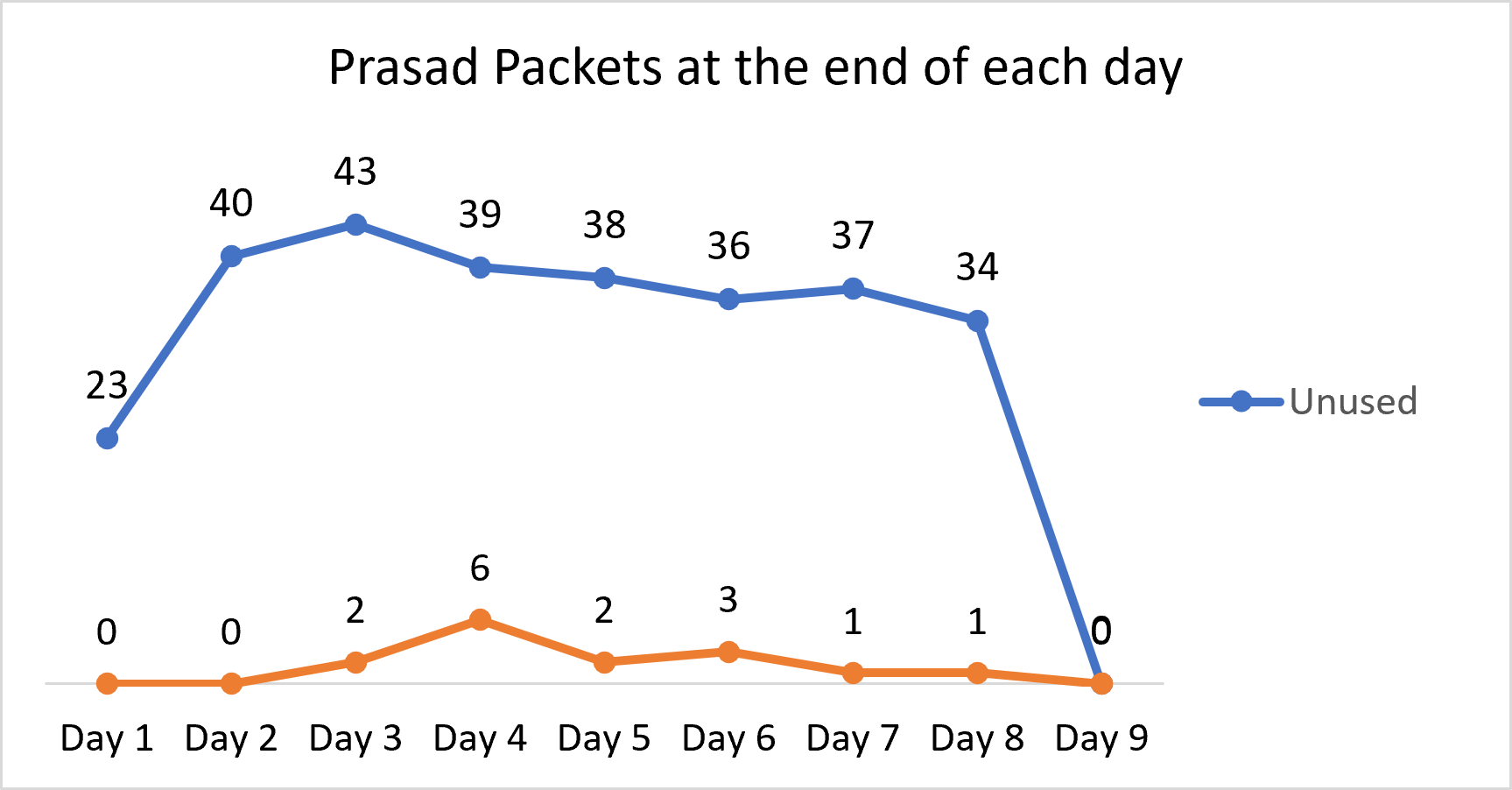
The graph below shows the number of unused packets of prasad and the number of prasad packets that vanished by the end of each of the 9 days.
It is known that:
- The number of people consuming the prasad on the last day of vanish is a single digit number for every day.
- The number of people consuming the prasad of previous day on day 2 was 15. The number of such persons (consuming prasad of previous day), increased by a constant number each day.
- It was mandatory for everyone to consume the prasad on the last day. As a result, there were no unused or vanished packets of prasad on the 9th day.
For packets given on day d, let s = eaten the same day, n = next day, t = third day, v = vanished, with s + n + t + v = 50.
- What the graph shows. Unused at the end of day d = (50 − sd) + (td−1 + vd−1). Vanished at the end of day d = vd−2.
- The next-day pattern. n1 = 15, and each later n grows by a constant k.
- Finding k. Working day by day, every value comes out in terms of k. Day 8’s packets must all be eaten by day 9, so s8 + n8 = 50, i.e. (27 − 3k) + (15 + 7k) = 50, giving k = 2.
| Received on | Same day (s) | Next day (n) | Third day (t) | Vanished (v) |
|---|---|---|---|---|
| Day 1 | 27 | 15 | 6 | 2 |
| Day 2 | 18 | 17 | 9 | 6 |
| Day 3 | 22 | 19 | 7 | 2 |
| Day 4 | 20 | 21 | 6 | 3 |
| Day 5 | 21 | 23 | 5 | 1 |
| Day 6 | 20 | 25 | 4 | 1 |
| Day 7 | 18 | 27 | 5 | 0 |
| Day 8 | 21 | 29 | 0 | 0 |
| Day 9 | 50 | – | – | – |
Every third-day count is a single digit ✓. Day 2, same day: 18.
From the table in Q11, n8 = 15 + 7 × 2 = 29.
From the table in Q11, the third-day counts are 6, 9, 7, 6, 5, 4, 5. The maximum is 9 (day 2’s packets).
From the table in Q11, s6 = 20 out of 50 = 40%.
Jalaj loves playing Minesweeper on his tablet. The game has a 10 x 10 matrix. The columns are labelled A to J from left to right, and the rows are labelled 1 to 10 from top to bottom. A cell is denoted by the combination of columns and rows. For example, G4 denotes the Gth column and the 4th row.
There’s a mine located at exactly at one of the cells. If a person clicks in a cell which is in the same row, same column or on any of the diagonals in the 4 possible directions, the mine blasts and the game is over. The objective of the game is to click on all the safe cells.
The first three clicks are safe, and based on these clicks, the computer picks a cell as a mine.
| A | B | C | D | E | F | G | H | I | J | |
|---|---|---|---|---|---|---|---|---|---|---|
| 1 | ||||||||||
| 2 | ||||||||||
| 3 | ||||||||||
| 4 | ||||||||||
| 5 | ||||||||||
| 6 | ||||||||||
| 7 | ||||||||||
| 8 | ||||||||||
| 9 | ||||||||||
| 10 |
The mine threatens cells like a chess queen (same row, column or diagonal). It threatens the fewest cells from a corner: 9 in its row + 9 in its column + 9 on its diagonal = 27.
Safe cells = 100 − 1 (the mine) − 27 = 72.
A mine can’t share a row, column or diagonal with any safe click. D3 is one column and one row from C2, so it lies on C2’s diagonal. If the mine were there, C2 would have exploded.
E1, H9 and F7 share no line with C2, G4 or J5. D3 cannot hold the mine.
A cell is unsafe if it shares D8’s row or column, or is diagonal to it (equal column and row shifts).
- B6: 2 columns left, 2 rows up, so it is diagonal ✗.
- F10: 2 columns right, 2 rows down, so it is diagonal ✗.
- C10, A4, E5, G3, H5 share no line with D8 ✓.
Unsafe cells: 2.
The graph gives the distribution of the circulation of three newspapers - The Times of India, The Hindu and The Hindustan Times in five localities - A, B, C, D and E of a city. The total circulation of these three newspapers in these localities is 5600, 7800, 7000, 6400 and 5000, respectively.
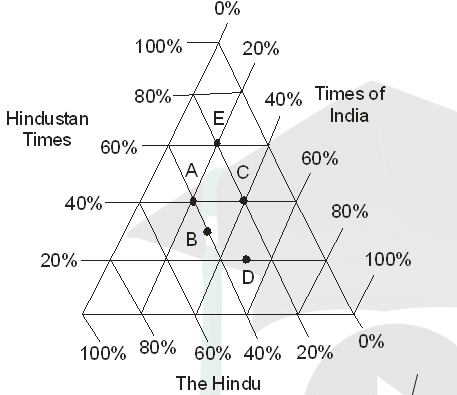
Reading the triangle: Hindustan Times from the horizontal lines, Times of India along the right axis, The Hindu along the bottom.
| Locality | Total | HT % | TOI % | Hindu % | HT | TOI | Hindu |
|---|---|---|---|---|---|---|---|
| A | 5600 | 40 | 20 | 40 | 2240 | 1120 | 2240 |
| B | 7800 | 30 | 30 | 40 | 2340 | 2340 | 3120 |
| C | 7000 | 40 | 40 | 20 | 2800 | 2800 | 1400 |
| D | 6400 | 20 | 50 | 30 | 1280 | 3200 | 1920 |
| E | 5000 | 60 | 20 | 20 | 3000 | 1000 | 1000 |
HT exceeds 1500 in A, B, C and E, i.e. 4 localities.
From the table in Q18: 2240 + 3120 + 1400 + 1920 + 1000 = 9680.
From the table in Q18, locality D next year: TOI 3200 × 1.2 = 3840, Hindu 1920 × 1.3 = 2496, HT 1280 × 1.4 = 1792.
Total = 8128.
QA · Quantitative Ability
Total = 385. First three = 123. Sixth and seventh = 2 × 73.5 = 147.
Fourth + fifth = 385 − 123 − 147 = 115, and fourth − fifth = 21, so the fourth innings = 68.
Let u = log2 x and v = log3 y. Then 2u − 3v = 4 and u + 4v = 13, giving u = 5 and v = 2. So x = 32 and y = 9.
log4 32 − log9 9 = 5/2 − 1 = 3/2.
Write the numbers as four digits abcd (leading zeros allowed) with a ≤ 5. Solutions of a + b + c + d = 8: C(11, 3) = 165.
Remove those with a ≥ 6: C(5, 3) = 10. Total = 155.
Subtracting the equations for n and n − 1: f(n)(n2 − 1) = (n − 1)2 f(n − 1), so f(n) = f(n − 1)(n − 1)/(n + 1).
Multiplying these ratios: f(n) = f(1) × 2/[n(n + 1)]. So f(2025) = 2025 × 2/(2025 × 2026) = 1/1013.
Each goat grazes a quarter circle of radius a, so together they graze πa2/2. Ungrazed area: 60a − (11/7)a2 = 175, i.e. 11a2 − 420a + 1225 = 0.
a = (420 ± 350)/22. The integer root is 35.
Total = (tigers + panthers) + 3(tigers + panthers) = 4(tigers + panthers), so the total is a multiple of 4. Of the options, only 84 qualifies.
In a quadrilateral with an inscribed circle, opposite sides have equal sums: PQ + RS = QR + PS.
164 + RS = 226 + 180, so RS = 242 mm.
Original plan (SI for 2 years, then CI for 1): 1.4A × 1.2 = 1.68A, so the interest is 0.68A.
Reversed (CI for 2 years, then SI for 1): 1.44A × 1.2 = 1.728A, so the interest is 0.728A.
Difference 0.048A = 3300, so A = 68,750.
- x ≤ 1: 11 − 3x = 10, so x = 1/3 (not an integer).
- 1 ≤ x ≤ 3: 9 − x = 10, so x = −1, outside the interval ✗.
- 3 ≤ x ≤ 7: x + 3 = 10, so x = 7 ✓.
- x ≥ 7: 3x − 11 = 10, so x = 7 (same solution).
Integral solutions: 1.
Let the speeds be 5k and 3k and the distance d. From the two round-trip times, k = 5, so X = 25 km/h, Y = 15 km/h and d = 75 km.
At 6.25 h, Y’s position depends on which way it went first:
- Downstream first (20 km/h): reaches 75 km at 3.75 h, then returns 2.5 h × 10 = 25 km. It is 50 km from M.
- Upstream first (10 km/h): has gone 62.5 km and hasn’t turned yet. It is 62.5 km from M.
The direction isn’t given, so the answer is either 50 km or 62.5 km.
Correct: 0 · Wrong: 0 · Accuracy: 0%
Keep the streak alive. See you tomorrow for Day 47.