CAT 50 Day Streak – Day 45
30 questions across VARC, DILR & QA · +3 for a correct answer · −1 for a wrong MCQ · no negative marking for TITA
VARC · Verbal Ability & Reading Comprehension
The Aztec historians, creators of a genre called the xiuhpohualli (SHOO-po-WA-lee), developed a highly effective way of keeping satisfying memories alive. The pictographic texts that Itzcoatl burned were only a part of the Aztec way of keeping history. The glyphs served as mnemonic devices designed to elicit volumes of speech. The image of smoke billowing from a burning temple reminded the speaker to describe a certain group’s defeat. A winding sheet over a chief’s head sparked the story of his death.
How can we know the details of exactly what they said? Their narrations, counterintuitively in some ways, have been preserved because of the Spanish conquest. The Spaniards aimed to produce a local elite who would help them rule, so they educated many boys and young men in the Roman alphabet. It was the priests who taught them so they could study the Bible. The Indigenous people studied scripture with the friars and, inevitably, they took the sound transcription system home with them. There, they asked elders to tell them old histories, as they used to say them aloud. And then the young scholars wrote down their elders’ stories, listening to the sounds of the words in Nahuatl, their own language, and transcribing them onto paper in their best handwriting, in the alphabet taught them by the friars.
For many years, however, scholars read them with scepticism. The histories weren’t like the books, such as ‘The Florentine Codex’ that the Aztecs wrote working side by side with the friars, answering the Spaniards’ questions, and drawing pictures of a specific plant or god. These were wide-ranging, confusing histories about mysterious, pre-conquest political dramas, often without any apparent narrative or context. They did not even proceed in chronological order. In fact, they frequently covered the same ground multiple times.
Recently, it has become clear to those who study these Aztec annals that repetition is a feature, not a quirk or bug. The reason is that whenever they came to a period of contention or a place where things could have turned out quite differently, the historian turned into a sort of director, bringing a series of speakers to the fore in order to speak.
For the Aztecs, history did not require textbook-like consensus. In their understanding, the truth was not singular and could accommodate different perspectives. This pattern had almost certainly been part of their social practice for many generations, as they sat around campfires, talking and telling stories, trying to build common cause with the friends they’d made along their route. Now they turned it into an art form, a formalised way of keeping history that literally depended on multiple speakers standing up at different moments.
Yet, this relativism did not mean that the Aztecs believed that there was no truth. Their historians never gave up on the idea that there is a truth that transcends differences in perspective. Their histories reminded listeners that, together, they had trekked a long way, over rough terrain and through painful events, to come to the present moment. They weren’t now about to give up everything with a shrug of the shoulders and an implicit conclusion that no one could ever know what happened or why.
The passage moves from scholars’ old “scepticism” toward the annals to the recent recognition that their repetition “is a feature, not a quirk or bug”, a deliberate staging of multiple perspectives. That is a re-evaluation.
A: the transcription process is only background. B is the opposite: the passage defends the annals. C: Itzcoatl’s burning is mentioned in passing and isn’t said to cause anything.
The conquerors taught the Roman alphabet so that young men could study the Bible and help them rule. Those same young men used it to write down their elders’ pre-conquest histories, which is the irony.
B: the transcription succeeded. C and D are true details, but they aren’t what the passage calls counterintuitive.
Repetition came “whenever they came to a period of contention or a place where things could have turned out quite differently”. Those are contested, politically sensitive events.
A, B and D (myths, genealogies, rituals) are never linked to the repetition.
The historian acted as “a sort of director”, bringing several speakers forward on contested events. History “did not require textbook-like consensus”. A documentary that brings together different voices on a controversial battle matches this.
A and C are single, authoritative narratives. D mirrors the question-and-answer Codex, which the passage contrasts with the xiuhpohualli.
“That” refers to the lag just described: even net zero tomorrow wouldn’t stop warming for decades. That lag is what makes action “feel futile”. Then “And though the problem is global…” adds a second, separate feature.
At blank 2 the decades-long lag hasn’t been fully stated yet. At blank 4 the sentence would follow the point about unequal consequences, which it doesn’t relate to.
The sentence reports what the man said in that first conversation, his background as a Zimbabwean safari guide. It explains why the author took him out that night to hear more.
From blank 2 on, the narrative is at the bar and in his war story. Basic introductions there would be out of sequence.
The passage pairs America’s space leadership with an ambivalent public, which may explain why the program hasn’t reached its potential. D keeps both parts.
A invents “cheaper alternatives”. B contradicts the passage’s explanation (public opinion). C invents “shifting scientific priorities”.
- Mass extinctions become examples of winners and losers.
- The narrative becomes one of power, influence and longevity, one group of organisms above all others deciding the course of entire ecosystems over the span of millions of years.
- For more than a century, the decimation of the ‘ruling reptiles’ has been taken as a cautionary tale of what could happen to us.
- The entire reason we so often fixate on the supposed dominance of the dinosaurs is because we now see ourselves in that position.
- No species could have prepared for what was to come, even if they had somehow been granted foreknowledge of the calamity.
The coherent paragraph is 3 → 4 → 1 → 2:
- 3: The fall of the “ruling reptiles” is treated as a cautionary tale for us.
- 4: We fixate on dinosaur dominance because we see ourselves in that position.
- 1: So mass extinctions become stories of winners and losers.
- 2: The narrative becomes one of power and longevity.
Sentence 5 is about how unpredictable the calamity itself was. The other four are about the narratives we build around dinosaur dominance.
- As historian Maria Rentetzi writes, “the cardboard box — the waste of our commercial world — is recycled in such a way as to make visible the disorder in our societies, the faults of capitalism.”
- And for many of us, the cardboard box is our closest touchpoint to globalized trade, structuring our relations with people in distant places.
- Its very existence in our homes, Marshall McLuhan would say, is the message.
- The magnificently ripped metal freight container may get the Economist cover shot, but the plain brown box delivers messages to our homes.
- It is an abject object that touches all parts of the city, from the granite kitchen island to the sewer grate.
- The cardboard box, therefore, is not merely packaging, but a pervasive symbol of our interconnected and often chaotic modern world.
The order runs like this:
- 4: “It” (the box from A) is an abject object touching all parts of the city.
- 1: “And” it is our closest touchpoint to global trade.
- 3: The freight container gets the headlines, but the brown box “delivers messages to our homes”.
- 2: “Its very existence in our homes … is the message”, which leads into F.
- As two scholars described it recently in the Annual Review of Anthropology, disappointment is “the messy, friction-filled, and unsatisfying gap between lived experiences and expectations that have not come to pass.”
- Because of this distinction, psychologists writing in the journal Cognition and Emotion find that regret more often leads to self-reproach, in contrast with the usual unhappiness associated with disappointment, which comes from a sense of powerlessness.
- But whereas regret involves wishing you had done something differently, disappointment does not necessarily involve your decision-making agency.
- The feeling is similar to regret, in that it involves a past event that didn’t turn out the way you had hoped.
- For example, you might vote for a candidate and regret it (that is, reproach yourself for doing so).
- But if the candidate for whom you voted loses, that can also give you a sense that you have no say over how you are governed—that’s where the powerlessness comes in.
The order runs like this:
- 3: “The feeling” (disappointment, from A) is similar to regret.
- 2: “But whereas” regret involves your own agency, disappointment needn’t.
- 1: “Because of this distinction”, regret leads to self-reproach and disappointment to powerlessness.
- 4: “For example”, regretting a vote, which F follows with “But if the candidate … loses”.
DILR · Data Interpretation & Logical Reasoning
There are 3 popular cafes in a city: Flamingo, Robin, and Woodpecker. A teacher asked students of a class which of these cafes had they visited. 10 students had not visited any of these cafes. Also, no student had visited all these cafes. The table gives the number of students who are yet to visit these cafes:
| Café | Students who have not visited the cafe |
|---|---|
| Flamingo | 20 |
| Robin | 30 |
| Woodpecker | 40 |
Let a, b and c be the students who visited only Flamingo, only Robin and only Woodpecker. Let x = Flamingo and Robin only, y = Flamingo and Woodpecker only, z = Robin and Woodpecker only.
- Not visited Flamingo: b + c + z + 10 = 20, so b + c + z = 10.
- Not visited Robin: a + c + y = 20.
- Not visited Woodpecker: a + b + x = 30.
Adding: 2(a + b + c) + (x + y + z) = 60. So the total N = 10 + (a + b + c) + (x + y + z) = 70 − (a + b + c).
N is smallest when a + b + c is largest. Since b + c ≤ 10, a + c ≤ 20 and a + b ≤ 30, a + b + c ≤ 30, reached at a = 20, b = 10, c = 0. Minimum N = 40.
From Q11, N = 70 − (a + b + c). The largest N comes when nobody visited exactly one café (a = b = c = 0, x = 30, y = 20, z = 10). N = 70.
From Q11, the minimum (N = 40) forces a = 20, b = 10, c = 0. Only Flamingo = 20.
“Not visited only Woodpecker” means students who missed Woodpecker but visited both of the others: x (Flamingo and Robin only).
Let a = t, b = 2t, c = 3t. From b + c ≤ 10, t ≤ 2. Then x = 30 − a − b = 30 − 3t, which is smallest at t = 2: x = 24.
From Q11, x + y + z = 60 − 2(a + b + c) = 26, so a + b + c = 17.
y = 20 − (a + c) = 20 − (17 − b). This is smallest when b = 0, giving y = 3. (Take c ≤ 10 and a = 17 − c; all regions stay non-negative.)
In a quiz, a participant is asked 4 questions successively, and then followed by the next participant. When all have finished one such round, the process is repeated. It is mandatory to answer all questions. If a question is answered correctly, 10 points are given to that participant but if the answer is wrong, 5 points each are given to the other participants. The first participant who gets 200 points wins the quiz. Three participants, Jacob, Kane, and Liam, participated in the quiz. Jacob got 200 points, Kane got 155 points, and Liam got 175 points. Out of the questions asked, a total of 24 questions were answered incorrectly.
- Number of questions. Every question adds 10 points in total (10 to the answerer, or 5 + 5 to the others). Total points 530 means 53 questions: 29 correct and 24 wrong.
- Who answered how many. 53 questions is 13 full blocks of 4 plus 1. So the first person answered 20, the second 17 and the third 16.
- Each person’s equation. A player’s score is 10c + 5(24 − w), where c and w are their correct and wrong answers. That gives Jacob 2c − w = 16, Kane 2c − w = 7, Liam 2c − w = 11.
- Matching counts. Liam must have answered 16 (c = 9, w = 7). Jacob and Kane split 20 and 17 in either order, and both splits fit.
| Case | Order | Jacob (c / w) | Kane (c / w) | Liam (c / w) |
|---|---|---|---|---|
| 1 | Jacob, Kane, Liam | 12 / 8 | 8 / 9 | 9 / 7 |
| 2 | Kane, Jacob, Liam | 11 / 6 | 9 / 11 | 9 / 7 |
In case 1 the 53rd question goes to Kane, whose wrong answer gives Jacob his last 5 points. In case 2 it goes to Jacob, who answers correctly. Both work, so who went first cannot be determined.
From the table in Q16, Kane has the most wrong answers in both cases (9 or 11): Kane.
From Q16, Liam answered 16 questions with 2c − w = 11, so c = 9.
Jacob first is case 1 in Q16, where Kane answered 17 questions with 8 correct.
Jacob has the fewest wrong answers only in case 2 of Q16 (Jacob 6, Liam 7). There, Kane gave 11 incorrect answers.
QA · Quantitative Ability
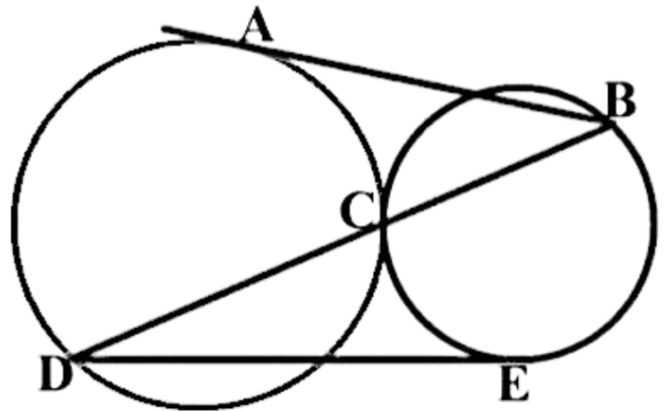
Use the tangent–secant theorem (tangent² = product of the secant’s two parts) for each point:
- B and the larger circle: BA2 = BC · BD, so 64 = BC · BD.
- D and the smaller circle: DE2 = DC · DB, so 225 = DC · BD.
Adding: BD(BC + DC) = BD2 = 289, so BD = 17.
Let both tanks hold K litres of kerosene, so A has 9K/4 petrol. After adding 30 L of petrol: K/(9K/4 + 30) = 3/8, so K = 72 and A has 192 L of petrol.
To get back to 4 : 9: (72 + k)/192 = 4/9, so k = 40/3 litres.
- x ≥ 1: x8 − x5 ≥ 0 and x2 − x ≥ 0, so the sum is at least 1 > 0.
- 0 ≤ x < 1: x8 + (x2 − x5) + (1 − x) > 0.
- x < 0: every term is positive.
The expression is always positive, so there are 0 real roots.
4πr2 = 256π gives r = 8. The cut makes caps of height 12 and 4 (curved areas 3 : 1 ✓).
Bigger part: curved area 2π × 8 × 12 = 192π, plus the flat circle π(64 − 16) = 48π. Total = 240π sq cm.
a = b = 0 gives f(0) = 2f(0) + 4, so f(0) = −4.
a = 3, b = −3: f(0) = f(3) + f(−3) + 9 + 4, so f(3) + f(−3) = −4 − 13 = −17.
82 ≡ 10 (mod 12). 102 = 100 ≡ 4, and 4 × 10 = 40 ≡ 4, so every power from 102 onward leaves 4.
The remainder is 4.
(a + 23d) + (a + 47d) = a + 63d gives a = −7d. Then S12 = 6(2a + 11d) = 6(−3d) = −18d, a multiple of 18.
800, 650 and 700 are not multiples of 18, so the answer is none of the above.
Days 1, 3, 5 are A + B (each 1/16 + 1/n). Days 2 and 4 are A + C (each 1/16 + 1/5 = 21/80). Day 6 is A + C for 31/42 of a day: (21/80)(31/42) = 31/160.
Total: 3/16 + 3/n + 42/80 + 31/160 = 1, so 3/n = 15/160 and n = 32.
Total profit = 21.8421% of 38 lakh ≈ 8,30,000. With t TVs and f fridges: 6000t + 0.25xf = 8,30,000 and 30000t + xf = 38,00,000.
Substituting xf: 6000t + 9,50,000 − 7500t = 8,30,000, so t = 80, f = 70 and x = 14,00,000/70 = 20,000.
SP of a fridge = 1.25 × 20,000 = Rs. 25,000.
The points form a rectangle 8 units wide (−1 to 7) and 2 units tall (2 to 4). Area = 16.
Correct: 0 · Wrong: 0 · Accuracy: 0%
Keep the streak alive. See you tomorrow for Day 46.