CAT 50 Day Streak – Day 44
30 questions across VARC, DILR & QA · +3 for a correct answer · −1 for a wrong MCQ · no negative marking for TITA
VARC · Verbal Ability & Reading Comprehension
At one point or another, we all knew something about how to heal ourselves using the plants and animals that surround us, at least somewhat. We treated pain with willow bark and terminated pregnancies with abortifacient herbs. We treated insomnia with lettuce and halitosis with parsley – according to a 10th-century cookbook from Baghdad, which devotes an entire chapter to the humoral properties of different vegetables. Many of us still know something about these treatments: studies estimate that as much as 80 per cent of the world’s population, roughly 6 billion people, still use traditional plant- and animal-based medicines. Such bonds that once existed between all humans and the rest of the natural world were born of scarcity, which dictates need. As a child in Soviet Russia, I made plantain weed poultices for skinned knees, ate raspberry jam to bring down fever, picked the sweet-smelling linden blossoms and dried them on newspaper in the sun to brew later as an expectorant.
Lately, we often relegate this kind of intelligence to laboratories: who needs myrrh when there is aspirin? My childhood herbalist memory, for instance, is fading. I remember picking fireweed and goatweed, but I have forgotten what they are for. It seems portentous that we should lose the memories of how to maintain our bodies: it is as if we are unremembering how to stay alive, and our forgetting what sustains us allows us to neglect and abuse the resources we no longer know how to use. In the process, we neglect and abuse something less easily defined but arguably more important: decency, morality, community, ourselves.
Amadou still keeps close the medicinal knowledge of the bush, which is why we were here at the market, getting lion fat. I had returned to Mali to visit him and our nomadic friends, though the spreading violence was making it too dangerous for them to be seen with a white woman. In 2019, war was already eating away at the country. Two days before our market visit, we had spent an afternoon sitting on woven plastic mats in the camps for displaced Fulani families.
Before the conflict spread in 2012, central Mali’s bush was home to thousands of Fulani herders who drove their zebu cattle along migration routes honed over centuries. When they approached a village, they carried with them a scent of sour milk. But war over dwindling resources, combined with an Islamist rebellion, had grown into ethnic violence against Fulani people: everywhere, the settled often marginalise the transient in times of unrest. Militias raided Fulani camps and villages, massacred families, burned people alive, and threw bodies down wells.
Most of the Fulani we met in the camps had been nomadic but lost their animals in the violence and no longer had a way to make a living in the bush, even if it had been safe. Others had lived in villages that were destroyed. Amadou and I visited a camp built with sticks and tarps behind a livestock market, another in a street of unfinished concrete rowhouses, and one of stuffy UNHCR tents. Some people had been there a year; others had arrived only a week earlier.
Forgetting what sustains us, the author writes, leads us to neglect “something less easily defined but arguably more important: decency, morality, community, ourselves”. The violence against the Fulani illustrates that erosion of community.
B: no causal link to weapons funding is suggested. C: scarcity is one factor, not presented as “the primary driver”. D: the Soviet setting is incidental.
The claim links knowing how to use resources with caring for them. B gives the flip side: communities that keep traditional knowledge conserve resources better. That supports the claim directly.
A is about diet, not stewardship. C shows a loss of knowledge but says nothing about abuse of resources. D concerns why herbalism revived, not neglect.
Nothing in the passage mentions the Fulani withholding medicinal knowledge.
A: they lost their animals and their livelihood in the bush. B: an Islamist rebellion grew into ethnic violence. C: “the settled often marginalise the transient in times of unrest”.
The author’s herbal memory “is fading”, while “Amadou still keeps close the medicinal knowledge of the bush”. The contrast is about connection to nature.
A: safety versus danger is not the contrast the passage draws. B: Amadou is never described as a refugee. D: profit is never mentioned.
- The following day, however, the occupants – mostly businessmen who had worked late – would rise up and head back to the office, grateful for this efficient sleep solution that had saved them a commute home in the early hours.
- As the concept spread, tourists, eager to sample this unusual aspect of Japanese culture, began to bunk up alongside them, happy to sleep in a room no bigger than their bed.
- By night, the world's first capsule hotel (founded in Osaka, Japan, in 1979) must have looked like a morgue, with neat rows of narrow sleeping capsules each containing a recumbent body.
- Fast-forward to today, and high hotel room rates, fuelled by years of rising real estate prices, have supercharged this typically low-cost concept, which offers budget travellers priced out of traditional hotels more privacy than a hostel dormitory and more comfort and connectivity than camping.
The order runs like this:
- 3: “By night”, the first capsule hotel looked like a morgue.
- 1: “The following day, however”, the businessmen rise and head to work.
- 2: “As the concept spread”, tourists joined “them”.
- 4: “Fast-forward to today”, high room rates have supercharged the concept.
The opening question asks where science can place “these phenomena”. A list of specific cases follows, each starting with “What about…”. The sentence about locating the self is the first case, and the next two (“What about beliefs…”, “What about free will…”) add to it.
At blanks 2 and 3 it would interrupt the “What about” sequence. At blank 4 it would come after the summarising question that wraps the list up.
- It is natural enough for professional academics to look back to distant moments in history as a guide to political action today.
- It is also natural for radical academics to focus their energies on the way that structures of domination continue in the present rather than on the progress that has been made against them in the relatively recent past.
- Attributing the setbacks principally to the sinister structures of domination eclipses the dynamic, contingent role of actual politics—national parties, grassroots movements, ideological media, the courts— in how these events have played out.
- Thanks to their immersion in the sources, they feel at home in these moments in a way that most people do not.
- Everyone knows perfectly well that the conditions of Black Americans have improved in many ways since the days of Jim Crow, not to mention the era of slavery.
The coherent paragraph is 1 → 4 → 2 → 5:
- 1: It is natural for academics to look to distant history.
- 4: “Thanks to their immersion”, they feel at home in “these moments”.
- 2: “It is also natural” for radical academics to focus on continuing domination rather than progress.
- 5: Yet everyone knows conditions have improved since Jim Crow.
Sentence 3 criticises blaming “the setbacks” on structures of domination. No setbacks are mentioned in the other sentences, and it moves into a separate argument about politics.
The author rejects the “argument from inevitability” as black-and-white: we should get as close to “not political” as possible, even if we never fully get there. C captures this.
A and B adopt the very view the author rejects. D calls the effort pointless, the opposite of “our job”.
- This study tracks the individual career aspirations over 3 years for 78 children aged 7–9 at the start of the study, from three schools in North East England, taking part in a STEM outreach project.
- School career information, advice and guidance in England has typically focused on pupils aged 13–18.
- Career aspirations are used as a proxy for future occupational destinations.
- However, pupils aged under 11 have already formed career aspirations.
- The data are also used to explore the applicability of aspiration development frameworks for younger children.
Detailed solution coming soon.
- It’s not by coincidence that the modern novel is so invested, both formally and in its subject matter, in the avant-garde and high modernism.
- In Wharton and in James, we see the formal precepts of realism taken to their absolute limit—the breaking point before modernism.
- The traditional nineteenth-century novel aspired, for the most part, to reflect the world objectively.
- But toward the end of the nineteenth century, I think many novelists were turning that mirror away from the road and toward its bearer.
- Stendhal famously wrote that the novel is a mirror carried along a road, which sums it all up.
The coherent paragraph is 3 → 5 → 4 → 2:
- 3: The 19th-century novel aimed to reflect the world objectively.
- 5: Stendhal’s “mirror carried along a road” sums it up.
- 4: “But” novelists turned “that mirror” toward its bearer.
- 2: In Wharton and James, realism reaches its breaking point before modernism.
Sentence 1 jumps to the modern novel’s investment in high modernism. The paragraph stops at the threshold of modernism.
DILR · Data Interpretation & Logical Reasoning
Out of five siblings - Amrit, Gunjan, Kirti, Madhu, and Shashi - two are females. All the siblings are of different ages. Their monthly salaries (in Rs. thousands) are 40, 45, 50, 60, and 75, in no particular order. It is also known that
- The sibling with the lowest salary is not the oldest. The sibling with the highest salary is older than one of the two sisters and younger than the other.
- The difference between the monthly salaries of Gunjan and Madhu is Rs. 15000.
- The salary of the older sister is more than that of the younger sister.
- Kirti does not have the highest salary.
- Gunjan is the youngest among the brothers and Shashi is the older of the two sisters. Amrit is older than both Gunjan and Shashi.
- The monthly salaries of Amrit, Madhu, and Shashi (not necessarily in this order) form an arithmetic progression.
- Genders. Shashi is the older sister and Amrit is older than her, so Amrit is a brother. Gunjan is a brother. The second sister is Kirti or Madhu.
- Highest salary. The top earner is between the two sisters in age, so not a sister, and not Amrit (who is older than both sisters). Kirti is excluded, so it is Gunjan or Madhu. Gunjan and Madhu differ by 15, so they are 60 and 75.
- If Madhu had 75, Gunjan would have 60, and the AP of Amrit, Madhu, Shashi would need 45, 60, 75, but 60 is taken ✗. So Gunjan = 75 and Madhu = 60.
- The AP. With Madhu at 60, Amrit and Shashi are 40 and 50, and Kirti gets 45. Madhu can’t be a sister, because Shashi would then earn less than the younger sister. So Kirti is the younger sister, and Shashi (50) earns more than Kirti (45), leaving Amrit = 40.
- Ages. Shashi > Gunjan > Kirti, Amrit > Shashi, and Gunjan is the youngest brother. Amrit (lowest salary) is not the oldest, so Madhu is.
| Age order | Sibling | Gender | Salary (Rs.) |
|---|---|---|---|
| 1 (oldest) | Madhu | M | 60,000 |
| 2 | Amrit | M | 40,000 |
| 3 | Shashi | F | 50,000 |
| 4 | Gunjan | M | 75,000 |
| 5 (youngest) | Kirti | F | 45,000 |
Amrit earns Rs. 40,000.
From the table in Q11, Gunjan and Kirti are younger than Shashi: 2.
From Q11, the sisters earn Shashi 50,000 and Kirti 45,000. Average = Rs. 47,500.
From the table in Q11, Gunjan earns the most (75,000).
From the table in Q11, the youngest is Kirti, the younger sister.
On the occasion of Children’s Day, chocolates were distributed at Sophia Convent School. The number of students present in each class is a multiple of 10. Chocolates are distributed from the school office to all the classrooms. The number of students present in some classrooms is known.
The following figure shows the route through which the chocolates are distributed to each classroom.
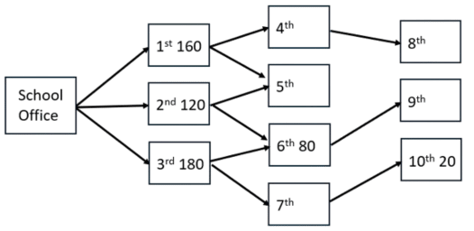
- The chocolates can be passed from one classroom to another only when chocolates are distributed to every student in the previous classroom.
- There are 900 chocolates, and an equal number is sent through each route from the office. The chocolates sent in other routes need not be equal.
- Each student gets exactly one chocolate.
- It takes 1 second per student to distribute chocolates.
- The time taken to move from the office to the classes and from one class to another is 30 seconds.
Detailed solution coming soon.
Path to class 8th: office → 1st → 4th → 8th. Time = 30 + 160 + 30 + (4th) + 30 + (8th). Every class has at least 10 students (a non-zero multiple of 10).
Earliest = 30 + 160 + 30 + 10 + 30 + 10 = 270 seconds.
Detailed solution coming soon.
Each office route carries 900/3 = 300 chocolates. Class 1st keeps 160 and passes 140 on to 4th and 5th. Class 4th’s share has to cover both 4th and 8th.
Send all 140 to 4th: with at least 10 for 8th, 4th can have up to 130. Class 5th is still supplied by 2nd, so this works (7th = 50 only affects the 3rd/6th side).
Maximum = 130.
Let 1st send a to 4th, 2nd send b to 5th, and 3rd send c to 6th. Each route starts with 300.
- Class 5th = (140 − a) + b. With a ≥ 20 (4th and 8th need at least 10 each), 5th ≤ 120 + b.
- Class 9th = (180 − b) + c − 80. With c ≤ 90 (7th needs at least 10, since 7th = 100 − c), 9th ≤ 190 − b.
Setting them equal at the maximum, b = 30 gives 5th ≤ 150 and 9th ≤ 160, so both can be 150 (with c = 80). Reaching 160 for both would need b ≥ 40 and b ≤ 30 at once, which is impossible. N = 150.
QA · Quantitative Ability
The two discounts leave 0.8 × 0.85 = 0.68 of MP. So 0.68 MP − (MP − 2500) = 500, giving MP = 6250 and CP = 3750.
At a 35% discount, SP = 0.65 × 6250 = 4062.5, so profit = 312.5. The profit falls by 500 − 312.5 = Rs. 187.5.
The small cone is 1/8 of the whole cone’s volume, so it is the whole cone scaled by 1/2: r = h = 5 and slant height 5√2.
Small cone TSA = π·5(5 + 5√2) ≈ 60.36π. Frustum TSA = π(10 + 5)(5√2) + π(100 + 25) ≈ 106.07π + 125π = 231.07π.
Ratio ≈ 60.36 : 231.07 = 1 : 3.83.
The second equation is (x + y)2(x − y). Dividing by the first: (x + y)2/(x2 + y2) = 1805/965 = 361/193, so x + y = 19 and x2 + y2 = 193.
2xy = 361 − 193 = 168, so xy = 84 (x = 12, y = 7).
STATURE has vowels A, U, E and consonants S, T, T, R. Place the vowels in 3 of the 4 odd positions: 4P3 = 24 ways.
The consonants fill the other 4 positions: 4!/2! = 12 ways. Total = 24 × 12 = 288.
A : B = 3 : 2 gives 72% milk. Mixing that with C in the ratio 2 : 1 gives (144 + 90)/3 = 78%.
Let the mix be Q litres: 0.78(Q − 25) + 75 = 0.8625(Q + 50), so Q = 150.
C makes up 1/3 of this: 50 litres.
The first inequality gives x ≤ 2.4, the second x ≥ −2. So −2 ≤ x ≤ 2.4.
Multiples of 0.4 run from −5 × 0.4 to 6 × 0.4, which is 12 values.
Let RS = 10, so ST = 3 and TR = PQ = 7. With height h, area of PQRS = h(7 + 10)/2 = 8.5h.
Triangle QTS has base ST = 3 and the same height: area = 1.5h. Ratio = 8.5 : 1.5 = 17 : 3.
A 6-digit palindrome has the form 1bccb1. Four of its six digits are 1s, so exactly one of b and c is 1. That gives 110011 (51) and 101101 (45).
Sum = 96 = 1100000 in binary.
(1 + r)2 = 1.44, so r = 20%. Interest in year 4 minus interest in year 2 = 0.2P(1.23 − 1.2) = 0.1056P.
0.1056P = 1,16,160, so P = ₹ 11,00,000.
f(m) = 3m, so the sum is 3(3n − 1)/2 = 9840. That gives 3n = 6561 = 38, so n = 8.
Correct: 0 · Wrong: 0 · Accuracy: 0%
Keep the streak alive. See you tomorrow for Day 45.