
CAT 50 Day Streak – Day 41
30 questions across VARC, DILR & QA · +3 for a correct answer · −1 for a wrong MCQ · no negative marking for TITA
VARC · Verbal Ability & Reading Comprehension
Notwithstanding, it is the most recent postmodern form of feminism, as Teresa Ebert calls it, ‘lucid’ feminism, that may bring reconciliation to radical feminism and Marxism by showing, though unknowingly, the importance of materialism for feminism. Influenced by Jacques Derrida, Michel Foucault and Judith Butler, lucid feminism challenges the idea of emancipation by arguing that power is a ‘multiplicity of force relations immanent in the sphere in which they operate and which constitute their own organisation’. Such a diffused nature of power dispenses with the need for organised revolution to overthrow the dominant locus of power, making the idea of resistance redundant, and poses a substantial challenge to the Marxist concept of ‘class’, as well as to the idea of patriarchal oppression of the body. The body is no longer viewed as a tool of patriarchal exploitation but rather an abstraction isolated from socioeconomic relations on its own. This analysis of power is clearly simplistic and ahistorical, which describes rather than explains the established forms of coercion and shows no attempt to change exploitative social arrangements.
This bears a chance for radical feminism to enhance its strength by collaborating with Marxism to show that sexual oppression is the result of the division of labour that is historically determined by coercive social relations and ideologically constructed gender differences. Labour, in this case, would mean ‘the human activity of transforming nature involved in the reproduction of human life itself as well as the basic means to sustain that life’. Writing from a socialist feminist perspective, Barbara Ehrenreich shows that the two forms of oppression, capitalist and patriarchal, always interact when analysed in the historical context. Marxism would, thus, help radical feminism depart from its transfixion with male supremacy and its simplistic view of capitalism as one of its expressions. In turn, so-called ‘mechanical’ Marxists with their economic determination, could also expand their comprehension of ‘class’ to include the atomisation and exploitation of women. In short, the theory of historical materialism has the potential to be applied in feminism in order to explain the development of division within the family, state and economy and their interplay.
At this juncture, it is worth mentioning an influential radical feminist, Shulamith Firestone, who brings Marxist methodology into radical feminism. First, she agrees with Engels that sexual oppression originated in the first division of labour, and, although the technological advances can no longer justify the continuation of oppression, the consolidated power of the ruling class, in this case men, finds new means of coercion. She also borrows Marxist solutions and employs them in her theory. Since ‘procreation is at the origin of dualism’, Firestone promotes the revolt of women as the underclass and the seizure of control of reproduction. Her account culminates in the statement that unless Marxism transforms the most fundamental, in her opinion, form of social organisation that is ‘the source of psychological, economic and political oppression’ – the biological family - exploitation in society will never be eliminated.
The author sees “a chance for radical feminism to enhance its strength by collaborating with Marxism” and says historical materialism “has the potential to be applied in feminism”. That makes the two complementary on materialist terms.
A contradicts the reconciliation the author proposes. C: the benefit runs both ways, since “mechanical” Marxists could also widen their idea of class. D: each is described as missing something the other offers.
Detailed solution coming soon.
The passage states plainly: “She also borrows Marxist solutions and employs them in her theory.” So D is false.
A: she agrees with Engels that oppression began with the first division of labour. B: technology “can no longer justify the continuation of oppression”. C: she treats the biological family as “the most fundamental, in her opinion” form of social organisation, implying Marxism has missed it.
Lucid feminism treats the body as “an abstraction isolated from socioeconomic relations”, which the author calls “simplistic and ahistorical”. The author’s alternative ties oppression to the division of labour. C captures this criticism.
A: biology versus psychology is not the issue. B: the problem is abstraction, not liberation. D: lucid feminism makes resistance “redundant”, so it doesn’t treat the body as a site of resistance.
The core point is that despite their diversity, laws of nature are necessary and can’t be broken. That sets them apart from “accidents” that are true without exception but not necessary. C is the closest summary.
A treats the gold-cube fact as impossible to break, but the passage says it “could have been false”. B shifts from objects to “everybody” obeying. D says the gold-cube fact holds “on most occasions”, but the passage calls it exceptionless.
Declaring Africa a conceptual terra nullius (nobody’s land) is “this”: it let precolonial law be ignored entirely. The next sentence then contrasts Africa with “other colonies, such as India, where some form of precolonial law was recognised”.
At blank 1, “this” would point to political exclusion, not to a legal void. At blanks 3 and 4 the passage is about India, where precolonial law was recognised rather than disregarded.
- That’s why drinking water is so important.
- It’s about time for water to get its due.
- In fact, your body processes about two to three quarts a day to transport nutrients to where they’re needed, get rid of body wastes, regulate temperature, support chemical reactions, and perform other critical tasks.
- After all, water is the only fluid that you truly can’t live without.
The order runs like this:
- 2: Water deserves its due.
- 4: “After all”, it’s the only fluid you can’t live without.
- 3: “In fact”, the body processes 2–3 quarts a day for vital tasks.
- 1: “That’s why” drinking water matters.
- Researchers worked with 20 patients who were undergoing intracranial recording of brain activity to guide surgery for the treatment of their drug-resistant epilepsy.
- They looked at how the patients' brain activity was affected when shown film clips containing different types of cognitive boundary transitions thought to trigger changes in how a memory is stored, and that mark the beginning and end of memory files in the brain.
- Researchers have identified two types of cells in our brains that are involved in organizing discrete memories based on when they occurred.
- This finding improves our understanding of how the human brain forms memories and could have implications for memory disorders such as Alzheimer's disease.
The order runs like this:
- 3: The finding: two types of memory-organising cells.
- 4: “This finding” and why it matters.
- 1: The method: 20 epilepsy patients.
- 2: “They looked at” brain activity during film clips.
- Philosophers do not aim to discover the laws of nature.
- The laws of nature not only are true, but also would still have been true under various hypothetical circumstances.
- That’s a job for scientists.
- The philosopher’s aim is to better understand the job that scientists are doing.
- What philosophers aim to do is to figure out what sort of thing scientists are discovering when they discover the laws of nature.
The coherent paragraph is 1 → 3 → 4 → 5:
- 1: Philosophers don’t aim to discover laws of nature.
- 3: “That’s a job for scientists.”
- 4: Philosophers aim to understand the scientists’ job.
- 5: Specifically, what sort of thing scientists discover.
Sentence 2 is a claim about the nature of laws themselves (they hold under hypothetical circumstances). The other four are about the division of labour between philosophers and scientists.
- The process of mental health requires its own set of specific skills.
- People may visualize mental health as a place one arrives at or a treasure one possesses.
- Life, goes the saying, is like a diamond—hard and beautiful.
- Many are experiencing the hardness of it quite acutely these days, in the form of stress, dread, and fatigue.
- Much of our success in navigating these difficult times depends on our mental health.
The coherent paragraph is 3 → 4 → 5 → 2:
- 3: Life is like a diamond, hard and beautiful.
- 4: Many feel “the hardness of it”.
- 5: Navigating “these difficult times” depends on mental health.
- 2: People picture mental health as a place or treasure.
Sentence 1 jumps to mental health as a process requiring skills, with no contrast word linking it to the “place or treasure” image.
DILR · Data Interpretation & Logical Reasoning
Five students, viz. Alina, Bindi, Chhaya, Dipti, and Emily rolled a dice and obtained different numbers 2, 3, 4, 5, and 6, not necessarily in that order. Their teacher calls out seven different random numbers. The students who had their number that is a factor of the number called out by the teacher answered with a ‘Yes’, and the ones who did not have a factor of the number answered with a ‘No’.
- The sum of the seven numbers called by the teacher is 100, and each of them is greater than 2.
- The sum of the first and the second numbers is 30.
- The teacher did not call out the numbers 6 and 7.
- Exactly one of the called numbers is less than 10.
The table that is formed at the end of the activity looks as follows:
| Number | 1st | 2nd | 3rd | 4th | 5th | 6th | 7th |
|---|---|---|---|---|---|---|---|
| Alina | Yes | Yes | No | No | Yes | No | No |
| Bindi | Yes | Yes | No | No | Yes | Yes | Yes |
| Chhaya | No | No | Yes | No | No | Yes | No |
| Dipti | Yes | Yes | No | No | Yes | No | No |
| Emily | No | Yes | No | No | Yes | No | No |
- Chhaya = 5. Number 2 is divisible by four of the dice values but not Chhaya’s. If Chhaya had 2 or 3, those four would include 6 (or 4 and 6), which forces 2 or 3 to divide it as well. So Chhaya = 5.
- Emily = 4. Number 1 gets Yes from Alina, Bindi and Dipti, and No from Emily. The only way three of {2, 3, 4, 6} divide it without the fourth is if the excluded one is 4.
- Bindi = 2. Number 7 gets a Yes only from Bindi, so Bindi can’t hold 4 or 6 (their factors would also say Yes). If Bindi held 3, the sum and “one number below 10” conditions can’t be met. So Bindi = 2, and Alina and Dipti hold 3 and 6.
- The numbers. n1 = 18 (a multiple of 6, not of 4) and n2 = 12 (a multiple of 12, not of 5), summing to 30. The remaining five sum to 70 with only one below 10: n3 = 5, n5 = 24, n6 = 10, and n4 + n7 = 31 gives n4 = 17 and n7 = 14.
| Called | 1st | 2nd | 3rd | 4th | 5th | 6th | 7th |
|---|---|---|---|---|---|---|---|
| Number | 18 | 12 | 5 | 17 | 24 | 10 | 14 |
Dice: Bindi 2, Emily 4, Chhaya 5, and Alina and Dipti 3 and 6 in either order. Their Yes/No columns are identical, so who has 6 cannot be determined.
From the table in Q11, the numbers are 18, 12, 5, 17, 24, 10 and 14. The highest is 24.
From Q11, the primes called are 5 and 17: 2.
From Q11, the 7th number is 14. It is even (Bindi, with 2, says Yes) but not divisible by 3, 4 or 5.
From Q11, only 24 exceeds 20, so the answer is 1.
The following table represents the addition of two six-digit numbers given in the first and second rows, while the sum is given in the third row. In the representation, each of the digits 0, 1, 2, 3, 4, 5, 6, 7, 8, 9 has been coded with one letter, with distinct letters representing distinct digits.
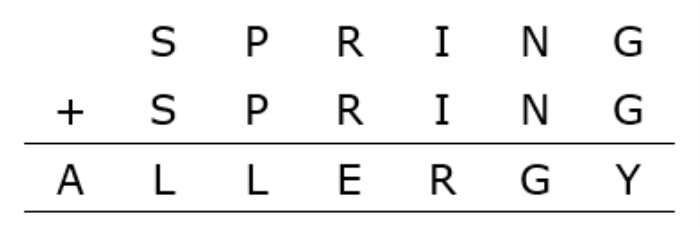
- A = 1. Two six-digit numbers add to a seven-digit number, so the leading digit A must be 1.
- S = P + 5 and L = 2P. The two leftmost columns both produce L: 2S + carry = L + 10 and 2P + carry = L + 10×carry. This forces both carries to be 0, so S = P + 5 and L = 2P.
- R ≤ 4. The carry into the P column is 0, so E = 2R + carry, which keeps R at 4 or below.
- Testing P. Trying P = 2, 3, 4 (P = 0 would make L = 0 as well), only P = 3 works: L = 6, S = 8, R = 4, E = 9, I = 7, N = 2, G = 5, Y = 0.
Check: 834725 + 834725 = 1669450 ✓. Digit 1 is represented by A.
From Q16, S = 8 and P = 3, so the difference is 5.
SPRING = 834725 uses 8, 3, 4, 7, 2 and 5. The digit 6 (L) is not used.
G = 5, so G + G = 10, which makes Y = 0 with a carry of 1.
AIR = 174, and 174 + 174 = 348. That is P (3), R (4), S (8): PRS.
QA · Quantitative Ability
|E| > E only when E < 0. Here (x − 8)(x + 2) < 0, so −2 < x < 8.
The integers −1, 0, 1, …, 7 give 9 values.
Let the chair’s marked price be c. Chair SP = 0.8 × 0.8 × 0.9c = 0.576c. Table SP = 0.7 × 0.8(c + 100) = 0.56c + 56.
|0.016c − 56| = 48 gives c = 6500 or c = 500. Combined marked price = 2c + 100 = 13100 or 1100. Of the options, 13100.
Area = d2/2. [(d + 4)2 − d2]/2 = 56 gives 8d + 16 = 112, so d = 12.
The areas are 72 and 128. New : old = 128 : 72 = 16 : 9.
Writing all three as powers of 2 gives x = 2y = 3z. Then xyz = x × x/2 × x/3 = x3/6 = 288, so x = 12, y = 6 and z = 4.
1/(2x) + 1/(4y) + 1/(8z) = 1/24 + 1/24 + 1/32 = 11/96.
Let N + 100 = b4 and N + 29 = a2. Then b4 − a2 = 71, i.e. (b2 − a)(b2 + a) = 71. Since 71 is prime, b2 − a = 1 and b2 + a = 71, so b2 = 36 and a = 35.
N = 1225 − 29 = 1196. The next cube is 113 = 1331, so add 1331 − 1196 = 135.
Let b be the boat’s speed and s the stream’s. b − s = 0.7(b + s) gives b = 17s/3.
Downstream speed = 20s/3. Return speed (stream doubled) = b − 2s = 11s/3. Total time: 220 × 3/(20s) + 220 × 3/(11s) = 33/s + 60/s = 93/s = 31, so s = 3.
The trips take 11 h and 20 h. Difference = 9 h = 540 minutes.
Treat parent–boy–parent as one block, giving 6 units around the table: (6 − 1)! = 120 ways. The parents can swap sides: × 2.
Total = 240.
All three known points are 13 units from the origin, so the circle is x2 + y2 = 169.
x2 + 169 = 169 gives x = 0.
Let Binita buy B chocolates. Then A = 1.25B = 5B/4. Also A = 0.8(B + C + D), so B + C + D = A/0.8 = 25B/16.
Total = A + (B + C + D) = 5B/4 + 25B/16 = 45B/16. For every count to be a whole number, B must be a multiple of 16.
The largest multiple of 16 below 100 is 96. Then A = 120, B + C + D = 150, and the total = 270.
Discriminant: (a − 1)2 − 16a(a − 1) ≥ 0, i.e. (a − 1)(15a + 1) ≤ 0, so −1/15 ≤ a ≤ 1.
That allows a = 0 or 1, but a = 0 makes the equation not quadratic. Only a = 1 works (4x2 = 0): 1 value.
Correct: 0 · Wrong: 0 · Accuracy: 0%
Keep the streak alive. See you tomorrow for Day 42.