CAT 50 Day Streak – Day 40
30 questions across VARC, DILR & QA · +3 for a correct answer · −1 for a wrong MCQ · no negative marking for TITA
VARC · Verbal Ability & Reading Comprehension
In the Middle Ages, kitchens were ill-lit. Covered by thatched roofs and generally chimney-less, they were noisy, smelly, messy places, heated with wood-burning stoves which took time to catch and needed to remain lit long enough that food could be cooked, making them hot and uncomfortable. Until the late nineteenth century, kitchens featured only a few basic pieces of furniture: “a worktable and sink, a storage cupboard, and a few open shelves; dry goods purchased from the grocer were kept in a pantry, along with rows of the canned goods that most women made from homegrown produce,” writes Nancy Hiller in “The Hoosier Cabinet and the American Housewife.”
For the most part, built-in shelving, cabinetry, and countertops were costly luxuries enjoyed exclusively by the upper-class, whose members were the only ones able to afford expert carpenters. At the same time, the industrial revolution was in full swing, prompting advancements in mass production and making goods of all sorts more available and affordable. Consumers embraced new ways of thinking about outfitting their homes. Kitchens could now readily grow to include features—cabinets and countertops—that we now take for granted. Among those who met this hunger was the Indiana-based Hoosier Manufacturing Company, which began making its Hoosier cabinet in 1899. This was, Hiller explains, “a freestanding cupboard equipped with ingenious mechanical devices, consolidated storage and maximized the efficiency of kitchen labor, thereby alleviating some of the most exasperating aspects of the middle-class housewife’s daily responsibilities.”
Tracing the lineage of the Hoosier Cabinet is complicated, according to William Warner, a retired historian at Coppes Commons, a shopping centre and museum complex in Indiana that houses a collection of early Hoosier cabinets. “As far as we know, no one person or company is given credit for the invention of what we now call the Hoosier cabinet,” he says. While it’s possible to find several early United States patents for a kitchen cabinet starting about 1885, many furniture companies jumped on the Hoosier cabinet-making bandwagon. Though most of these concerns hailed from Indiana, as the cabinet name suggests, some were based in Ohio and elsewhere in the Midwest.
“We have found approximately 130 different companies that produced a version of the new popular kitchen cabinet, either from newspaper advertisements, internet sales of cabinets, or seeing a cabinet personally at antique malls,” Warner says. The only one that still makes cabinets is Coppes Napanee, which began its life as a sawmill in 1876 before branching out into retail lumber and then, in 1903, Hoosier cabinets. Twenty-four odd years later, it was making 23,000 of them annually. Indeed, some estimates suggest a tenth of all households contained a Hoosier cabinet by the 1920s. The Hoosier cabinet made the kitchen easier to navigate and more accessible to middle-class housewives in particular, who had largely depended on housekeepers to run their kitchens. By the turn of the century, Hiller writes, these domestic workers headed elsewhere to earn their wages, leaving the housewives to tend to kitchen affairs. “As domestic servants exchanged their harried positions for the structure and independence of industrial work, their former mistresses were forced back into their own kitchen,” she writes.
Warner says no single person or company gets credit for the invention, and about 130 companies made versions to meet consumers’ “hunger” for kitchen features. That points to broad market demand, not one protected invention.
A: the cabinet “maximized the efficiency of kitchen labor”, so it wasn’t inefficient. B: nothing suggests illegal counterfeiting. D: the passage says nothing about how the company’s patents were enforced.
Domestic servants left for industrial work, and “their former mistresses were forced back into their own kitchen”. Middle-class housewives suddenly needed to run their kitchens themselves, which is the labour-force shift in B.
A: grocery costs are never presented as a cause. C: upper-class luxury is background, not the trigger. D: Coppes Napanee began as a sawmill in 1876 and only started making cabinets in 1903.
Hiller describes it as “a freestanding cupboard equipped with ingenious mechanical devices” that “consolidated storage and maximized the efficiency of kitchen labor”. D restates this.
A describes the expensive built-ins the cabinet replaced. B: the passage never calls it a replacement for the pantry specifically. C describes medieval stoves.
The passage starts with uncomfortable kitchens run largely by housekeepers and ends with the Hoosier cabinet making kitchens accessible to middle-class housewives, the “former mistresses” of those servants. A captures that shift.
B: the cabinets were for homes, not factories. C reverses the direction: workers moved to industry, while the furniture stayed in homes. D: aesthetics are never discussed.
- Yet it is not true that you can change the other characters in it.
- It is true that you created your story and you are the only one who can change it.
- Are you tired of this negativity becoming the story permeating your life?
- You’ve likely spent many years trying to do that.
The order runs like this:
- 3: The hook: tired of negativity becoming your “story”?
- 2: “It is true” that you created your story and only you can change it.
- 1: “Yet” you can’t change the other characters in it.
- 4: “Trying to do that” refers back to changing other characters.
The paragraph lists European inventions now coming back to Europe in American form: coffee (Austrian café to US chains), then pizza (Neapolitan to “New York”), then hamburgers. The pizza line belongs between coffee and hamburgers, and “And don’t get me started…” adds a third item to the list.
At blank 1 the American takeover hasn’t been introduced yet. Blanks 3 and 4 come after the list has moved on to politics.
- In the university, you get to immerse yourself in an object and learn about it on its own terms.
- This is why so much humanities work actually frowns on trying to transmit to the reader the passion, say, a work of literature might stir in you.
- But, no less importantly, academic work also involves constant critical self-reflection on the tools and methods that you use to approach that object.
- These things do happen at the university, but they are, ultimately, means to the end of producing knowledge.
- This would be the difference between learning about the Roman Empire from a video essay or just flipping around on Wikipedia, and the years of contact with primary sources you’d put in as a history major.
The coherent paragraph is 1 → 5 → 3 → 2:
- 1: At university you immerse yourself in an object on its own terms.
- 5: For example, years with primary sources versus a video essay.
- 3: “But, no less importantly”, critical reflection on your methods.
- 2: “This is why” humanities work avoids transmitting raw passion: the focus is on method, not feeling.
Sentence 4’s “These things” has no antecedent among the other four. Nothing listed is something that merely “happens” at university as a means to an end.
The passage compares the height and gait of Americans and Britons, then Irish and British men in the 19th century, and links the Irish height to a potato diet. B covers the national differences and their historical and dietary roots.
A says “inherited”, which the passage doesn’t claim. C focuses on one detail and invents a causal claim the passage doesn’t make (the navy figures recorded height, not strength). D creates a false link between US–UK gait and Irish navy recruits.
“They” must be Hartle and Hawking, who are named only in the last sentence. That sentence says they had to “drastically simplify”, and the missing sentence explains how: toy universes in minisuperspace with a single energy field.
At blanks 1–3, “they” would have no clear referent, and the simplification hasn’t been mentioned yet.
- Most significant to me, the survey shows that although young people’s emotional and psychological distress is more pronounced in wealthy, industrialized nations, it is occurring across the world.
- They derive that answer by getting people in multiple countries to answer a single self-assessment question about life satisfaction.
- The organizations that produce them always attract a lot of attention by answering “Which is the world’s happiest country?”
- I don’t place much stock in this methodology because we can’t accurately compare nations based on such a limited self-assessment.
- I have some skepticism about these international rankings of happiness.
The coherent paragraph is 5 → 3 → 2 → 4:
- 5: Skepticism about happiness rankings.
- 3: “The organizations that produce them” ask which country is happiest.
- 2: “They derive that answer” from one self-assessment question.
- 4: “This methodology” isn’t reliable.
Sentence 1 praises a survey finding about youth distress, which runs against the paragraph’s skeptical argument about ranking methods.
DILR · Data Interpretation & Logical Reasoning
Six friends - Fred, Ross, Ian, Eden, Nancy, and Diana played five games of UNO. In each game, 10 points were awarded to the one who came first, 8 points to the one who came second, 6 points to the one who came third, 4 points to the one who came fourth, 2 points to the one who came in fifth, and 1 point to the one who came last. It is also known that:
- None of these friends got the same rank in any of the five games.
- Nancy and Diana got the highest and the lowest total score, respectively.
- Ross got two points more than Ian in total.
- Eden came 2nd and Diana came 4th in the third game.
- Ian got the fifth rank in the first game.
- Nancy did not come first in the first game.
- Eden got the lowest rank in the fourth game.
- Fred got his best rank in the third game.
- Nancy got a better rank than Ian in the second game.
- Ross came 3rd in the first game and 4th in the second game.
- Only in the first and the fifth games Diana got a better rank than Fred.
- Totals. No one repeats a rank, so across the 5 games each player misses exactly one of the 6 ranks. Each rank occurs 5 times, so each rank is missed by exactly one player. A player’s total is 31 minus the points of the missed rank, so the totals are 21, 23, 25, 27, 29 and 30 in some order. Nancy has 30 (misses 6th) and Diana 21 (misses 1st).
- Ross and Ian. Ross = Ian + 2, so Ross misses the rank just below Ian’s missed rank. Ross already has 3rd and 4th, so Ross must miss 5th (29) and Ian 4th (27). That puts Ross 6th in game 3, Ian 3rd and Nancy 5th.
- Fred. His best rank came in game 3, which is only possible if he was 1st there (with 3rd as his best he couldn’t fill five distinct ranks). So Eden takes 1st in game 1. Eden then misses 3rd (25) and Fred misses 2nd (23).
- The rest. The Diana-versus-Fred conditions and Nancy beating Ian in game 2 fix the remaining places.
| Player | G1 | G2 | G3 | G4 | G5 | Total |
|---|---|---|---|---|---|---|
| Nancy | 4 | 1 | 5 | 3 | 2 | 30 |
| Ross | 3 | 4 | 6 | 2 | 1 | 29 |
| Ian | 5 | 2 | 3 | 1 | 6 | 27 |
| Eden | 1 | 5 | 2 | 6 | 4 | 25 |
| Fred | 6 | 3 | 1 | 4 | 5 | 23 |
| Diana | 2 | 6 | 4 | 5 | 3 | 21 |
(Table entries are ranks.) No one scored 28.
From the table in Q11, Nancy came 3rd in game 4.
From the table in Q11, Ian came last in the 5th game.
From Q11, Fred has every rank except 2nd: 1 + 6 + 10 + 4 + 2 = 23.
From the table in Q11, Diana came 3rd in game 5, which is worth 6 points.
Mohit Sharma is checking the stats of his brother Rohit Sharma against different countries. Rohit has played against 13 different countries namely: Afghanistan, Australia, Bangladesh, England, Hong Kong, UAE, Ireland, New Zealand, Pakistan, South Africa, Sri Lanka, Zimbabwe, West Indies, and his top scores against these teams are: 18, 23, 57, 64, 114, 137, 137, 140, 147, 150, 162, 209, 264, not necessarily in the same order. He called his friend Shobhit and gave him the following hints:
- There are three pairs of countries (Afghanistan, South Africa), (Australia, UAE), and (Ireland, England) for which the sum of his top scores is equal. The score against England is higher than four of the above countries.
- The top scores against New Zealand and Zimbabwe are multiples of 11 and 19, respectively.
- His top scores against England and South Africa are consecutive multiples of an integer.
- Pakistan is one of the countries against whom he has a top score of 137.
- The top score against Bangladesh is less than one-fourth of the top score against the UAE, but more than one-third of the top score against Hong Kong, which is more than 130.
- The top score against West Indies is half of the top score against some other team.
- West Indies = 57. The only score that is half of another is 57 (half of 114).
- Bangladesh = 64, UAE = 264. Hong Kong > 130, so Bangladesh > 130/3 ≈ 43, and Bangladesh < UAE/4 ≤ 66. With 57 already taken, Bangladesh = 64, so UAE > 256, i.e. 264.
- New Zealand = 209, Zimbabwe = 114. The multiples of 11 are 209 and 264, and 264 is taken. The multiples of 19 left are 114 and 209, and 209 is now taken.
- Australia = 23. Australia + 264 must equal two other disjoint pair sums. Only Australia = 23 works (sum 287 = 140 + 147 = 137 + 150). Hong Kong (> 130) = 162 and Sri Lanka = 18.
- England = 150. England must beat Afghanistan, South Africa and Ireland as well as Australia, so it is the largest of 137, 140, 147, 150. Then Ireland = 137, and Afghanistan and South Africa share 140 and 147. Both 140 and 147 are consecutive multiples with 150 (14×10 and 15×10; 49×3 and 50×3), so their order stays open.
| Country | Top score |
|---|---|
| UAE | 264 |
| New Zealand | 209 |
| Hong Kong | 162 |
| England | 150 |
| Afghanistan / South Africa | 140 / 147 (either way) |
| Pakistan | 137 |
| Ireland | 137 |
| Zimbabwe | 114 |
| Bangladesh | 64 |
| West Indies | 57 |
| Australia | 23 |
| Sri Lanka | 18 |
The 64 is against Bangladesh.
From the table in Q16, only Afghanistan and South Africa (140 and 147, either way) are undetermined: 2 countries.
From the table in Q16, his top score against Hong Kong is 162.
From Q16, England = 150 means its pair partner Ireland = 137. The other 137 is Ireland.
South Africa is 140 or 147 and Pakistan is 137, so the difference is 3 or 10. Only “at most 10” holds in both cases.
QA · Quantitative Ability
Three times the second equation minus the first: 22b + 26c = 792 − 139 = 653.
The left side is always even but 653 is odd, so there are 0 solutions.
By cost: 360 sold for 324, 360 sold for 342, and 720 sold for 828. Cost of 360 is left.
Target revenue = 1.27 × 1800 = 2286. Remaining apples must fetch 2286 − 324 − 342 − 828 = ₹ 792.
Choose the A student for the leftmost seat: 3 ways. Choose the students: C(5, 3) × C(4, 2) = 10 × 6 = 60. Arrange those 5 in the other seats: 5! = 120.
Total = 3 × 60 × 120 = 21600.
For a segment of length d, the total time is d(1/120 + 1/90 + 1/60 + 1/180) = d × 15/360.
Average speed = 4d ÷ (15d/360) = 96 km/h.
Let u = x + y and v = x − y, so y = (u − v)/2. Then 2(xy + y2) = 2y(x + y) = u(u − v), so f(u, v) = u(u − v).
f(n, 1 − n) = n(2n − 1) = 253 gives 2n2 − n − 253 = 0, so n = (1 ± 45)/4. The integer root is n = −11.
In base b: (2b + 4) + (3b + 2) = b2, so b2 − 5b − 6 = 0 and b = 6. There are 36 employees, so the attendance is 36 − 7 = 29 in decimal.
29 = 4 × 6 + 5, which the director writes as 45 in base 6.
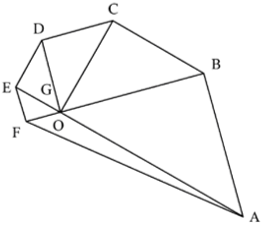
Each right isosceles triangle has a 45° angle at O, and each hypotenuse is √2 times the next leg. So OB = 8/√2, OC = 8/2, …, OF = 8/(√2)5 = √2.
The five triangles cover 5 × 45° = 225° at O, so ∠AOF = 135°. (This also matches B, O, F being collinear: 180° − 45°.)
Area of AOF = ½ × 8 × √2 × sin 135° = ½ × 8 × √2 × (√2/2) = 4 sq cm.
(3m − 2x)(m + 3x) = 0 gives m = 2x/3. From 9n2 = 4y2, n = 2y/3.
Then m2 − n2 = (4/9)(x2 − y2) = 112, so x2 − y2 = 252. With x2 + y2 = 900, x2 = 576 and y2 = 324. So m = 16 and n = 12.
m − n = 4.
From πr2 × 3 = 9π, the cylinder’s radius is √3. The ball (radius 2) rests on the rim, so its centre sits √(4 − 3) = 1 cm above the rim.
Top of the ball = 3 + 1 + 2 = 6 cm above the base.
5 inlets and 2 outlets give a net of 3 pipes, which fill the tank in 60 min. So one pipe takes 180 min (rate 1/180 per min).
With all 20 open, the remaining 3/4 fills in 33.75 min, a net rate of 0.75/33.75 = 1/45. That is 4 pipes’ worth, so inlets − outlets = 4. With inlets + outlets = 20, there are 12 inlets.
Correct: 0 · Wrong: 0 · Accuracy: 0%
Keep the streak alive. See you tomorrow for Day 41.