CAT 50 Day Streak – Day 39
30 questions across VARC, DILR & QA · +3 for a correct answer · −1 for a wrong MCQ · no negative marking for TITA
VARC · Verbal Ability & Reading Comprehension
The older generation always discounts the workplace complaints of the younger generation. In my 20s, there seemed to be an endless supply of commentary about how we millennials were lazy and entitled, just like the members of Generation X before us were slackers. Members of Gen Z get the bad rap of being “unemployable,” because apparently, they do not prize achievement for its own sake, or they’d rather be influencers because the internet has broken their brains. Gen Z-ers don’t even deserve this perfunctory slander, because the entire process of getting and keeping an entry-level job has become a gruelling and dehumanizing ordeal over the past decade.
Certainly, the job market seems grim at this moment. Michael Madowitz, the principal economist at the Roosevelt Institute, described it as “an awful traffic jam.” “If you’re just out of college, you’re trying to merge into a freeway and nobody is letting you in,” he explained. Employers at companies like Airbnb and Intuit almost sound excited when talking to The Wall Street Journal about staying lean and culling the number of employees they have, as long as it creates short-term profits.
But the whole experience of work for young people has been tortured for far longer than the economy has been stalled. Earlier this year, my colleague David Brooks spoke to a college senior who called young Americans “the most rejected generation,” describing the hypercompetition that has bled into all aspects of life, even for the most privileged college-educated strivers. Because most job applications are submitted online, the bar to applying is so much lower than it was in the analogue world decades ago, and so for any open role, applicants are competing with hundreds of people. The sense of scarcity and lack starts earlier because so many selective colleges boast about their record-low admissions rates.
But now artificial intelligence is performing the first few rounds of culling, including early screening, which is further dehumanizing and gamifying the application process. Richard Yoon, who is an economics major at Columbia, told me that when his peers have multiple interviews for jobs in finance, he asks if they have heard back from any of them. They tell him, “You don’t understand. Like 19 of those 20 interviews were with bots.”
It’s customary for job seekers to review their résumés for keywords they think A.I. likes, Yoon told me, so that they might have a chance of getting through the digitised gauntlet and one day making human contact that could possibly lead to a job offer. Or at the very least a real-life networking connection. Yoon called the process “dystopian.”
But once you actually have a job, the real dystopia begins. Young people feel as if jobs offer far less mentorship and more micromanaging. Stevie Stevens, who is 27 and lives in Columbus, Ohio, told me that she left a full-time job in July at an exhibition design and production firm because she felt hyperscrutinized and undersupported. “Managers expect you to do six jobs in a 40-hour workweek. My company had mediocre benefits and offered little to no professional growth or training,” she told me.
The slander is called “perfunctory” (superficial) and cyclical: millennials were “lazy”, Gen X were “slackers”, and Gen Z are “unemployable”. The author argues it misses how the job process has become “gruelling and dehumanizing”, including AI screening.
A: the author never calls the slander necessary or helpful. C: the influencer jibe is one of the criticisms being mocked, not the author’s point. D: the author stresses that it repeats every generation.
AI screening is dehumanizing because interviews happen with bots, and gamifying because applicants seed their résumés with “keywords they think A.I. likes” to get through the “digitised gauntlet”.
A: the bots screen applicants; they don’t compete with them. B misreads the example: the 19 bot interviews were across 20 different jobs, and inefficiency isn’t the point. D: micromanaging is a problem on the job, not in applying.
The author’s defence of Gen Z rests on the claim that getting an entry-level job has become uniquely gruelling in the past decade, partly because online applications create hypercompetition. If earlier generations faced even more of it, Gen Z’s situation is no worse, and the defence collapses.
B undercuts a single quote, not the argument. C supports the critics’ caricature but doesn’t address the structural changes the author describes. D concerns productivity and touches only the job-experience point.
“The real dystopia” ranks the job itself above the already “dystopian” application process: less mentorship, more micromanaging, “six jobs in a 40-hour workweek”.
A: the application ordeal is real, not an “illusion”. B: no intent to force anyone out is suggested. C: the influencer idea belongs to the critics.
C keeps the mechanisms (plausibility checks, accountability, arguments, trustworthiness) and the catch: people are vigilant only when they aim for accurate beliefs.
A contradicts “how sophisticated people are”. B ignores the catch (“regardless of their motivation”). D drops accountability, which the passage lists as one of the cues.
The sentence sets up the hypothetical (“If water behaved like most liquids…”). The next sentence then asks us to “imagine” the result: ice at the bottom of ponds. The paragraph follows that scenario and ends with what actually happens.
At blank 2 the scenario has already been described. At blanks 3 and 4 the paragraph has moved to the consequences and to reality.
- By geological classification, these rocks are ‘metamorphic’, meaning that they have been transformed under punishing heat and pressure beneath the surface.
- Still, the process strikes me as deeply mysterious, a kind of natural alchemy.
- At each stage of their pilgrimages, they preserve a record of their experiences, and through them, we can gain a glimpse of inaccessible subsurface worlds.
- This makes them the itinerant ‘travel writers’ of the rock world, returning to tell us about the restless, animate, hidden nature of the solid Earth.
- Unlike an igneous basalt crystallised from lava, or a sedimentary sandstone laid down by water, metamorphic rocks form in one environment, then go on journeys deep in the crust.
The coherent paragraph is 1 → 5 → 3 → 4:
- 1: These rocks are metamorphic, transformed by heat and pressure.
- 5: Unlike basalt or sandstone, they form in one place and then travel.
- 3: At each stage of these “pilgrimages” they keep a record.
- 4: “This makes them” the travel writers of the rock world.
Sentence 2 is a personal reaction (“strikes me as deeply mysterious”) introduced by “Still”. Nothing in the sequence calls for that concession, and it breaks the travel-writer metaphor.
The passage makes three points: the smile is the easiest expression to recognise, the easiest to make, and highly versatile, carrying everything from pleasure to contempt. B covers all three.
A and D limit the smile to positive emotions, against the passage’s long list. C reverses the comparison.
- Traditional news organizations increasingly use tools from companies like OpenAI and Google to streamline work that used to take hours: sifting through reams of information, tracking down sources and suggesting headlines.
- Almost all of the news organizations have some guardrails in place to prevent errors, such as requiring a human to review anything that A.I. writes before it is published.
- In some cases, including at Fortune and Business Insider, publications have explored using A.I. to write full articles, notifying readers they intend to use it for drafts.
- Artificial intelligence is sweeping through newsrooms, transforming the way journalists around the world gather and disseminate information.
- But, as with much of technology, it comes with significant risks.
The coherent paragraph is 4 → 1 → 3 → 2:
- 4: AI is sweeping through newsrooms.
- 1: Newsrooms use AI tools for research, sourcing and headlines.
- 3: Some even explore AI-written articles.
- 2: Almost all have guardrails such as human review.
The four sentences describe in a neutral tone how newsrooms adopt and manage AI. Sentence 5 opens with “But” and announces “significant risks”, which would need to be spelled out, but none of the other sentences discusses them.
“This quieter, more enduring form” refers back to “a less volatile, calmer state” described just before blank 3. The sentence explains why infatuation must give way to it. “Alternatively” then offers the other route: skipping infatuation entirely.
At blanks 1 and 2 the calmer form hasn’t been introduced yet. At blank 4 the sentence would come after the “alternatively” route, which skips infatuation, so it no longer connects.
DILR · Data Interpretation & Logical Reasoning
Four friends, P, Q, R, and S, are playing a game called Raja-Wazir-Chor-Sipahi 2.0. They are holding four different slips containing the numbers 100, 500, 800, and 1000, not necessarily in that particular order. Four slips containing the numbers 100, 500, 800, and 1000 are kept in a box in four consecutive rounds. Each child is asked to pick one slip in the four rounds. Every child intends to pick a slip that has the same or a greater number than the number on his slip.
The order in which they pick the slips on each of the rounds is given below in Table 1.
| Order | 1st | 2nd | 3rd | 4th |
|---|---|---|---|---|
| Round 1 | P | Q | R | S |
| Round 2 | Q | R | S | P |
| Round 3 | R | S | P | Q |
| Round 4 | S | P | Q | R |
If a child cannot find a slip, which he intends to pick (represented by N in the second table), he randomly picks any slip. However, if the child finds a slip that he intends to pick (represented by Y in the table), he always picks any of those slips only.
| Round 1 | Round 2 | Round 3 | Round 4 | |
|---|---|---|---|---|
| P | Y | N | Y | Y |
| Q | N | Y | Y | N |
| R | Y | Y | Y | Y |
| S | N | N | Y | Y |
- Q holds 1000. In round 1, Q (second to pick) gets N. Only one slip is gone, so Q can’t be holding 800 or less. So Q holds 1000, and P took 1000 first.
- R holds 100. The holder of 100 always finds a slip, so whoever holds it never gets N. P and S each get an N somewhere, so R holds 100.
- S holds 800, P holds 500. In round 2, Q takes 1000 and S (third to pick) gets N, so both remaining slips are below S’s number. If S held 500, both would have to be below 500, but only 100 is. So S holds 800 and P holds 500. This also means R took 800 in round 2.
- Round 3. Q (last) gets Y, so 1000 is still there. R, S and P therefore pick from 100, 500 and 800, each needing one at least their own number, which is only possible if each takes their own number.
- Round 4. Q gets N, so 1000 was taken by S or P.
| Round | P (holds 500) | Q (holds 1000) | R (holds 100) | S (holds 800) |
|---|---|---|---|---|
| 1 | 1000 | 800 / 500 / 100 | remaining | 100 or 500 |
| 2 | 100 | 1000 | 800 | 500 |
| 3 | 500 | 1000 | 100 | 800 |
| 4 | 1000, or 500/800 | remaining | remaining | 800 or 1000 |
In round 1, 800 must go to Q or R, since S is left with a slip below 800. S holds 800.
From Q11, S’s N in round 2 means both slips left after Q and R are below 800. So R took 800.
From the table in Q11, rounds 2 and 3 are fully fixed. Rounds 1 and 4 each have several possibilities, so the answer is 2.
Q gets N in round 4, so 1000 was gone before Q picked, taken by S or P. S took 800, so P must have taken 1000.
In round 1, P takes 1000, 800 goes to Q or R, and S gets 100 or 500. For example, Q 800, R 500, S 100 and Q 800, R 100, S 500 both work. So who took 500 cannot be determined.
Five students – Aman, Bala, Chandra, Daksh and Eram - attempted a quiz consisting of 10 questions. Each question had five options – A, B, C, D, E, of which only one was correct. The following table gives the responses of the students for the 10 questions and their score (which is equal to the number of correct responses).
| 1 | 2 | 3 | 4 | 5 | 6 | 7 | 8 | 9 | 10 | Score | |
|---|---|---|---|---|---|---|---|---|---|---|---|
| Aman | A | A | D | B | A | B | E | C | B | B | 3 |
| Bala | C | B | D | B | B | A | E | C | B | D | 7 |
| Chandra | A | A | B | B | C | C | D | D | E | E | 0 |
| Daksh | A | B | C | B | E | A | B | C | D | D | 5 |
| Eram | D | B | D | B | E | B | A | A | D | B | 4 |
The correct answers to the first and the last questions were C and D, respectively.
- Chandra scored 0, so none of her answers is correct. Everyone answered B on Q4, so nobody got Q4 right.
- Aman vs Bala. They agree on Q3 (D), Q7 (E), Q8 (C) and Q9 (B). Let X be how many of these are correct. Aman: X + [Q5 = A] + [Q6 = B] = 3. Bala (who already has Q1 and Q10): X + [Q2 = B] + [Q5 = B] + [Q6 = A] = 5. Only X = 3 satisfies both, which also gives Q5 ≠ A and Q6 ≠ B.
- Eram (4). She can reach 4 only if Q2 = B, Q3 = D and Q5 = E, plus one of Q7 = A, Q8 = A or Q9 = D (whichever of Aman and Bala’s four shared answers is wrong).
- Bala then needs Q6 = A. Daksh (5) needs exactly one of Q8 = C or Q9 = D, which leaves only Q7 = A, Q8 = C, Q9 = B.
| Q | 1 | 2 | 3 | 4 | 5 | 6 | 7 | 8 | 9 | 10 |
|---|---|---|---|---|---|---|---|---|---|---|
| Answer | C | B | D | not B | E | A | A | C | B | D |
| Solved by | Bala | B, D, E | A, B, E | none | D, E | B, D | Eram | A, B, D | A, B | B, D |
(In the “Solved by” row, letters are students’ initials.) Q6 and Q7 are A, and Q4 could also be A. That gives 2 or 3.
From the table in Q16, the answer to question 5 is E, which is option D.
From the table in Q16, only Bala got Q1 right and only Eram got Q7 right. That is 2 questions.
Only Q4: everyone answered B, and B is wrong. That makes 1 question.
From the table in Q16, Eram got Q2 (B), Q3 (D) and Q5 (E) right, so she scored 3 on the first five.
QA · Quantitative Ability
Let the present ages be a (Anita) and r (Rahul). The clues give r + S = (14/11)(a + S) and a + r = (21/11)(a + S).
Subtracting: a − S = (7/11)(a + S), so a = 4.5S and r = 6S. (The T clue is consistent: T = 0.5S.)
S years ago: Anita was 3.5S and Rahul 5S, so 3.5/5 = 70%.
Regroup: (x2 + 6x + 9) + (x2 − 2xy + y2) = 0, i.e. (x + 3)2 + (x − y)2 = 0. Both squares must be 0, so x = y = −3.
3x2 − 2xy + 5y2 = 27 − 18 + 45 = 54.
Let the journey take t hours at 75 km/h. At the new speed it takes t + 3 hours, and at 1.8 times that speed it takes t − 1 hours. So (t + 3)/1.8 = t − 1, giving t = 6 and distance = 450 km.
Arriving at 10:30 means 4.5 hours, so the speed is 450/4.5 = 100 km/h.
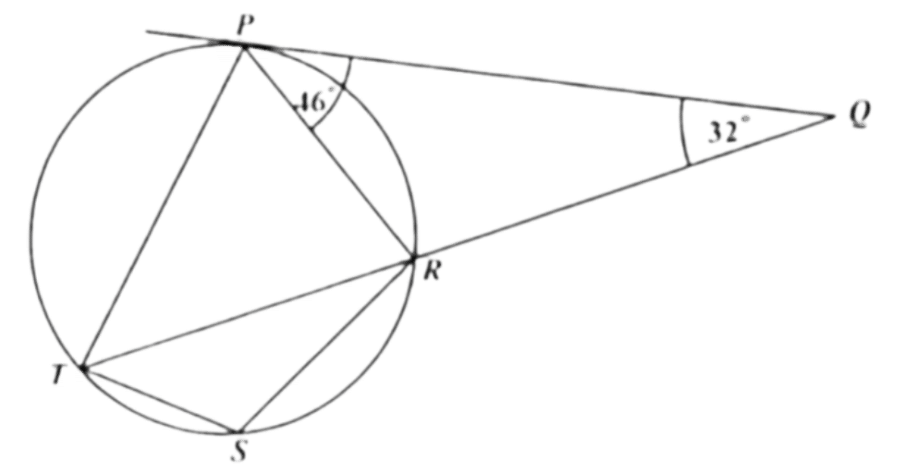
Detailed solution coming soon.
Let t = f(x) = x−3, so x = t−1/3 and g(t) = x2 = t−2/3.
g(a) = a−2/3 = a/2 gives a5/3 = 2, so a = 23/5.
Let the group have n students with average A. Adding one 60 kg student: 60 = A + 2(n + 1), so A + 2n = 58. Adding a second: 120 = 2A + 3(n + 2), so 2A + 3n = 114.
Solving gives n = 2 and A = 54.
With a third 60 kg student: (108 + 180)/5 = 57.6 kg.
Let t students like all three. Exactly one = 600 − 2(240) + 3t = 120 + 3t, so it is smallest when t is smallest.
Only matcha = 150 − 90 − 70 + t = t − 10 can’t be negative, so t ≥ 10. (The total 360 + t stays within 500.)
The minimum is 120 + 30 = 150.
Navya’s mix is milk : water = 3 : 1, so 100 L has 75 L milk and 25 L water. Bhavya’s mix is 2 : 1, so 60 L has 40 L milk and 20 L water. Tank: 160 L with 115 L milk and 45 L water.
Each replacement removes 1/3 of the water: 45 × (2/3)2 = 20 L remains. Milk = 160 − 20 = 140 litres.
0.612 = (612 − 6)/990 = 606/990 = 101/165.
101 and 165 share no factor, so the least multiplier is 165.
With r = 2.5 cm, the apparent capacity is πr2 × 10 = 62.5π. The hemisphere takes up (2/3)πr3 = 10.42π.
Reduction = 10.42π/62.5π × 100 = 16.67%.
Correct: 0 · Wrong: 0 · Accuracy: 0%
Keep the streak alive. See you tomorrow for Day 40.